

The worst rotations often belong to the loudest attendings—but they do not have to own your evaluation.
You may be stuck on a toxic service right now: pimping meant to humiliate, residents snapping at you in front of nurses, attendings rolling their eyes when you present. And in the back of your mind? “This eval is going into my MSPE. This could screw my residency application.”
You’re not wrong to worry. But panic makes people sloppy, and sloppy gets you burned. Instead, you need a survival plan.
Here’s how to get through a toxic rotation without letting one miserable month follow you into ERAS.
1. First: Identify What Kind of “Toxic” You’re Dealing With
Not every bad rotation is the same. You handle “unpleasant but safe” differently than “career-threatening.”
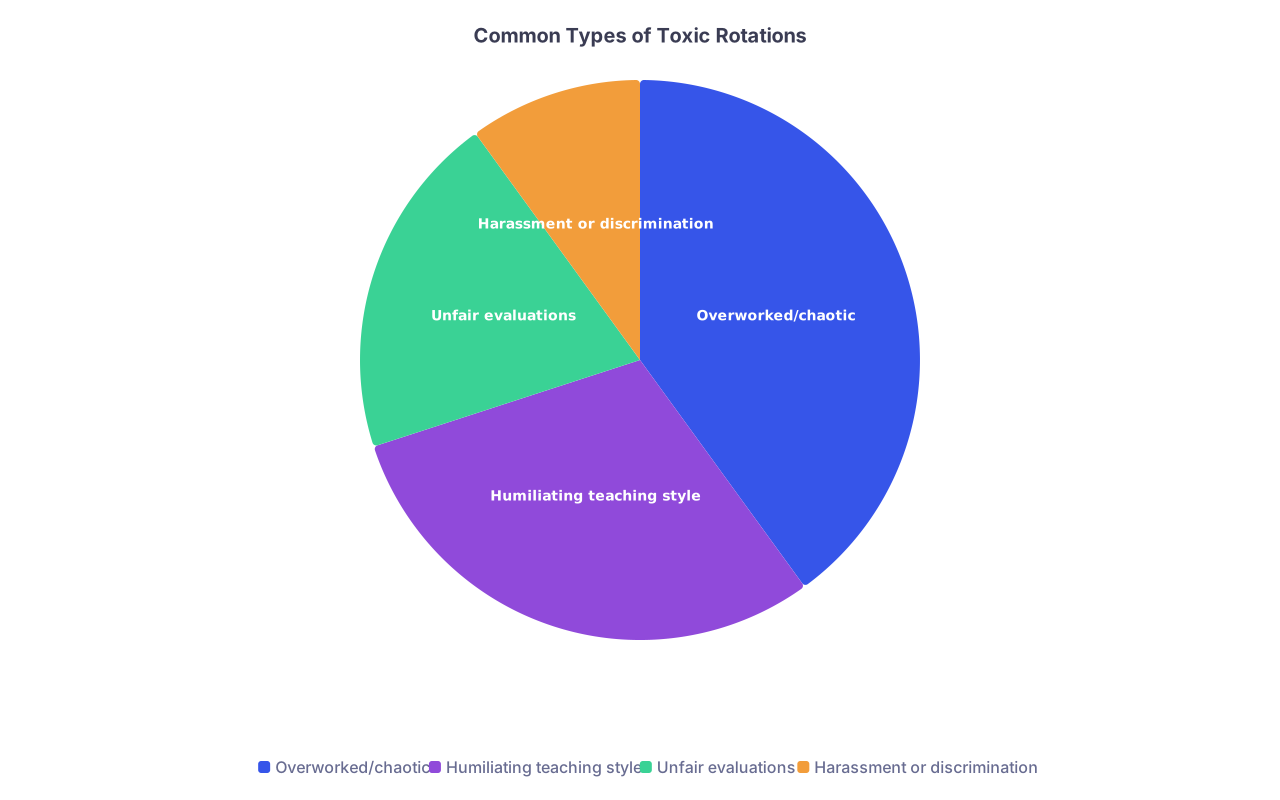
| Category | Value |
|---|---|
| Overworked/chaotic | 40 |
| Humiliating teaching style | 30 |
| Unfair evaluations | 20 |
| Harassment or discrimination | 10 |
Roughly, there are four flavors:
Overworked / chaotic
- Constant pages, no teaching, everyone short-tempered.
- Residents are generally decent but exhausted.
- Evaluations are rushed and generic, often fine if you’re not a disaster.
Harsh / humiliating culture
- “Why are you even here?” in front of the team.
- Pimping as blood sport. Shaming for not knowing minutiae.
- Classic: attending smirks, “Do you even want to be a doctor?”
Arbitrarily unfair / punitive
- You do the work; feedback says you’re “unreliable” with no examples.
- Expectations change daily.
- One resident or attending clearly decided they do not like you.
Harassment / discrimination / true boundary violations
- Sexist, racist, homophobic comments.
- Physical boundary issues, retaliation for speaking up.
- This is no longer just “toxic”; this is reportable.
You’re probably seeing a mix. But be honest with yourself which bucket is dominant. Because:
- Overworked = survive the chaos, make their life easier, you usually come out okay.
- Humiliating = emotional armor + strategy.
- Unfair/punitive = documentation + backup evaluators.
- Harassment = safety + reporting + getting out if needed.
Decide what you’re in. Then you can stop spinning and start acting.
2. Your Real Goal On a Toxic Rotation (Hint: It’s Not “Learn As Much As Possible”)
On a dream rotation, your goal is learning, letters, and confirming interest in a field. On a toxic rotation, the priority shifts.
Your main goals now:
- Protect your summative evaluation.
- Avoid giving anyone ammunition against you.
- Capture at least one decent written evaluation or advocate.
- Get out with your sanity and basic competence intact.
Learning still happens—it always does if you’re awake and curious—but it’s not the primary mission if the environment is dysfunctional. Survival and damage control are.
So everything you do should pass this filter:
“Does this help me look like a solid, professional, low-drama student on paper?”
If yes, do it. If no, drop it.
3. Daily Behavior That Protects Your Evaluation
This is the boring part that works. You build a quiet, boring, professional persona that even a toxic team struggles to tank.
A. Become predictable in the best way
You want your residents to be able to say, without thinking, “Yeah, they were reliable.”
Concrete moves:
- Show up 10–15 minutes earlier than the earliest resident on your team. Do not be the person arriving with them.
- Pre-chart your patients: vitals, labs, overnight events, new imaging. Have your numbers ready.
- Never be late for rounds, sign-out, or teaching. If you’re going to be late (transport, patient issue), text the senior with a one-line update: “Going to bedside with nurse for hypotensive pt, may be 3–5 min late to X.”
You’re not trying to wow them. You’re trying to keep your name out of the “problems” category.
B. Reduce friction for the team
On toxic services, everyone’s bandwidth is gone. The student who creates work for them gets torched on evals.
Ask your senior on day 1 or 2:
“What’s actually most helpful for me to focus on so I’m useful to the team?”
Then listen for the unsexy answers: putting in notes early, drafting orders (if allowed), calling consults, updating the list. Do those first, enthusiastically, without sighs.
You want residents thinking: “Rotation sucked. But this student didn’t make it worse.”
C. Manage your face and body language
Sounds trivial. It is not.
Bad attendings watch for eye rolls, smirks, shrinking posture. Then they label you “unprofessional” or “disengaged” in your eval.
Be intentional:
- When you’re being grilled, make eye contact, nod, take a brief note, say “Got it” or “I’ll read up on that today.”
- If you’re corrected sharply, respond with: “Thank you for pointing that out.” Full stop. Even if they were a jerk.
- Do not argue on rounds. Ask clarifying questions later, 1:1, when emotions are down.
I’ve watched excellent students sabotage themselves with a single visible eye roll in front of a malignant attending. Do not give them that satisfaction.
4. How to Handle Public Humiliation and Harsh Pimping
You will not “win” against an attending who pimps to dominate. Your aim is to avoid being labeled defensive, disinterested, or unteachable.
Here’s the script playbook.
When you do not know the answer
Bad version: rambling, guessing wildly, or saying “I have no idea” with a shrug.
Better version:
“I’m not sure. My guess would be X based on Y, but I’d like to read more about it and follow up tomorrow.”
If they nail you anyway (“You should already know this”), your response:
“You’re right—I’ll make sure I know it cold for next time.”
Short. Calm. No sarcasm. Then actually read it and bring it up the next day:
“Yesterday you asked about managing DKA in pregnancy—I looked it up last night. The key points are…”
This is how you convert a bad interaction into “teachable” on your eval.
When you’re attacked personally
Classic: “Do you even care about this patient?” or “Maybe medicine isn’t for you.”
Your move:
- Do not match their tone. Keep your voice level.
- Pivot back to patient or learning.
Example:
“I do care, and I see I missed X, which is important. I’ll correct that now and make sure I do it correctly going forward.”
You’re not agreeing they’re right about your character. You’re refusing to take the bait and turning it into performance improvement. That’s what evaluation forms are built around.
5. Documentation: Your Insurance Policy Against Unfair Evals
On a truly unfair or unstable rotation, you need a quiet paper trail. Not dramatic. Just factual.
What to track (briefly, daily or every few days)
Use your notes app or an email draft to yourself:
- Date, shift times, and teammates.
- What you did: “Rounded on 5 pts, wrote 5 notes, called nephro consult, stayed until 7:30 to help admit new CHF pt.”
- Any abnormal incidents: direct quotes if something crosses a line (“Resident said X”).
- Any positive feedback, even small: “Senior: ‘Thanks for staying late—super helpful.’”
This isn’t for a lawsuit. It’s for:
- Meeting with the clerkship director if your evaluation is wildly off.
- Giving specific examples when you ask someone else for a narrative comment.
- Reminding yourself you were not the disaster they may claim you were, when you’re second-guessing everything at 2 a.m.

6. Get Other Evaluators on Record
Toxic rotations are less dangerous when multiple people are forced to weigh in, not just the malignant attending.
| Role | How They Help |
|---|---|
| Senior resident | Day-to-day performance |
| Intern | Direct observation of work |
| Fellow | Teaching/rounds impressions |
| Other attending | Short but positive comments |
A. Ask for feedback early and mid-rotation
Week 1–2, say to your senior or attending:
“I want to make sure I’m meeting expectations. Is there anything you’d like me to do differently or focus on for the rest of the rotation?”
If they give you any specific expectations, write them down and follow them. Then, in week 3:
“You mentioned earlier you wanted me to focus on X—I’ve been doing Y and Z to work on that. Is there anything else I should adjust?”
You’re doing two things:
- Showing you respond to feedback = “teachable.”
- Making it harder for them to later claim you “never improved” without sounding lazy or inattentive themselves.
B. Ask multiple people to fill out evaluations
Many schools allow more than one evaluator per rotation. Use that.
Toward the end, say to:
- Senior resident: “Would you be willing to fill out an evaluation for me? You’ve seen most of my work.”
- Fellow: “Could you add a brief comment about my performance this month? Even a few sentences would help.”
- Another attending who’s neutral-to-decent: same ask.
You want to dilute one malignant voice with 2–3 sane ones. MSPE narratives and “clerkship summaries” often synthesize across all submitted evaluations. That matters for residency applications.
7. When and How to Involve the Clerkship Director (Without Looking Like the Problem)
You’re afraid that if you complain, you’ll be labeled “difficult” and it’ll follow you. Reasonable fear. But there are smart ways to do this.

| Step | Description |
|---|---|
| Step 1 | Experience toxic behavior |
| Step 2 | Document in detail |
| Step 3 | Contact clerkship director or student affairs |
| Step 4 | Try feedback + self adjustment |
| Step 5 | Meet clerkship director with facts |
| Step 6 | Focus on survival + extra evals |
| Step 7 | Unsafe or discriminatory? |
| Step 8 | Still clearly unfair? |
A. When to escalate
Move from “just survive” to “get leadership involved” when:
- You’re seeing harassment, discrimination, or screaming meltdowns.
- You’re repeatedly blocked from basic opportunities (no patients to follow, banned from writing notes, not allowed to attend teaching) without reason.
- You get mid-rotation feedback that’s wildly disconnected from reality (“You’re never here” when you’re regularly staying late and your log shows it).
B. How to phrase it
Approach this as problem-solving, not an emotional rant.
Email or speak to the clerkship director:
“I was hoping to get your advice about my current rotation. I’m concerned that some aspects of the environment might be affecting both my learning and how my performance is perceived. I’d really appreciate your guidance on how to handle this professionally.”
Then, in the meeting:
- Stick to facts and specific examples.
- Use neutral language: “On three occasions, X happened,” not “They’re all toxic.”
- Emphasize your goals: “I want to learn and get a fair evaluation. I’m not trying to cause trouble.”
If you have your quiet documentation (dates, tasks, quotes), you’ll sound grounded, not dramatic. Many clerkship directors have seen this show before. If you present like an adult, they’re much more likely to back you.
8. Protecting Your Residency Application Downstream
You’re in this category: “Clerkships That Help With Residency Match.” A bad rotation can feel like a nail in the coffin. It isn’t. But you do need to be intentional.
A. One bad rotation rarely kills you
Programs look at patterns.
, Letters, MSPE narrative, Research/ECs](https://cdn.residencyadvisor.com/images/articles_svg/chart-relative-weight-of-application-components-6094.svg "Relative Weight of Application Components")
| Category | Value |
|---|---|
| Step scores | 30 |
| [Clerkship grades](https://residencyadvisor.com/resources/best-clerkships-match/pass-vs-high-pass-grading-pitfalls-that-are-totally-avoidable) | 25 |
| Letters | 25 |
| MSPE narrative | 15 |
| Research/ECs | 5 |
Roughly speaking (varies by specialty):
- One outlier evaluation in an otherwise solid record raises eyebrows but rarely ends you.
- Multiple “concerns about professionalism,” “difficulty working with team,” or poor narratives? That’s where you get into trouble.
Your job: keep this toxic rotation an outlier, not the beginning of a trend.
B. Compensate with strong rotations and letters
If this rotation isn’t your target specialty, you have space to offset it:
- Crush the core rotations that do matter for your specialty (e.g., IM for cards, surgery for ortho).
- Lock in at least two strong letters from sane attendings who explicitly state things like “excellent team player,” “eager learner,” “professional under pressure.”
Programs read between the lines. A glowing letter saying you were poised and hardworking in a high-stress setting directly counters a malignant eval suggesting you’re “easily overwhelmed” or “unprofessional.”
C. If the MSPE narrative mentions the rotation
Some schools include every ugly word. Others summarize. If your MSPE explicitly calls out this rotation as problematic, you don’t ignore it in interviews if asked.
You frame it:
- Own what you reasonably can.
- Describe what you changed after.
- Make it clear it did not become a pattern.
Example answer if asked:
“On my X rotation, I received feedback that my presentations were disorganized and that I seemed flustered under pressure. At the time, the environment was high-intensity and I struggled to adjust my style. After that, I met with my advisor, worked deliberately on structured presentations, and on my subsequent rotations I received specific feedback that my organization and composure improved a lot. It was not pleasant to hear, but it pushed me to build skills that I use every day now.”
You don’t throw anyone under the bus in the interview. That usually backfires. You show growth, stability, and that it was a one-off learning experience.
9. Handling Harassment and Serious Misconduct
Different category. This is not “tough teaching.” It’s not “they raised their voice once.”
Red flags that justify immediate reporting:
- Overt sexist/racist/homophobic/transphobic comments about you or patients.
- Physical contact that’s even slightly sexual or clearly non-consensual.
- Retaliation threats: “If you report this, I’ll make sure you fail.”
Here, the priority shifts: your safety and legal protection come before your evaluation.
Steps:
- Write down exactly what happened, word for word, with date/time and who was present.
- Contact someone outside the rotation: student affairs, title IX, your college advisor, or clerkship director you trust.
- Use phrases like: “I need to report a professionalism and safety concern” or “I believe there may be a Title IX issue.” That triggers appropriate channels.
Yes, you still worry about fallout. But being silent in those scenarios is not “smart career strategy.” It’s how toxic people keep doing this for years. Schools and hospitals are (slowly) getting less tolerant of this. Use the systems that exist.

10. Mental Health: Getting Through the Month Without Imploding
You’re not a robot. A malignant rotation will get in your head if you let it.
A. Build a tiny off-service support team
Pick 2–3 people:
- A classmate who gets it.
- A partner/friend outside medicine.
- A mentor or older resident you can text.
Let them know: “This month is going to be rough. I may need to vent for 5 minutes or get a sanity check.” That’s it.
B. Use micro-recovery, not fantasy vacations
You’re not fixing burnout in a month with one “self-care” day. You’re using 10–20 minute resets:
- Walk outside between cases. No phone, just air.
- Music or podcast on the commute home that has nothing to do with medicine.
- A strict “no reading evals or emails after 9 p.m.” rule so you can actually sleep.
And stop giving this rotation more power than it deserves. It’s one line on one page in a 20-page application.
11. Quick Scenario Playbook
Scenario 1: Attending humiliates you daily, but residents are decent
Strategy:
- Bond quietly with residents. Ask them for feedback and evals.
- Use residents as a buffer: “Is there anything I can do differently to make rounds smoother for Dr. X?”
- Accept that attending may never like you; focus on not feeding their narrative (no attitude, no visible frustration).
Scenario 2: Senior resident clearly dislikes you and is your main evaluator
Strategy:
- Ask for specific, neutral feedback: “What can I do this week to better meet your expectations?”
- Implement one or two of their suggestions and name them later: “I’ve been focusing on tightening my SOAP format like you suggested.”
- Ask another resident/attending to submit an evaluation as well.
- If feedback becomes hostile or unfair, document and consider a quiet meeting with clerkship director mid-rotation.
Scenario 3: Eval comes back much worse than you expected
Strategy:
- Read it once. Walk away for a day.
- Then outline: which comments are accurate? Which are unfair or not based in reality?
- If it’s way off, schedule a calm meeting with the clerkship director:
- Bring 1–2 specific examples that contradict the evaluation (not 20).
- Say: “I accept that there were areas I needed to improve. I am concerned that some comments may not accurately reflect my performance, and I worry about how this will be interpreted on my MSPE.”
- Ask if there’s a way to add a student response or contextual note, or if other evaluations from the same block can be considered when summarizing.
FAQ (Exactly 3 Questions)
1. Should I ever ask to switch off a toxic team mid-rotation?
Yes, but selectively. If it’s “just” harsh teaching and high expectations, usually no—you focus on survival strategies and additional evaluators. If there is harassment, screaming, retaliation, or you’re being blocked from basic educational activities, you can absolutely request a switch. Approach the clerkship director or student affairs with specific, factual descriptions and ask, “Is there any possibility of moving to a different team so I can have a functional learning environment?” They may not always manage it, but you will not be the first person to ask.
2. How do I explain a bad rotation in my personal statement or ERAS application?
Usually you don’t. Personal statements are not rehab documents for one bad month. You focus on why you want the specialty, what you’ve done to prepare, and positive clinical experiences. The only time you address a toxic rotation directly is if there’s a conspicuous professionalism flag or narrative comment that keeps coming up in interviews. Then you prepare a tight, honest, growth-oriented explanation for interviews—not a long written excuse in ERAS.
3. Can I still ask for a letter from someone on a tough rotation?
Maybe—but be very selective. If an attending was harsh but respected your work ethic and occasionally praised your effort, they might actually write a strong “this student performed well under high expectations” letter. If someone clearly disliked you, gave you a bad eval, or made you feel unsafe, do not ask. You want letters that actively help you. An average letter from a neutral attending is far better than a lukewarm or subtly negative one from a prestigious but toxic name.
Key points to walk away with:
- On a toxic rotation, your priority is protecting your evaluation, not winning over broken people.
- Reliable behavior, controlled reactions, documentation, and multiple evaluators are your shield.
- One bad month does not decide your Match—unless you let it turn into a pattern.


