
The home rotations that get you ranked are not the ones your school tells you are “required.” They’re the ones the program quietly uses as live auditions in front of the people who actually sit in the rank meeting.
Let me walk you through how this really works behind closed doors.
Program directors and clerkship directors do not weigh all rotations equally when they decide who from their own medical school will rise to the top of the rank list. Some rotations are essentially invisible. Some are neutral. And a few are nuclear—everyone on the rank committee knows your name by the time interviews even start.
You want those nuclear ones.
How rank committees actually know who you are
Before we get specific about which home rotations matter, you need to understand the pipeline.
Your school’s home residency program (IM, EM, gen surg, peds, etc.) usually has some version of this setup:
- A clerkship director who runs the 3rd‑year core rotation.
- An associate/assistant program director who “oversees” 4th‑year electives and sub‑Is.
- A residency program director who runs the rank meeting.
- A set of key faculty whose opinions are treated like gold during ranking.
Here’s the uncomfortable truth: most names brought up in the rank meeting don’t come from ERAS. They come from sentences like:
- “Oh, that’s the student from our wards sub‑I who crushed nights.”
- “She was on my ICU month in August—absolutely fantastic.”
- “He was that student on consults who wrote better notes than my interns.”
Those statements are anchored to specific rotations, not your transcript.
So the question isn’t: “Which rotations look good on paper?”
The real question is: “On which home rotations does my performance get carried directly into the rank room by people whose voices are loud in that room?”
That’s the game.
The heavy-hitter home rotations: where your name actually travels
Every institution is a little different, but the pattern is remarkably consistent. Nearly every academic program has 3–5 rotations that function as their internal audition tracks.
Here they are, with how they really play behind the scenes.
1. The sub‑I on the program’s own inpatient service
If you remember nothing else, remember this: a strong sub‑I on the home program’s primary inpatient service is the single most powerful face-time rotation you can do.
I’ve sat in rank meetings where the PD literally pulled up a mental list: “Our star sub‑Is from wards this year were X, Y, and Z,” and those three names automatically floated higher.
Why this rotation is nuclear:
- You’re functioning very close to intern level.
- Residents are directly comparing you to their PGY‑1s.
- Core faculty are on those teams and round with you daily.
- The clerkship/APD usually asks, “Who are your top students this month?” and they actually write those names down.
If you’re going into Internal Medicine, that means the IM wards sub‑I on the home program’s teaching service.
For Surgery, that’s the main general surgery service, not random electives.
For Peds, inpatient general pediatrics.
This isn’t “just another 4th‑year elective.” This is how PDs decide who is safe to trust with their brand name.
Where you get visibility:
- Attending feedback emails forwarded to the PD: “This student is basically at PGY‑1 level.”
- Residents advocating for you: “We need her in our program, she made our lives easier.”
- The sub‑I director’s shortlist of “top 5 students this year,” which goes straight into the PD’s head before interviews.
If you skip this or push it to late spring, you’re walking into interview season with an empty file where there should’ve been strong, recent, local buzz.
2. The critical care / ICU rotation attached to the home program
ICU rotations are brutally revealing, and that’s exactly why rank committees love feedback from them.
Medical ICU, Surgical ICU, Cardiac ICU—it depends on the specialty—but for the home program, their ICU often overlaps heavily with their core faculty and senior residents. You’re in the war zone. Everyone sees how you behave when things are busy and stakes are high.
Why ICU months matter more than the brochure says:
- The sickest patients mean the clearest contrast between students who “sort of follow along” and students who actually think.
- Faculty in the ICU skew heavily toward being influential: critical care attendings, APDs, system-level QI folks.
- The rotation director often has a direct line to the PD. Their opinion doesn’t get filtered.
I’ve seen this scenario more than once: A borderline candidate on paper gets bumped up the rank list because two ICU attendings say, unprompted, “If he doesn’t match here, we’re losing someone special.”
That never happens after your outpatient family med elective.
3. The specialty’s consult service where faculty know the residents well
Consult services are way more politically connected than students realize.
Example: You’re going into Neurology at your home institution. The general neuro consult elective where you see every stroke, seizure, and confused patient in the hospital? That’s where the PD hears things like: “She saw the patient, presented clearly, anticipated the plan, and called the primary team herself. No hand holding.”
Same pattern in other specialties:
- Cardiology consults for IM-bound students.
- Trauma consults for surgery.
- Ortho consults for Ortho hopefuls.
- Psych consults (especially CL psych) for Psych applicants.
The consult attending often works side-by-side with the residents who will soon be your chiefs. Their informal comments carry tons of weight:
- “He worked like a sub‑I even though this wasn’t technically a sub‑I.”
- “She handled difficult teams and chaotic pages without complaining.”
Those comments repeat in morning report. Then in hallway chats. By the time ERAS is reviewed, faculty already have an impression of you as “one of ours” or “one we should pass on.”
4. The ED month—only when ED faculty are players in your specialty
This one’s nuanced, and students get it wrong all the time.
The ED rotation is powerful for some specialties and nearly irrelevant for others.
For EM applicants at their home EM program: the ED month (and especially the EM sub‑I) is everything. It’s where the SLOE-writers live. It’s where the PD, APDs, and clerkship director all watch you in real time. Your performance there is basically your audition tape.
For other specialties, it depends:
- If your IM program director is a former ED doc or has significant presence in the ED, your performance there can filter back.
- If the ED rotation is staffed mostly by community docs or part‑timers with zero involvement in residency, it’s basically a clinical skills exam, not an audition.
I’ve heard PDs say bluntly:
“I don’t care if they were ‘excellent’ on ED if none of my core faculty have ever worked with them. That eval might as well be from a different hospital.”
So you need to know who staffs your ED shifts. Is the EM PD or APD present? Do your own specialty’s residents take ED call and see you in action? If yes, this can be a high-yield face-time month. If not, don’t kid yourself—it’s not moving your name in the rank meeting.
5. The rotation where the PD / APDs personally round
This is the hidden gem category. Every program has 1–2 rotations where the PD or APDs are actually on service and interacting with students daily.
Sometimes that’s:
- A specific inpatient teaching team.
- A niche clinic the PD runs.
- A required “advanced” clerkship that just happens to be the PD’s pet project.
If you can place yourself directly under the person who will run the rank meeting, do it early in 4th year and treat every day like an interview.
Here’s why it matters so much: PDs trust their own relationships over any letter. When they’ve seen you show up at 5:30, handle consults, keep a good attitude after a string of admissions, they don’t need to interpret your MSPE adjectives. They remember you.
And in the rank meeting, “I’ve worked with this person and I’d be happy with them as my resident” shuts down a lot of doubt.
To make this concrete, here’s how this hierarchy often looks in real life.
| Rotation Type | Typical Impact on Rank Committee |
|---|---|
| Home specialty sub-I (inpatient wards) | Very High |
| ICU / Critical Care (home program-linked) | High |
| Specialty consult service | High |
| ED month (for EM or PD-connected) | Moderate–High |
| Outpatient general clinic | Low |
| Random elective (derm if going into IM) | Very Low |
If you’re stacking your 4th-year schedule with “low” and “very low” while your classmates are quietly claiming the high-yield spots, you’re starting the match cycle behind them before ERAS even opens.
The rotations that do not get you in front of the rank committee (but masquerade like they might)
Let me be blunt: there are rotations you’re told are “important” that have essentially zero direct translation into the rank room for your chosen specialty.
They may be clinically useful. They may be graduation requirements. But they don’t move your name.
Typical offenders:
- Random outpatient primary care month when you’re going into surgery.
- Anesthesia if there’s no overlap in faculty with your target program.
- Dermatology elective when you’re aiming for IM.
- Radiology elective (unless your PD is a radiologist or you’re going into rads).
- Community rotations staffed by non-faculty preceptors with no academic titles.
I’ve sat through rank discussions where somebody asked, “Any home rotations with us?” and the answer was, “No, they did Anesthesia, Derm, and Radiology this fall.” Silence. Shrugs. Their performance there might help them be a better physician, but it did not earn them advocates in that room.
Don’t confuse “interesting to you” with “visible to the people who vote on you.”
You absolutely can and should mix in rotations for your own growth or sanity. Just don’t do it at the expense of the handful that actually get your face in front of the right people.
Timing: when these home rotations matter most
The timing is more strategic than students realize. Faculty memory is short, and institutional momentum builds early.
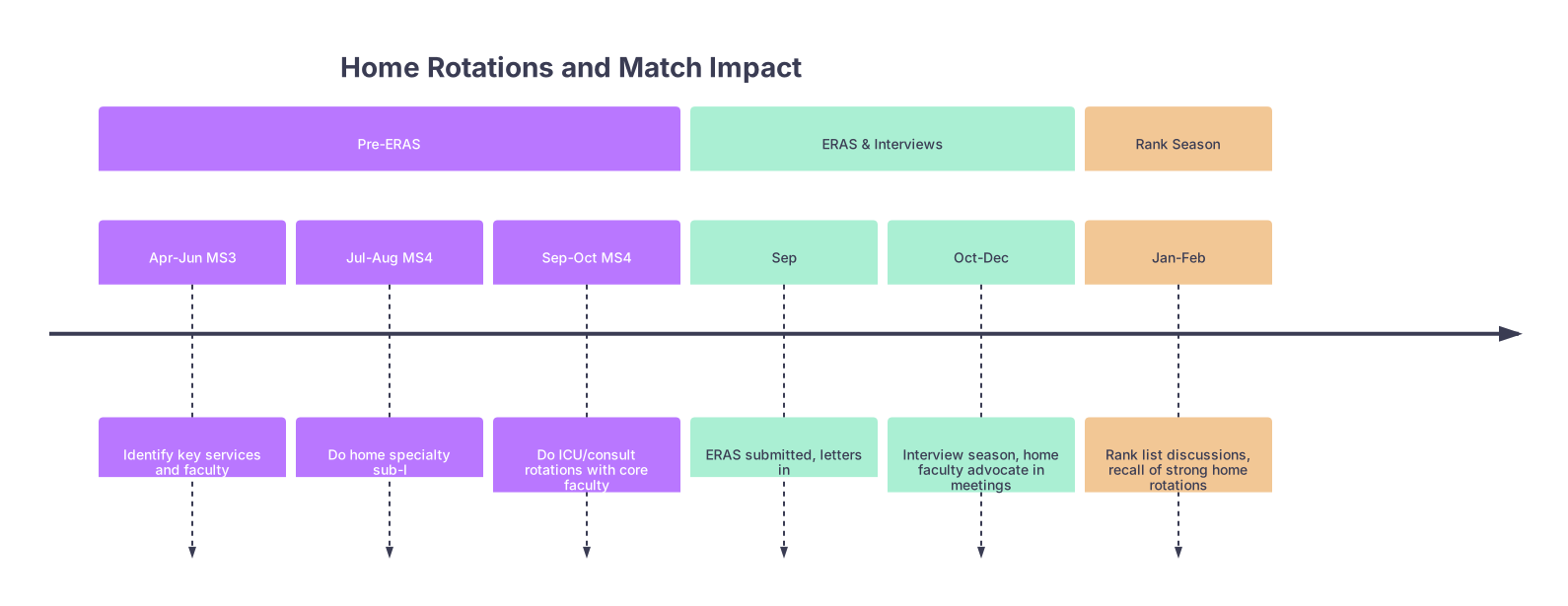
| Period | Event |
|---|---|
| Pre-ERAS - Apr-Jun MS3 | Identify key services and faculty |
| Pre-ERAS - Jul-Aug MS4 | Do home specialty sub-I |
| Pre-ERAS - Sep-Oct MS4 | Do ICU/consult rotations with core faculty |
| ERAS & Interviews - Sep | ERAS submitted, letters in |
| ERAS & Interviews - Oct-Dec | Interview season, home faculty advocate in meetings |
| Rank Season - Jan-Feb | Rank list discussions, recall of strong home rotations |
Here’s how timing usually plays in real life:
- July–September MS4: Prime months. PDs and faculty are wide awake, noticing talent, and forming their mental shortlists.
- October–November: Still good, but now they’re distracted by interview season. Feedback trickles in more slowly.
- December–January: The ship has mostly sailed. Rotations here are fine, but their impact on this year’s rank list is minimal unless someone truly blows people away.
So, if you’re asking which months to load with high-yield home rotations that put you in front of the rank committee: July, August, September. Maybe October if that’s all you can get.
What I’ve seen work well:
- Do your home specialty sub‑I early (July/Aug).
- Follow it with ICU / consult time in Aug/Sep/Oct.
- Make sure at least one of those blocks has a PD, APD, or core faculty who sits on the rank committee directly supervising you.
If you do that, you walk into ERAS season with fresh, specific, local buzz. Your name is already circulating.
How to verify which rotations are high-yield at your institution
You cannot rely on the official course catalog language. It’s written to sound like everything is equally magical. It’s not.
You need to do quiet recon.
Here’s how residents and savvy students actually figure it out:
Ask a senior who just matched into your target specialty at your home program:
“Which home rotations actually got you in front of the PD and rank committee? If you had to redo your 4th year just for face-time, which 3 rotations would you keep?”Ask a trusted resident:
“On which services do you see the PD/APDs work closely with students? When you guys talk about students informally, which rotations are they usually from?”Ask, very directly, a core faculty member you trust:
“If I want to be seriously considered by our home program, which rotations with your group do you think matter most?”
Pay attention to patterns in their answers. You’ll hear the same 3–4 rotations over and over if you listen carefully.
You can also read between the lines by watching who’s in the room:
- Whose names are always on student evals as attendings?
- Which services have senior residents who obviously know the PD well?
- Which teams present at grand rounds or M&M with students included? Those faculty are plugged in.
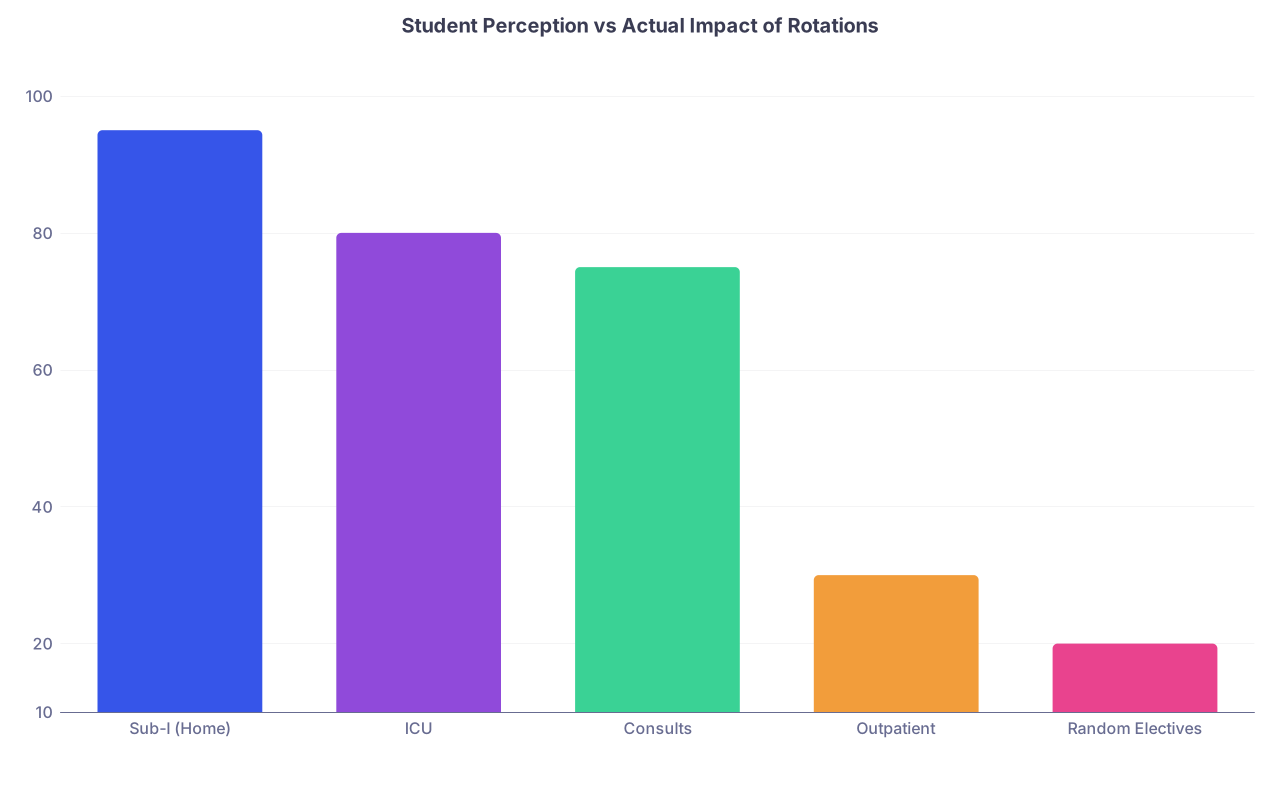
| Category | Value |
|---|---|
| Sub-I (Home) | 95 |
| ICU | 80 |
| Consults | 75 |
| Outpatient | 30 |
| Random Electives | 20 |
The student body often vastly overestimates the impact of “chill” or “interesting” electives and underestimates how much the main inpatient and ICU months define their reputation locally.
How to behave on these rotations so people actually remember you
Just doing the right rotations isn’t enough. You’ve got to be the student faculty want in their program.
I’ll spare you the generic “work hard, be on time” fluff. You already know that. Here’s what faculty and residents actually say when they advocate for a student in the rank meeting:
“She made my job easier.”
That’s the magic sentence. Help with notes, anticipate tasks, offer to call consults, follow up on labs without being asked three times.“He never disappeared.”
The student who’s always findable, always aware of what’s happening on their patients, and never mysteriously gone at 3 p.m.“She took feedback and got better fast.”
If someone points out an issue on Monday and by Wednesday it’s fixed, that’s gold. It signals coachability. PDs love that.“He acted like an intern, not like a short-stay tourist.”
You own tasks. You think ahead. You stay until the work is reasonably done even if the other student bailed.
The soft stuff matters too:
- No complaining about hours in earshot of residents who will one day be asked, “How was this student?”
- No eye-rolling at scutwork. Residents see it; they always do.
- Ask smart, targeted questions that show you’re engaged, not bored or trying to show off.
When you’re on the high-yield rotations, assume every interaction is part of a months-long interview. Because at your home program, it is.

Strategy by specialty: where home face-time matters most
Different specialties lean on home rotation impressions to different degrees. I’ll be blunt.
Internal Medicine: Home impressions matter a lot. Wards sub‑I + ICU + maybe cards/consults. PDs take “our own” very seriously because they know exactly what they’re getting.
General Surgery: Even more. Surgery PDs will heavily weight your performance on their core services and trauma/ICU. Show toughness, reliability, zero drama.
Pediatrics: Home performance is big here, but they also put weight on “fit” and teamwork. Inpatient peds, NICU/PICU, and continuity clinic with core faculty can matter.
Emergency Medicine: EM is basically built on these home (and away) audition rotations. Your home EM month(s) are your audition. PDs will trust in-person impressions more than anything else.
Psych: Home psych inpatient and CL psych can be huge. Psych PDs pay attention to who residents loved working with; they strongly consider “feel” and maturity.
Competitive surgical subspecialties (ortho, ENT, etc.): Home and aways both matter. At home, the subspecialty service and related ICU/trauma are key. You can’t be anonymous.
The less competitive primary care–oriented paths at community programs sometimes care a bit less about these nuances and more about solid letters and no red flags. But at academic centers, your behavior and face-time on those three or four key rotations absolutely shapes your fate.
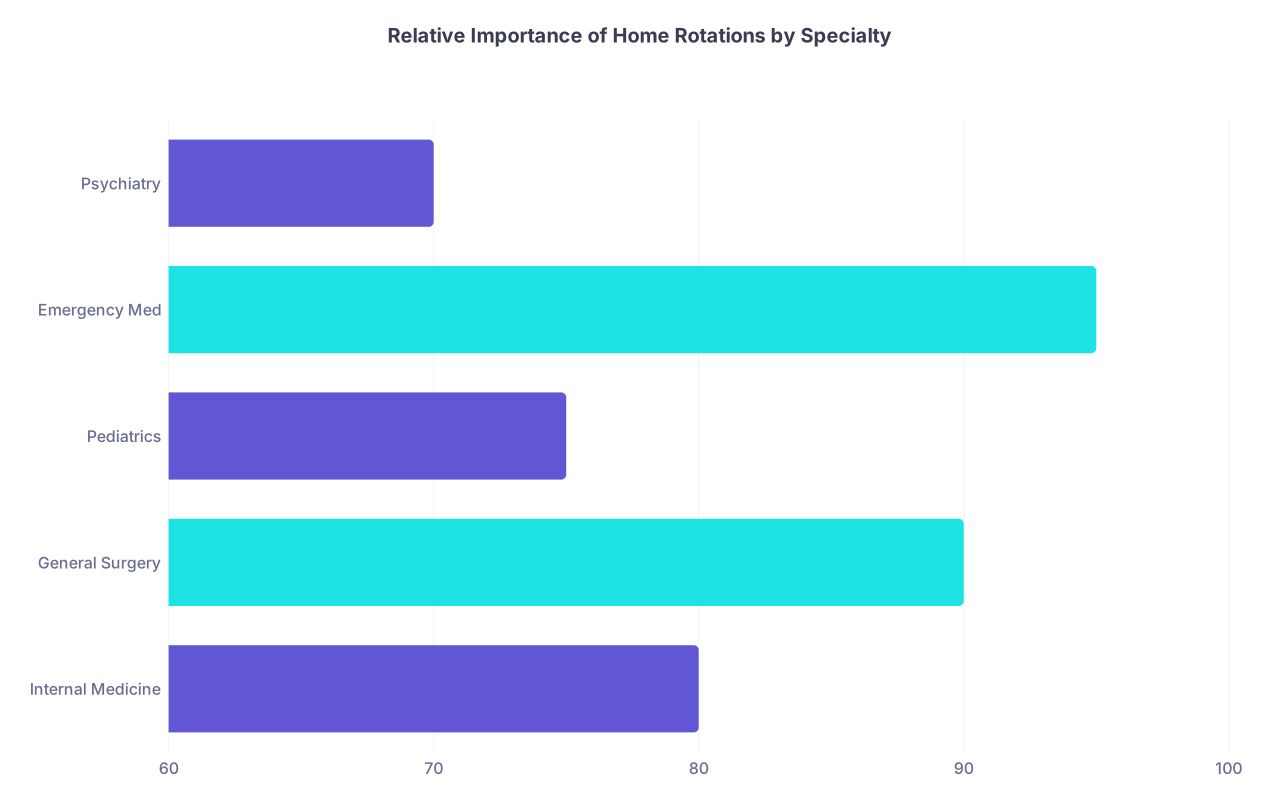
| Category | Value |
|---|---|
| Internal Medicine | 80 |
| General Surgery | 90 |
| Pediatrics | 75 |
| Emergency Med | 95 |
| Psychiatry | 70 |
Put it all together: build a schedule that feeds the rank room
If your goal is to maximize how often your name comes up positively when your home program ranks applicants, your 4th-year schedule for that specialty should look something like this:
- Early sub‑I on the home inpatient service.
- Followed by ICU or high-yield consult month where you’ll work with core faculty.
- Slot in a rotation where the PD/APDs are likely to supervise you directly.
- Around that, you can plug in additional electives, aways, and lighter blocks.
What you’re really doing is stacking the deck so that by November, multiple people in your home department—residents, attendings, PD/APDs—can look at your ERAS photo and say, “Oh yeah, I know them. Strong. I’d be happy to have them here.”
That’s your win condition.
FAQs
1. If I have to choose between a home sub‑I and an away sub‑I in my desired specialty, which comes first?
Do the home sub‑I first unless your school’s program is extremely weak or you absolutely don’t want to stay there. A strong home performance gives you a safety net and advocates. Then go do aways with that experience and (ideally) that letter in your pocket. Walking into away rotations without proving yourself at home first is a harder path.
2. What if my home program is small and I barely interact with the PD on these rotations?
Then your priority shifts to whoever the PD actually listens to. Find out which attendings or chiefs are their “trusted voices.” Often it’s the ICU director, a long-standing clerkship director, or a couple of senior residents. Get under their supervision. You don’t need direct daily PD time if their inner circle is strongly in your corner.
3. Can a bad performance on a key home rotation sink my chances at that program?
Yes. And people won’t say this out loud, but it happens. A truly poor showing—chronic lateness, weak work ethic, attitude issues—on a core home rotation can put you on the “do not rank” or “rank very low” list. The flip side is more important: a very strong performance can elevate a borderline application into the “we should keep this one” tier. That’s exactly why you need to treat these rotations as your most important exams. Not on paper. In the room that actually decides.