
The wrong clerkship timing can quietly sabotage an otherwise strong residency application.
Not your letters. Not your Step scores. Your calendar.
I have watched excellent students miss their dream specialties not because they were weak, but because they misunderstood how brutal the timing game is. The system will not adjust to your schedule mistakes. Program directors will just move on.
Let me walk you through the traps that actually hurt people. The ones you will not fully appreciate until it is too late—unless you plan now.
Trap #1: Delaying Core Rotations So You “Feel More Ready”
This one looks innocent. It is not.
Students often say some version of:
“I’ll push internal medicine and surgery to the middle or end of third year so I’m more comfortable in the hospital first.”
Sounds reasonable. It is a scheduling landmine.
Here is what actually happens when you push major cores (IM, surgery, peds, OB/GYN) to late third year:
- You decide your specialty too late.
- You miss the best windows for aways/sub‑Is.
- You lack strong, specialty‑relevant letters when programs start screening.
For competitive or moderately competitive fields—derm, ortho, ENT, plastics, EM, anesthesia, rads, even competitive IM programs—doing relevant cores late is a silent killer.
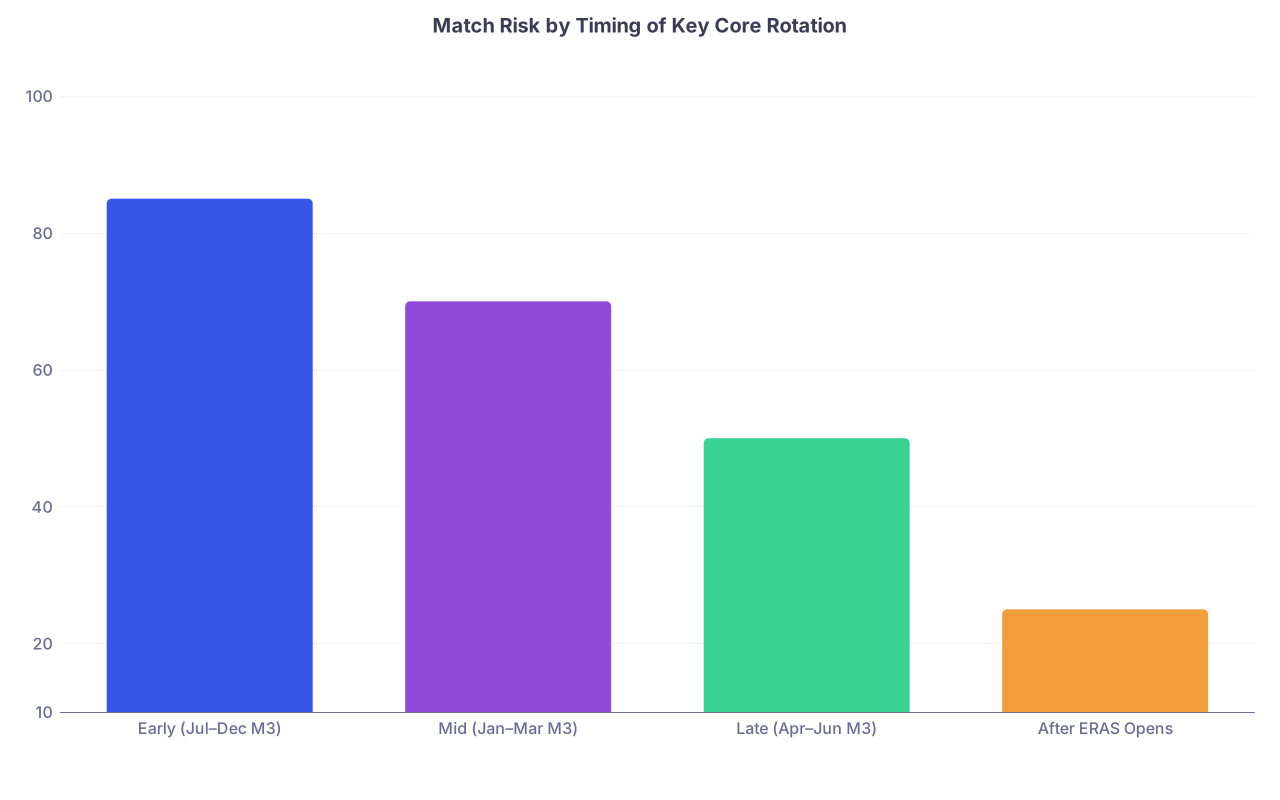
| Category | Value |
|---|---|
| Early (Jul–Dec M3) | 85 |
| Mid (Jan–Mar M3) | 70 |
| Late (Apr–Jun M3) | 50 |
| After ERAS Opens | 25 |
Interpretation (these numbers are representative, not exact): your chances of putting together a competitive application plummet if the relevant core happens late, because you are missing letters, narrative comments, and time for follow‑up rotations.
Classic bad pattern:
- Q4 M3: First exposure to internal medicine, suddenly you love it.
- Q4 M3–Q1 M4: Try to arrange sub‑I and maybe one away. Slots are mostly full.
- July 1 M4: You are barely starting your IM sub‑I.
- September: ERAS is due. You are still waiting for that sub‑I letter. Panic.
You will still match somewhere in many fields. But in the programs you actually want? You just made life much harder.
Avoid this mistake:
Prioritize earlier timing for:
- Internal Medicine if you are even vaguely considering IM, cards, GI, pulm/crit, heme/onc, or any medicine subspecialty.
- Surgery if you might want any surgical subspecialty (ortho, ENT, urology, neurosurg, plastics, vascular, etc.).
- Pediatrics if you might want pediatrics, peds subspecialties, or Med‑Peds.
- OB/GYN if there is even a small chance you will apply OB, MFM, REI, etc.
You want at least one “anchor” core related to your likely choices in the first half of third year. Not because you need to be perfect. Because you need time to respond to what you learn about yourself.
Trap #2: Taking Step 2 CK Too Late To Fix Step 1 (or To Prove You’re Strong)
Some of you will underestimate how aggressively programs use Step 2 CK timing against you.
You have a mediocre or pass-only Step 1. You are banking on a strong Step 2 to show you belong in your target specialty. Reasonable plan.
Then you schedule it in August or September of your M4 year.
That is not a plan. That is self-sabotage.
Programs start screening ERAS applications as soon as they come in. For a lot of them, that is mid–late September. Many competitive specialties review in the first 1–3 weeks and send a large chunk of interview invites early.
If your file shows:
- Step 1: Pass, or lower than average
- Step 2 CK: “Scheduled” or “Score pending”
You just got quietly filtered to the bottom at many places.
Here is the pattern I watch year after year:
- Student with 220 Step 1 → takes Step 2 CK in late August → score reports late September.
- ERAS submitted September 15 with no Step 2 score visible.
- Competitive field (EM, rads, anesthesia, ortho, etc.).
- Programs screen early; no score = weaker looking file.
- You get fewer interview offers than your final Step 2 score would have earned—if it was visible.

| Step | Description |
|---|---|
| Step 1 | Low/Pass Step 1 |
| Step 2 | Plans strong Step 2 CK |
| Step 3 | Schedules CK Aug-Sep |
| Step 4 | No score when ERAS reviewed |
| Step 5 | Filtered or lower priority |
| Step 6 | Fewer interview invites |
Safer strategy:
If you need Step 2 CK to rescue or strengthen your application:
- Aim to take it by late June or early July of M4.
- That way your score typically posts before or right around ERAS opening.
- Your score is live when programs are building their first pass interview list.
The mistake is not “taking Step 2 later.” The mistake is taking it after programs start serious screening. At that point, you are trying to fix a file that has already been quietly triaged.
Trap #3: Late Sub‑Internships and Away Rotations
A sub‑internship in your chosen field done in September or October can feel intense and meaningful. It will not help your initial application very much.
The timing problem is simple:
- ERAS opens for submission mid‑September.
- Many programs send their first, biggest batch of interview invites late September–October.
- Your September sub‑I letter usually arrives… October or November.
Which means for the most critical part of the season, that golden “I worked like an intern and crushed it” letter is not in your file.
If you are applying to competitive fields or competitive programs, this is a nasty hit.

Worst‑case timing chain:
- July: Realize you want anesthesia.
- September: First available anesthesia sub‑I at home.
- October: First away rotation because everything earlier was full.
- November: Letters uploaded.
- Interviews: Programs already mostly booked.
You will still get interviews in less competitive places. But you may have shut yourself out of your reach or dream programs, because you were basically invisible during the period when they were choosing their first slate.
Better pattern:
- Sub‑Is/aways in your chosen specialty June–August (maybe early September) of M4.
- At least one high‑quality rotation in that window so you have 1–2 strong, specialty‑specific letters in ERAS from day one.
If you cannot get all your dream sub‑Is early, at least get one strong home sub‑I before September. Late aways can still help for rank list positioning, but they are terrible as your first meaningful exposure and main letter source.
Trap #4: Front‑Loading Electives and Pushing Cores To The Back
Here is another one that looks clever and is usually harmful:
“I’ll use early third year to do cool electives to figure out what I like, then do cores later when I’m more experienced.”
Translation: you are burning the most powerful “decision-making” part of third year on low‑impact electives while delaying the rotations that programs actually care about and that produce your core letters.
Electives are dessert. Cores are the meal.
Programs do not read your application and say:
“Oh, two extra weeks of radiology as an M3, nice, that compensates for that weaker medicine evaluation.”
They mostly care about:
- Medicine
- Surgery
- Pediatrics
- OB/GYN
- Family Medicine / Primary Care
- Psychiatry
Those evaluations, narratives, and honors (or not) carry more weight than 2–4 weeks of some random M3 elective you enjoyed.
The practical problem of back‑loading cores:
- You run out of time to show improvement if one goes badly.
- You have no strong core evaluations ready when asking for early letters.
- Your relative performance looks more “raw” compared to classmates who did the same core earlier and then built skills.
I have literally seen students schedule like this:
- July–September: dermatology elective, radiology elective, research elective.
- October–March: all major cores jammed together.
- March: exhausted, burned out, stumbling through internal medicine, which they then decide they want. Too late to do meaningful sub‑Is before ERAS.
Do not let “fun” or “exploratory” electives eat the space where your core foundations should go. You have limited prime calendar real estate. Spend it on what programs value most.
Trap #5: No Buffer Time For Letters And Logistics
Most students underestimate friction. Letters delayed. Faculty on vacation. Schedulers slow. Things fall through.
If your entire plan depends on everything running perfectly on time, your plan is bad.
Here is a rough but helpful way to think about the timeline for a letter from a sub‑I or away:
- Week 0–4: Rotation happens. You work hard, impress.
- End of Week 4: You politely request a letter. Attending agrees.
- Week 5–8: They draft it—often in between a thousand other tasks.
- Week 9–10: Letter actually gets uploaded to ERAS.
If your sub‑I ends August 31:
- Letter might not be in ERAS until late September or even early October.
For some programs, that is already “mid‑season.” They have sent a lot of invitations.
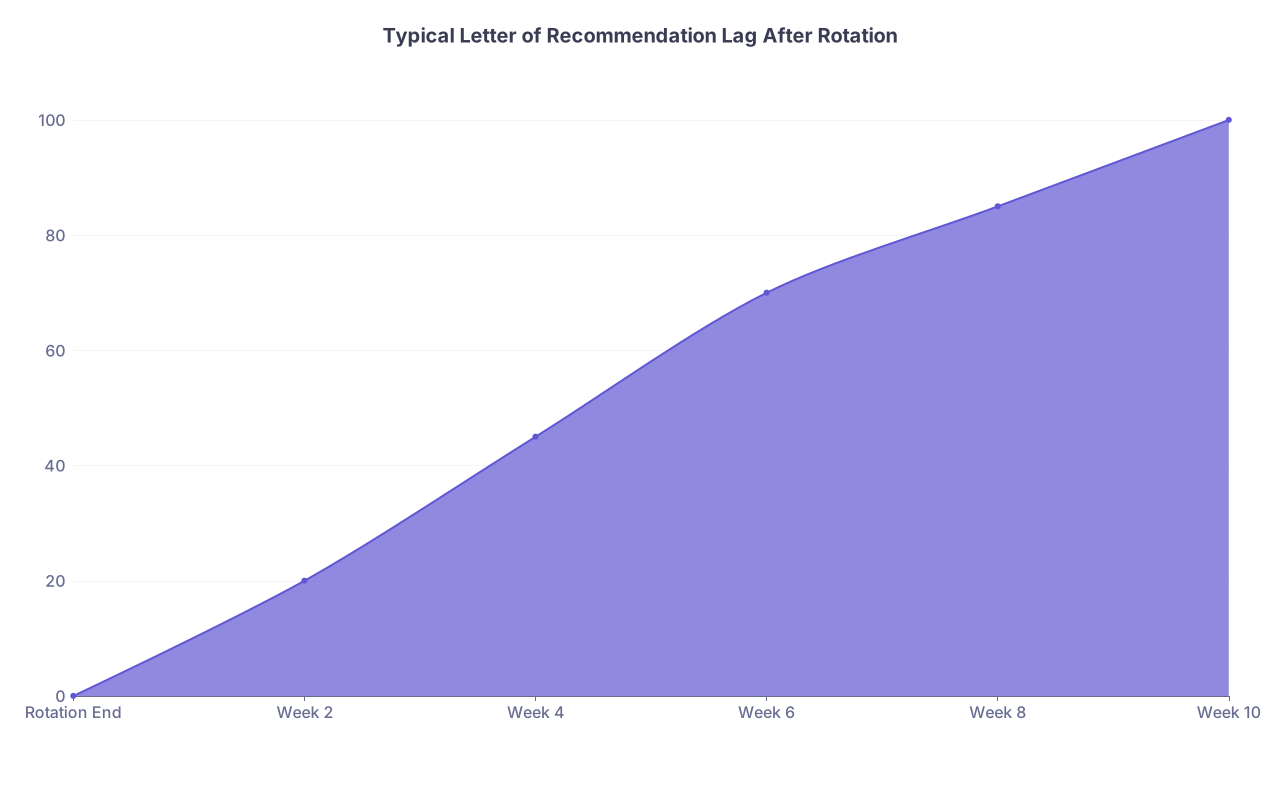
| Category | Value |
|---|---|
| Rotation End | 0 |
| Week 2 | 20 |
| Week 4 | 45 |
| Week 6 | 70 |
| Week 8 | 85 |
| Week 10 | 100 |
(This represents percent of letters that have been uploaded by each time point.)
Common timing mistake:
- Sub‑I #1: August
- Sub‑I #2: September
- Both attendings say yes to letters.
- ERAS submitted mid‑September with only generic M3 core letters; specialty letters arrive piece‑by‑piece in October.
Again, this does not doom you. But it absolutely suppresses your interview yield.
Build buffer on purpose:
- Try to get at least one specialty sub‑I done by end of July of M4.
- Ask for the letter a week before the end of the rotation, not after you leave.
- Politely mention your ERAS timeline when you ask:
“I am applying to X this cycle and will be submitting ERAS around mid‑September; if you feel you can write a strong letter, having it in by then would really help me.”
Do not rely on miracles in late August and September.
Trap #6: Misaligned Away Rotation Timing For Competitive Specialties
Away rotation timing is where plenty of strong students quietly lose ground, especially in:
- Orthopedic surgery
- Neurosurgery
- ENT
- Plastics
- Dermatology
- Emergency medicine
- Some competitive radiology/anesthesia programs
Aways are not just “experience.” They are month‑long interviews.
The mistake is doing the key away rotations too late:
- September, October, or even November of M4.
- At that point, programs have already offered most of their interview slots.
- Your away becomes more about rank list tweaking than generating an invitation in the first place.
I have literally heard program leaders say during selection meetings:
“We do not hold interview spots for late rotators. If we like them, we will rank them highly when they apply here next year.”
Read that again. They are thinking about next year.
For many surgical fields, the highest‑yield slots for aways are June–August of M4. Some programs view September rotators as “late” for their current cycle.

Red flags in your away rotation planning:
- You are “waiting to be sure” about the specialty before scheduling any aways.
- You are hoping the VSLO system (or equivalent) will still have prime spots if you apply late.
- You have not looked at each specialty’s recommended timeline from organizations like EMRA, AOA, AAMC, etc.
These fields often have an unofficial expectation: “early birds show seriousness.” If you roll in late, they question how committed you are—or they just have no room to respond, even if they like you.
Trap #7: Clustering All Hard Rotations Right Before ERAS
I understand the instinct:
“I’ll schedule big, impressive sub‑Is in July and August to show I am ready.”
Then you find yourself:
- On a brutal inpatient sub‑I in July
- Another sub‑I or ICU in August
- Trying to finish your personal statement
- Updating your CV
- Wrestling with ERAS
- Begging faculty to upload letters
- Maybe also studying for Step 2 CK or shelf exams
This is how personal statements end up rushed. How ERAS is uploaded with typos or missing content. How you do “fine but not great” on a key sub‑I because you are exhausted and distracted.
There is a physical and cognitive limit to what you can execute at a high level in July–September of M4. Overloading that period with maximum‑intensity rotations is asking for mediocrity in the single most critical window of your journey.
Smarter pattern:
- 1–2 high‑intensity sub‑Is in June–July.
- Something slightly lighter (or at least predictable) in August while you polish ERAS.
- Avoid combining: “Hardest rotation of med school + Step 2 CK + ERAS writing + letter chasing” in a single 6–8 week window.
You are not lazy for doing this. You are strategic. Performance suffers under constant, maximal load, and program directors see the results in your evaluations and in your application quality.
Trap #8: Ignoring How Different Specialties Use Timing
Not all fields read your timeline the same way. A mistake in one specialty is tolerable in another. Students often apply “generic” wisdom and get burned.
Here is a simplified, high‑level view:
| Specialty Group | Timing Sensitivity | Critical Early Elements |
|---|---|---|
| Ortho/Neurosurg/ENT/Plastics | Very High | Early surgery core + early aways/sub-Is |
| Derm/Rads/Anesthesia | High | Early exposure + early Step 2 CK |
| EM | High | Early home EM + at least 1 early away |
| IM/Peds/OB-GYN | Moderate | Early related core + June–Aug sub-I |
| FM/Psych/Pathology | Lower (but real) | Reasonable timing of cores and Step 2 |
If you are undecided but considering anything on the “Very High” or “High” lines, you cannot treat your third‑year calendar like it is entirely flexible. You need at least one early anchor rotation that keeps your options open.
The mistake is thinking:
“I can always pivot later.”
Past a certain calendar point, “later” is just code for “next cycle.”
Trap #9: Believing Your School’s Default Schedule Is Optimized For The Match
Do not confuse “administratively convenient” with “strategically smart for you.”
Schools make schedules that:
- Fit faculty coverage needs
- Balance student volume across services
- Simplify logistics
None of that is designed specifically around your target specialty or competitiveness level.
I have seen default schedules with:
- Internal medicine in April–June of M3 for students who are considering competitive IM programs.
- Surgery pushed late for students flirting with surgical subspecialties.
- No built‑in buffer for early aways in EM or ortho.
The toxic assumption is:
“If my school gave me this order, it must be fine.”
No. It is fine for average outcomes. You are not aiming for average.
You need to proactively:
- Ask early (even late M2) how to request schedule changes.
- Talk to residents or recent grads in your target specialty about ideal timing.
- Be willing to endure some inconvenience—summer rotations, odd vacation timing—to get the rotation order that supports your goals.
The students who match best are rarely the ones who accepted the default schedule without a fight.
Trap #10: Last‑Minute “Oh No, I Need Backup” Clerkships
Backup planning is rational. Panic‑planning is destructive.
Here is the pattern that gets people in trouble:
- You aimed high in a competitive field with borderline scores.
- In August or September of M4, your mentor gently suggests a parallel or backup specialty.
- You scramble to add a late sub‑I in that backup field.
- It lands in October or November.
- The backup program directors see: almost no early evidence of interest, and only a late, rushed rotation.
To them, you look like what you are: someone who realized too late that they needed options.
That does not mean you should never pivot. It means you should not wait until your primary plan is clearly collapsing to show any commitment to a realistic alternative.
A more mature approach:
- During M3, quietly build at least one plausible backup path with a reasonably timed core and maybe a low‑stakes elective.
- Do not advertise it loudly if you do not want to, but leave yourself an exit ramp that is not last‑minute chaos.
The mistake is not “having ambition.” It is putting every chip on one extremely fragile, late‑dependent path.
What You Should Do This Week
Open your school’s rotation planner or calendar right now and do three concrete things:
- Identify your likely top 2–3 fields (even if you are not sure). Mark which core(s) feed those options.
- Circle July–September of M4 and ask:
- Will I have at least one strong sub‑I in my chosen field completed before this window?
- Will my Step 2 CK score be back before or during this period?
- Write down one change you need to request: swapping a core earlier, moving an elective later, scheduling an earlier sub‑I, or pulling Step 2 CK into June/July.
Then actually email your dean’s office or scheduling coordinator and ask how to request that change.
The students who get hurt by scheduling traps are not usually weaker. They are just late. Do not let your timeline tell programs you were not serious, when in reality, you just planned like the calendar did not matter.
It does. Fix it now, while you still can.