
Away Rotation Red Flags: Behaviors That Get You Blacklisted
Away rotations don’t just “help” with residency match. They can quietly destroy it.
People love to talk about aways as “auditions.” What they don’t say clearly enough is this: a single month can land you on a program’s internal do‑not-rank list. And yes, those lists exist. I’ve seen them. I’ve heard the words: “Nice kid, but after that rotation? Hard no.”
Let me walk you through the behaviors that get you mentally blacklisted. Some are obvious. Some are subtle. All of them are avoidable if you know what programs watch for.
1. Acting Like You’re Already a Resident
This is the fastest way to get silently cut.
You are not a sub‑intern. You are not a PGY‑1. You are a visiting student being evaluated every single day. When you forget that, you start stepping on landmines.
Overstepping Clinical Boundaries
Classic blacklist behaviors:
- Putting in orders without explicitly being told to
- Changing meds or doses “because that’s how we did it at my home program”
- Giving families prognostic info or “explaining the plan” unsupervised
- Presenting yourself to nurses as if you’re the primary decision-maker
I watched a visiting student on a surgery away place real orders for fluids and electrolytes “to be helpful.” No one caught it for a few hours. The patient was fine. The student’s application was not. The PD literally said: “We’re not taking someone who doesn’t understand their lane.”
If you’re not sure whether you can do something, you ask. Every time. Until it’s unquestionably clear that on this team, in this place, for this attending, it’s okay.
Acting Like You’re Running the List
You want to help. Good. But away students who:
- Tell juniors, “I already updated that order”
- Try to “manage” cross-cover issues
- Correct the intern in front of the attending
…very quickly get labeled: “thinks they’re smarter than they are.”
You’re allowed to be competent. You’re not allowed to make your intern or resident look unsafe or uninvolved. Even if you’re right clinically, doing it in the wrong way gets you burned.
The safer version:
- “Hey, I noticed K was 3.1—should we replete? I can put in a draft order for you to review.”
- “I’m not sure if this was already done, but I can call the nurse and check if you’d like.”
Respect the hierarchy or it will be used against you.
2. Being a Ghost When It’s Inconvenient
Programs don’t blacklist you for not knowing which antibiotic to choose. They blacklist you for disappearing when work shows up.
And they notice patterns.
The “Selective Hard Worker”
This student looks great when the attending is around. On rounds? Sharp. In clinic with the PD? Engaged. End of the day when there’s a new admit or a complicated discharge? Suddenly:
- “I need to finish my notes for my evaluation.”
- “I have to catch the shuttle.”
- “I really need to study for Step 2 tonight.”
Once is fine. Three or four times? Residents start making mental notes. Then they talk. They absolutely talk.
You do not need to stay until midnight to prove yourself. But consistently trying to leave when real work hits screams: “I like the resume‑building parts, not the actual job.”
Chronic Tardiness and Weak Excuses
Here’s the pattern that gets remembered:
- Shows up just on time every day, never early
- Late for cases, especially early morning ones
- “Traffic” and “parking” are regular excuses
No one wants a resident they can’t trust with a 6:30 a.m. start. Being late on an away is like walking around with a sign that says: “Don’t trust me with responsibility.”
Fix the basics:
- Aim to be there 15–20 minutes before your team’s start time
- For OR-heavy rotations, know the first case start and be there before the intern
- If you’re late once, apologize quickly, own it completely, and do not let it happen again
You don’t get many forgivable mistakes on an away. Don’t waste one on your alarm clock.
3. Toxic Talking: Gossip, Complaints, and Oversharing
This is where a lot of otherwise strong students quietly sabotage themselves. They think they’re “bonding.” They’re actually getting blacklisted.
Trash-talking Your Home Program or Other Rotations
If you bad-mouth other institutions, everyone assumes you’ll do it about them later.
Red flag phrases I’ve heard from away students:
- “At my home program, the residents are useless. Here is so much better.”
- “My last away was terrible, the attendings were incompetent.”
- “Honestly, my school doesn’t prepare us for anything.”
The residents will nod. Maybe even laugh. Then say to each other later: “If they talk like that about everywhere, what will they say about us?”
Safe alternatives:
- “At my home program, we do X—interesting to see how you all do Y.”
- “The last site I was at was very different; I’m learning a lot seeing multiple styles.”
Respect other places, even if they weren’t great. Word travels.
Complaining to the Wrong People
Everyone vents. But you’re not at home. You’re on stage.
High-risk complaints:
- “This rotation is so disorganized.”
- “These hours are ridiculous.”
- “I don’t understand why they expect us to stay so late when we don’t get paid.”
When you say this to other students, it sometimes dies there. When you say this within earshot of a chief, fellow, or attending? That’s game over.
You can ask for help. You can ask for clarity. You can’t sound like someone who’s already burned out before residency even starts.
Oversharing Personal Drama
Yes, you’re a human being. You have a life. But if your story every day is:
- Breakup drama
- Family conflict details
- Step score obsession and anxiety
- Every minor physical complaint turned into a saga
You get labeled as “high maintenance” very quickly.
What programs want in a resident: someone stable enough that their personal life won’t constantly bleed into work. Fair or not, they make that judgment early. Protect yourself by keeping heavy personal stuff for friends, family, or a therapist—not your away team.
4. Looking Disengaged, Even When You Care
You might care deeply and work hard… and still come across like you don’t give a damn. That disconnect kills applications.
Phone Addiction in Patient Care Areas
If there’s one universal black flag, this is it.
Behaviors that get repeated in resident rooms:
- Scrolling your phone on rounds, even if you’re “looking up labs”
- Checking texts in front of patients or nurses
- Phone out during sign-out or teaching
No one will ask, “Were they reading UpToDate or Instagram?” They’ll just say, “Always on their phone.”
Solution: Default to phone away, laptop closed, eyes up. If you must use your phone for work:
- Say it out loud: “I’m just pulling up the imaging on my phone.”
- Do it fast, then put it away.
Dead-Face and Low-Energy Presence
I’ve seen students who were introverted, exhausted, maybe just shy—get written up informally as “disengaged,” “not interested,” or “low enthusiasm.”
Red flag impressions:
- No eye contact when you’re being taught
- No follow-up questions, ever
- Presentations that sound like they’re read from a script
- Blank face in the OR when someone asks if you want to scrub
You don’t need to be fake-hyper. But you do need signs of life.
Concrete fixes:
- Nod when someone explains something
- Ask one thoughtful question per day
- When offered to do something procedural, default to: “Yes, thank you, I’d love to.”
Programs don’t want to train mannequins. They want signs that you’re actually engaged in the work.
5. Bad Team Dynamics: Making Life Harder for Residents
Here’s the quiet truth: residents decide your fate more than attendings do. PDs listen to the people who actually worked with you.
So any behavior that makes residents’ lives harder? That’s dangerous.
Needing Constant Babysitting
You are allowed to ask questions. You are not allowed to require step-by-step hand-holding for the same task every day.
Residents get frustrated by students who:
- Ask how to write the same note type three days in a row
- Can’t pre-round independently on even one patient
- Need repeated reminders to check vitals, I/Os, labs
The message they send to the PD: “We’d have to do double work to carry this person as an intern.”
Your goal is to make yourself “light on the system”:
- Take ownership of a small, appropriate list of tasks and do them reliably
- Keep your own list and check it rather than asking 10 times what to do next
- When corrected, adjust fast and don’t repeat the same lapse
Making Residents Look Bad
This one burns long and deep.
Examples:
- Correcting your resident in front of the attending
- Saying, “We didn’t do that because [resident name] said it wasn’t necessary.”
- Telling the PD, “I haven’t been getting feedback,” when you’ve just ignored suggestions
Even if your resident is disorganized or weak, publicly hanging them out to dry is suicide for your application.
The better path if something isn’t working:
- “I might have misunderstood, but I thought we were doing X—should I have done Y instead?”
- If feedback is missing, privately ask the resident: “Can I get some feedback so I can improve for the rest of the month?”
You have to survive the rotation. You’re not there to fix the culture.
6. Dishonesty and Documentation Games
This is non-negotiable. Once a program thinks you’re dishonest, that’s it. You’re done there.
Fudging the Truth
Common student lies that get discovered:
- Claiming you pre-rounded when you didn’t
- Saying you checked labs/imaging that you never opened
- Pretending to have done a task (calling a consultant, updating a family) when you didn’t
Someone always finds out. A nurse mentions no one called. Chart shows no note. Lab clearly wasn’t reviewed. And suddenly every other thing you say is doubted.
If you missed something, the safest sentence is:
“I’m sorry, I thought I had time and I didn’t get to it—I’ll do it right now.”
That won’t blacklist you. Lying about it might.
Documentation You Didn’t Earn
This one is sneaky but serious:
- Copying and pasting your resident’s note structure without understanding it
- Marking things as “reviewed” that you didn’t review
- Documenting physical exam findings you didn’t actually check
Attendings spot inconsistencies. Nurses spot inconsistencies. Denials teams spot inconsistencies. No one wants to risk Medicare fraud or malpractice because a brand-new intern likes to “document optimistically.”
Be painfully honest in your notes. If you didn’t examine the abdomen, don’t write “abdomen soft, nontender.” Write what you actually did or leave it for the resident to add.
7. Poor Awareness of Specialty Culture
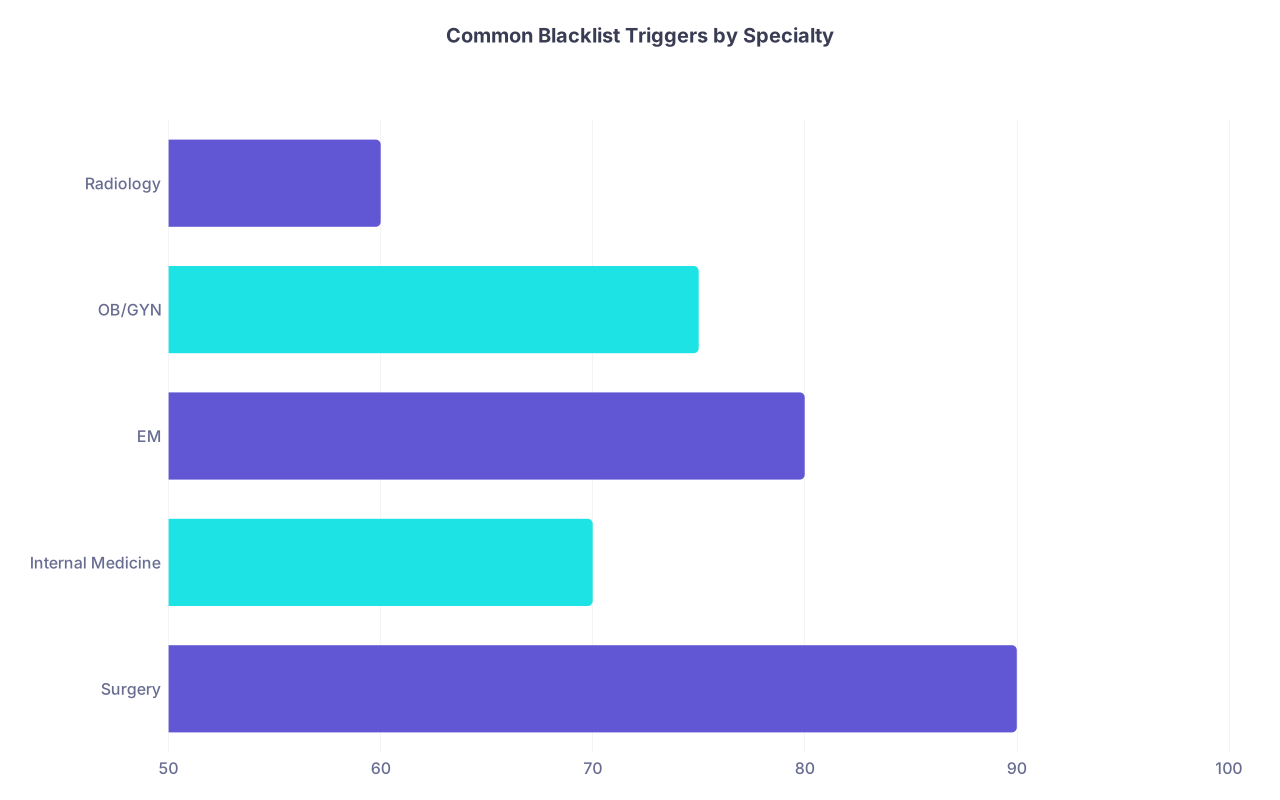
Different specialties blacklist for different reasons. Ignoring that is a mistake.
| Category | Value |
|---|---|
| Surgery | 90 |
| Internal Medicine | 70 |
| EM | 80 |
| OB/GYN | 75 |
| Radiology | 60 |
(Values approximate how often faculty/residents cite these behaviors in debriefs: OR etiquette for surgery, reliability/professionalism for IM, teamwork/attitude for EM, work ethic for OB, preparation and communication for radiology.)
Surgery and OB/GYN: OR Etiquette and Work Ethic
On surgical aways, you get blacklisted for:
- Touching sterile fields without asking
- Being on your phone in or near the OR
- Acting bored when you’re not scrubbed in
- Leaving before cases “because I’ve already met my required hours”
If they think you won’t hustle as a resident on a call night when a 2 a.m. appy comes in, they won’t rank you.
Internal Medicine: Reliability and Follow-through
IM cares deeply about:
- Showing up prepared to discuss your patients in real depth
- Following through on every task (calls, notes, discharge summaries)
- Responding appropriately to subtle clinical changes
You’ll get quietly blacklisted if the repeated comment is: “Nice student, but not someone I’d trust on a busy ward month.”
EM: Team Fit and Attitude
In EM, big red flags include:
- Arguing with nurses or dismissing their concerns
- Complaining about “scut” like stocking or helping with room turnover
- Disappearing when a trauma or resuscitation rolls in
EM is all about team dynamics under pressure. If staff feel you’re not someone they want in their resus bay at 3 a.m., they won’t want you in their rank list either.
8. The “Not Actually Interested in Us” Problem
Programs don’t want to waste spots on people who are clearly using them as a backup plan. If you act like you don’t really want to be there, they believe you.
Broadcasting You’re Chasing Somewhere Else
Students sink themselves by saying things like:
- “My dream is [elite coastal program] but I figured I’d try here too.”
- “Honestly, I just needed another away and you all had open spots.”
- “I’m really hoping to match in [other city/region], that’s where my partner is.”
Then later they’re shocked they got no interview.
You don’t need to lie about geography, but on their turf, speak as if matching there is a real option you’d be happy with. If you can’t say that truthfully, you shouldn’t be doing an away there.
Not Learning the Program’s Basics
This one is subtle but noticed:
- You don’t know if they’re 3 or 4 years
- You have no clue about their fellowships
- You mix them up with another local program
Residents notice when you don’t know where you are. Comments like “They didn’t even know we were categorical” show up in debriefs.
Spend 30 minutes before the rotation:
- Read their website
- Learn key features of the program
- Know at least one genuine reason you’d rank them highly
Then, your behavior and questions should reflect that you’ve done the homework.
9. Ignoring Feedback and Repeating the Same Mistakes
One negative comment won’t blacklist you. Failure to adjust when you’re given a warning absolutely can.
Brushing Off Mid-Rotation Feedback
If a resident or attending says something like:
- “Try to be a little earlier to pre-round.”
- “We need you to work on closing the loop on tasks.”
- “You’ve seemed a bit disengaged, try to be more involved in discussions.”
That’s not casual. That’s them giving you a chance to change the narrative.
If nothing changes over the next week, the story solidifies: “We tried to help them improve, they didn’t.”
When given feedback:
- Say: “Thank you, I appreciate you telling me.”
- Clarify if needed: “Just so I’m clear, would it help if I ___?”
- Over-correct slightly so nobody can miss the difference.
Blaming Everything Except Yourself
You may have a tough resident. A chaotic service. Poor onboarding. All real.
But if your internal monologue all month is:
- “This system is trash.”
- “They never explained anything.”
- “They just don’t like me.”
You’ll miss every opportunity to adapt.
You don’t have to agree with all the feedback. You do have to show you can function in less-than-ideal environments without falling apart or turning bitter. Because that’s residency.
Quick Reality Check: How Programs Actually Decide
Here’s how it often goes behind closed doors after away season:

| Step | Description |
|---|---|
| Step 1 | End of Rotation |
| Step 2 | Resident Feedback |
| Step 3 | Do Not Rank / Cautious |
| Step 4 | Neutral or Positive |
| Step 5 | Interview + Higher Rank |
| Step 6 | Maybe Interview |
| Step 7 | Any Red Flags? |
| Step 8 | Strong Fit? |
People won’t remember every note you wrote or fact you recited. They will remember:
- “Would I want this person on my night float team?”
- “Would I trust them with my sickest patients?”
- “Would I tolerate them for three years?”
If the answer is “no” because of any of the mistakes above, you’re done—no matter how good your scores and letters are elsewhere.
10. How to Stay Off the Blacklist (Without Being Perfect)
You don’t need to be flawless. You do need to avoid the major landmines.
Three protective habits:
Default to humility plus initiative.
Volunteer for work, ask to help, but don’t act like you know everything. Never try to “fix” systems or people during a month-long audition.Communicate early, honestly, and directly.
If you’re struggling, say so to the right person (usually your senior resident). If you make a mistake, own it immediately and show you learned from it.Protect your reputation with small daily choices.
Be five minutes early. Keep your phone away. Don’t gossip. Ask questions. Do what you said you’d do, when you said you’d do it.
Programs are not expecting finished products on away rotations. They’re looking for red flags that scream “problem intern.” Your job is simple:
Don’t give them one.
Key takeaways:
- You get blacklisted for professionalism and attitude, not for not knowing obscure medical facts.
- Behaviors that make residents’ lives harder—dishonesty, unreliability, arrogance, constant complaining—stick in people’s minds.
- You can protect yourself by staying humble, communicating clearly, doing what you say you’ll do, and treating every day like a month-long interview—because that’s exactly what it is.