What do you think hurts more: missing an admission because you “didn’t see the message,” or realizing months later that the attending who was going to write your strongest letter quietly decided… not to?
This is what call schedule mismanagement does to you on sub‑internships. It doesn’t always explode in your face. No big shouting match. No formal write-up. Just a silent downgrade in how people talk about you behind closed doors. And those conversations shape your letters of recommendation.
Let me be blunt: on sub‑Is, you’re not just being evaluated on knowledge and work ethic. You’re being tested on whether you can function as an almost-intern. And interns live and die by the call schedule.
Mess this up, and your LOR potential bleeds out quietly.
Why Call Management Matters More Than You Think
On paper, you’re “just a student.” In reality, your sub‑I is a month‑long audition for residency. Programs look at your LORs from sub‑Is as proof that:
- You can be trusted at 2 a.m.
- You won’t abandon your team
- You won’t be the intern who “disappears” when stuff hits the fan
Attendings and residents care a lot about reliability. More than your Step score. More than how many esoteric facts you can recite. Reliability is mostly invisible when it’s good and extremely obvious when it’s bad.
And reliability on a sub‑I shows up in exactly three places:
- Call schedule
- Sign‑out
- Response to pages / messages
You’re judged on whether the team can find you, count on you, and trust you to show up when you said you’d show up.
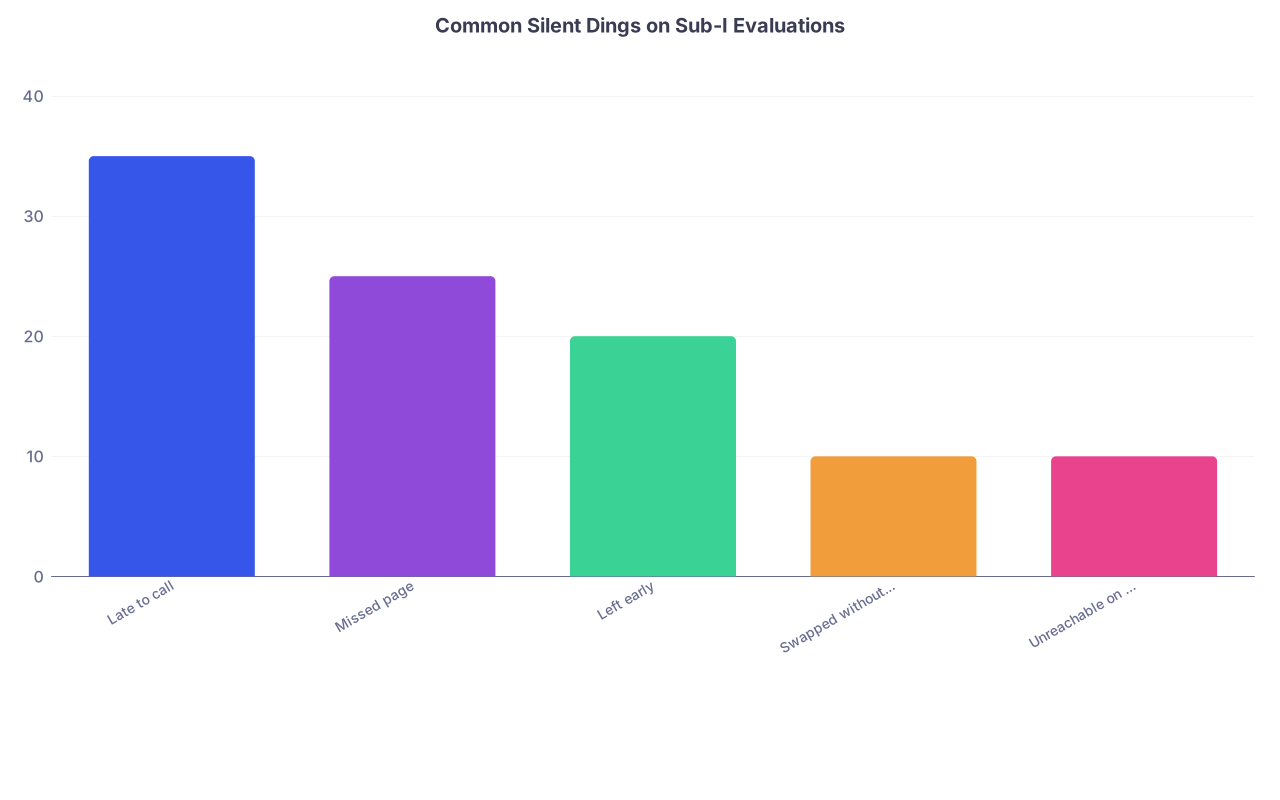
| Category | Value |
|---|---|
| Late to call | 35 |
| Missed page | 25 |
| Left early | 20 |
| Swapped without telling | 10 |
| Unreachable on night shift | 10 |
Here’s the thing: most students don’t get formally reprimanded for call schedule screw‑ups. They just get phrases like:
- “Reliable when present…”
- “Would benefit from improved communication…”
- “Needed more oversight on nights…”
Those are quiet death sentences for a strong LOR.
The Biggest Call‑Related Mistakes That Kill Strong Letters
You want to avoid disaster? Start by not doing the dumb, common stuff I see every single year.
1. Treating the Call Schedule as “Flexible”
You are not flexible. You are scheduled.
I don’t care if your classmates on other rotations swap shifts all the time. Sub‑I = they are watching to see if you respect the system.
Here’s what gets you in trouble:
- Verbal swaps with a co‑student and never emailing the chief
- Assuming “I think I told the resident” counts as confirmation
- Half‑baked swaps: “She said she’d cover if she could, so I didn’t show up.”
To the team, all they see is: you were scheduled, and you weren’t there.
How this shows up in your LOR:
“She was enthusiastic but occasionally had issues with schedule reliability.”
Read: “Do not trust this person with night float.”
What you should do instead:
- Any swap = written, confirmed, documented
- Email or message the chief resident and the senior on service
- Get a clear reply that it’s approved. No reply = not approved.
- Keep your own updated copy of the current schedule
If you don’t have the final, updated schedule screenshotted, you’re playing with fire.
2. Being “Technically On Call” but Functionally Absent
You show up, you sit somewhere, you maybe see a couple of patients, and then halfway through the night your presence sort of… dissolves.
Classic behaviors:
- Disappearing for “a quick break” that morphs into an hour
- Vanishing to “read about a topic” without telling anyone where you went
- Sleeping more than the team, and not setting an alarm for pages
- Leaving the call room door closed, phone buried, volume off
Nobody screams at you. But they all notice that when things got busy, the medical student was never actually around.
This is how you end up in the “meh” category. Not unsafe. Not impressive. Definitely not letter‑worthy.
Better approach:
Tell the resident what you’re doing. Every time you change locations or step away for more than a bathroom break.
Say things like:
- “I’ll be at the workroom finishing notes. Page or message me if a new admission comes in.”
- “I’m going to grab food—back in 15 minutes. Want me to bring you anything?”
- “I’m going to quickly read up on DKA—where should I sit so you can find me easily?”
Annoying? Slightly. But no one will ever complain that the sub‑I was too available during call.

3. Not Knowing Who You Actually Report To on Call
Another common failure: you show up for call and don’t know who’s supposed to be supervising you.
You think:
“I’m on call with the team, they’ll find me.”
Wrong. At night, things get messy:
- Different senior overnight
- Cross‑cover resident not on your daytime team
- Night float system separate from day team
- Multiple services covering the same floor
If you float around “helping wherever,” but no one really sees you consistently, it looks like you did nothing, even if you were busy all night.
And guess what? The attending writing your letter asks the night residents what you were like on call.
You should be crystal clear on:
- Who is your primary contact from 5 p.m. onward
- Where that person usually works (ED, ICU, floor, night office)
- What expectations they have for students (“Pre-round on admissions?”, “See every consult?”, “Just follow me?”)
On your first day of the sub‑I, you should ask the senior:
“Who am I with for call? Where should I report? And what does a good call shift look like for a sub‑I on this service?”
If you don’t ask, they assume you don’t care.
4. Mishandling Calls Around Days Off & Interviews
This one burns people quietly, especially in the residency application phase.
Common screw‑ups:
- Stacking all your days off around interview travel and leaving the team hanging
- Asking for multiple changes last‑minute because you “forgot” you had an interview
- Not blocking off your interview dates before the schedule is made
- Expecting the chief to reorganize everyone else’s lives around your ERAS calendar
I’ve seen this exact scenario:
Student does a sub‑I in October, applies to that program. They knew they’d have 3–4 interviews during the month. They don’t tell anyone until after the call schedule is set. Then they start asking: “Can I be off this call? And that one? And also that Friday?”
The message that sends: “My stuff matters more than the team.”
That’s how someone goes from “for sure letter” to “generic, lukewarm write‑up.”
Plan like an adult.
- As soon as you know your sub‑I month, try to schedule interviews before or after if possible
- If you absolutely must miss calls: notify early, before schedules are finalized
- Trade fairly—don’t only offload nights; be willing to take less desirable shifts too
- Own the inconvenience and be excessively polite when you ask
5. Ignoring Pages / Messages Because “It’s Late” or “I Was With a Patient”
This one is lethal.
The fastest way to torpedo your reputation overnight is to be the student who’s impossible to reach.
Excuses I’ve heard:
- “I had my phone on Do Not Disturb”
- “I thought it was probably for the resident”
- “I didn’t recognize the number”
- “I left my phone to charge in the call room”
To the team, all of that translates to: “You can’t rely on this person.”
On call, your phone is your lifeline. If you cannot be reached, you might as well not exist.
Minimum baseline:
- Phone on loud
- Vibrate on
- In your pocket or directly next to you at all times
- Nursing unit numbers saved if possible
And if you miss a page—even once—you own it hard:
“Apologies, I had stepped away from my phone for five minutes. I’ll keep it on me constantly.”
One missed page won’t kill you if you respond like a responsible human. Repeated missed pages? Fatal.
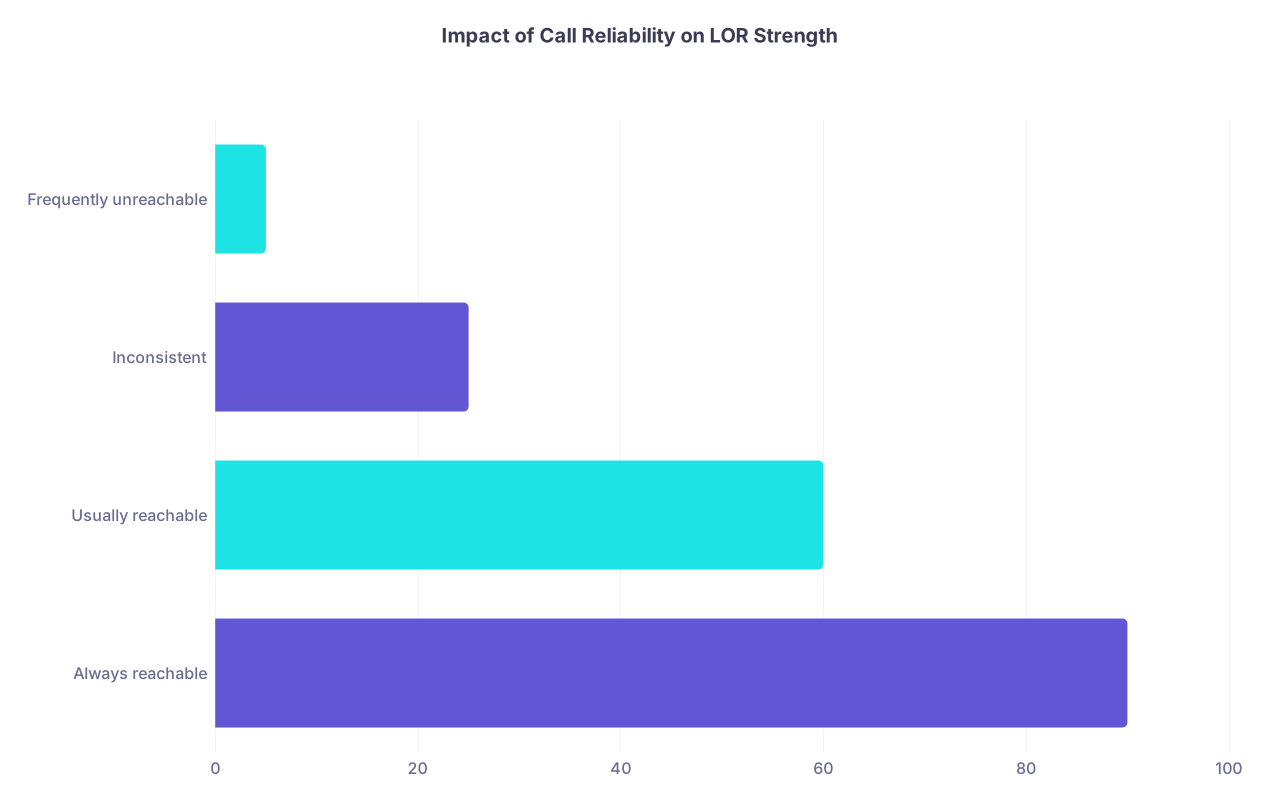
| Category | Value |
|---|---|
| Always reachable | 90 |
| Usually reachable | 60 |
| Inconsistent | 25 |
| Frequently unreachable | 5 |
6. Failing to Understand Workload vs. Presence
Another subtle mistake: confusing being there with being useful.
Students sometimes think, “I showed up for call, what more do they want?” A lot more.
Red flags that you’re physically present but functionally useless:
- You stand silently during admissions, never volunteering to write the H&P
- You don’t ask to follow a new patient from ED to floor
- You never say, “What else can I do?” after the main task is done
- You disappear into a note for hours and miss the action
The residents aren’t going to beg you to help. If you fade into the background, they will gladly let you. But then when evaluations come, no one remembers anything specific you did.
And specific = strong LOR.
Bad: “She was pleasant and worked hard.”
Good: “He consistently volunteered to take new admissions on call, and his notes were often usable with minimal edits—he functioned at the level of a new intern.”
That second one only happens if you aggressively take ownership during call.
How to Handle Call So You Become “Letter Material”
Let’s get tactical. Here’s what actually impresses residents and attendings enough to mention you by name when letters come up.
Build a Personal Call System Before Day 1
Do not improvise this at 11 p.m. while half-asleep.
Have:
- A digital calendar (Google, iCal) with all call shifts clearly labeled
- A photo and PDF of the latest call schedule saved to your phone
- A back‑up written copy in your pocket notebook
| Tool | Purpose |
|---|---|
| Digital calendar | Reminders & big picture |
| Photo of schedule | Quick reference on the go |
| Pocket notebook | Changes, notes, sign-outs |
| Contacts list | Key residents/attendings |
Set reminders:
- Night before each call shift: “On call tomorrow – confirm time/coverage.”
- 2 hours before call: “On call tonight – bring food, chargers, extra layers.”
This alone will put you ahead of half your classmates who “forgot” they were on.
Over‑Communicate With the Right People
You want to avoid the quiet “we couldn’t find the student” complaint? Communicate like your grade depends on it—because it does.
At minimum, every call shift you should:
- Identify who’s in charge: night senior, cross‑cover, or team resident
- Tell them explicitly: “I’m here for call, I’d like to help with admissions, cross‑cover, anything you think is useful.”
- Ask where you should physically be when not actively with them
- Before stepping away >10–15 minutes, say where you’re going and when you’ll be back
- Before leaving at the end of call, check if anything needs to be wrapped up
You’re not being needy; you’re being reliable.

| Step | Description |
|---|---|
| Step 1 | Arrive for call |
| Step 2 | Find night senior |
| Step 3 | Clarify expectations |
| Step 4 | Confirm where to be |
| Step 5 | Help with admissions/cross-cover |
| Step 6 | Update senior before any break |
| Step 7 | Check out before leaving |
Own Your Mistakes Immediately and Publicly Enough
You will screw something up. Everyone does. The difference between recoverable and fatal is how you respond.
Bad response patterns:
- Denying: “I’m pretty sure I was there at that time.”
- Blaming: “Nobody told me I was supposed to cover that patient.”
- Minimizing: “It wasn’t that big a deal; the resident handled it anyway.”
Good pattern:
- “You’re right, I missed that page. I should have kept my phone on me; it was charging in the call room. I’m going to keep a battery pack with me from now on so it doesn’t happen again.”
Residents see that and think: okay, this one can handle being an intern.
That shows up in letters as “responds well to feedback” instead of “defensive when issues arose.”
Use Call to Create LOR‑Worthy Moments
Letters are built on stories, not vibes.
You want the attending to remember you like this:
- “He stayed late after a brutal call night to help finish notes without being asked.”
- “She volunteered to take a complex admission at 3 a.m. and presented clearly despite being exhausted.”
- “When the unit got slammed, he stepped up, kept track of multiple patients, and communicated like a team member.”
Those stories almost always happen on call.
So during call:
- Volunteer for the next admission
- Offer to call family with the resident and then write the note
- Ask to do the first draft of the admission orders (with supervision)
- Be the one tracking the sign‑out list, knowing who’s sick, who needs labs followed up, who might decompensate
Call is where your “almost intern” identity is built. Or not.

How Call Performance Quietly Echoes Into Your LORs and Match
Here’s the part students underestimate: your call performance doesn’t stay on that floor. It travels.
What Attendings Ask Residents When Writing Letters
I’ve heard these questions literally asked in workrooms:
- “How were they on call?”
- “Could you find them when things got busy?”
- “Would you want them as your intern next year?”
- “Any issues with reliability or professionalism?”
If your name pulls up:
- “Oh yeah, she vanished a lot at night.”
- “Nice kid, but we could never find him when stuff was going down.”
- “He swapped a bunch of his call and left others to pick up the slack.”
Your letter is done. Best case, it’s generic. Worst case, it has that one poison line:
“While overall he performed satisfactorily, there were a few concerns around schedule reliability.”
Program directors read that and move on.
Why This Matters More for Certain Specialties
Some fields are obsessive about reliability and night work:
- Internal Medicine (especially at academic places with heavy cross‑cover)
- Surgery and surgical subspecialties (call is the job)
- OB/GYN
- EM (obviously)
- Pediatrics at big children’s hospitals
If you’re doing a sub‑I in the specialty you want to match into, your call performance isn’t just a grade issue. It’s you saying, “Here’s how I’ll behave as a resident in your program.”
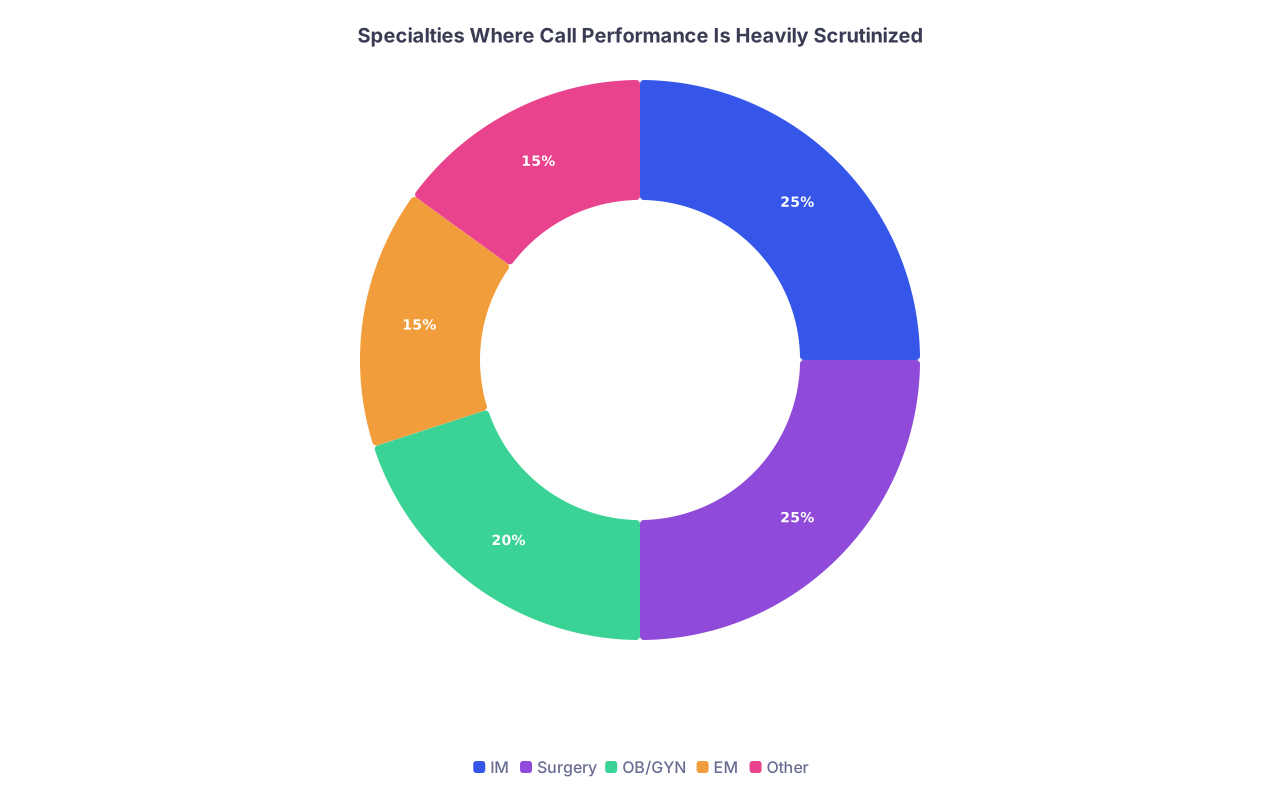
| Category | Value |
|---|---|
| IM | 25 |
| Surgery | 25 |
| OB/GYN | 20 |
| EM | 15 |
| Other | 15 |
Red Flags You’re Already Mishandling Call (And How to Fix It Mid‑Rotation)
Sometimes you’re already in trouble and don’t realize it. Watch for these subtle signs:
- A resident makes a snide joke about “if you’re actually around tonight”
- The senior starts texting another student about admissions, not you
- You’re never directly included in night sign‑out
- You get pulled aside with comments about “being more present” or “communicating better”
That’s your warning shot. You can recover—but not by getting defensive.
How to fix it:
Ask for direct feedback from the senior:
“I want to make sure I’m pulling my weight on call. Is there anything I should be doing differently at night?”Then listen. Don’t argue. Don’t justify. Just take notes.
On the next call shift, visibly over‑correct:
- Be early
- Be easy to find
- Volunteer first
- Give one or two concise updates without being prompted
After a couple of better shifts, ask again:
“I’ve tried to work on being more present on call. Have you noticed any improvement, or is there something else I should adjust?”
Residents remember the arc: messed up → took feedback → improved. That’s intern material. That can still produce a good LOR.

FAQ: Call Schedules, Sub‑Is, and LOR Damage
1. If I mess up one call shift, is my LOR ruined?
No, one bad night doesn’t automatically kill your letter. What ruins you is a pattern: repeatedly late, unreachable, or absent. If you screw up once, own it completely, apologize without excuses, and fix the underlying problem (e.g., your phone habits, your calendar, your communication). Residents respect visible improvement. That can even become a positive in your evaluation: “responded quickly to feedback and adjusted behavior.”
2. How many call shifts do I need to show I’m reliable?
There isn’t a magic number; it’s about impressions, not counts. But after 3–4 solid call shifts, people start forming a stable opinion of you. If you’re consistent—present, helpful, easy to reach, volunteering reasonably—they’ll start using phrases like “reliable,” “trustworthy,” and “functions like an intern.” Aim for every single assigned call shift to be one where someone could point to you and say, “We’d be fine with them as our intern.”
3. What if I truly can’t make a scheduled call (illness, emergency, or critical interview)?
Then you act like a responsible adult, not a disappearing student. You notify the senior and chief as early as humanly possible. You don’t just text another student and hope it’s fine. You offer to swap into an equivalent or less desirable shift later if appropriate. And you don’t make this a recurrent habit. One legitimate, well‑communicated absence rarely destroys you. Sneaky, last‑minute, or repeated dodging of call absolutely will.
4. How do I know if my call performance is actually helping my LOR potential?
Ask. Near the middle of your sub‑I, say to your attending or senior: “I’m aiming to perform at an intern level, especially on call. Is there anything I should change or improve in how I’m handling nights?” Their response—and whether they can name specific positives—will tell you a lot. If all you get is vague “You’re doing fine,” you might be blending into the background. Adjust and actively look for ways to create clear, memorable examples of reliability on call.
Open your calendar and your phone right now. Put every remaining call shift in with clear alerts, screenshot your call schedule, and save it in a folder labeled “Sub‑I – DO NOT MESS UP.” Then, before your next shift, decide exactly who you’ll check in with at the start of the night and what you’ll say to make it clear: “You can count on me tonight.”