
The feedback you brush off as “not a big deal” on MS3 can absolutely wreck you on sub‑Is and in the Match.
You are not getting “random” feedback in clerkships. You are getting an early, low‑stakes preview of the exact things attendings and program directors will judge you on when it counts. Ignore that preview, and you walk into your sub‑internships and residency applications with blind spots that everyone but you can see.
I have watched strong students sink themselves with the same pattern:
MS3: “It’s just one comment on my eval, they still gave me Honors.”
Sub‑I: Same issue, now in bolder font.
Residency: Interviewers circle those same red flags in your letters and quietly move you down the rank list.
I am going to walk you through the specific categories of feedback that students routinely ignore on MS3 rotations—and how those exact issues come back to burn you on sub‑Is and in the Match.
Do not make these mistakes. They are fixable. But only if you treat them like problems now, not bad luck later.
The Most Dangerous Feedback: “Soft Skills” You Think You Can Fake Later
The single most dangerous lie students tell themselves is: “I’ll flip the switch and be more professional / prepared / proactive once it really matters on sub‑Is.”
You will not. You will default to your habits. And your letters will reflect those habits bluntly.
Here is the feedback that usually looks “minor” on MS3 but detonates on sub‑Is.
1. “Shows up on time but could be better prepared”
On MS3, this usually appears as:
- “Could be better prepared for rounds”
- “Needs to know patients in more detail”
- “Should review disease processes before seeing patients”
You read that and think: “Fine, I will study more for my shelf.”
Wrong target. They are not talking about your shelf exam. They are talking about work.
On a sub‑I, that same behavior becomes:
- “Did not know key details on their patients on rounds”
- “Required prompting for basic plan items”
- “Not operating at an intern level”
That is fatal language in a sub‑I letter. Programs are asking: “If I hand this person a list of patients, will they function like a safe, organized intern or like a student shadowing?”
You fix this in MS3, or you spin your wheels later while everyone else runs past you.
How to not make this mistake:
- Before rounds, know:
- Last 24h vitals trends, I/Os, new labs, imaging
- Active problems and today’s concrete plan for each
- The night before: read on your patients’ top 1–2 active issues, not random textbook chapters
- Never present a plan you obviously have not thought through. “I am not sure; I was thinking X vs Y because of Z,” is fine. Silence is not.
On a sub‑I, the bar is: you walk into rounds already updated and with a proposed plan. If MS3 feedback is telling you you’re not even meeting student-level preparation, you have work to do now.
2. “Quiet but pleasant” = “Does not take ownership”
This one hides in “nice” language:
- “Quiet but pleasant team member”
- “Easy to work with, nice to patients”
- “Well‑liked by staff”
You think that sounds positive. It is not. That is the polite version of: “Did not really step up or own anything.”
On a sub‑I, the expectation shifts:
- You pre‑round on your patients without being chased
- You call consults (with supervision)
- You follow up on studies and update the team
- You call family with the team’s plan
- You stay until the work is done, not until the clock hits 5
So if your MS3 comments basically say, “Nice in the background,” program directors will not picture “ready-to-function intern.” They will picture “passenger.”
How to not make this mistake: On MS3, start practicing low‑risk ownership:
- Say out loud: “I will follow up that CT and update you.”
- Volunteer: “I can call radiology / lab / the nurse.”
- After rounding: “Can I help put in these orders or call this consult with you watching?”
- End of day: “Before I go, is there anything left I can do for the team?”
Sub‑Is are just ownership with the volume turned up. If you have never practiced turning the dial, you will look lost.

The Feedback You Dismiss As “Style” That Actually Screams “Professionalism Risk”
Everyone thinks “professionalism” means obvious disasters: yelling at nurses, showing up hungover, HIPAA violations. Programs reject far more students for boring, low‑grade, repeated lapses that started showing up in MS3 comments.
Pay attention to these phrases.
3. “Could improve time management” / “Sometimes late with…”
On clerkships, they phrase it gently:
- “Sometimes late with notes”
- “Could improve time management”
- “Occasional tardiness”
You interpret: “I am not the fastest note‑writer, but whatever, I passed.”
Here is how that mutates in sub‑I letters:
- “Frequently late with notes”
- “Needed multiple reminders to complete documentation”
- “Concern for ability to keep up with intern workload”
That wording kills your application in competitive programs. They know you will drown as an intern.
Do not ignore these early signs:
- You consistently start notes after rounds, not before
- You are the last person still charting when everyone else is done
- You “lose track of time” and show up late to teaching, rounds, or the OR
You cannot “decide” to be faster on a sub‑I. You have to train it.
Fix this during MS3:
- Pre-chart before seeing the patient; fill in details after
- Template wisely; do not reinvent the wheel each note
- Aim to be done with the bulk of your note before rounds finish
- Use hard time cutoffs: “By 10:30 my notes are drafted, no exceptions”
You need the reps while expectations are lower.
4. “Defensive when receiving feedback”
This is the one that silently ruins promising students.
Common MS3 wording:
- “Can be defensive when corrected”
- “Needs to be more receptive to feedback”
- “Takes feedback personally at times”
On a sub‑I, that becomes:
- “Struggles to accept feedback”
- “Difficult to coach; may not respond well to correction”
- “Interpersonal challenges when redirected”
Program directors hate that. They can work with weak knowledge. They do not want a resident who argues every correction or sulks after criticism.
I have literally heard attendings in ranking meetings say, “I do not care how smart they are. I am not dealing with defensive.”
How to recognize this in yourself:
- You explain why you were not wrong instead of saying “Thanks, I’ll fix that”
- You feel your face heat up whenever someone critiques you
- You go vent to other students about “unfair” feedback instead of examining if there is truth in it
How to not make this mistake: When you get feedback you do not like:
- Do not argue. Say: “Thank you for telling me that. I will work on it.”
- Ask a focused question: “Can you give me an example so I understand what to change?”
- Write it down. Treat it like data, not a personal attack.
- Show visible change within 48 hours. People notice and often soften their impression quickly.
On a sub‑I, the students who rise are the ones who can say, “I did not realize I was coming off that way—thank you,” then actually adjust. Program directors read those comments very carefully.
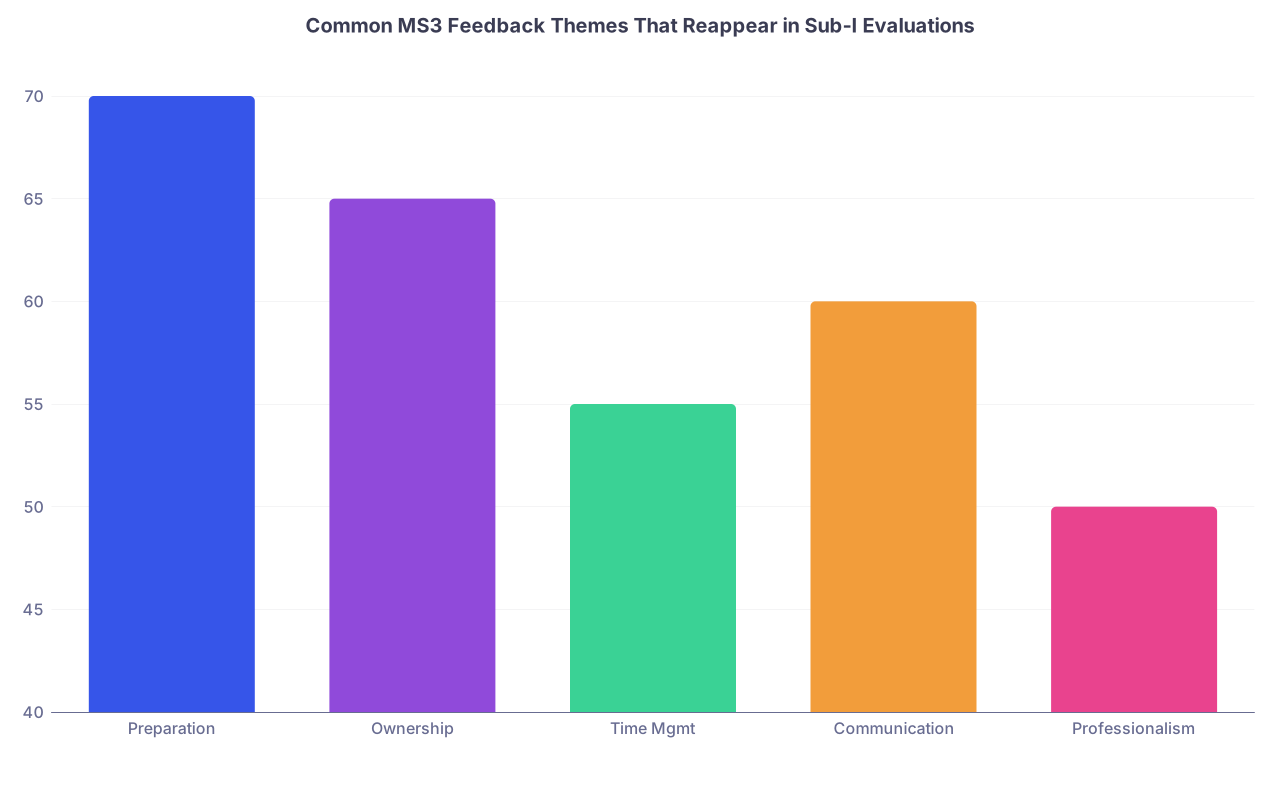
| Category | Value |
|---|---|
| Preparation | 70 |
| Ownership | 65 |
| Time Mgmt | 55 |
| Communication | 60 |
| Professionalism | 50 |
Communication Feedback That Becomes “I Do Not Trust This Person With Patients”
You underestimate how much evaluators read between the lines about your communication. The same comments keep appearing.
5. “Needs to improve patient communication”
On MS3:
- “Could improve in explaining plans to patients”
- “Sometimes uses too much medical jargon”
- “Should work on confidence when speaking with families”
You see it as “bedside manner fluff.” It is not. It is a safety issue.
On sub‑Is:
- “Struggles to clearly communicate plans to patients”
- “May inadvertently confuse patients and families”
- “Needs close supervision when providing updates”
Programs read: “If I leave this person alone, they may mislead patients or create chaos.”
Do not shrug off these signs:
- Nurses re‑explain what you told the patient—correctly
- Families ask, “Wait, what did the doctor say?” after you just “explained”
- Your resident says, “I will go in and clean that up” after you talk to a patient
How to actually improve this:
- The “teach‑back” habit: after explaining, ask, “Can you tell me in your own words what the plan is for today?”
- One‑liner rule: be able to tell a patient their problem and today’s step in one simple sentence
- Ask attendings to watch you: “Can you observe one of my patient explanations today and tell me what to fix?”
You want your sub‑I letter to say, “Communicates clearly and compassionately with patients.” That does not come automatically. It starts with MS3 feedback you take seriously.
6. “Sometimes abrupt with staff” / “Could work better with team”
You probably think you “get along fine with everyone.” You are wrong if you see words like:
- “Could improve interactions with nursing staff”
- “At times seemed frustrated with team”
- “Should work on collegial communication”
That is the polite way to say: “People complained about you, or I saw some behavior I did not like.”
On a sub‑I, that comment becomes more explicit:
- “Concerns about interactions with nursing / ancillary staff”
- “At times dismissive; needs to work on teamwork”
- “Will need close mentoring early in residency regarding team dynamics”
Those lines haunt applications. Programs see “potential problem resident.”
Specific red flags:
- You sigh or eye‑roll when nurses ask questions
- You answer staff with one‑word replies while charting
- You “vent” about nurses or consults loudly at the workstation
- You escalate irritation instead of de‑escalating confusion
How to correct this early:
- Default phrases: “That is a good question, let me check,” and “Thanks for calling about this.”
- Never, ever show frustration in front of patients or families
- If a nurse seems upset with you, do the uncomfortable thing: “I think I may have come off short earlier; that was not my intention. I appreciate you reaching out about the patient.”
You want your letters to contain this sentence: “Nurses and staff speak highly of working with them.” That one line is gold. You earn it in MS3.

The “You Study Hard but Work Soft” Trap
Some of you crush shelf exams and then are genuinely confused when your clinical comments are lukewarm and your sub‑I letters do not sparkle. Let me be blunt: programs do not want the resident who only exists in UWorld.
Look for these patterns in your MS3 narrative comments:
- “Strong fund of knowledge but needs to apply it more at the bedside”
- “Excellent on exams; could be more engaged clinically”
- “At times seemed more focused on studying than team needs”
That is not subtle. They are telling you: “You are great on paper, underwhelming in real life.”
On sub‑Is, that becomes:
- “Academic strengths are clear; however, clinical initiative is limited”
- “Does not yet function at intern level in day‑to‑day work despite strong knowledge base”
Those letters read like backhanded compliments. Programs can smell the student who disappears to “study for Step 2” at 3 pm while others stay and grind with the team.
Do not make this mistake:
- Leaving early at every opportunity “to read”
- Saying “I was going to read about that” instead of just reading about it and returning prepared
- Treating cases as abstract pathophysiology puzzles and ignoring mundane tasks
Shift your mindset: Knowledge is a tool, not the product. The product is patient care and team contribution.
Actionable change:
- Tie every study session to a patient: “I am reading about Mrs. X’s COPD management tonight.”
- The next day, demonstrate it: “I read about inhaler regimen optimization; could we consider stepping down her steroids like this…?”
- Stop using “studying” as your default excuse to vanish. Especially on sub‑Is. Everyone notices.

| Step | Description |
|---|---|
| Step 1 | MS3 Rotation |
| Step 2 | Subtle Narrative Comments |
| Step 3 | Sub-I Higher Expectations |
| Step 4 | Explicit Concerns in Sub-I Letter |
| Step 5 | Program Director Review |
| Step 6 | Lower Rank or No Interview |
The Feedback You Never See But Everyone Talks About
Here is the uncomfortable reality: not all feedback that matters makes it onto your written evals. Residents and attendings talk. A lot. Especially about sub‑Is.
If you are only reading your final grades and not hunting for mid‑rotation feedback, you are missing 80% of what matters.
7. You never explicitly ask, “What is one thing I should change right now?”
Students who get better do one thing differently. They force people to be honest with them before it is too late.
On MS3, if you just float through waiting for formal evals:
- Residents stick to generic comments
- Attendings “do not want to crush a student’s confidence”
- Small issues stay small…until they repeat on your sub‑Is
Smart students corner people (politely) and ask:
- “Is there anything I am doing that would stop you from giving me your strongest possible letter?”
- “If I were starting as an intern tomorrow, what would worry you the most about me?”
- “What is one behavior I should change this week?”
Yes, it is uncomfortable. Yes, you may hear things you do not like. That is the point. Better from one attending in April than written down forever in your sub‑I letter in October.

Using MS3 Feedback Strategically Before Sub‑Is and Residency Apps
Here is how to turn all this around instead of feeling attacked.
Step 1: Audit your MS3 comments honestly
Sit down with all your written feedback. Do not look at grades. Look at phrases. Make a simple table.
| Domain | MS3 Comments Pattern | Risk Level for Sub-I | Priority to Fix |
|---|---|---|---|
| Preparation | “Could be more prepared” | High | High |
| Ownership | “Quiet but pleasant” | High | High |
| Time Management | “Occasionally late notes” | Medium | Medium |
| Communication | “Needs clearer explanations” | High | High |
| Professionalism | “Sometimes defensive” | Critical | Critical |
If the same theme appears on more than one rotation, that is not a fluke. That is your pattern.
Step 2: Pick 1–2 themes to actively fix per rotation
Do not try to fix everything at once. You will do nothing well.
Example:
- On medicine sub‑I: focus on preparation and ownership
- On surgery sub‑I: focus on professionalism and communication with staff
Tell your senior on day 1:
“I have gotten feedback that I can be too quiet and not take enough ownership; I want to specifically work on that this month. If you see me falling into that pattern, please call me out.”
That shows insight. It makes people root for you. And when they see real change, they write about it.
Step 3: Make sure your improvement gets reflected in writing
Improvement that no one documents does not help you.
Close the loop in the last week:
- “At the start of the month I mentioned I was working on X. Have you seen improvement? Is there anything I still need to adjust?”
- If they say yes, gently: “If you are comfortable, it would really help me if you could mention that improvement in your evaluation, since I am applying in this specialty.”
Not every attending will. Enough will that your narrative shifts from “has issues” to “is coachable and improved quickly.”
Programs love that second story.
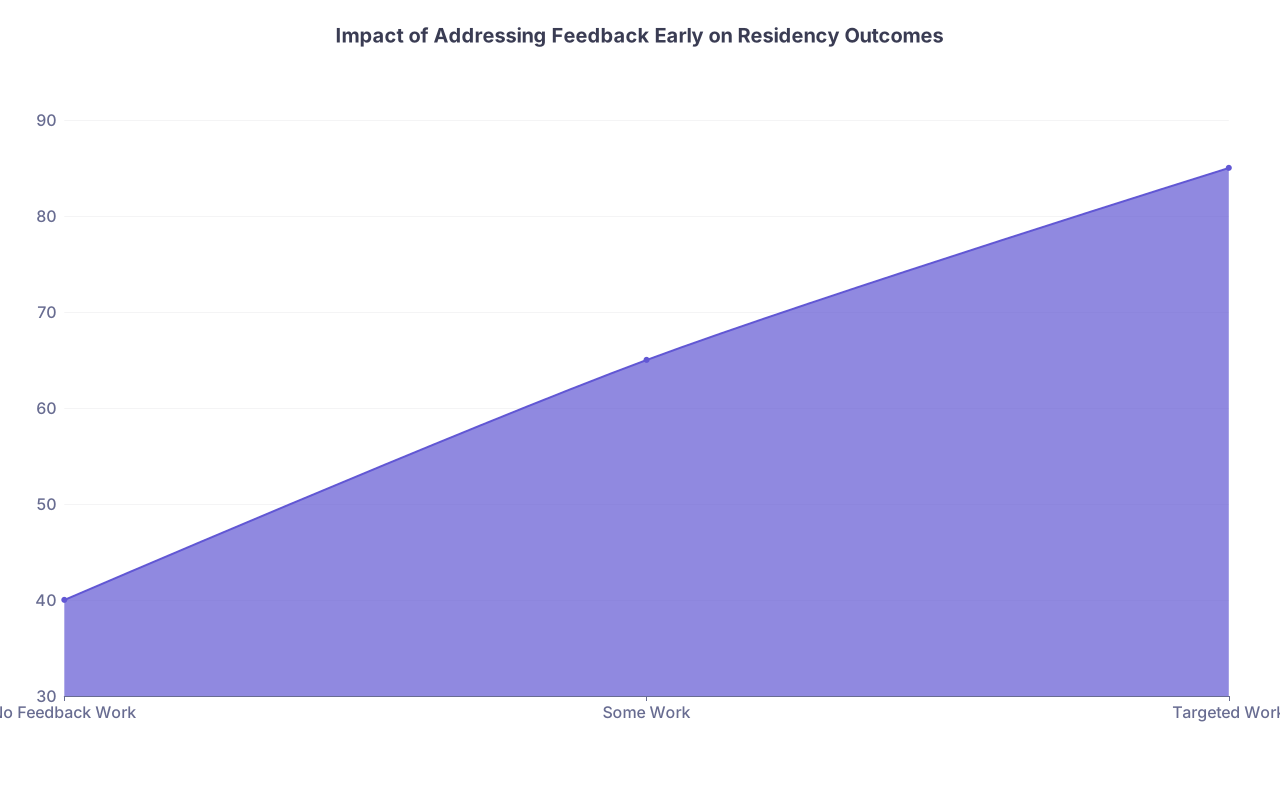
| Category | Value |
|---|---|
| No Feedback Work | 40 |
| Some Work | 65 |
| Targeted Work | 85 |
FAQ (Read These Before You Rationalize Anything)
1. “My grades are mostly Honors and High Pass. Do these little comments really matter?”
Yes. Program directors have said this out loud in meetings: “Everyone we are looking at has strong grades. The narratives and letters decide the order.” A single line like “struggles with feedback” or “concern about time management at intern level” can drop you below a similarly qualified applicant with cleaner comments. Honors with toxic narrative text is worse than High Pass with strong, specific praise.
2. “What if the feedback feels unfair or based on one bad day?”
Sometimes it is. People are biased, moody, and inconsistent. But your response is what gets remembered. If you hear something that feels unfair, do not fight in the moment. Ask for specific examples, reflect, and improve anything even partially valid. If a true misunderstanding occurred (e.g., they thought you left early without permission when you actually checked out), calmly clarify once. Do not launch a crusade. On sub‑Is and residency, how you handle “unfairness” is half the evaluation.
3. “I changed a lot after MS3, but my early comments look bad. Am I doomed?”
No, but you cannot hope people just ignore them. You need a clear story of growth. That means:
- Later rotations and sub‑Is that explicitly say “improved markedly in X”
- A personal statement or interview answer that speaks to learning from early feedback and changing behavior
- Letter writers who can vouch for the new version of you
Programs forgive early missteps when the trajectory is upward and believable. They do not forgive the same complaint repeated across two years.
4. “If I ask for feedback directly, will I look insecure or needy?”
You will look like an adult. The only time it backfires is if you ask and then argue, ignore, or visibly sulk. Ask once or twice a rotation in a focused way. Example: “I am working on being more efficient with notes; have you seen any progress, or is there something specific I should change?” That reads as self‑aware and serious about development. The students who never ask usually get surprised by negative patterns too late to correct them.
Key points to walk away with:
- The “small” MS3 feedback you are ignoring is exactly what gets magnified on sub‑Is and in residency letters. Patterns, not grades, decide a lot of rank lists.
- Defensiveness, weak ownership, and soft professionalism problems are far more dangerous than a shaky knowledge gap—and they are clearly flagged in your evaluations if you bother to read them honestly.
- Treat every rotation as a live experiment: identify your patterns, pick 1–2 behaviors to change, ask for real feedback, and make sure your improvement is visible and documented before you ever set foot on a sub‑I.