Program directors are not afraid of your Step score. They are afraid of your professionalism.
They can remediate knowledge. They cannot babysit behavior. And your clerkship year is where they decide which bucket you belong in.
I am going to walk you through the specific professionalism slips that quietly kill applications. The things attendings mention in “off the record” emails. The patterns that turn “strong candidate” into “do not rank” in under a minute.
You are not competing just on grades and scores. You are competing on: “Would I trust this person alone with my patients at 2 a.m.?” Every move on clerkships either builds that trust—or erodes it.
Let’s make sure you do not get quietly blacklisted.
1. The Attendance and Reliability Traps
Most students think “professionalism” means being nice and not yelling at nurses. That is the bare minimum. Where people really get burned is reliability. The boring stuff.
Chronic Tardiness (Even 5–10 Minutes)
The most common, most underestimated red flag.
A student rolls into sign-out at 6:45 when everyone else is there at 6:30. “Sorry, traffic.” “Parking took forever.” “The shuttle was late.” I have heard all of it. So have PDs.
One late day does not tank you. A pattern does. And attendings do keep mental score:
- Late to pre-rounds.
- Late to OR starts.
- Late to clinic sessions.
- Logging on late to required virtual conferences.
Eventually someone says during your evaluation: “Great with patients, but frequently late and not dependable with start times.”
That one sentence is poison in a dean’s letter.
Do not make the mistake of thinking your peers do not notice. They do. And they talk—especially when they are picking who gets the good procedures or letters.
The “Soft Absence” Problem
You know the move: “Can I leave early today? I finished my notes.” Or mysteriously needing “appointments” more frequently than others.
Examples I have actually seen:
- A student leaving the OR early “because I was told students can go at 3,” while everyone else stays until cases finish.
- Someone regularly disappearing from clinic under the pretext of “working on notes” but is really scrolling on their phone in the lounge.
- Students who are technically “present” but miss every teaching session because they are “helping with discharges” no one asked them to do.
These patterns show up in comments as:
- “Often not present when needed.”
- “Hard to find on the floors.”
- “Not always engaged in patient care.”
All of which translate loosely to: “I would not trust this person as an intern.”
Sick Call That Smells Wrong
You are allowed to be sick. You should stay home if you are truly ill.
The problem is the pattern: absent or calling out on…
- Post-call teaching days.
- Friday afternoons.
- The day of a big exam on another rotation.
- The morning after a known big party.
Residents are not stupid. PDs are even less forgiving. A single poor judgment day here can brand you as unreliable.
How to avoid this category of mistakes:
- Show up 10–15 minutes earlier than the person who is supposed to be “first.” Consistently.
- If you have a real conflict (appointment, interview, family issue), notify early, document it, and do not lie.
- When you are on service, be on service. Not “around.”
2. Documentation and EMR Conduct That Gets You Flagged
You can destroy your reputation from a computer terminal faster than from a patient’s bedside.
Copy-Paste Without Thought
The fastest path to a professionalism incident report is lazy charting.
Common dangerous behaviors:
- Copying yesterday’s note—still saying “no chest pain” even though the patient was transferred to telemetry for chest pain overnight.
- Carrying forward old physical exam findings when you did not actually re-examine the system.
- Copying another student’s or resident’s note as your own.
This is not just “sloppy.” It is a patient safety issue. And PDs care far more about patient safety than whether you got honors.
When attendings see “Exam: clear lungs” on a patient with new crackles and rising oxygen needs, they do not think “Oh, the student is busy.” They think: “This person is unsafe and careless.”
Documenting Things You Did Not Do
This is where “unprofessional” edges toward “dishonest.”
Concrete red flags:
- Saying “reviewed prior records” when you never opened them.
- Writing “discussed risks and benefits” when you were not in the room, and the attending led the full consent.
- Documenting parts of a physical exam you did not perform because “that is what a full exam looks like.”
You might think everyone does this. They do not. And people get reported for it.
Once a faculty writes “concern for integrity” or “questions about honesty” in your file, you are in deep trouble. Schools are required to report significant professionalism concerns in the MSPE. And yes, PDs read that paragraph first.
Mishandling Sensitive Information
I have watched multiple students walk up to a nurses’ station computer, open a chart of someone not on their team “because it was interesting,” and chat about it. Bad move.
HIPAA violations that really happen:
- Opening ex-partners’ or friends’ charts “just to see.”
- Talking about “that crazy case with the gunshot wound” in a crowded elevator with full details.
- Printing patient lists and leaving them in a cafeteria.
- Using real patient names in group texts or sharing screenshots of EMR pages.
Schools protect themselves. They do not protect you. A single HIPAA complaint can trigger mandatory reporting language that PDs cannot ignore.
Avoiding EMR-related disasters:
- Only chart what you personally did, saw, or confirmed.
- Read your own note like an attending who has never met the patient. Does it match reality?
- Do not open charts for curiosity. Ever.
- Assume every EMR click and access is logged. Because it is.
3. Team Behavior That Quietly Destroys Your Reputation
Most PDs are not worried about the student with a weak neuro exam. They are worried about the student that residents hate working with.
Acting Like You Are “Above” the Work
Classic student mistake: deciding some tasks are “beneath” you.
I have watched students:
- Refuse to call a consultant because “I thought that was the intern’s job.”
- Complain about “scut” when asked to transport a patient or track down an outside record.
- Stand at the nurses’ station scrolling on their phone while residents are drowning in discharges.
Word for word, I have heard a senior resident say during ranking: “I do not care what his Step score is. He never lifted a finger to help. I would rather be short an intern than work with him.”
That is how fast it happens.
Being Argumentative or Defensive with Feedback
You will get feedback you disagree with. You may even get feedback that is unfair.
The mistake is turning it into a debate every time.
Red-flag reactions I have seen:
- “Well, I actually did that, you just did not see it.”
- “At my last rotation, they told me to do it this other way.”
- Heavy sighs, eye-rolling, or visible irritation when corrected in front of the team.
- Sending long defensive emails after evals are submitted.
Residents and attendings have limited patience. If they feel you cannot take correction, they stop giving you chances. And they write it down:
- “Defensive with feedback.”
- “Argues about instructions.”
- “Difficult to coach.”
Those phrases stay with you.
Gossiping and Triangulation
The fastest way to be labeled “toxic” is to complain laterally and upwards.
Examples:
- Trash-talking one resident to another.
- Telling your attending about conflicts with residents in a way that makes you look like the reasonable one and them incompetent.
- Repeating confidential complaints another student told you about a faculty member.
- Making jokes about nurses, subspecialties, or certain patient groups.
People will laugh with you in real time. Then they will describe you later as “unprofessional” or “lacking maturity.”
How to stay on the right side of the team:
- Default to helping with unglamorous tasks. That is what interns do. You are auditioning for that role.
- When corrected, your response should be some version of: “Got it. I’ll adjust.” Then prove it the next day.
- If there is a real conflict, discuss it privately and calmly with a trusted faculty or clerkship director—not as gossip, but as a problem-solving conversation.
4. Patient Interaction Violations That Scare PDs
This is where PDs get truly alarmed. You can be mediocre on rounds and still get a decent letter. You mishandle patients, and people remember.
Overstepping Your Role
Students sometimes get too enthusiastic. That enthusiasm can cross into unsafe territory quickly.
I have seen:
- Students giving prognosis or treatment recommendations (“You probably have cancer but the biopsy will confirm it”) before an attending has spoken to the patient.
- Trying to “clarify” things the attending said but accidentally contradicting the plan.
- Telling a patient they are “ready to go home” before discharge is finalized.
- Offering guarantees: “You will definitely feel better after this surgery.”
Patients then complain: “But the medical student told me X.” Now the attending has to clean that up and explain why someone without a license was making promises.
This is the kind of story attendings share with PDs when they are deciding how seriously to take your letter.
Poor Boundaries and Over-Familiarity
You are not their friend. You are not their therapist. You are not their social media contact.
Unprofessional boundary slips:
- Accepting friend requests from patients or their family members during or after the admission.
- Sharing personal life stories in vivid detail (relationship drama, party stories, finances).
- Letting conversations drift into politics, religion, or intimate personal beliefs in a way that makes patients uncomfortable.
- Giving patients your personal phone number for “updates.”
Faculty notice. Nurses notice. They report when things feel off.
Judging or Mocking Patients
Even if you think you are whispering at the doorway, someone hears you.
Red-flag behavior:
- Making jokes about patient weight, hygiene, psychiatric conditions, or substance use with classmates.
- Rolling your eyes when a “frequent flyer” is admitted again.
- Calling someone “drug-seeking” or “noncompliant” loudly at the nurses’ station.
- Groaning when a certain room number appears on the new admit list.
This is the opposite of professionalism. It is also the kind of thing that can show up in 360-degree feedback from nursing or staff.
How to protect yourself with patient interactions:
- Do not deliver bad news or discuss prognosis without explicit attending direction.
- Keep your role clear to patients: “I am a medical student working with Dr. X.”
- Vent about difficult cases outside the hospital, in private, with de-identified details—or better yet, with a therapist or mentor, not in public hallways.
5. Digital Footprints and Social Media Missteps
PDs search names. Residents search names. Do not kid yourself.
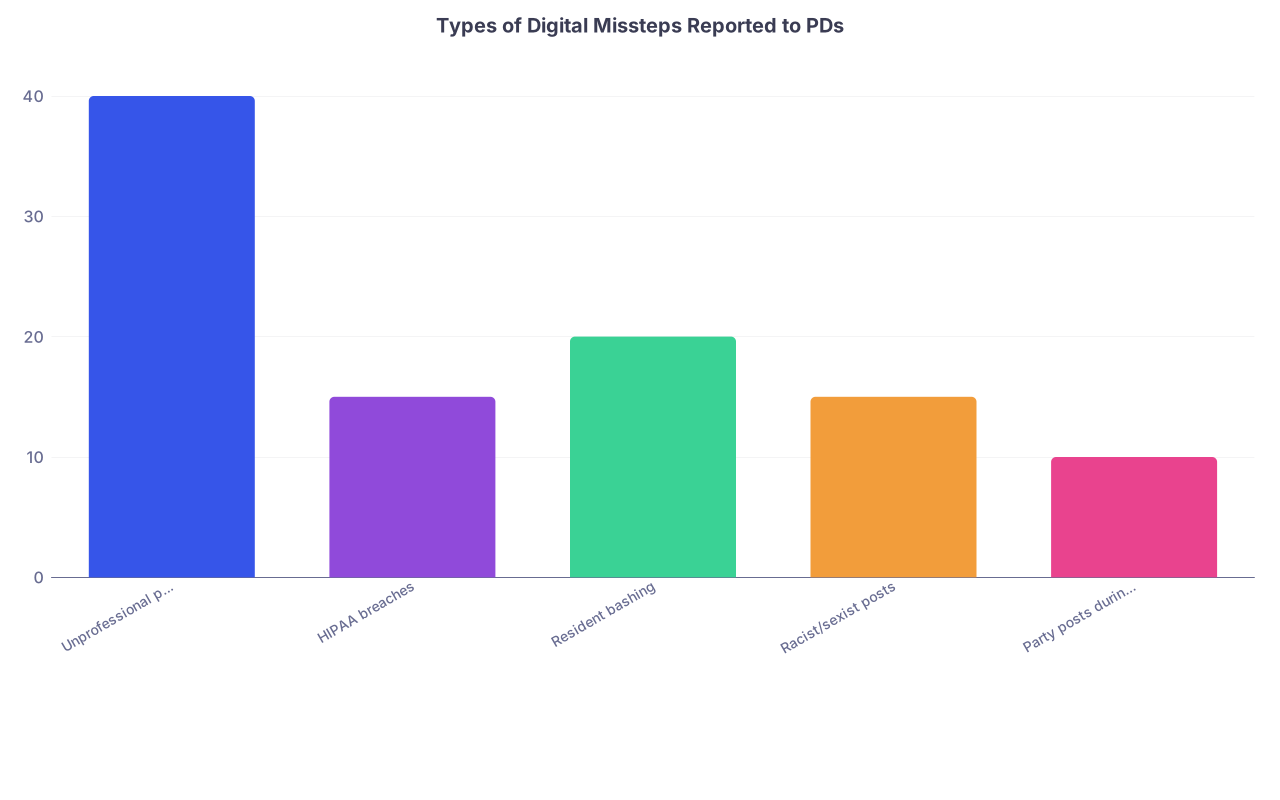
| Category | Value |
|---|---|
| Unprofessional photos | 40 |
| HIPAA breaches | 15 |
| Resident bashing | 20 |
| Racist/sexist posts | 15 |
| Party posts during rotation | 10 |
Posting During Work Hours
Nothing looks worse than a timestamp.
You told the team you left early because you were sick, then your Instagram story shows you at a concert that night.
You are “in the OR” but there is a real-time post from the hospital bathroom with a caption about how bored you are.
Residents see this. Some shrug. Some screenshot. You do not know which type you are working with.
Sharing Hospital Content
Big mistake:
- Photos in patient care areas with monitors, charts, or even just recognizable layout in the background.
- Posting about “the crazy trauma I saw tonight” with enough detail that someone could identify the case.
- Taking TikToks in scrubs in ICU hallways.
Hospitals care about their image and liability far more than your social media presence. Any complaint about an “influencer” med student on their unit will be taken seriously.
Publicly Trashing Programs or Colleagues
I have seen students tweet:
- “Another day with my useless attending who never teaches.”
- “If I have to work with [subspecialty] again I might drop out.”
- Screenshots of passive-aggressive patient portal messages with mocking captions.
You might assume nobody from your institution follows you. You are wrong.
One forwarded post to a clerkship director can trigger a chain of conversations that ends in a formal professionalism write-up.
Safe rules:
- Assume your PD, dean, and every attending can see everything you post.
- If you would be embarrassed to see your post read aloud in a rank meeting, do not post it.
- Lock your accounts, but still behave as if they are public. Privacy settings fail. Screenshots do not.
6. Communication Failures That Worry PDs
Most dangerous errors on clerkships boil down to this: you did not communicate when you should have.

| Step | Description |
|---|---|
| Step 1 | Notice new concerning symptom or vital sign |
| Step 2 | Notify resident immediately |
| Step 3 | Document and mention on rounds |
| Step 4 | Is this clearly expected and documented? |
| Step 5 | Any doubt or worsening? |
Sitting on Critical Information
I have personally seen a student:
- Hear a patient say, “I feel more short of breath than yesterday,” then wait to mention it on rounds 2 hours later.
- Notice a blood pressure of 80/40 on the monitor and say nothing because “the nurse probably knows.”
- Read a lab of K+ 6.2 and assume, “They must be working on it.”
When this comes out later, faculty are blunt: “That shows poor judgment. They do not yet grasp urgency.” PDs do not want interns who hesitate when patients are unstable.
Sloppy Handoffs
If you take ownership of any task—calling family, following up a lab, arranging imaging—you are responsible for closing the loop or handing it off clearly.
Common student errors:
- “I think someone is calling the family” when asked who is updating them.
- Forgetting to mention that a critical test is pending and needs follow-up that evening.
- Failing to communicate that a consultant never actually saw the patient.
Even as a student, you can be the weak link that almost causes a miss. And that sticks in people’s minds.
Unclear or Inappropriate Paging/Texting
Some students treat paging like texting. It is not.
Red-flag behaviors:
- Sending multiple pages in rapid succession for non-urgent issues.
- Writing vague messages: “Call about pt” with no details.
- Paging the attending directly for minor questions because you are nervous to ask the resident first.
- Using unsecured text or group chats to share PHI.
Residents remember which students blew up their pager at 2 a.m. for Tylenol orders.
To avoid communication red flags:
- When in doubt about patient safety, escalate immediately. You will never be punished for calling too early in good faith. Waiting too long is what gets mentioned.
- If you own a task, either complete it and document it, or clearly hand it off to someone by name.
- Learn your team’s paging/texting norms the first day. Ask explicitly how they want to be contacted and for what.
7. The Hidden Professionalism File: How PDs Actually Hear About You
You may think it all comes down to your grade and one write-up. It does not.
PDs see:
- MSPE professionalism paragraph.
- Coded language in clerkship comments.
- Off-the-record calls from faculty they trust.
| Comment Phrase | How PDs Often Interpret It |
|---|---|
| "Requires close supervision" | Questionable judgment / unsafe |
| "Can be defensive with feedback" | Difficult to teach / coach |
| "Not always reliable with follow-up" | Potential patient safety risk |
| "Sometimes late and disorganized" | Poor work ethic / time management |
| "Better suited to non-clinical work" | Do not rank for demanding fields |
You will never see some of the conversations that really decide your fate.
Typical scenario:
- PD: “We are considering [Your Name] for an interview. How were they on your service?”
- Faculty: “Smart. But we had a couple of professionalism issues—lateness, some documentation concerns. I would be cautious.”
That single “I would be cautious” can move you from “invite” to “reject” pile in seconds—even with a strong application.
On the flip side, the student who is relentlessly reliable, humble, and easy to work with gets described as:
- “Someone you can trust at 3 a.m.”
- “Would be an asset to any program.”
Those phrases get you interviews even if your transcript is not perfect.
8. How to Build a Professionalism Reputation That Helps You Match
You are not aiming for “no major incidents.” That is too low a bar. You want attendings to remember you as safe, dependable, and low-drama.
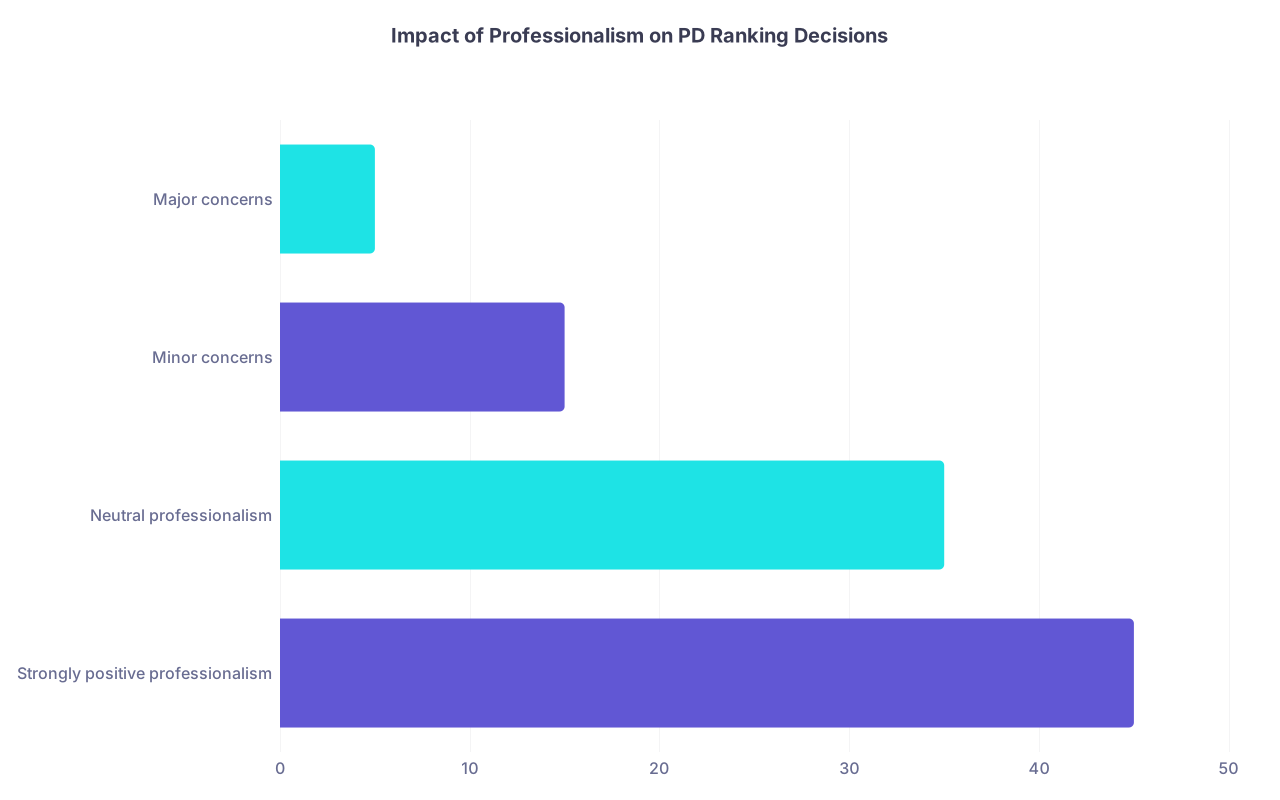
| Category | Value |
|---|---|
| Strongly positive professionalism | 45 |
| Neutral professionalism | 35 |
| Minor concerns | 15 |
| Major concerns | 5 |
Small Daily Habits That Pay Off
- Be early. Every day. For everything.
- Volunteer for unglamorous work without rolling your eyes.
- Close the loop: if you say you will do something, do it, and tell the team when it is done.
- Own your mistakes quickly: “I missed that lab result. I have it now, here is what it shows.”
How to Recover from a Slip
You will mess up at some point. Everyone does. The mistake is trying to hide it.
If you have a lapse (late without a good excuse, awkward patient interaction, sloppy charting), do three things:
- Acknowledge it clearly: “Yesterday I was late and that was unprofessional.”
- Take corrective action: change your routine, set multiple alarms, ask for guidance.
- Demonstrate a new pattern. Faculty forgive isolated incidents. They do not forgive repeated ones.

Protecting Yourself Proactively
- If you sense a faculty member or resident is unhappy with you, ask directly, professionally: “I would appreciate any feedback about how I can be more effective on the team.”
- If you make or suspect you made a documentation or boundary error, bring it up early to someone you trust instead of hoping nobody notices.
- Keep your digital life clean and boring during rotations. Save the loud opinions and edgy jokes for private, non–medicine spaces—ideally after you match.

Bottom Line
Three things to remember:
- PDs fear professionalism problems more than imperfect knowledge. Reliability, honesty, and judgment are what they are screening for during clerkships.
- The biggest career-threatening mistakes are usually small repeated lapses: lateness, sloppy documentation, poor communication, loose boundaries, and unprofessional digital footprints.
- You cannot fake professionalism in bursts. It is built through boring, consistent behavior that makes residents and faculty say: “I would trust this person with my patients and my team.”