
The way students think about “Pass vs High Pass” is broken. And it quietly ruins otherwise strong residency applications every single year.
If you are treating clerkship grading like a mysterious black box that will “work out,” you are handing away control of one of the few levers you actually have in medical school. Especially during core clerkships that programs care about.
Let me be direct: you can avoid most grading disasters. But only if you stop making the same predictable mistakes everyone before you made.
The Myth That “A Pass Is Fine” For Clerkships
I keep hearing the same confident nonsense from third-years in July:
- “Our school is really pass-heavy. Programs know that.”
- “Step 1 is pass/fail now, they care more about narrative comments.”
- “I will just crush Step 2 and it will balance out.”
This is how people sleepwalk into a transcript full of “Pass” in core rotations and then panic in September of M4 when they realize competitive programs are quietly screening them out.
Here is the part students underestimate: the Pass vs High Pass vs Honors ratio heavily shapes your relative rank at your school. And programs look at you in context.
They do not only see “P” and “HP.” They see the MSPE language: “Student performed below the mean in the clerkship cohort” or “Student’s clinical performance was in the upper third of the class.”
Pass-heavy or not, your school knows who rose to the top of that grading system. And they tell residency programs.
The mistake is not “getting a Pass.” The mistake is:
- not understanding how often you can “afford” to get a Pass in your specialty of interest, and
- not realizing early enough that you are drifting below your peer group.
Here is how this bites people:
You are interested in EM. You pass Medicine, High Pass Psych, Pass OB, High Pass Surgery, Pass Peds, Pass EM. You tell yourself, “It’s okay, our grading is tough.” Then your advisor quietly tells you in August: “You are in the lower half of your class for clinical performance.” And all the EM programs that care about your rank list and core clerkships have already pre-filtered you into the “unlikely to interview” bucket.
Preventable.
How Clerkship Grades Actually Get Decided (And Where Students Blow It)
If you still think your grade is “just the shelf score,” you are dangerously misinformed.
Most schools use some variation of this formula:
| Component | Weight (%) |
|---|---|
| Clinical evaluations | 50–60 |
| Shelf/subject exam | 30–40 |
| OSCE / practical | 5–15 |
| Professionalism / admin | 5–10 |
The weight shifts by school and by clerkship, but the pattern is the same: your day-to-day behavior, reliability, and how you are perceived matter more than raw test performance.
Mistake 1: Treating the Shelf as the Only Thing That Counts
Students love numbers. They trust NBME percentiles. They do not trust subjective evaluations, so they pretend those matter less.
I have watched students be top 10% on the shelf and still get a Pass because they:
- annoyed every intern by disappearing at 4 p.m. every day,
- never closed the loop on tasks, or
- were “fine but invisible” the entire rotation.
Your goal is not to be the smartest. It is to be the easiest student to work with who also knows enough medicine.
What you must avoid:
- Ignoring feedback because “I am killing the shelf.”
- Skipping clinic or post-call teaching to “go study,” without clearing it with the team.
- Being the student who is technically good but emotionally exhausting to supervise.
Mistake 2: Letting One Bad Day Define Your Evaluation
Clinical grades are usually an average of multiple evaluators. But here is the trap: one or two people often dominate the narrative comments. And narrative comments drive the final box checked.
I have seen this play out:
- Student has one awkward interaction with a senior resident on week one.
- They get labeled “disengaged” or “low initiative.”
- That senior fills out an evaluation early and strongly.
- Final grade: “Pass – met expectations.”
You cannot control every personality clash. But you can reduce the damage:
- Identify early who is likely writing your main evaluation (attending, senior resident, clerkship director).
- Ask them directly, mid-rotation, “How am I doing compared to what you expect for a strong High Pass or Honors performance?”
Students avoid this question because they fear bad news. So they get the real news written in the evaluation summary instead—when nothing can be changed.
Pass vs High Pass vs Honors: What Programs Actually Care About
Not every program dissects your grade distribution. The competitive ones do. The ones you actually want? Definitely.
Here is where people make dangerously naïve assumptions.
The Pattern That Hurts You
For core clerkships (Medicine, Surgery, Pediatrics, OB/GYN, Psych, sometimes EM or Family), the pattern programs notice most:
- Honors/HP clustered in one “easy” clerkship and Pass in everything else.
- A downtrend: early Honors, then increasingly Pass once you get “tired.”
- Obvious misalignment with stated interest: You say you love medicine, but you got Pass in Medicine and OB, and your only Honors is in Psychiatry.
Programs do not expect string-of-Honors perfection. They do expect coherence.
If you are applying Internal Medicine and your MSPE shows:
Medicine: HP, Surgery: P, Peds: HP, OB: P, Psych: HP, EM: HP
You are fine. Mixed but strong.
If it shows:
Medicine: P, Surgery: P, Peds: P, OB: P, Psych: H, EM: P
You have a problem. And it is obvious what it looks like: “Liked one clerkship, mailed in the rest.”
How This Interacts With Step 2
Programs are increasingly using Step 2 as the objective anchor now that Step 1 is pass/fail.
Look at it this way:
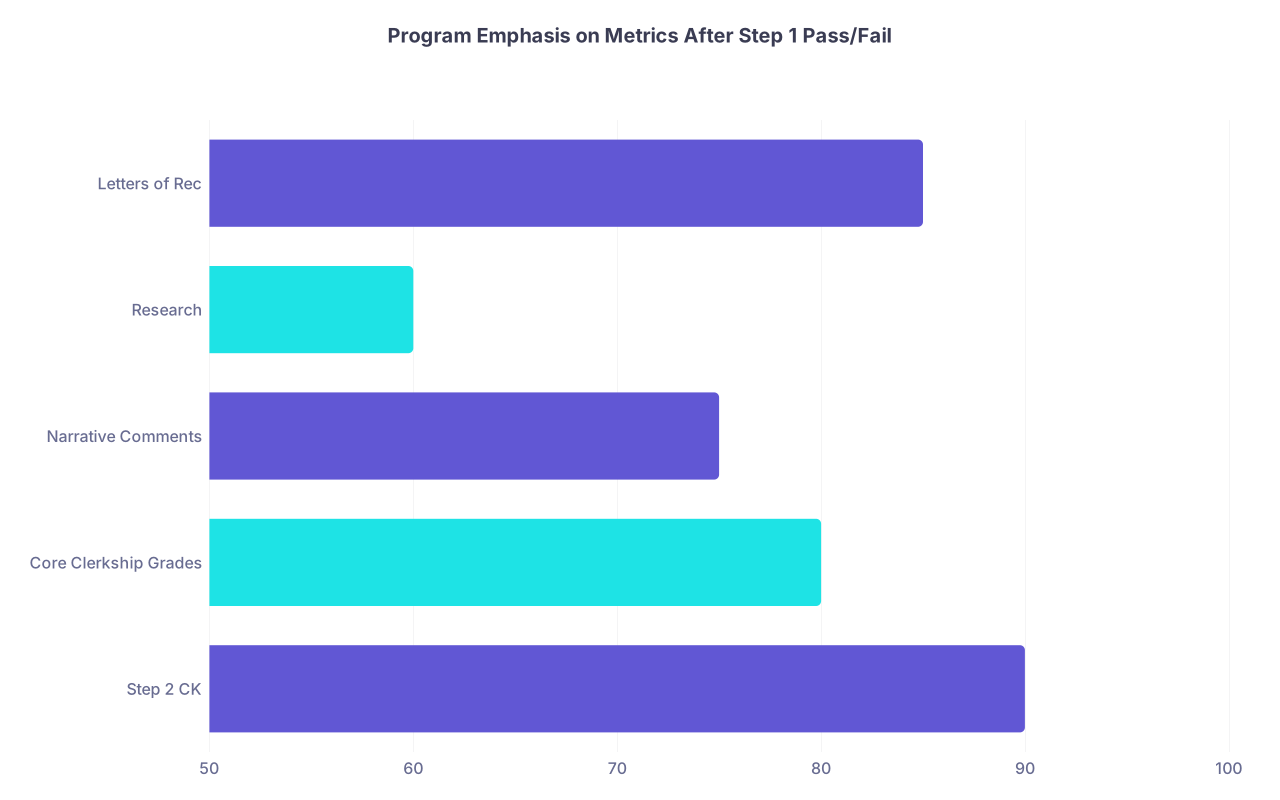
| Category | Value |
|---|---|
| Step 2 CK | 90 |
| Core Clerkship Grades | 80 |
| Narrative Comments | 75 |
| Research | 60 |
| Letters of Rec | 85 |
If:
- Step 2 is strong (≥ 245–250),
- core grades show High Pass/Honors sprinkled across rotations, and
- narratives talk about initiative and ownership,
you are easy to rank.
If Step 2 is mediocre and clerkship grades are mostly Pass without a clear “uptick” story, programs start asking: where is the evidence this person can push themselves?
Specialty-Specific Landmines With Pass vs High Pass
The mistake students make is assuming all specialties read Pass vs High Pass the same way.
They do not.
Competitive Fields (Derm, Ortho, ENT, Plastics, Rad Onc, Neurosurgery)
Here is the blunt reality: if you are aiming for these and your core clerkships are a wall of Pass, you are already in salvage mode. It is not impossible, but the path narrows.
Typical expectations for a realistic shot at strong programs:
| Specialty | Ideal Core Grade Pattern |
|---|---|
| Derm | Majority HP/Honors, esp. Medicine/Peds |
| Ortho | HP/Honors in Surgery, Medicine |
| ENT | HP/Honors in Surgery, Medicine, EM |
| Plastics | HP/Honors in Surgery, EM |
| Neurosurg | HP/Honors in Surgery, Medicine |
Fatal mistake: deciding on these specialties late, after you already racked up a series of Passes in the core rotations those specialties care about most.
So you end up explaining: “I got serious later,” to committees that have hundreds of applicants who were “serious” from day one.
Middle-Competitiveness Fields (EM, Anesthesia, OB/GYN, Gen Surg, Radiology)
These programs usually care about:
- A clean pattern: mostly HP with a few Passes, or a mix with a clear upward trajectory.
- No glaring fail or remediation.
- Strong letters that match the grade (no “Pass” with a glowing “top 10% ever” letter – that contradiction raises eyebrows).
You can absolutely match these with a mixed P/HP profile. The mistake is thinking they will not notice where the weak spots are.
Examples that hurt:
- EM applicant with Pass in EM and weak narrative like “met expectations, quiet on shift.”
- Anesthesia applicant with Pass in Medicine and OB, where peri-op management shows up.
- Surgery applicant with Pass in Surgery and narrative emphasizing “hesitant in the OR.”
Less-Competitive Fields (FM, Psych, Peds at community programs)
You have the most flexibility here. But do not get cocky.
I have seen students aiming for Family Medicine who assumed “anyone can match FM” and then applied only to high-end academic programs with:
- multiple remediated clerkships,
- mostly Pass with lukewarm comments, and
- modest Step 2 scores.
They got hurt.
You avoid trouble in these fields by:
- Preventing disasters (no fails, no professionalism issues),
- Avoiding a pattern of being one of the weakest evaluators in every core, and
- Not overshooting with your program list based on faulty assumptions.
The Preventable Grading Mistakes I See Every Single Year
If you want to stay out of trouble, pay attention to this list. These are not rare. They are routine.
1. Never Asking How Grades Are Assigned Until It Is Too Late
You would be shocked how many M3s cannot answer: “What percentage of Honors is allowed on this clerkship?” Or: “Is the shelf required to be above a certain percentile for High Pass?”
Different schools use wildly different systems:
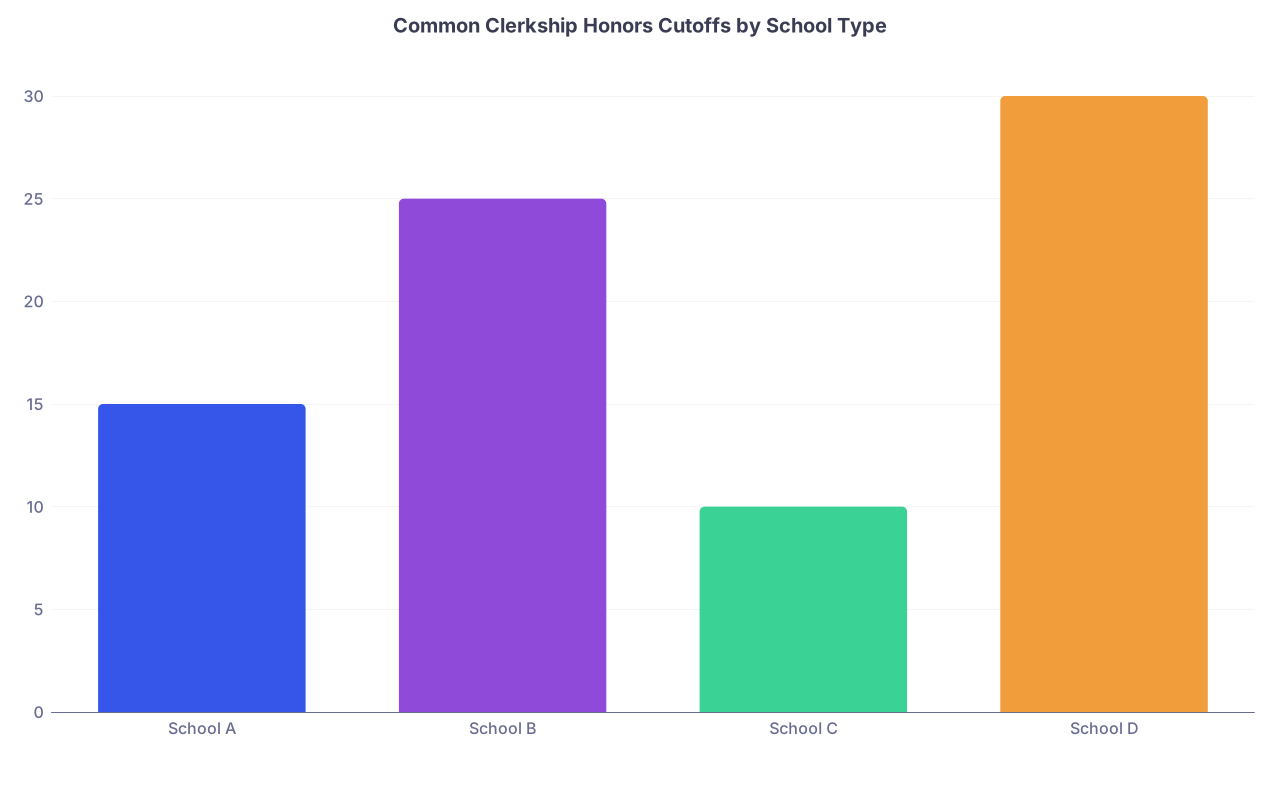
| Category | Value |
|---|---|
| School A | 15 |
| School B | 25 |
| School C | 10 |
| School D | 30 |
If you do not know:
- the max proportion of Honors allowed,
- whether clinical or shelf is the gatekeeper, and
- how narratives are translated into “HP vs P,”
you are playing blind.
Fix this in week one. Not week seven. Ask your clerkship coordinator or a trusted upperclassman for the real rules, not the vague orientation slide.
2. Ignoring Weak Early Feedback Because “I Just Need to Warm Up”
On almost every rotation, there is a mid-rotation feedback session, formal or informal. It often sounds soft:
- “You could be more proactive.”
- “You are doing fine, but you could speak up more.”
- “Try to read around your patients a bit more.”
Students hear: “You are not failing.”
What the evaluator is actually saying: “Right now you are on track for a Pass.”
The people who fix this:
- Ask explicitly: “What would I need to be doing to be in the High Pass or Honors range?”
- Then mirror it back: “So if I present more patients, read nightly on my top 2 problems, and pre-chart for tomorrow’s list, that would move me toward HP?”
You avoid the trap of vague feedback by forcing it into a concrete plan.
The ones who do not? They shrug, keep doing the same thing, and are “surprised” by the final grade.
3. Being Overly Tactical With “Easier” Clerkships
This one is subtle.
Students hear from upperclassmen: “Psych is easy Honors. OB is brutal for Honors.” So they:
- Coast in psych, because they assume the curve will carry them.
- Accept a mediocre evaluation because “everyone gets Honors.”
Then their psych eval comes back: “Pleasant but somewhat disengaged. Completed tasks when asked.” Translation in many systems: High Pass or Pass, not Honors.
You do not sandbag the “easy” clerkships. You exploit them. You overperform where others under-try. That is how you accumulate the HP/Honors pattern that later buys you forgiveness for one or two Passes on tougher services.
How This Shows Up In The MSPE (Dean’s Letter) And Hurts Your Match
Too many students think: “The MSPE is just a compilation of my grades.” No. It is also a compilation of patterns and coded language.
Every October, I watch students read their MSPEs for the first time and realize what programs have been seeing for weeks. The surprises are usually not pleasant.
Common MSPE landmines:
“Student met expectations on all core clerkships, performing competently at the expected level.”
Sounds neutral. Reads like: “middle of the pack.”“Student’s performance was solid, with growth noted over the course of the year.”
Translation: struggled early, not top tier.“Student required additional coaching around time management and follow-through.”
Programs see: reliability concerns.
If you see phrases like:
- “below the mean,”
- “required remediation,”
- “needed frequent redirection,”
you have real damage control to do.
The mistake is pretending that one Pass in Medicine with “needed frequent redirection” will be invisible when you apply to IM. It will not.
Your job is to not let that language be a surprise. Ask early:
- “Will any of my clerkship performance be flagged as below expectations in the MSPE?”
- “Based on my grades so far, where do I likely fall in my class’s clinical performance distribution?”
Fast? No. Comfortable? Also no. But avoiding those questions does not make the problems disappear. It just delays when you hear about them—after programs already have.
Salvage and Strategy: If You Already Have More Passes Than You Wanted
Let us say you are reading this with:
- 4–5 core clerkships done,
- mostly Pass with maybe 1 HP,
- and a creeping sense of dread.
Is the game over? No. But you must stop making fantasy plans.
Here is what to avoid and what to do.
Avoid These Fantasy Moves
“I will just apply Derm/Ortho anyway and hope my letters carry me.”
They will not. These specialties swim in applicants with HP/Honors walls.“I will not apply community programs because I want ‘academic or bust’.”
That is how people scramble unmatched with a transcript that would have matched well at several solid community or mid-tier academic places.“I’ll fix it later with a research year.”
A research year can help. It does not erase a class rank dragged down by multiple Passes in big-core clerkships.
Smart, Boring, Effective Moves
Crush Step 2.
If your clerkship record is average, Step 2 is your best way to re-enter the conversation for better programs. Treat it accordingly.Prioritize your sub-I and away rotations.
These are often your last chances to prove: “The earlier Passes do not represent my current level.” You need:- Strong clinical performance,
- Letters that explicitly say “significant improvement,” and
- Comments that emphasize work ethic and ownership.
Build a realistic program list.
Use your school’s match data. Not Reddit, not vibes. Identify programs where:- Past students with similar grade patterns and Step 2 scores matched,
- Your letters are likely to be respected (home affiliations, known faculty).
Own the story in your personal statement and interviews without over-defending.
A line like:
“Early in clerkships, I met expectations but did not consistently push beyond them. Over the year, I learned how to better anticipate team needs and study more efficiently, which is reflected in my later evaluations and Step 2 performance.”
That is honest. Controlled. Mature.
A Simple, Boring System To Stay Out Of Trouble
If you want one practical structure that prevents 80% of clerkship grading disasters, here it is.

| Step | Description |
|---|---|
| Step 1 | Start Clerkship |
| Step 2 | Learn grading criteria |
| Step 3 | Ask seniors for real expectations |
| Step 4 | Set target: P, HP, or H |
| Step 5 | Week 2 feedback check |
| Step 6 | Maintain habits |
| Step 7 | Explicitly ask how to reach HP/H |
| Step 8 | Implement concrete changes |
| Step 9 | Week 4 re-check |
| Step 10 | Document feedback patterns |
| Step 11 | Adjust next clerkship strategy |
| Step 12 | On track for target? |
And pair that with this simple reality check each rotation:
- If you cannot answer, by week 3,
“What specifically do I need to do to be in the High Pass/Honors group here?”
you are almost certainly drifting toward Pass.
The Bottom Line: Pass vs High Pass Is Not Just Semantics
Three points, and then you can go back to Anki.
Clerkship grades are not random and not solely about intelligence. You avoid most damage by understanding the grading system early, asking for explicit expectations, and treating clinical performance as at least as important as shelf scores.
Residency programs read patterns, not isolated grades. A few Passes in difficult rotations will not sink you. A consistent wall of Passes in the exact areas your chosen specialty cares about, paired with vague or lukewarm narratives, will.
Silence and avoidance are the real killers. Students get hurt not because they are incapable, but because they never ask where they stand, never clarify what HP/Honors actually require, and never adjust their behavior until it is too late for that year’s transcript.
Do not make clerkship grading into a mystery. It is not. And pretending it is “all political” is just a convenient way to dodge the uncomfortable work that could still change your outcome.