
The fastest way to sabotage a strong clerkship performance is to let a rushed resident write your story for you.
You are not just being graded on “hard‑working, pleasant student.” You are being packaged. And if you let residents do that packaging on autopilot, your narrative evaluations will quietly sink your residency application while your numerical grades look fine.
Let me be blunt: the Match committees read the narratives. They compare what attendings say to what residents say. They notice lazy copy‑paste comments. They notice faint praise. They notice weird inconsistencies. You cannot afford to treat narrative evaluations like background noise.
You are in the “Residency Match and Applications” phase now. That means you have one job on rotations: generate credible, specific, and consistent narratives that support the story you want programs to believe about you. You cannot do that if you passively accept whatever a tired PGY‑2 types into MedHub at 11:57 p.m.
Let us talk about the specific evaluation pitfalls you are walking straight toward if you are not intentional.
1. The Biggest Mistake: Assuming “Honors” Alone Will Save You
I have watched students with a transcript full of Honors get screened out because their narratives read like they were written by a robot. Or worse, by a mildly annoyed one.
Program directors know the grade inflation game. Everyone looks “excellent” on paper now. So they hunt in the narratives for real signal:
- Pattern of initiative or passivity
- Whether people actually trusted you with responsibility
- Whether anyone thought you were exceptional or just “fine”
- Any red flags about teamwork, professionalism, or judgment
If you let residents dash off generic comments, you get bland narratives that do not move the needle.
Here is the trap:
On many services, residents write or heavily influence your evaluation, especially on large teams where attendings barely see you. Sometimes the attending literally clicks “approve” on what the resident wrote, changing nothing.
So the mistake is not just “residents write your narrative.” The mistake is letting residents write your narrative with:
- Minimal exposure to your best work
- No reminder of your specific contributions
- No understanding of your career goals
Then being surprised when the final comment reads:
“Pleasant to work with. Completed tasks as assigned. Will do well with continued training.”
Translation for PDs: forgettable.
2. The Pipeline Problem: How Narratives Actually Get Written
If you do not understand the machinery, you cannot spot where it fails you.
On most rotations, the workflow looks something like this:

| Step | Description |
|---|---|
| Step 1 | Student Performance on Rotation |
| Step 2 | Resident Perception |
| Step 3 | Resident Drafts Evaluation |
| Step 4 | Attending Reviews/Edits |
| Step 5 | Clerkship Director Reads |
| Step 6 | Deans Office Summarizes |
| Step 7 | Program Director Reads in ERAS |
The weak link is obvious: Step C.
Residents are:
- Overworked
- Evaluating multiple students at once
- Filling out forms days or weeks after the rotation ends
- Working off shaky recall and vague impressions
So what do they default to? Templates. Stock phrases. Whatever “sounds fine” and gets the evaluation done.
That is how you end up with the same narrative copied across 3 students on a team. I have literally seen:
“X was a pleasure to work with and will make a fine physician.”
…used for three different people. One stellar. One average. One concerning. On the same service. Same resident.
Pitfall: you assume the system is fair and precise. It is not. It is human, rushed, and sloppy unless you actively create reasons for people to remember you and to write something better.
3. Pitfall #1: Being Invisible to the People Writing About You
If most of your direct work is with interns or junior residents, but the evaluation gets submitted by the senior or the attending who barely saw you, your narrative risk skyrockets.
Classic scenario:
- You impress the intern daily
- You sign out early to the senior, who is always busy and distracted
- The attending sees you present twice per week
- The senior gets the evaluation request in their inbox
- They vaguely recall you as “solid” but cannot remember specifics
Result: generic, lukewarm narrative.
The mistake here is failing to map who actually holds your pen.
You need to know:
- Who will submit the evaluation (often senior or attending)
- Who will inform the evaluation (interns, fellows, nurses, other team members)
Then you need to deliberately be visible to both.
That does not mean being loud or fake. It means:
- Presenting to the attending at least a few times
- Clarifying plans directly with the senior and closing the loop
- Letting the senior see you run the list, follow up results, and handle pages when appropriate
If the person writing your evaluation has only seen you as “the student sitting behind the computer,” do not expect magic in the narrative.
4. Pitfall #2: Letting Residents Forget Your Work
Residents are filling these out late at night, days after you left. They will forget details. That is not malice. It is reality.
Your choice is simple:
Either they guess from vague impressions or they are reminded with specifics. You control which.
Common mistake: doing solid work for four weeks, then on the last day mumbling “thank you” and disappearing. No summary. No ask. No anchor in their memory.
You can avoid this by giving them something concrete, short, and non-annoying:
- Send a brief “thank you + reminder” email on the last day. Something like:
- A sentence thanking them for teaching
- 2–3 bullet points of what you worked on or improved
- Your career interest if relevant (e.g., “I am applying Internal Medicine next year, so any specific feedback for improvement is very welcome.”)
This is not “telling them what to write.” It is giving them a memory jog.
Done badly, it becomes transparent fishing for praise. Done well, it is professional and makes their job easier. The mistake is pretending their memory will be perfect without help. It will not.
5. Pitfall #3: Ignoring Subtext – How Residents Actually Phrase Red Flags
You might think “There are no red flags in my evals; no one ever said anything terrible.” You are reading like a student. Program directors read like forensic linguists.
Certain phrases scream “problem” to experienced eyes, even if they sound polite.
| Phrase in Narrative | How PDs Often Read It |
|---|---|
| "Pleasant to work with" | No substance, generic |
| "Will be a good resident with supervision" | Concerns about independence |
| "Improved after feedback" | Initial performance was poor |
| "Needed guidance on basic tasks" | Below expected level |
| "Completed all assigned tasks" | Did not go beyond minimum |
Residents sometimes use these coded phrases when they are uncomfortable writing outright negative comments. Or when they want to hint, “Something was off here.”
Your mistake is assuming “no obviously bad words = good evaluation.” That is wrong. Faint praise, coded concern, or damning with gentle language will hurt you in the Match, especially in competitive specialties.
Where do these phrases come from? Often from:
- Minor professionalism issues (chronically late, phone out on rounds)
- Needing to be chased for tasks
- Sloppy notes that residents had to fix
- Weak knowledge with no visible improvement
Sometimes from one bad day that you never addressed.
If you sense tension or critical feedback from a resident, do not just absorb it and move on. Ask, explicitly:
“I really want to make sure I am meeting expectations. Is there anything that might show up in my evaluation that I can still address or correct before the rotation ends?”
That last sentence matters. You are giving them permission to be honest in person rather than in your permanent record. Many will be more straightforward when they see you want to fix it, not argue.
6. Pitfall #4: Letting Residents “Script” Your Career Story
Another subtle trap: letting a single rotation, or single resident, define your overall professional story in ways that do not match your application.
Example:
You are a strong IM applicant with years of internal medicine research. Then you do a surgery rotation where a resident loves you and writes:
“Shows clear potential for a career in surgery.”
Your MSPE summary later mashes that into:
“Faculty have encouraged careers in both internal medicine and surgery.”
Suddenly your ERAS application screams “uncertain,” especially if your personal statement is lukewarm.
On the flip side, suppose a resident writes:
“Student may be better suited for non‑procedural specialties given discomfort in the OR.”
That single line can poison future applications for EM, anesthesia, OB/GYN, anything even vaguely procedural.
Do not let casual comments like “You’d be a great surgeon” go uncontextualized if they are not accurate for you. On your last day, it is not crazy to say:
“I really enjoyed this rotation. I am still planning to apply IM, but working here really improved my comfort with sick patients and procedures.”
You are gently steering their mental frame so their narrative supports, rather than conflicts with, your stated path.
7. Pitfall #5: Never Asking for Real‑Time Feedback
A lot of students treat evaluations as a mysterious black box. Perform for four weeks, then hope. That is amateur behavior at this stage.
By the time you are building a residency application, you should be doing structured “course corrections” mid‑rotation. Why? Because:
- Residents will anchor on early impressions
- Improvement only helps you if people notice it
- Small issues can snowball into negative narrative themes
If you do not ask “How am I doing?” until the last day, it is too late. The evaluation is emotionally written already. They will not completely rewrite their impression after 24 hours of improvement.
Ask early. Week 1 or 2:
“Could I grab 5 minutes for feedback on how I am doing and how I can be more useful to the team?”
Let them talk, do not defend, implement changes, and then follow up:
“You mentioned earlier I needed to be more proactive about checking labs and updating the team. I have been trying to close the loop on that—have you noticed improvement, or is there anything I am still missing?”
Now, when they write your narrative, they are not just thinking “initially passive.” They are thinking “responded to feedback, improved, reliable by the end.” Others may see only the phrase “improved after feedback.” But the tone will usually change when they remember your follow‑through.
8. Pitfall #6: Counting on “One Hero Letter” to Overcome Mediocre Narratives
You can get away with one mediocre clerkship narrative. Maybe two. But if a pattern shows up, no single glowing letter will fully erase it.
Program directors look at patterns:
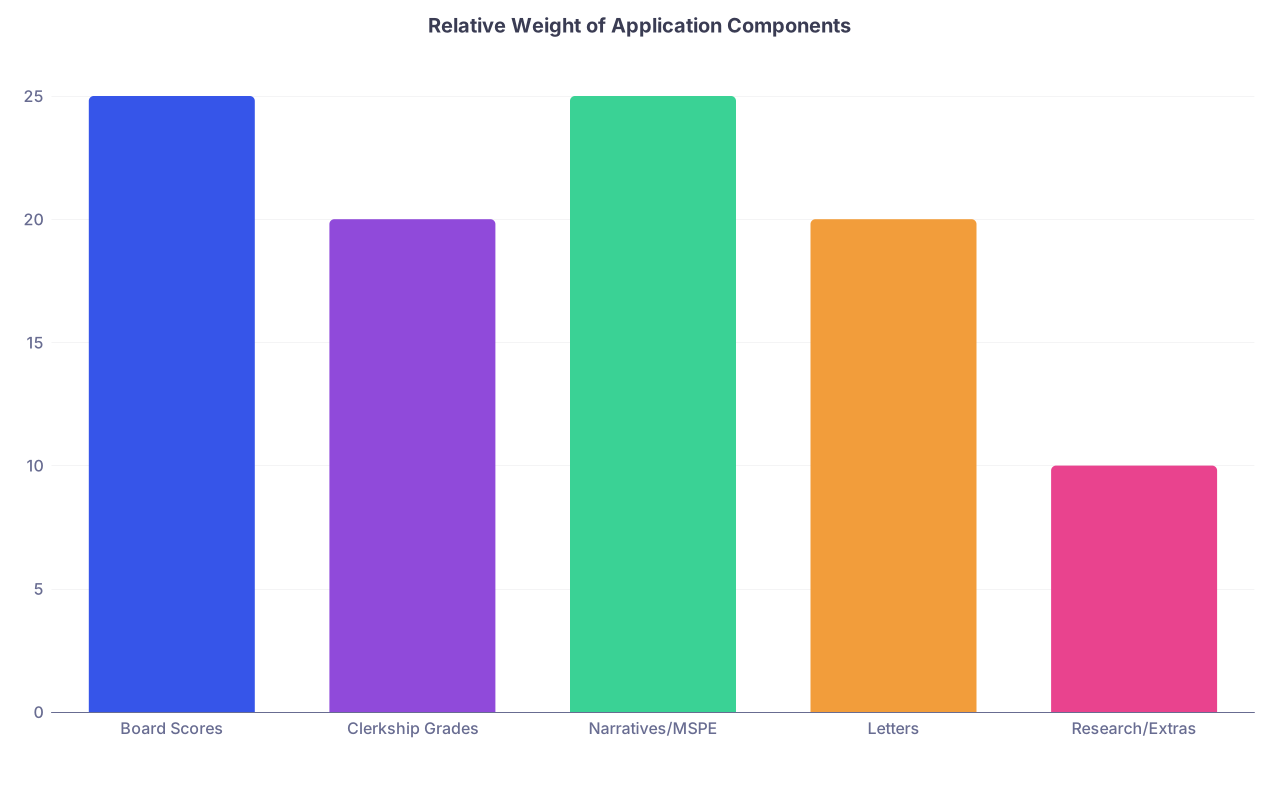
| Category | Value |
|---|---|
| Board Scores | 25 |
| Clerkship Grades | 20 |
| Narratives/MSPE | 25 |
| Letters | 20 |
| Research/Extras | 10 |
Those numbers are approximate, but you get the point: narratives and the MSPE summary carry as much or more weight as your raw grades.
Big mistakes students make:
- Assuming one famous‑name letter overrides months of lukewarm team narratives
- Ignoring “average” comments in non‑home specialty rotations, assuming no one will care
- Believing that a single outstanding Sub‑I eval fixes a long trail of “solid but unremarkable”
Your application has to feel coherent:
- Honest worker
- Learns from feedback
- Trusted by teams
- Clear direction (or at least believable story)
If residents constantly describe you as “quiet but pleasant,” then a single attending calling you “outgoing and energetic” looks off. Inconsistency raises eyebrows.
9. Pitfall #7: Failing to Own Your Professionalism Narrative
Let me be very clear: any hint of professionalism concern from residents is toxic. Way more than a lower grade or mediocre knowledge.
Common sources of “professionalism‑flavored” comments:
- Chronic slight tardiness (“sometimes late to rounds”)
- Phone use seen as disengagement
- Complaining within earshot of the team
- Poor communication about absences or appointments
- Inappropriate joking, oversharing, or boundary issues with staff
Residents are especially sensitive to anything that makes their job harder or the team less functional. They will punish this in evaluations, even if they like you personally.
You cannot afford to be sloppy here, because once the MSPE summary includes phrases like:
“Did well overall but required reminders regarding timeliness and communication.”
That stain follows you into the Match.
The mistake is assuming “I apologized, we are fine” means the issue disappeared. It does not. It often gets fossilized in the evaluation.
When something does go wrong:
- Own it explicitly and early:
“I was late. It is my responsibility. I will set two alarms and show up 10 minutes earlier from now on.” - Overcorrect visibly.
- At the end of the rotation, you can say:
“Thank you again for addressing the punctuality issue earlier. I have been trying hard to correct that, and I would appreciate if you could comment on whether you felt there was improvement.”
Otherwise, the only part that gets recorded is “had punctuality issues.” Not “corrected after feedback.”
10. How to Ethically Influence, Not Control, Your Narrative
I am not telling you to ghost‑write your own evaluations. I am telling you to stop acting like a bystander.
Here is what works without being manipulative:
- Make your work visible to the person who enters the eval
- Ask for mid‑rotation feedback and implement it
- Give a short, specific end‑of‑rotation thank‑you + reminder email
- Clarify your career goals so comments support your application
- When you have a great interaction or teaching moment, briefly acknowledge it (it sticks in memory)
And here is what crosses the line and will backfire:
- Emailing suggested phrases for them to use
- Asking “Can you please write that I was the best student?”
- Arguing about comments after the fact
- Shopping for evaluators who will inflate you
You want residents to think:
“This student made my life easier, clearly tried to learn, and is serious about growth.”
They will usually reward that with thoughtful narratives.
11. Protecting Your Narrative Across Rotations
The residency Match is not about one amazing rotation. It is the pattern over time. The danger of letting residents script your story is cumulative.
Think about what programs will infer if they see patterns like:
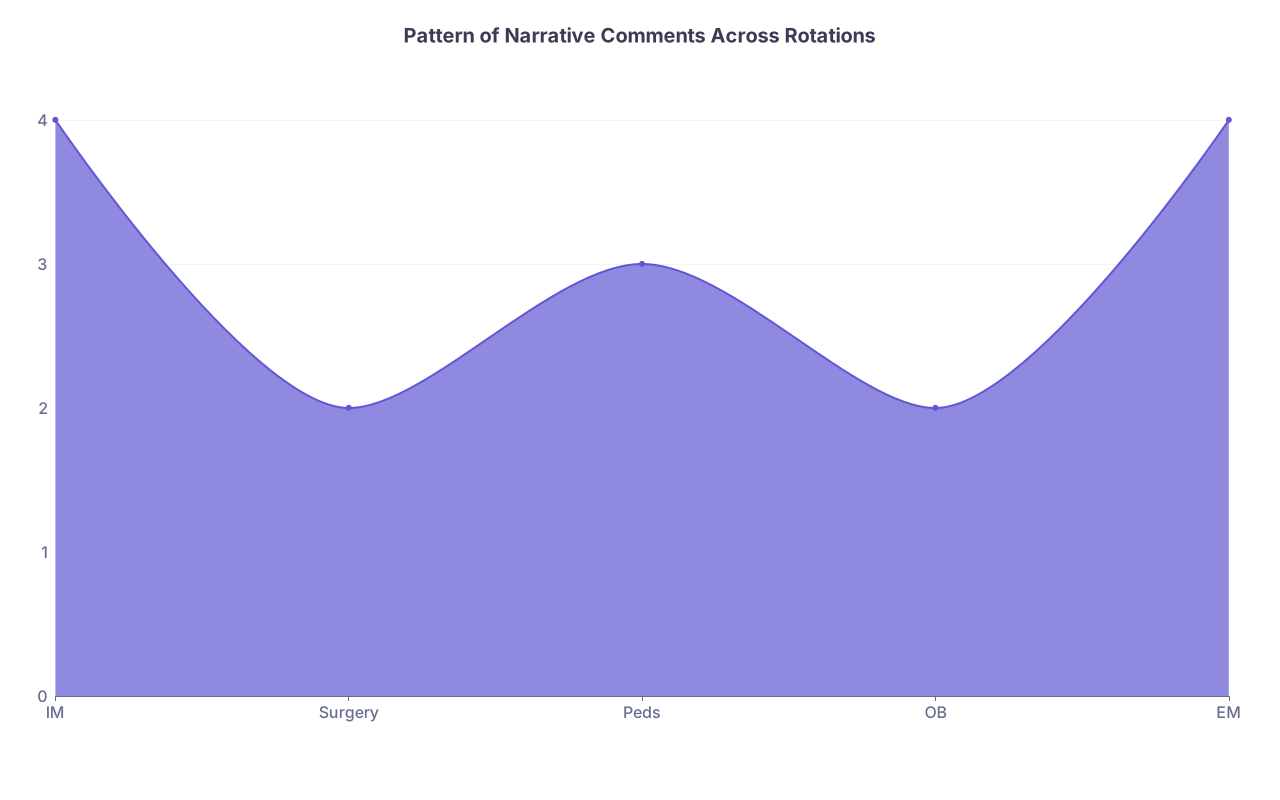
| Category | Value |
|---|---|
| IM | 4 |
| Surgery | 2 |
| Peds | 3 |
| OB | 2 |
| EM | 4 |
Imagine 1–5 scale where 5 = specific, enthusiastic praise; 1 = clear concern. You might feel “no one failed me, so I am fine.” But they see a jagged record with recurrent “2–3” level enthusiasm.
Your job now is to stop the accumulation of:
- Generic, content‑free phrases
- Faint praise
- Small professionalism digs
- Comments that do not match your intended specialty
and replace them with:
- Concrete examples of initiative and follow‑through
- Clear recognition of your growth curve
- Consistent descriptions of your strengths
You do not get that by being the quiet, compliant student that everyone forgets. You get it by being intentionally visible, responsive to feedback, and professionally transparent about your goals.

12. Specialty‑Specific Vulnerabilities
A quick word on how this plays out differently by specialty, because the stakes vary.
Surgical fields (gen surg, ortho, ENT, etc.):
Residents often virtually control your narrative. Attendings may see you for 10 minutes of presentation and a few cases. If you let the chiefs think you are “fine but not hungry,” that will bleed into lines like:
“Interested in surgery but will need to demonstrate sustained commitment and independence.”
That is death in a competitive surgical application.
Psych, family med, peds:
Words about communication, empathy, and team dynamics matter more than procedural skill. One resident who felt you were dismissive of a difficult patient can brand you with:
“Will benefit from continued development of communication skills in challenging encounters.”
Internal medicine:
They look for reliability and clinical reasoning. Residents will hammer you if you seem disorganized or uninterested in follow‑up:
“Showed improvement but needed reminders to follow through on pending tasks.”
Emergency medicine:
Shift‑based, many evaluators, but residents often dominate. One comment about struggling with multitasking or being flustered in busy environments can really hurt.
You cannot afford to pretend this is random. It is not. Each resident‑written line either supports or erodes your credibility as an applicant to that field.

13. The Bottom Line: Guard Your Narrative Like Your Score Report
Let me wrap this up clearly.
You are making a dangerous mistake if you:
- Assume residents will automatically remember your best work
- Believe generic praise is harmless
- Treat professionalism comments as small or fixable later
- Rely on one or two superstar letters to offset months of lukewarm narratives
- Let residents define your “career potential” arbitrarily
You do not control what people think. But you absolutely control how easy you make it for them to remember you accurately, see your growth, and align their comments with your goals.
Three things you must keep front and center:
- Visibility and memory. The people writing your evaluations must actually see your work and be reminded of it at the end. Otherwise you get generic filler.
- Early feedback and correction. Mid‑rotation feedback is not optional anymore. It is your only chance to prevent small issues from fossilizing into your permanent record.
- Coherent story. Across rotations, your narratives must generally align with the identity you present to residency programs. Do not let a random resident decide who you are on paper.
Residents will write many of your narratives. Do not give them your entire professional story to write for you.