
How PDs Read Your Clerkship Grades When Screening ERAS Files
It’s late September. Your ERAS is in. You’re refreshing your email, pretending to “study” while your brain is doing one thing: replaying every Honors, High Pass, and awkward eval comment from third year.
Meanwhile, in some conference room or dim office, a program director just opened your file. Your transcript is on one screen, your MSPE on the other. They’ve got 400 files to get through before the rank meeting next week.
Here’s what actually happens to your clerkship grades when your ERAS hits their queue—and how people in that room are reading them, line by line.
The Order PDs Actually Look At Things
Let me kill a myth right away: nobody is sitting there carefully reading every word of every eval for every applicant. They don’t have the time, and honestly, they don’t have the patience.
The usual order when they open your file:
- USMLE/COMLEX scores (or pass/fail plus Step 2 if relevant)
- Medical school name and class percentile info
- Clerkship grades & summary table/MSPE graph
- Red flags (failures, repeats, professionalism comments)
- Narrative comments from core clerkships in their specialty and medicine/surgery
Only after that do they skim your personal statement or letters.
So clerkship grades are in the first core block of your “academic risk assessment.” Not decorative. They’re one of the main levers for: “Do we interview? Do we move on?”
How They Read The Grade Grid (And What They Actually Care About)
Most schools give some version of: Honors / High Pass / Pass / Fail. PDs know every school plays a different game. I’ve been in plenty of rank meetings where someone says:
“Yeah but at [School X] Honors is like the top 10%, so three Honors is actually really strong.”
Then someone else:
“True, but at [School Y] 60–70% get Honors, so a bunch of High Passes there doesn’t impress me much.”
So they’re not just counting Honors. They’re pattern-reading.
Here’s what they’re scanning for in ~15 seconds:
- Performance in core rotations, especially:
- Internal Medicine
- Surgery
- Pediatrics
- OB/GYN
- Psychiatry
- Family Medicine (for some programs, this is huge; for others, barely registers)
- Trend: early mediocrity followed by improvement? Or early strength followed by drift?
- Outliers: a single low grade surrounded by stronger ones, or the opposite
If they’re screening for Internal Medicine, they look very differently at:
- Applicant A:
IM – Honors
Surgery – High Pass
Peds – HP
OB – HP
Psych – Honors
FM – Honors
vs.
- Applicant B:
IM – Pass
Surgery – Pass
Peds – Honors
OB – Honors
Psych – Honors
FM – Honors
On paper both have “a bunch of Honors.” In the room, Applicant B is getting side-eye. Because the one rotation that matters most to us (IM) is your weakest. That’s not a coincidence. That’s a flag.
Now compare two internal medicine applicants:
- Applicant C: All High Passes in everything, at a school where Honors rate is 20%.
- Applicant D: Two Honors (Psych, FM), rest Passes, at a school where Honors is 50%.
Applicant C is safer. Faculty in that room know: grade inflation is real; you want the student who stood out where the bar was actually high.
The Hidden Column: Your School’s Grade Culture
PDs absolutely keep mental scorecards of grading cultures. We talk about it during application season. Sometimes literally pull up an internal cheat sheet.
| School Type | PD Mental Note |
|---|---|
| Heavily inflated, >60% Honors | Honors are nice but not decisive; look closer at comments and MSPE graph |
| Tiered 15–25% Honors | Honors meaningful, especially across multiple core rotations |
| No Honors, just Pass/Fail | Need to lean much more on comments, narratives, Step 2, and school rank |
| Strict curve with clear percentiles | Very helpful; PDs actually trust these numbers |
I’ve seen this exact thing happen:
A faculty reviewer sees “mostly Honors” from a school notorious for grade inflation. They say, “Okay, but that’s just their default. What do the comments say? Any mention of being top of the team?”
Then they open the MSPE and scan the class percentile graph. That graph is more useful than your raw Honors count in inflated schools.
If your school:
- Inflates: You need your comments and MSPE language to carry the signal.
- Deflates: PDs often give the benefit of the doubt once they recognize your school’s reputation.
- Hides ranks: Then the only way you stand out is narrative, Step 2, and specialty-specific performance.
Programs that screen hundreds from the same 20–30 schools each year know exactly how your school plays the game—even if you don’t.
Which Clerkships Matter Most (And Which They Half-Ignore)
This part is specialty-dependent, and this is where people get surprised. Let me walk through how different PDs actually weigh them.
Internal Medicine Programs
They care most about:
- Internal Medicine grade
- Surgery grade
- Any sub-I/AI in medicine or ICU
- Pediatrics to a lesser degree
The conversation often sounds like:
“Strong Step 2, IM Honors, sub-I Honors, Surgery HP. Yeah, solid. Comments?”
If you’ve got:
- IM – Pass
- Sub-I – “did fine, needed reminders, slow to take ownership”
You’re getting bumped down. Not necessarily rejected, but pushed into the “maybe” pile, which is the death zone when apps are thick.
General Surgery Programs
They look very hard at:
- Surgery grade (obviously)
- Medicine (to see if you struggled on complex inpatient care)
- Any surgery sub-Is and away rotations
I’ve watched surgical PDs basically ignore an Honors in Psych and obsess over a High Pass in Surgery with lukewarm comments. They don’t care that you crushed OB if your operative notes say “timid, needed repeated prompting in the OR.”
They want to see:
- Took ownership on surgery
- Hustled
- Showed up like an intern
A single Pass in Surgery with weak comments can sink an otherwise strong application at competitive programs.
Competitive Fields (Derm, Ortho, ENT, Plastics, etc.)
Here’s the dirty truth: for the very top programs, your third-year grades are a screening tool, not the decision tool.
They check for:
- Any non-Honors in Surgery if you’re ortho/ENT/plastics
- Any red flags in professionalism
- Whether your grades match your Step scores (big mismatch = questions)
But the heavy weight shifts to:
- Home and away rotation performance in that specialty
- Departmental letters
- Research alignment
If you’re applying Derm with:
- IM – HP
- Surgery – Pass
- Derma rotations – Honors with “best of the year” comments
You’re not out. But that Pass in Surgery will get talked about. Someone will ask “What happened here?” during the rank meeting. I’ve heard it.
Primary Care Fields (FM, Peds, Psych)
They like:
- Balanced, consistent performance across all cores
- Strong FM/Peds/Psych grades
- Comments like “empathetic,” “great with patients,” “excellent team member”
Family Medicine PDs tend to be more forgiving of a single Pass in Surgery if everything else is solid and comments are glowing. But they are not oblivious. A string of mediocre clinical grades signals “average worker, limited upside,” which is not what they want in their top tier.
The MSPE: Where The Real Judgement Lives
Your grade grid is just the teaser. The MSPE (Dean’s Letter) is where they really learn about you.
Two big insider points:
- PDs read “between the lines” of MSPE language.
- They know the code phrases your school uses.
Someone from a given school will usually say, “At our place, if they say ‘among the top students I’ve worked with,’ that means truly top 5–10%. ‘Strong student’ means… fine, but not outstanding.”
They’ll skim:
- Summary of clinical performance
- Specialty-specific clerkship narratives
- Any “concerns” sections
- Comparative phrases (top third, upper quartile, etc.)
And here’s how they merge it with your grades:
- Honors + lukewarm comments = grade inflation / generous attendings.
- High Pass + rave comments + “top 10%” = we trust the comments more than the raw letter.
- Single low grade + one bad narrative = they check if it’s pattern or one-off.
If your IM grade is HP but your narrative literally says “One of the best students I’ve worked with,” that helps you a lot more than you think. Someone will say, “This HP is probably functionally an Honors at that site.”
How PDs Treat Imperfect Transcripts
Nobody has a spotless record. The question in a PD’s head is: “What kind of imperfection is this?”
There are four categories.
1. The Early Stumble
Example:
- First rotation: Surgery – Pass
- Rest of the year: IM, Peds, OB, Psych, FM – mostly Honors/HP with strong comments
Behind closed doors you’ll hear:
“Okay, they were green. They figured it out.”
Programs will forgive this. Especially if:
- It was your very first clinical block.
- Your later comments explicitly mention growth, independence, or improved confidence.
2. The Specialty Mismatch
You’re applying IM with:
- IM – HP
- Surgery – Honors
- OB – Honors
- Peds – HP
- Psych – HP
People will ask why you’re not doing surgery or OB. But for general IM, this is fine. What kills you is the opposite: weak performance in the field you’re now claiming is your passion.
A classic red flag: Applying Psych with a mediocre Psych clerkship and no psych sub-I or strong psych letter. PDs notice that instantly.
3. The Pattern Of “Just Okay”
All HPs. All “solid, good team member, reliable” comments. No real enthusiasm anywhere.
Programs see this as:
“Safe, but not exciting. Probably fine, but not someone we fight for on rank day.”
These are the applicants who get screened in for mid-tier programs and screened out at the most competitive ones. Nothing to attack; nothing to champion.
4. The Professionalism Hit or Failure
Single failed clerkship? Every PD looks at why.
If it’s knowledge-based and early, with remediation and later strength, you can still get rescued by a strong Step 2, letters, and later honors. But professionalism failures: showing up late, attitude problems, dishonesty—that follows you.
I’ve sat in meetings where everything else looked solid but a single phrase like “required repeated feedback on professionalism expectations” tanked discussion. Nobody wants that headache.
How Much Grades Actually Matter For Interview Selection
Let me quantify this a bit, because you probably over- or under-estimate it. Rough average for non-ultra-competitive specialties at many university programs:
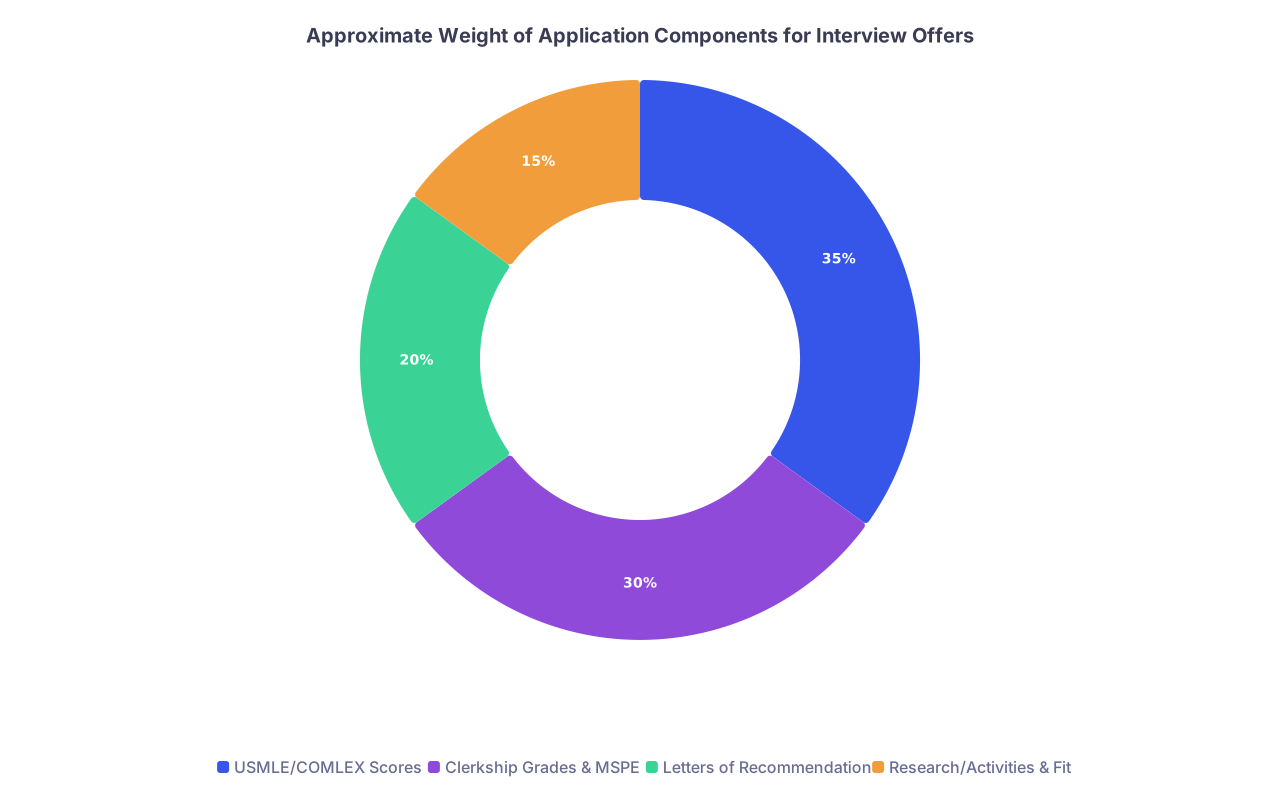
| Category | Value |
|---|---|
| USMLE/COMLEX Scores | 35 |
| Clerkship Grades & MSPE | 30 |
| Letters of Recommendation | 20 |
| Research/Activities & Fit | 15 |
Are these exact numbers? Of course not. But that’s roughly the mental weighting in a lot of academic programs:
- Scores open the door or close it.
- Clerkship grades and MSPE tell them how you functioned as a near-intern.
- Letters and research decide whether you’re worth one of their limited interview slots.
For community programs, research weight drops; clerkship performance and letters go up.
Bottom line: Honors vs High Pass doesn’t decide your future on its own. Patterns, comments, and fit do. But a string of mediocre or concerning grades can absolutely keep you out of the interview pile.
Away Rotations & Sub-Is: Your Second Chance (Or Second Transcript)
Here’s the part students misunderstand: once you hit fourth year, your sub-Is and away rotations are basically new, high-resolution clerkships judged in real time by the very people who rank you.
They don’t just say “Sub-I: Pass/Honors.” They say things like:
- “Functioned at the level of a strong intern.”
- “Needed significant direction; not ready for independent management.”
- “We would be happy to have this student as a resident.”
Those lines matter more at that specific program than your original third-year grades from home.
But there is a pattern PDs react to strongly:
- Third-year: mixed/average grades
- Sub-I at their program: average/weak performance
That reinforces the impression that the transcript was an accurate preview of your work style.
Versus:
- Third-year: decent but not stellar grades
- Sub-I at their program: absolute rockstar, with glowing faculty support
People will say, “They bloomed late,” or “Grading at their home institution may not have captured their strengths.” That’s how you get pulled from “meh” into “definite interview, and maybe rank highly.”
What You Can Still Control If Your Grades Are Already Set
You can’t rewrite your third year. But you’re not powerless. PDs are pattern-readers. You change the pattern.
Focus on four levers:
Step 2 performance
A strong Step 2 (250+ in competitive fields, solidly above your specialty’s mean otherwise) tells committees your clinical knowledge is there even if your early grades were meh.Sub-I and away rotation performance
Treat every sub-I like a month-long interview. Show up early. Know your patients cold. Anticipate next steps. Intern-level behavior can paper over earlier grade modesty.Letters that explicitly counter your weaknesses
If you had a rocky IM rotation, a later IM sub-I letter saying “dramatic growth,” “ready for intern role,” “top-tier performance” is gold. PDs pay attention when letters directly address an earlier concern.MSPE addenda and advisor explanations
Some schools will contextualize your performance: family issues, illness, first rotation, site-specific chaos. PDs don’t ignore context. They just want to see that the story has an upswing, not a flat line.
How PDs Talk About You In The Room
Let me give you a realistic transcript-level conversation from a rank meeting, anonymized but very real.
Applicant X, applying to IM:
- School: mid-tier MD
- Step 2: 245
- Clerkships: IM – HP, Surgery – HP, Peds – Honors, OB – Pass, Psych – HP, FM – HP
- Sub-I in IM: Honors with excellent letter
Comments in the room:
Attending 1:
“OB Pass worries me a bit. What happened there?”
Attending 2 (who read the file):
“First rotation of third year. Site noted ‘struggled early, improved, but overall below peers.’ Everything after that is stronger. Sub-I comments are great—‘essentially functioning at intern level.’”
PD:
“So early stumble. Okay. I’m not thrilled, but the arc is good. I’d keep them comfortably in the middle tier.”
That’s how this goes. Not “perfect or dead.” But “how bad, what pattern, what direction?”
Visualizing Your Trajectory
Think of your clerkship record the way PDs subconsciously see it: as a trajectory, not a snapshot.
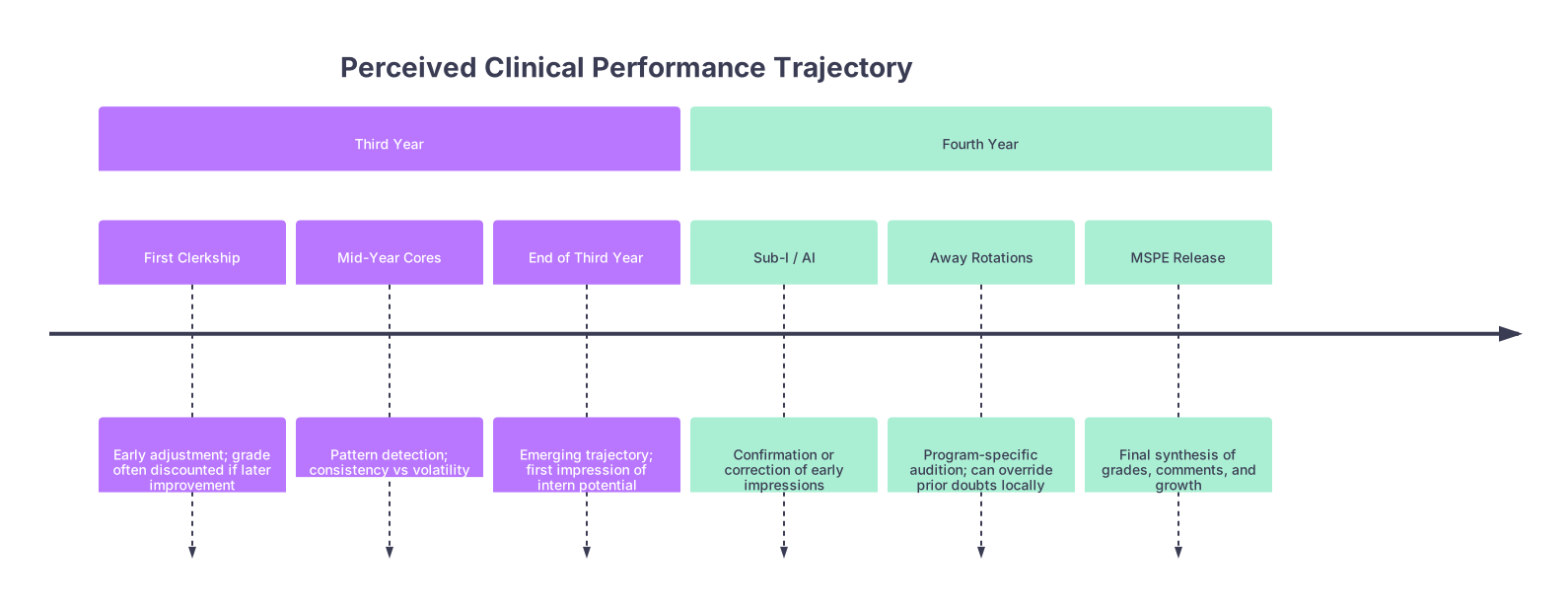
| Period | Event |
|---|---|
| Third Year - First Clerkship | Early adjustment; grade often discounted if later improvement |
| Third Year - Mid-Year Cores | Pattern detection; consistency vs volatility |
| Third Year - End of Third Year | Emerging trajectory; first impression of intern potential |
| Fourth Year - Sub-I / AI | Confirmation or correction of early impressions |
| Fourth Year - Away Rotations | Program-specific audition; can override prior doubts locally |
| Fourth Year - MSPE Release | Final synthesis of grades, comments, and growth |
If the line is flat and average, you’re fine—just not memorable. If it slopes up, you get more grace for earlier mistakes. If it slopes down, people get nervous.
Your job, if you’re still in the middle of this process, is to tilt that line upward wherever you still can.