
It’s late February. The rank list meeting has already dragged on for three hours. The PD is tired, the chiefs are scrolling through their phones when they think no one’s watching, and your name comes up on the spreadsheet.
Someone says: “That’s the student who did the Sub‑I with us in August.”
Everyone looks up.
Now you’re about to see the real value of that month you spent trying not to drown as a pseudo-intern. This is where the glow (or the stink) of your Sub‑I performance finally cashes out. And I’m going to walk you through what actually gets said in that room, because it’s not what your school’s “Sub‑I orientation” talk made it sound like.
They talk about you like a future co‑intern. Not like a student. Huge difference.
Let’s go inside the room.
What PDs Really Use Sub‑Is For
Let me be blunt. Your Sub‑I is not primarily about “learning to manage patients” or “identifying gaps in your knowledge.” That’s brochure language.
Behind closed doors, Sub‑Is are used for three main things:
- Sorting: “Would I trust this person as my intern on July 1?”
- Filtering: “Is this someone I actively want in my program, or just ‘fine’?”
- Red‑flagging: “Is there any way this person could crash and burn here?”
When you’re applying to that same program later, your Sub‑I eval and hallway reputation carry far more weight than your beautifully curated ERAS essay.
Here’s the part students underestimate: a single sentence from a trusted chief or attending can move you dozens of spots up or down a rank list. And Sub‑Is are where those sentences get written.
How Strong Sub‑I Rotators Get Talked About
Let’s start with the good side. You want to know what “strong” actually means when the PD is looking at a dozen Sub‑I rotators and only remembering three.
When your name comes up in the ranking meeting, here’s what it sounds like when you were a strong Sub‑I.
1. They Talk About You Like You’re Already an Intern
I’ve heard this exact phrasing more than once:
- “That person was basically functioning at intern level by the end of the month.”
- “If they showed up July 1, I wouldn’t be nervous.”
That’s the holy grail. “Wouldn’t be nervous.”
Notice what they are not talking about: nobody is reciting your Step scores, your Phi Beta Kappa, or your obscure basic science publication. They are remembering how it felt to work with you at 2 a.m. on a call night or on a crushing Monday list.
Strong Sub‑I rotators give the team the sense that you’ll be safe, dependable, and not a headache. That emotional memory is what drives their language.
2. Specific Stories – Not Vague Praise
When you’re good, people don’t say, “They were great.” They say:
- “Remember when that transfer from the outside hospital came in? They’d already started pre-charting, had the prior echo pulled up, and caught that the patient had missed anticoagulation for four days.”
- “They stayed late when the rapid response hit, even though they could’ve left, and they took the initiative to call the family and update them.”
Program directors love specific stories, because that means the faculty actually remember you. Vague “hardworking, pleasant” comments go into the giant pile of mediocrity.
The Sub‑I eval might have a generic summary, but in the room, the PD turns to the chief or the attending: “You worked with them – what did you think?” That’s where the stories come out.
If no one has a story, you didn’t really make an impact. You were just… there.
3. Work Ethic Without Drama
Strong rotators are remembered for doing the work without creating more work.
I’ve heard chiefs say:
- “They just got stuff done. I didn’t have to babysit.”
- “If I asked them to follow up five things, they followed up seven.”
- “Never complained once, even on that insane call when we got five admits back-to-back.”
Here’s one detail that comes up more than you’d expect: how you reacted when things were unfair. Pager going off while you’re pre-rounding. Being asked to pick up an extra patient. Staying late while your friends from another service are already at the gym.
If you were the “Sure, I got it” person instead of the eye-rolling, sighing, subtle-whining person, they remember that. And yes, they bring it up.
4. Self‑Direction: The Non‑Needy Student
Program directors hate neediness. They will never say that in public, but behind closed doors they absolutely do.
Strong Sub‑I rotators are described like this:
- “They knew when to ask for help, but they didn’t constantly ask what to do next.”
- “They were already looking up guidelines and proposing plans.”
- “They would come to me with: ‘Here’s what I think we should do – am I missing anything?’”
That last one is gold. If you consistently frame your questions with a proposed plan, people see you as already thinking like a resident.
If, on the other hand, your chief has to feed you every next step (order this, call that, check this), you get quietly moved into the “not ready” bucket.
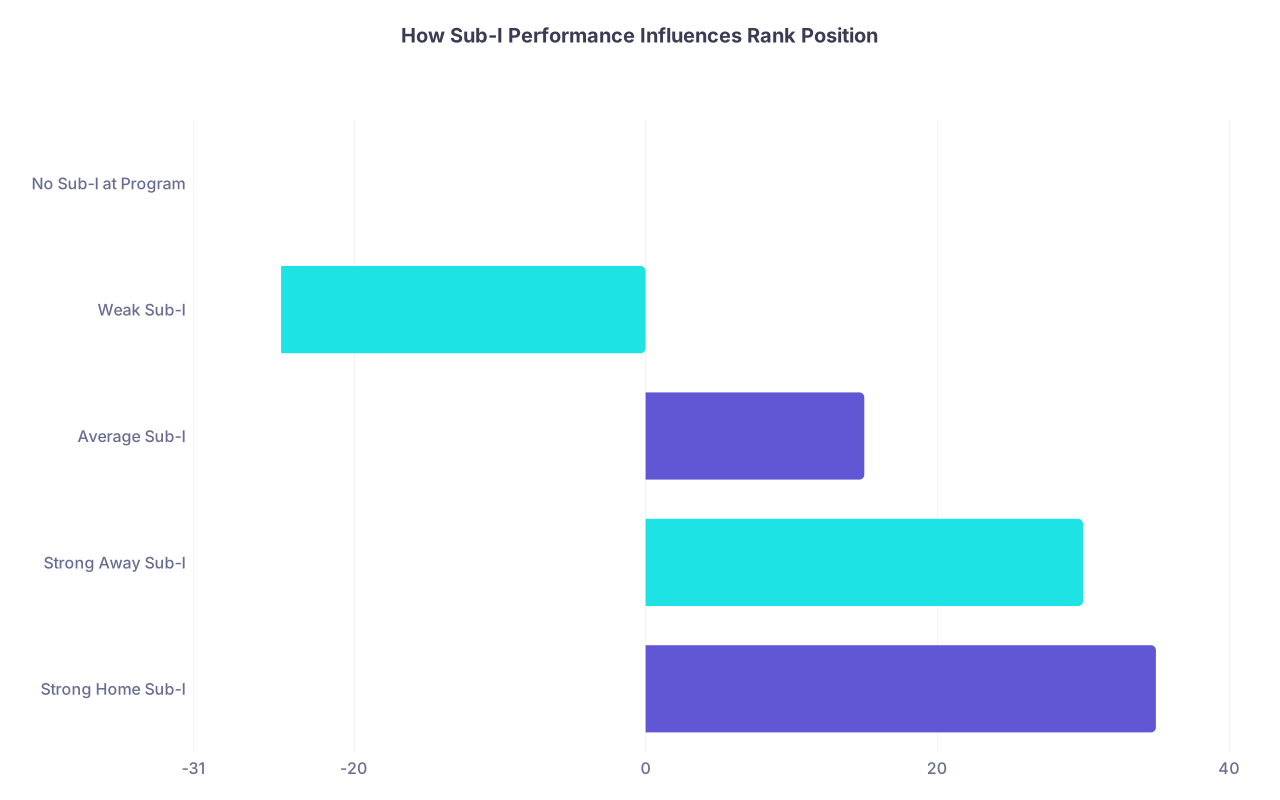
| Category | Value |
|---|---|
| Strong Home Sub-I | 35 |
| Strong Away Sub-I | 30 |
| Average Sub-I | 15 |
| Weak Sub-I | -25 |
| No Sub-I at Program | 0 |
How Weak Sub‑I Rotators Get Talked About (This Is Where It Hurts)
Now the part nobody tells you before your Sub‑I: being mediocre on a rotation is one thing. Being weak on a Sub‑I is dangerous.
On a random third-year clerkship, a so-so eval may just hurt your grade. On a Sub‑I, a weak impression can blacklist you from a program you actually want.
Here’s what it sounds like in the PD room when someone underperforms.
1. “I Don’t Think They’re Ready for July 1”
That’s the kiss of death.
When a chief says, “They’re not ready to be an intern,” your file effectively moves into the do‑not‑rank or “only as a last resort” column.
Nobody wants to be the PD who knowingly ranks someone their own residents said was unsafe or unready. That’s reputational suicide inside the hospital.
The wording varies:
- “I wouldn’t feel comfortable with them cross-covering my patients.”
- “They’re very green. Needs a lot of hand-holding.”
- “I worry they’re going to struggle significantly as an intern.”
Those sentences carry more weight than a 260 Step score. I’ve seen high‑scoring, research-heavy applicants sink 30–40 spots on a list off a single comment like that.
2. The “Trust” Problem
Weak Sub‑I rotators are not always blatantly incompetent. More often, they’re inconsistent. And inconsistency breeds lack of trust.
You’ll hear:
- “Sometimes they were on it, sometimes they totally missed obvious things.”
- “We’d ask them to follow up labs, and we’d have to double-check every time.”
- “I don’t know if they know what they don’t know.”
That last line is a major red flag. “Doesn’t know what they don’t know” = unsafe. PDs hate that phrase.
There’s a difference between being slow but reliable vs fast but sloppy. Programs will tolerate slower learners who are meticulous and honest. They won’t tolerate people who exude false confidence and then drop the ball on basic tasks.
3. Work Ethic Questions (Even Subtle Ones)
Weak rotators often get subtle but deadly commentary:
- “They left right at sign-out every day.”
- “When things got busy, they kind of faded into the background.”
- “Needed to be told multiple times to check on a sick patient.”
Nobody expects a Sub‑I to be a martyr. But if you’re consistently the first one with your bag packed, the one drifting at the edges while others are working… that shows up in how you’re described.
And here’s the harsh truth: if there’s any question about your work ethic on a Sub‑I, you’re done at that program. They’ll smile and thank you for rotating, but they’re not going to commit four years of salary and training to someone they suspect might drag the team.
4. Poor Adaptability and Bad Attitude
This is where things get ugly fast.
The phrases that kill you:
- “Bit defensive when given feedback.”
- “Didn’t seem to take ownership of mistakes.”
- “Blamed the system or others when things went wrong.”
- “Kind of a know‑it‑all.”
I’ve seen PDs tank someone’s rank position based almost entirely on vibe. If a senior resident says, “Honestly, they were kind of painful to work with,” that carries more punch than your glowing letter from the research department.
And yes, they talk about minor stuff: how you treated nurses, whether you rolled your eyes when asked to do mundane tasks, whether you disappeared to “study” during crunch time. It all feeds into one simple question: “Do I want this person on my call schedule?”

What Actually Gets Remembered from Your Sub‑I
Students imagine PDs poring over detailed evaluation forms. Reality is much messier.
Here’s what actually sticks when your name comes up months later.
1. The Chief’s One-Liner
If you rotated at a program that uses chiefs heavily, understand this: the chief resident’s opinion is often the single most influential voice about you.
The PD will literally look at the chief and say, “What about this one?”
If the response is:
- “That’s the Sub‑I we all loved – super solid, very low‑maintenance”
—you move up.
If it’s:
- “They were fine… nothing special”
—you float in the middle.
If it’s:
- “I’d be cautious” or even a long pause before answering
—you sink.
Chief opinions are shaped on long call days, during admissions, and while you’re all suffering through the EMR. Not during your polished presentations on rounds.
2. The Senior Resident’s Patience Level
Seniors quietly grade you on two things:
- Did you make my life harder or easier?
- Did I trust you by the end of the month?
I’ve watched seniors tank someone with one sentence: “Honestly, I felt like I had to double‑check everything they did.” That’s enough to make a PD say, “Ok, not here.”
On the other hand: “By week three, I felt comfortable letting them write initial orders and then review with me” is a huge vote of confidence.
3. Faculty Remember Outliers, Not The Middle
Attending physicians will not remember the daily grind of your Sub‑I. They remember:
- The one extraordinarily good or bad decision you made on a sick patient.
- The one time you handled a bad family conversation with maturity (or blew it).
- The one time you clearly didn’t read about your patients and got exposed on rounds.
So you end up with stuff like:
- “That’s the student who picked up early sepsis on that floor patient and escalated appropriately.”
- “Isn’t that the one who showed up late post‑call because they ‘didn’t know’ they needed to be there?”
Fair? Not always. But that’s how human memory works. Extremes stick. So your aim isn’t perfection every second; it’s avoiding big negatives and generating a few memorable positives.
| Student Behavior | Typical PD / Resident Interpretation |
|---|---|
| Consistently early, stays a bit late when needed | Reliable, good work ethic, low risk as intern |
| Proposes plans before asking what to do | Thinks like a resident, good potential |
| Admits uncertainty quickly, seeks help | Safe, self-aware, teachable |
| Frequently “forgets” tasks or follow-ups | Unreliable, potential patient safety issue |
| Deflects blame or gets defensive | Poor insight, likely difficult trainee |
| Treats nurses / staff poorly | Cultural misfit, potential toxicity |
How This Plays into Your Rank List – Home vs. Away Sub‑Is
Now let’s connect this to the match, because that’s where the real game is.
Home Program Sub‑I
At your home institution, the Sub‑I is essentially a prolonged audition. Everyone knows it. PDs absolutely weigh your Sub‑I more heavily than your third-year rotations.
If you crush your home Sub‑I, the PD discussion sounds like:
- “They’ve already been functioning at intern level here. We know what we’re getting.”
You jump substantially on their list. Often above outside applicants with similar or even slightly stronger paper stats.
If you perform poorly at your home Sub‑I, the conversation is more brutal:
- “If our own team didn’t love them on their Sub‑I, that’s a bad sign.”
- “If we weren’t impressed when they were on their best behavior, what happens when they’re tired as an intern?”
That’s how you end up being “soft passed” from your home program even when you thought you had an inside track.
Away Sub‑I (Audition Elective)
For away Sub‑Is, the stakes can be even higher. That might be your only month to prove you fit there.
Inside the PD room, the logic is:
- “We saw them for four weeks. That data point is more valuable than what their letter from Across-The-Country University says.”
A strong away Sub‑I can rocket you up a list. I’ve seen visiting students with average board scores jump over 250+ students because they absolutely lit it up on service.
But here’s the part students ignore: a bad away Sub‑I doesn’t just hurt your chances at that one place. It can haunt you if the PD knows other PDs in the specialty. Yes, they talk.
I’ve literally heard: “They rotated with us. Honestly, I’d be careful.” And that gets quietly texted or mentioned at PD meetings.

| Step | Description |
|---|---|
| Step 1 | Sub-I Performance |
| Step 2 | Positive Chief/Faculty Advocacy |
| Step 3 | Higher Rank at That Program |
| Step 4 | Stronger Specialty-Wide Reputation |
| Step 5 | Neutral Comments |
| Step 6 | Middle of Rank List |
| Step 7 | Negative or Lukewarm Feedback |
| Step 8 | Lower Rank or Do Not Rank |
| Step 9 | Potential Word-of-Mouth Red Flags |
| Step 10 | Strong |
| Step 11 | Average |
| Step 12 | Weak |
How to Behave on a Sub‑I So They Talk About You the Right Way
You already know you should read about your patients and “work hard.” That’s baseline noise. Let’s talk about the less-obvious behaviors that actually drive the behind-the-scenes conversation.
1. Signal Intern‑Level Ownership Early
From week one, start behaving like the primary owner for your patients.
That looks like:
- You know every lab, imaging study, consult note without being asked.
- You’re the first to notice when a patient’s status changes and you bring it to the team.
- You pre‑emptively update families, call consults, and re‑check results (after discussing with your senior, obviously).
So when the PD later asks the chief, “How were they?” the answer is: “They really owned their patients.” That phrase alone can move you up the list.
2. Eliminate “Forgetfulness” as a Personality Trait
Nothing tanks trust faster than unreliability. You can be slow. You can need teaching. You cannot repeatedly forget tasks.
Practical move: write everything down. Every task, every follow-up. Then close the loop. “I called cardiology – they’re coming to see the patient this afternoon.” “I checked the CT – no bleed, read is final.”
Residents love closed loops. PDs hear about that.
3. Take Feedback Like an Adult
You will mess up something on your Sub‑I. It’s guaranteed. The only thing that matters is how you respond.
The version that gets praised in the room:
- You acknowledge it without excuse.
- You fix it.
- You don’t repeat the same thing the next day.
The version that gets you quietly buried:
- You argue.
- You bring up how “different” things are at your home institution.
- You say you weren’t told, instead of just owning it.
I’ve heard PDs say, “They took feedback exceptionally well,” and use that as a reason to rank someone higher than technically stronger applicants who came across as prickly.
4. Be Good to Nurses and Staff (People Notice)
This one’s not fluff. It’s survival.
Here’s a very real scenario: after you leave the ward room, a nurse rolls their eyes and says to the resident, “That student is so rude.” Guess what the resident says in the PD meeting later?
- “Nursing didn’t love them.”
That’s enough to move you from “maybe” to “no thanks.”
The opposite is true too. When nurses say, “That student is really on top of it,” residents take note. That carries upstream.
The Quiet Reality: Sub‑Is Create Your Reputation
Sub‑Is are where your real reputation in a specialty begins. Not on ERAS. Not in your personal statement. In the day-to-day grind of being treated almost like an intern and seeing how you respond.
Inside the room, PDs and residents are not sorting you into “great human being vs bad human being.” They’re answering three questions:
- Do I trust this person with my patients?
- Will they make my residents’ lives better or worse?
- Will I regret ranking them?
Strong Sub‑I rotators make those answers easy: yes, better, no.
Weak rotators make people hesitate. And in a big pool of applicants, hesitation is basically a no.
If you remember nothing else, remember this:
- Your Sub‑I is an audition, not a class. They’re trying to see if you can be an intern tomorrow.
- The chief’s and senior’s one-liners about you will matter more than your board score once they’ve seen you in action.
- Reliability, ownership, and how you handle pressure will define how they talk about you in that rank meeting months later.
Show them the intern they want on July 1, and they’ll move your name where it needs to be.