

It’s mid‑January. Your interviews are mostly done, your ERAS token feels like ancient history, and your classmates are in full “coast mode” on easy electives. You, meanwhile, are staring at your schedule from February to April wondering:
“Do these rotations even matter anymore… or can they still move the needle for the Match?”
Short answer: they matter. But not in the way your pre‑clinical brain thinks grades matter. At this point, it’s about impressions, intel, and insurance.
Let’s walk it chronologically—from just before interview season through Match Day—so you know exactly what to do with post‑interview rotations and how to use late electives strategically instead of sleepwalking through them.
Big Picture Timeline: Where Late Electives Actually Fit
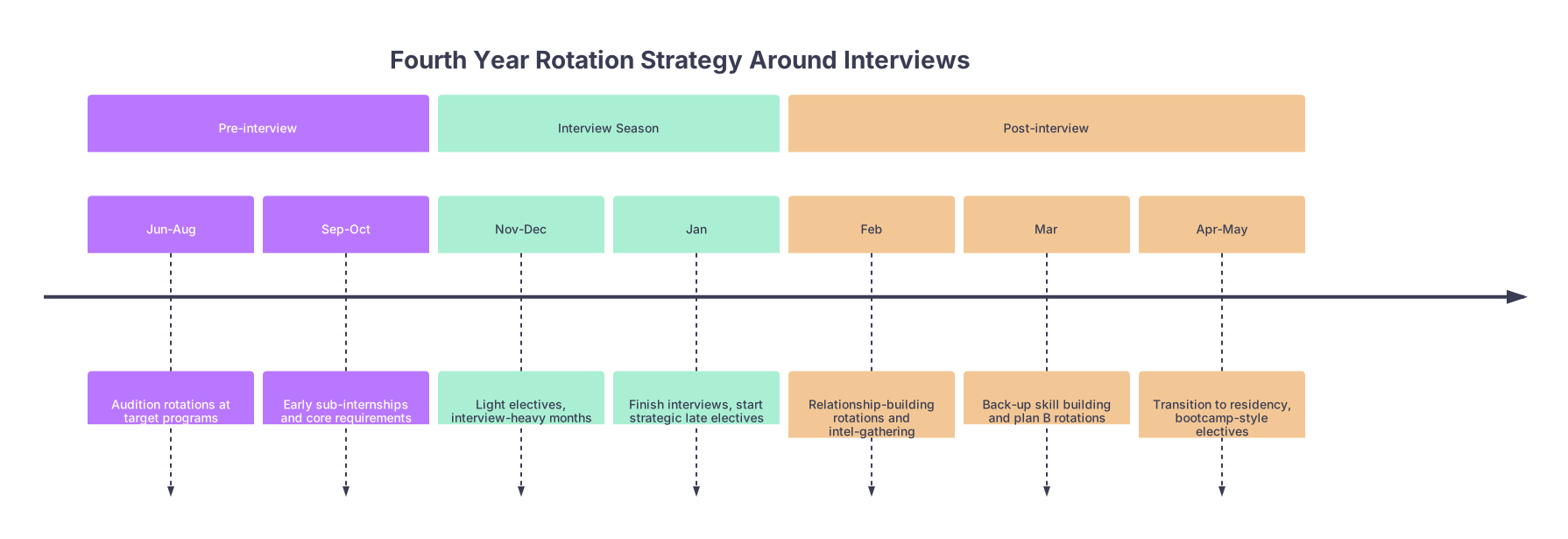
| Period | Event |
|---|---|
| Pre-interview - Jun-Aug | Audition rotations at target programs |
| Pre-interview - Sep-Oct | Early sub-internships and core requirements |
| Interview Season - Nov-Dec | Light electives, interview-heavy months |
| Interview Season - Jan | Finish interviews, start strategic late electives |
| Post-interview - Feb | Relationship-building rotations and intel-gathering |
| Post-interview - Mar | Back-up skill building and plan B rotations |
| Post-interview - Apr-May | Transition to residency, bootcamp-style electives |
Here’s the structure we’ll use:
- Pre‑interview (Jun–Oct): Set up the board
- Interview season (Nov–Jan): Protect time, don’t sabotage yourself
- Post‑interview, pre‑rank list (Feb): Rotations that still influence your rank decisions
- Post‑rank list, pre‑Match (late Feb–Mar): Rotations that protect your Plan B
- After Match (late Mar–May): Rotations that make you less useless on July 1
We’ll go month‑by‑month, then zoom in to week‑by‑week/daily tactics where it actually changes what you say and do on service.
June–October: Setting Up So Late Electives Actually Matter
By the time interviews roll around, the usefulness of late electives is determined mostly by what you did before them. At this point you should be:
June–August: Audition and “Signal” Rotations
If you’re reading this earlier in M4, here’s the brutal truth: the best way to make late electives matter is to use early electives to create leverage.
From June–August you should:
- Do away rotations (“auditions”) at 1–3 programs in your realistic target tier.
- Lock in at least one sub‑I at your home institution in your chosen specialty.
- Make sure at least 2–3 potential letter writers have seen you on service.
This sets up late electives to:
- Confirm or change your rank list based on culture fit.
- Give you fallback skills if your specialty is competitive.
- Provide additional networking in case of SOAP or a re‑application year.
If you coast through summer on random low‑yield electives, you’re forcing late electives to do work they simply can’t do that late.
September–October: Guardrails Before Apps Go Live
By fall, ERAS is submitted and interview invites start trickling in. At this point you should:
- Avoid brutal, soul‑crushing rotations (e.g., malignant ICU) that risk tanking your Step 2 or late grades.
- Finish any absolutely required core clerkships that are still hanging over you.
- Choose 1–2 electives that deepen your specialty story (e.g., peds heme/onc for peds, rheum for IM).
The goal: when interviews start, you’re not scrambling. You already look like someone committed to your chosen field, with enough bandwidth and confidence to step back strategically later.
November–January: Interview Season and “Don’t Be Dumb” Rotations
By November, interviews are rolling. This is where people sabotage themselves with the wrong elective choices.
At this point you should:
- Prioritize schedule flexibility over prestige.
- Protect 1–2 half‑days per week when possible for interviews and travel.
- Avoid high‑acuity sub‑Is unless they’re absolutely necessary for graduation.
Good choices in Nov–Jan:
- Outpatient rotations with predictable hours
- Research elective (with a PI who doesn’t care if you vanish for a Zoom interview)
- Teaching or simulation electives
- Light consult services
Terrible choices:
- MICU or SICU with 6am–8pm days
- Trauma with q4 call and random post‑call days
- Surgical sub‑I when you’re flying out midweek
Think of this block as “do not get in your own way” time. You want to be minimally exhausted, reasonably prepared for interviews, and not fighting with an attending because you’re gone every other day.
February: Post‑Interview Electives That Still Matter
Interviews are basically done. You’re starting to rank programs. This is where late electives become strategic—if you’re deliberate.
At this point you should ask:
“How can February rotations improve my rank list or my insurance policy if the Match goes sideways?”
Strategic Goals for February
- Clarify your rank list (fit and reality check)
- Strengthen a Plan B specialty or track
- Build relationships at your home institution for support letters/advocacy
Let’s break that down by scenarios.
Scenario A: You’re Confident in Your Specialty and Range of Interviews
You’ve got 10–15 interviews in your field, across a realistic spread. At this point you should:
- Choose a senior elective in your chosen field at your home program or a similar‑style program.
- Focus on seeing how attendings actually live: burnout, autonomy, call systems, fellowship support.
- Ask residents directly (off the record) about:
- Which programs on your list they liked/disliked and why.
- How your program’s workload compares to others on your list.
- Where recent grads matched for fellowship or jobs.
This elective is not about a grade. It’s about intelligence gathering. You’re trying to avoid ranking a pretty but toxic program over a less flashy but humane one.
Scenario B: Your Interviews Are Thin or Heavily Reaches
You got fewer interviews than you wanted, or most are at very competitive places.
At this point you should:
- Add a serious elective in your Plan B specialty (e.g., IM if you’re applying cards‑oriented EM and worried, FM if you’re shaky in peds).
- Work like you’re trying to earn a letter—even if letters are “done.”
- Quietly feel out:
- Fellowship options from that Plan B field.
- Whether your home PD or faculty would support you if you have to reapply.
You’re giving yourself skills and connections that will make SOAP or a re‑application less of a blind panic.
Scenario C: You’re SOAP‑Vulnerable (High‑Risk Profile)
You know you’re a risk—low Step scores, rocky clerkship history, late specialty switch. At this point you should:
- Do a rotation where:
- The PD knows you by name.
- You can be explicitly honest: “If I don’t match, I may need your help for SOAP or reapplication.”
- Choose a service that:
- Has historically taken SOAP candidates.
- Needs residents and is glad to meet a hard‑working MS4.
You’re not begging. You’re just building a bridge you might actually need in March.
Week‑by‑Week: February Rotation Tactics
Let’s take a 4‑week February elective and turn it into a playbook.
Week 1: Introduce Yourself with Intent
At this point you should:
Tell your attending(s) and chief:
“I’ve finished interviews and I’m finalizing my rank list. I’m especially interested in [X type of program] and want to see more of what real‑world practice looks like.”Ask 2–3 residents individually:
- “If you could redo your rank list, what would you change?”
- “Which programs on my list have you heard consistent red flags about?”
Start a simple, private note file:
- Pros/cons of program styles or regions.
- Specific stories—“current PGY‑2 at X says call is brutal but education is great.”
You’re not fishing for gossip. You’re collecting data that will matter when you’re staring at your rank list at 1 a.m. later this month.
Week 2: Clarify Your Rank List Priorities
By week 2 you should be narrowing what actually matters to you:
- Geography vs. prestige
- Fellowships vs. lifestyle
- Big academic center vs. strong community program
Concrete steps:
Pick one evening and actually write your tentative rank list.
Bring your top 3–5 options (without names) to a trusted senior resident:
“If someone wants [X priorities], which of these setups makes sense?”Clean up your online presence—yes, still:
- Residents you’re working with may have trained with people at your rank list programs.
- Connections get made quietly all the time.
Week 3: Reality‑Check and Commit
By week 3:
- You should have a working draft of your rank list.
- You should know your top 3 non‑negotiables (e.g., “west coast only,” “no more overnight q4 call,” “strong pulm/crit track”).
On service:
Have a candid chat with one attending who seems plugged in:
- “Here’s my situation and my rough rank order. Does anything here look obviously off to you?”
Ask if they’d be comfortable:
- Writing a short advocacy email if needed (for SOAP or a future cycle).
- Taking a call from a PD if someone asks about you later.
Week 4: Lock It In
Rank list certification deadline is usually late February / early March.
Final week moves:
- Double‑check:
- Every program you interviewed at is ranked somewhere you’d accept.
- No “courtesy ranks” above programs you’d actually prefer.
- On rotation:
- Finish strong. Do not mentally check out.
- Say a simple, direct goodbye to key residents and attendings:
- “Thanks for the teaching this month. I learned a lot about [specifics]. I’ll keep you posted after the Match.”
This is how you make sure people remember you as competent and engaged, not another M4 ghosting their last week.
Late February–March: After Rank List Submission, Before Match
Once your rank list is in, the game shifts. You can’t move how PDs see you this cycle, but you can radically change how prepared you are for three scenarios:
- You match your preferred field and level.
- You match, but at a tougher program than expected.
- You don’t match and land in SOAP or reapply.
At this point you should pick rotations serving at least one of those outcomes.
Rotations That Help If You Match Well
If you’re reasonably confident:
Choose bootcamp‑style skills rotations:
- ICU if you’re going into IM, EM, anesthesia, surgery.
- Emergency medicine for almost any field (triage, procedures, rapid decisions).
- Procedure‑heavy electives (lines, LPs, suturing, I&Ds).
Focus your days on:
- Developing systems—task lists, pre‑round templates, sign‑out structure.
- Practicing documentation that doesn’t embarrass your senior.
This is reputation insurance: early intern year, everyone can tell who used their last months well.
Rotations That Help If You Match Tougher Than Expected
Maybe you over‑reached and your rank list skews more competitive. If you match, you might end up in a brutal training environment.
At this point you should:
- Do at least one high‑intensity inpatient rotation:
- A real medicine floor month if going into any hospital‑based specialty.
- A demanding surgical service month if you’re ortho/gen surg/neurosurg bound.
Focus on:
- Managing 4–6 patients reasonably independently (with supervision).
- Writing complete but concise notes.
- Owning follow‑up on labs and consults.
You’re building callus. So the first July call night isn’t when you discover what true fatigue feels like.
Rotations That Help If You Don’t Match
I’ve seen this play out badly: student doesn’t match, has spent March on Dermatology of the Scalp and April on Wilderness Medicine, and has zero usable narrative for SOAP.
Do this instead:
- Pick rotations in SOAP‑rich, resident‑needy fields:
- Internal medicine
- Family medicine
- Psychiatry
- Pediatrics (in some regions)
On service:
- Work as if you’re already an intern. No coasting.
- Quietly let the PD or core faculty know:
- “If the Match doesn’t go my way, I’d be very interested in opportunities in [this field/this program].”
You’re setting up the story:
- “I realized I genuinely enjoy this work. I’ve done real time on service and would be happy to train here.”
April–May: After Match Day – Use Rotations as a Launchpad
Match is over. Now the temptation to disappear is high. And yes, you deserve some breathing room.
But at this point you should still be intentional about your last blocks:
Month After Match: Targeted “Intern Prep”
Base this on what you matched into.
Examples:
- Matched IM or prelim → do wards or ICU, plus a night‑float elective if available.
- Matched EM → another ED month focused on efficiency and multi‑tasking.
- Matched surgery → high‑volume general surgery or trauma, not cushy electives.
- Matched psych → inpatient psych and ED psych, plus maybe an IM month for medical comorbidity confidence.
This is not the time for random dermatology unless you’re derm. Tie your late electives to the skills and patient types you’ll actually see in July.
Final Months: Leave on a High Note
Your very last month can be lighter, but not a joke.
Reasonable options:
- Teaching elective with M3s (good for your own knowledge while low‑stress).
- Palliative care or geriatrics (useful in basically every specialty).
- Outpatient continuity clinic in your matched field.
Finish:
- With at least one attending who’d gladly take you as a resident.
- With a handful of residents who’d vouch that “this person works hard and is not a nightmare.”
People talk. Two years from now, a fellow might rotate through your residency and say, “Oh yeah, I worked with them as a student—they were solid.” You’re playing the long game.
Quick Comparison: High‑Yield vs Low‑Yield Late Electives
| Timing | High-Yield Choice | Low-Yield Choice |
|---|---|---|
| Feb (pre-rank) | Specialty-aligned inpatient | Random niche outpatient |
| Feb (SOAP risk) | Plan B core specialty month | Ultra-competitive niche elective |
| Mar (pre-Match) | ICU or ED skills month | Non-clinical hobby elective |
| Post-Match | Bootcamp in matched specialty | Unrelated research block |
| Final Month | Teaching or core continuity | Blow-off “vacation” rotation |
Day‑to‑Day Behaviors That Quietly Matter
Does every single day on a late elective change your Match outcome? No. But patterns do. On these rotations:
- Show up on time even when “no one cares.” Someone’s watching.
- Volunteer for admissions and procedures—intern life prep.
- Keep a running list of clinical questions and actually look a few up daily.
- Do not trash other programs or talk rank list politics loudly on the floor.
You’re building a reputation as the MS4 who didn’t mentally quit in February. PDs like that more than another line on your CV.
Key Takeaways
- By February, rotations rarely change how PDs view you for this Match—but they dramatically change your rank list quality, Plan B strength, and July readiness.
- Use post‑interview months to either (a) refine your understanding of program fit, (b) build a realistic backup specialty, or (c) gain ICU/ED/inpatient skills that make you a functional intern.
- Even late in the year, how you show up on service shapes who will vouch for you when things go well—or when they don’t.


