Most students ask for clerkship letters at the wrong time—and pay for it on Match Day.
If you treat letters like an afterthought, programs will treat your application the same way. Timing is leverage. You either use it, or you give it away.
I will walk you straight through when to request letters from clerkships for maximum impact—month by month, then week by week inside each clerkship, and finally day by day as ERAS deadlines approach.
Big Picture: The 12–18 Month Timeline
At this point, you need to see the full year, not just the next rotation.
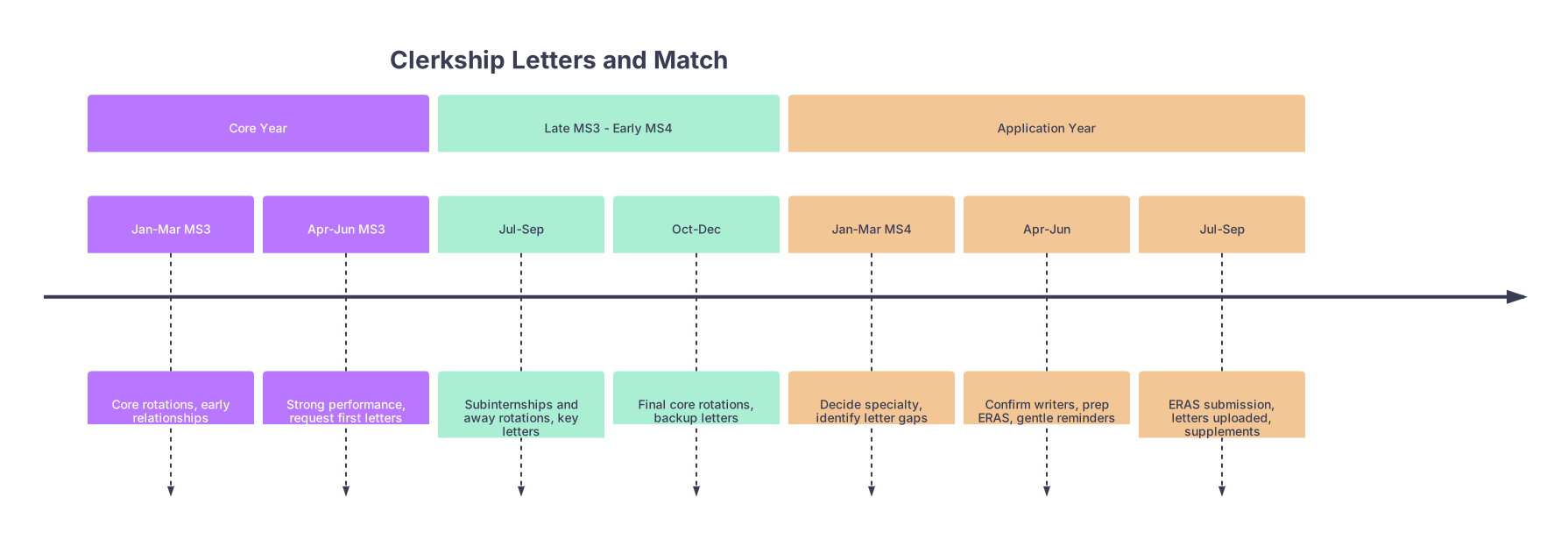
Here is the real sequence that governs when clerkship letters matter most:
| Period | Event |
|---|---|
| Core Year - Jan-Mar MS3 | Core rotations, early relationships |
| Core Year - Apr-Jun MS3 | Strong performance, request first letters |
| Late MS3 - Early MS4 - Jul-Sep | Subinternships and away rotations, key letters |
| Late MS3 - Early MS4 - Oct-Dec | Final core rotations, backup letters |
| Application Year - Jan-Mar MS4 | Decide specialty, identify letter gaps |
| Application Year - Apr-Jun | Confirm writers, prep ERAS, gentle reminders |
| Application Year - Jul-Sep | ERAS submission, letters uploaded, supplements |
The non-negotiable realities:
- ERAS applications typically open in June and can be submitted in September (dates shift slightly each year).
- Many competitive programs start screening as soon as they can see your application and at least two letters.
- The strongest clerkship letters come from:
- 1–4 weeks after you finish a rotation
- When your performance is fresh
- Before your attending forgets you among 30 similar students
You are aiming to have:
- 2 strong letters uploaded by ERAS submission
- 3–4 total letters in the system by early interview season
- 1–2 of those from key clerkships or subinternships in your target specialty
Now let us break this down chronologically.
MS3: Core Clerkships – The Foundation Year
Months 1–3 of Core Clerkships: Lay the Groundwork, Do Not Request Yet
At this point, you are still figuring out:
- How to preround without missing labs
- How to write a passable note
- How to not look lost on rounds
Your job in these first 2–3 months:
Identify potential letter writers:
- Attendings who actually observe you
- People who teach, give feedback, and seem to enjoy it
- Faculty with academic titles (Program Director, Clerkship Director, Division Chief)
Track them:
- Keep a simple note on your phone or doc:
- “IM wards, Dr. Smith – saw my presentations, said ‘excellent fund of knowledge’”
- “Surgery, Dr. Chen – let me assist multiple cases, gave mid-rotation praise”
- Keep a simple note on your phone or doc:
Do not rush to request letters here unless:
- You absolutely crushed a rotation
- You know you want that specialty
- The attending specifically says, “I would be happy to write you a strong letter”
If that happens, you say yes. But for most people, the letter timing sweet spot starts a bit later.
Months 4–6 of MS3: First Wave of Letter Requests
At this point, you should:
- Have a sense of your likely specialty (or at least a short list)
- Know which rotations you have actually excelled in
- Have 1–2 attendings who know you well enough to describe your performance
Best time to request letters from core clerkships:
- The last week of the rotation
- Or within 2–4 weeks after it ends
Why? Your cases, presentations, and patient interactions are still fresh. Wait three months and you become “that good student… what was their name again?”
Week-by-Week Inside a Core Clerkship
Week 1–2:
- Show up early, be prepared, volunteer appropriately.
- Signal interest if relevant: “I am considering internal medicine as a possible career, and I want to learn as much as I can on this rotation.”
Week 3:
- Ask for feedback: “Do you have any suggestions for how I can improve over the last two weeks?”
- Implement that feedback aggressively. Let them see you change.
Week 4 (or final week):
This is your move window.
At this point you should:
Identify the attending who:
- Has seen you repeatedly
- Has watched you present, write notes, and work with patients
- Has shown at least some enthusiasm or specific praise
Ask in person if possible, near the end of a day or after rounds:
- “Dr. Patel, I have really appreciated working with you this month. I am planning to apply to internal medicine, and I was wondering if you would feel comfortable writing a strong letter of recommendation based on my performance on this rotation?”
That word “strong” is not optional. If they hesitate, back off gracefully and choose someone else.
Then:
- Follow up the same day by email:
- Thank them
- Attach a CV and short paragraph about your goals
- Remind them of a specific patient or project you worked on together
You do not need ERAS open to start this. Letters can be written now and uploaded later.
Late MS3: After a Standout Rotation
Some rotations just go unusually well. You click with the team, you handle complicated patients, someone says, “You are functioning like an intern.” That is when you press the advantage.
Optimal timing: within 2 weeks after the rotation ends.
At this point you should:
- Send a targeted email:
- Reference specific feedback they gave you
- Mention your intended specialty (even if you are 80% sure, not 100%)
- Ask if they can comment on concrete strengths (clinical reasoning, work ethic, communication, etc.)
You can explicitly say:
- “I know ERAS will not open for several months, but I wanted to ask now while my performance on this rotation is still fresh in your mind.”
Strategic point:
Even if this is not your chosen specialty, a glowing letter from medicine, surgery, OB, or peds can still anchor your application. Programs love cross-specialty confirmation of work ethic and clinical ability.
Early MS4: Subinternships and Away Rotations – High-Yield Letter Season
This is where timing gets critical. Sub-Is and aways are the most letter-dense rotations of your life.

Subinternships (Home Institution)
For most core specialties, programs expect at least one letter from a subinternship (or equivalent senior rotation) in that field.
Best time to request: last 3–5 days of the sub-I.
At this point you should:
- Be functioning as close to an intern as they will let you
- Have at least one attending who:
- Knows your name without looking at the list
- Has seen you write full H&Ps, manage plans, and follow patients
Your ask here should be more pointed:
- “Dr. Lopez, I am applying to internal medicine this cycle, and this subinternship has been my most meaningful experience. Would you be able to write a strong letter that comments on how I functioned at the intern level on this rotation?”
Follow with:
- Email within 24 hours
- Attach:
- CV
- USMLE/COMLEX scores
- Brief “letter packet”: 1–2 paragraphs on why you chose this specialty, key experiences, and any specific things from the rotation you hope they will highlight
Away Rotations (Visiting Student Rotations)
Away rotations are tricky. Half the students overestimate what they will get. Many leave with a “generic” letter that says nothing unique.
To maximize impact, the timing looks like this:
During the first week:
At this point you should:
- Introduce yourself to the rotation director or key attendings:
- “I am visiting because I am strongly considering [specialty] and I am very interested in [this program or this faculty’s area]. I hope to contribute as much as I can this month.”
Week 2–3:
- Identify one attending who:
- Works with you consistently
- Actually watches your performance, not just your name badge
- Is known to write strong letters (ask residents quietly about this)
Last week (Day 3–5 before end):
This is your window.
- Ask directly in person:
- “Dr. Nguyen, I have really enjoyed working here, and this program is one of my top choices for residency. Do you feel you know my work well enough to write a strong letter of recommendation for my residency application?”
If they say yes:
- Immediately follow up by email before you leave the institution
- Include:
- ERAS letter ID (once available; if not yet, say you will send it as soon as you have it)
- Your CV and exam scores
- Specific reminders of cases or responsibilities you handled
Critical warning:
Do not wait 1–2 months after the away rotation to ask. By then you are just another visiting student in their memory.
ERAS Year: Aligning Letters with Application Deadlines
Now we zoom into the actual application year.
| Timeframe | What You Want Done |
|---|---|
| March–April MS4 | Core and early sub-I letters requested |
| May–June MS4 | All key specialty letters requested |
| July (ERAS opens) | At least 2 letters uploaded |
| August–Early September | 3–4 letters uploaded |
| Category | Value |
|---|---|
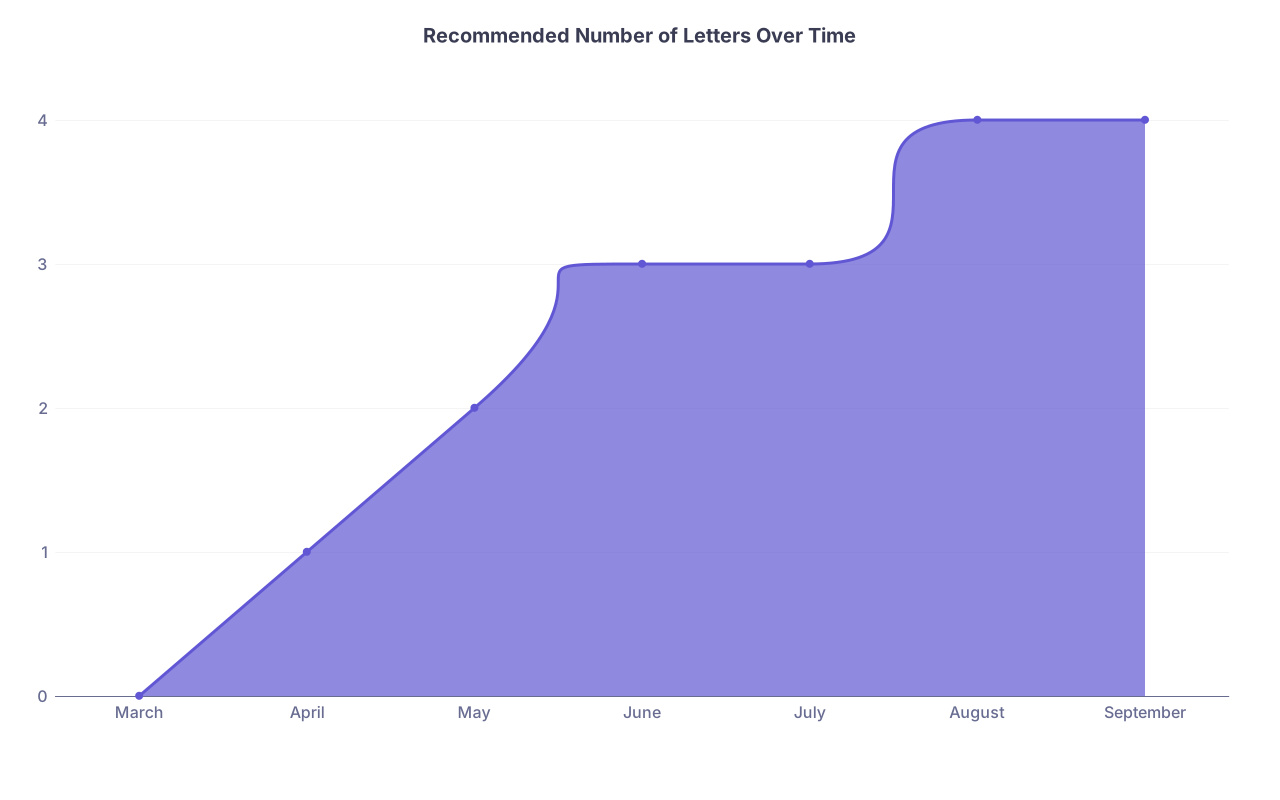
| March | 0 |
| April | 1 |
| May | 2 |
| June | 3 |
| July | 3 |
| August | 4 |
| September | 4 |
March–April (Before ERAS Opens)
At this point you should:
Make a master list of requested letters:
- 1–2 from core clerkships where you excelled
- 1 from your home sub-I in your chosen specialty
- 1 from an away rotation or another senior rotation in your field
- Optional: 1 “wild card” – research mentor, medicine letter for non-IM specialties, etc.
Check in with any faculty who agreed earlier in the year but have not written yet:
- Short, polite email:
- “Dear Dr. ___, as a quick update, I will be applying to [specialty] this upcoming cycle. I remain very grateful for your offer to write a strong letter based on my performance on [rotation]. ERAS will open in [month], and I would be honored to still include your letter. I have attached my updated CV. Please let me know if there is any additional information that would be helpful.”
- Short, polite email:
No nagging, just a nudge and updated context.
May–June: Concrete Follow-Through
This is your “lock it in” phase.
At this point you should:
- Have asked every intended letter writer
- Have ERAS letter slots created as soon as the system opens
- Send each writer:
- ERAS letter request link and ID
- Target date you are hoping to submit (e.g., “early September”)
- Any program-specific notes (for home vs away programs if they will tailor)
Reasonable expectation:
- Many attendings will write over the summer
- Some will wait until the last possible second
- Your job is to make writing the letter easy and timely, not to control them
July–Early September: Submission Window
This is where poor timing kills otherwise good applications.
Programs start reviewing early. You do not want your file sitting incomplete for weeks.
At this point you should:
- Aim to have at least 2 letters uploaded by the time you submit ERAS
- Try to have 3–4 letters uploaded within 1–2 weeks after submission
Ideal mix for maximum impact:
- 1 letter from a sub-I in your specialty (home or away)
- 1 letter from a core clerkship with strong comments about work ethic and clinical reasoning
- 1 letter from another faculty in your specialty
- Optional 4th: research or “cross-specialty” letter emphasizing reliability and teamwork
Polite reminder strategy:
- 3–4 weeks before your planned ERAS submission:
- One concise email:
- “Dear Dr. ___, I hope you are well. I plan to submit my ERAS application for [specialty] on [date]. I wanted to check in and see if you still anticipate being able to upload the letter of recommendation based on my [rotation/experience]. I remain very grateful for your support.”
- One concise email:
If someone clearly is not going to write on time:
- Identify a backup potential writer from a more recent rotation
- Ask them immediately while your performance is still fresh
Putting It All Together: Specialty-Specific Timing Nuances
Some fields are brutal with timing. Others are slightly kinder.
| Specialty | Critical Letter Timing Focus |
|---|---|
| Internal Med | Sub-I + strong MS3 IM core letter |
| General Surgery | Sub-I + away rotation letter |
| EM | 1–2 SLOEs from EM rotations |
| Pediatrics | Sub-I + solid MS3 peds core |
| Competitive (Derm, Ortho, ENT) | Early research mentor + sub-I letters |
| Category | Value |
|---|---|
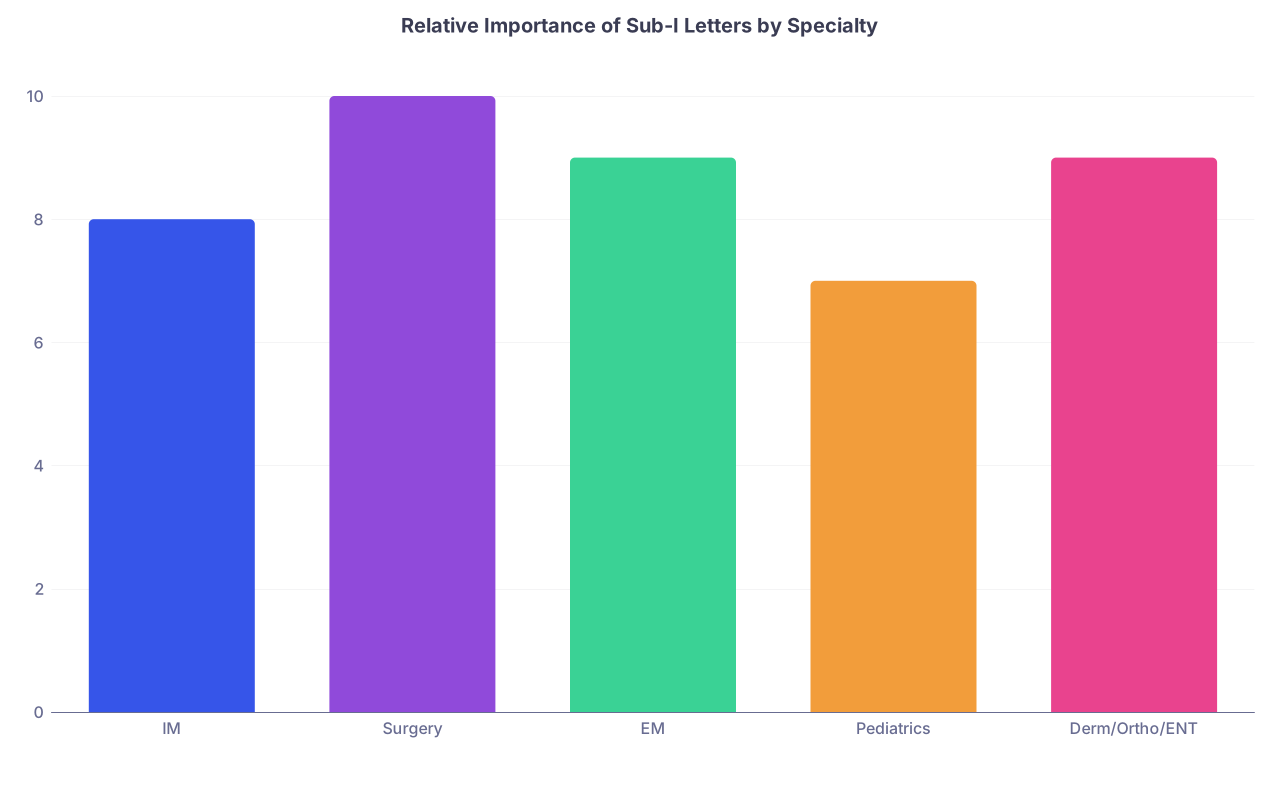
| IM | 8 |
| Surgery | 10 |
| EM | 9 |
| Pediatrics | 7 |
| Derm/Ortho/ENT | 9 |
Emergency Medicine is its own beast (SLOEs, early deadlines), and very competitive specialties often need letters from research mentors requested months earlier—often during MS2–early MS3.
But the timing principles stay the same:
- Ask within 1–2 weeks of a strong rotation
- Do not wait until ERAS opens to start the conversation
- Have letters from the most recent, senior-level rotations ready to go by summer
Common Timing Mistakes To Avoid
At this point you should be smarter than the average applicant. So avoid these:
Waiting until MS4 spring to ask for MS3 letters
- The attending barely remembers you. The letter becomes generic and weak.
Asking after a mediocre rotation “just to have something”
- A lukewarm letter is worse than no letter. Time your asks to coincide with strong performances.
Requesting all letters in August of your application year
- Faculty are slammed. Your application sits incomplete.
Not clarifying your specialty and timeline when you ask
- The writer has no idea what to emphasize or when they must finish.
Relying only on preclinical or research letters
- For residency, clinical clerkship letters carry the most weight. Time those first.
Quick Day-by-Day Checklist Before and After Each Rotation

Final 3 Days of Rotation
At this point you should:
- Decide: “Is this attending a strong letter candidate?”
- If yes:
- Ask in person before the rotation ends
- Confirm by email the same day
- Attach CV + short background + any relevant scores
1–2 Weeks After Rotation Ends
- Send a brief thank-you email even if you already asked:
- Reinforce a positive memory or patient interaction
- Update them if your specialty choice solidified
1–2 Months Before ERAS Submission
Review your letter list:
- Do you have at least 1–2 letters clearly from your target specialty?
- Are they from senior-level or sub-I experiences where possible?
Send gentle reminders with your target submission date
FAQ (Exactly 3 Questions)
1. How many clerkship letters should I actually use versus just request?
Request more than you use. For most specialties, you will assign 3–4 letters per program on ERAS. It is reasonable to request 5–6 total over MS3–MS4 so you can choose the strongest. Time the requests to follow your best rotations, but you do not need to assign every letter to every program.
2. What if my best rotation was early MS3 and I forgot to ask at the time?
Ask anyway, but acknowledge the gap. Email the attending, remind them of specific patients or projects you worked on, and attach your CV. The letter might be less detailed, but a clearly positive core clerkship letter is still useful. Going forward, do not wait more than a few weeks after strong rotations to request letters.
3. Should I delay submitting ERAS until all my letters are uploaded?
No. Submit your ERAS application as early as you can reasonably have it polished, usually early in the opening window. Programs can start reviewing your file as letters trickle in. The key is to have at least two letters uploaded close to your submission date and the rest within the following 1–2 weeks. Your job is to time your clerkship requests so writers can realistically meet that window.
Open your calendar right now and block 15 minutes at the end of each remaining clerkship to decide on potential letter writers and send the ask—that single habit will change how your application looks on review day.