
The biggest mistake students make with ERAS is pretending the calendar doesn’t matter. It does. Your rotation schedule can quietly boost – or quietly sabotage – your application.
You’re not just “doing third year” or “finishing fourth year.” You’re building a 12–15 month runway aimed at one thing: having the right clinical experiences, letters, and scores ready when ERAS opens and programs start looking.
I’m going to walk you through a month‑by‑month plan so that by the time you hit “submit” on ERAS, you’re not wishing you’d done surgery sooner, or panicking because your Sub‑I attending hasn’t even met you yet.
Big Picture: What Has To Be Done Before ERAS Counts You
Before we go month‑by‑month, anchor on this:
By the time programs are seriously reviewing applications (late September–October), you want:
- Core rotations in your chosen field finished (or nearly finished)
- At least 2 strong specialty letters uploaded
- Step 2 CK taken (or scheduled early) with a solid score if Step 1 is pass/fail
- One Sub‑I or advanced rotation in your target specialty completed or in progress
- CV and personal statement aligned with your rotation story
Here’s roughly how the calendar pressure looks across the year:
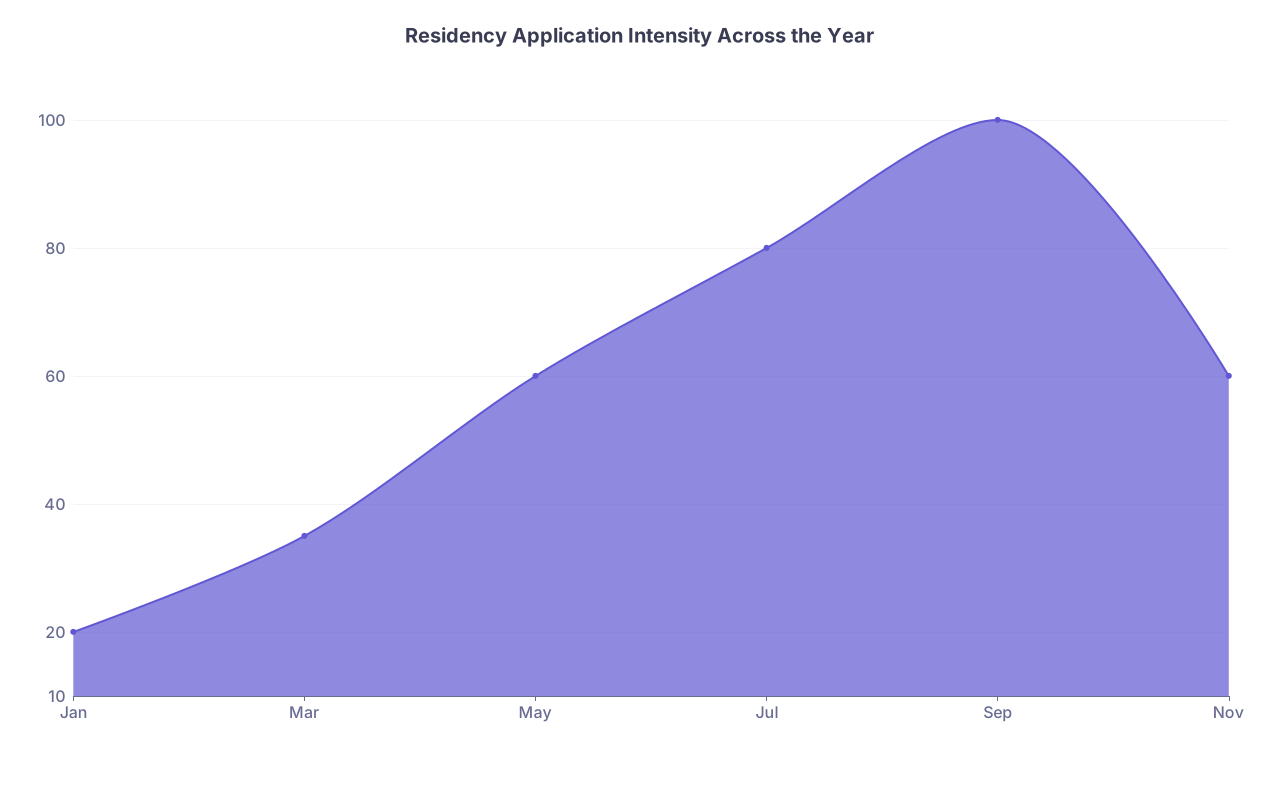
| Category | Value |
|---|---|
| Jan | 20 |
| Mar | 35 |
| May | 60 |
| Jul | 80 |
| Sep | 100 |
| Nov | 60 |
The spike is obvious: July–September. Your schedule should build toward that, not crash into it.
Core Strategy: When To Do What
For most MD/DO schools, this plan assumes:
- Core clerkships: roughly April/May of MS3 through February/March of MS4
- ERAS opens for editing: mid‑June
- ERAS submission opens: early September
- MS4 year starts: May–July (varies by school)
If your school calendar is offset, slide everything accordingly but keep the relative order.
MS3: January–June — Front‑Load What Matters For ERAS
This is the setup phase. You don’t know it yet, but letters and specialty choice are being decided here.
January–February (MS3) – Decide What You’re Leaning Toward
At this point you should:
- Look at your completed rotations so far and ask: “What could I realistically match into and not be miserable?”
- Rank likely options: e.g., “#1 IM, #2 EM, #3 Anesthesia”
- Talk to at least one advisor or resident in each option
Rotation‑wise, you should:
- If possible, have one of your likely specialties early in the spring, not in the last month of MS3.
- If you’ve already done your likely specialty and loved it, good. If not, push to get it March–May, not August.
Why? Because strong letters from cores done in March–June can be ready before ERAS opens. A July/August core leaves your letter writer scrambling.
At this point you should also:
- Start a simple running document:
- “Patients I won’t forget”
- Procedures/skills you cared about
- Feedback quotes from attendings
- This will feed your personal statement and MSPE bullets later.
March–April (MS3) – Target Your Core Rotations Strategically
Now you’re getting close to the point of no return.
At this point you should:
- Lock in your core in your target specialty to be done by June or July at the latest.
- If your school lets you rank rotations, aim for:
- Q2–Q3 MS3: your target specialty (IM, Peds, Surgery, Psych, etc.)
- Don’t bury it as your last core of MS3.
Example:
If you’re leaning Internal Medicine:
- March–April: Medicine core
- May–June: Surgery or Peds
- July–August: Family Med or Psych
I’ve watched plenty of students “discover” IM in November of MS3, then scramble for a rushed Sub‑I. Avoid that.
While you’re on your likely specialty core:
- Identify 2 attendings who see you regularly.
- Ask directly for feedback by week 3:
“I’m strongly considering [specialty]. Is there anything I should improve if I wanted to ask you for a letter later?” - Start a list of potential letter writers.
May–June (MS3) – Build Letter Capital and Prep for Step 2
This is where ERAS prep quietly begins.
At this point you should:
- Finish at least one rotation in your likely specialty by the end of June.
- Confirm with 1–2 attendings that you’d like a letter later (after grades are in, usually).
- Start blocking off time for Step 2 CK studying:
- Many students take Step 2 between late June and August.
- Do not schedule your hardest rotations back‑to‑back with Step 2 if you can help it.
Scheduling priorities:
Don’t schedule Step 2 during your Sub‑I.
You’ll underperform on one or both. Bad idea.Try to have a lighter rotation before the exam (outpatient, elective, FM).
If you are targeting a competitive field (Derm, Ortho, ENT, etc.) and Step 1 is pass/fail:
- Aim for Step 2 by July so that score can help your application.
Summer Transition: June–August — From MS3 to MS4 and ERAS Opens
This is when everything converges: Step 2, Sub‑Is, and ERAS.
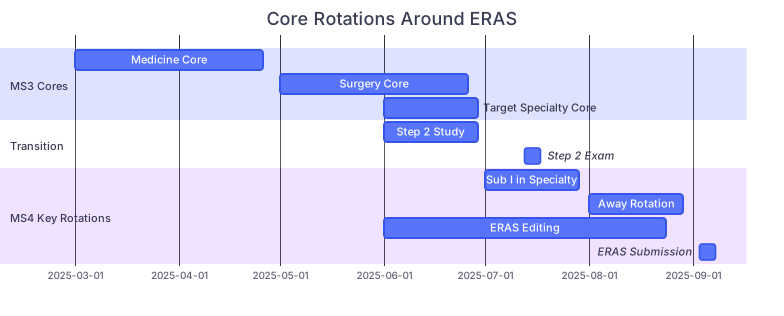
| Task | Details |
|---|---|
| MS3 Cores: Medicine Core | a1, 2025-03, 8w |
| MS3 Cores: Surgery Core | a2, 2025-05, 8w |
| MS3 Cores: Target Specialty Core | a3, 2025-06, 4w |
| Transition: Step 2 Study | b1, 2025-06, 4w |
| Transition: Step 2 Exam | milestone, 2025-07-15, 1d |
| MS4 Key Rotations: Sub I in Specialty | c1, 2025-07, 4w |
| MS4 Key Rotations: Away Rotation | c2, 2025-08, 4w |
| MS4 Key Rotations: ERAS Editing | c3, 2025-06, 12w |
| MS4 Key Rotations: ERAS Submission | milestone, 2025-09-05, 1d |
June – ERAS Opens For Editing
ERAS typically opens mid‑June for you to start filling in info.
At this point you should:
- Have your target specialty declared internally, at least in your own mind.
- Be finishing or just finished your target specialty core.
- Start:
- Entering experiences in ERAS
- Drafting personal statement(s)
- Listing letter writers and contacting them with:
- CV draft
- Brief statement of your goals in that specialty
- Specific patients/cases you worked on with them (to jog their memory)
Rotation considerations in June:
- Ideally on a moderate‑intensity rotation:
- Not ICU
- Not night float
- You need evenings or weekends to:
- Prep Step 2
- Start ERAS data entry
- Email letter writers and advisors
July – Sub‑I and Step 2
This month can make or break your application strength.
At this point you should:
- Be on a Sub‑I or advanced rotation in your target specialty or Medicine/Surgery if your specialty doesn’t have a neat Sub‑I (like EM at some schools).
- Have Step 2 either done or scheduled in the next 4–6 weeks.
Your July goals:
Crush your Sub‑I
- Show up early, stay late, own your patients.
- Tell your attending on week 1: “I’m applying to [specialty] this cycle and I’m hoping to earn a strong letter.”
- Ask for the letter by week 3, not the last day.
Don’t overstack
Doing a Sub‑I and trying to take Step 2 mid‑rotation is asking for a mediocre score and a lukewarm evaluation. Bad combination.
Better patterns:
- July: Sub‑I
- Early August: Step 2 + lighter elective
or
- Late June / early July: Step 2
- Late July / August: Sub‑I

August – Away Rotations and Locking Letters
This is often your last clean month before ERAS submission.
At this point you should:
If you’re doing an away rotation in your specialty, this is prime time:
- August away at a program you’d love to match at.
- September away can still generate useful signal, but the letter may be late.
Ensure:
- All core rotations in your field are completed by end of August (or at least your major exposure done).
- At least 2 letters from your specialty are requested:
- One from core or Sub‑I at home institution
- One from away, if you did one early enough
- Plus 1–2 “supporting” letters (IM, Surgery, research PI)
While on away:
- Treat it like a month‑long interview.
- Ask ahead of time:
- “Will there be faculty who work with students closely enough to write letters?”
- By week 3, if things are going well:
- Ask for a letter and confirm approximate upload timing.
Admin tasks in August:
- Polish personal statement.
- Finalize ERAS experiences.
- Check that letters are requested (not necessarily uploaded yet, but in progress).
ERAS Season: September–October — Submission and Review
Here’s the brutal truth: the earlier your application is complete, the better. That means not just “submitted,” but letters in and Step 2 score reported (if you’re counting on it).
| Timepoint | Rotations You Want Done | Letters You Want In |
|---|---|---|
| Early July | Core in specialty | 1 potential writer |
| Early August | Sub-I or major specialty block | 2 writers verbally agreed |
| ERAS Submission | Sub-I done or in progress | 2 specialty + 1 other in |
| October 1 | At least 1 strong eval from MS4 | All letters uploaded |
Early September – ERAS Submission
At this point you should:
- Submit in the first week ERAS allows submissions, not “whenever.”
- Have:
- Step 2 score finalized or pending with test taken
- Minimum 3 letters uploaded (4 is better, capped per program rules)
- Sub‑I evaluation either completed or soon to be included in your MSPE
Rotation scheduling in September:
- Ideal: a manageable elective:
- Something in your specialty or a complementary field that isn’t brutal.
- Allows time for:
- Interview prep
- Tracking programs
- Fixing any ERAS glitches
Avoid:
- ICU or night float
- Early acting internships that will leave you too tired to answer emails or schedule interviews
October – Programs Reviewing, You On a Useful Rotation
This is when programs start pulling applications and sending interview invites.
At this point you should:
- Be on a rotation that:
- Generates a helpful MS4 evaluation in your specialty or a related one
- Allows you to:
- Answer emails during the day
- Take the occasional half day for virtual interviews as they start trickling in
Rotation suggestions:
- If you’re going into IM:
- October: another inpatient IM or subspecialty month
- Going into EM:
- October: EM at a different site or a critical care block (if not overwhelming)
- Going into Surgery:
- October: one more general surgery month or a subspecialty you’re eyeing
Do not underestimate:
- Programs reading the narrative portions of your MS4 clerkship evaluations in the MSPE.
- I’ve seen “below expectations for level” on an October Sub‑I absolutely kill someone’s chances.
Late MS4: November–February — Interviews and “Signal” Rotations
Once ERAS is in, your schedule shifts away from building the application to supporting interviews and your sanity.
November–January – Interview Season
At this point you should:
- Prioritize rotations that:
- Are lighter or at least flexible
- Have attendings used to students leaving for interviews
Good options:
- Outpatient subspecialty clinics
- Research elective
- Radiology, pathology, dermatology consults (if not your specialty)
- “Interview elective” if your school offers it
Terrible options:
- ICU
- Heavy inpatient services with 6‑day weeks
- Rotations that require 100% attendance to pass
You want to:
- Keep appearing responsible and engaged on your rotations.
- Not burn bridges by disappearing constantly for interviews.
- Still have bandwidth to actually rank programs thoughtfully.

February–March – Rank List and Cleanup Electives
By this point, the die is mostly cast.
At this point you should:
- Finish any graduation‑required rotations not yet done.
- Take:
- A rotation that rounds out your skills for intern year.
- Future intern in IM? Consider an extra night float, cards, or ID month.
- Future EM? Another month of EM, or MICU/trauma if you haven’t done them.
- A rotation that rounds out your skills for intern year.
- Avoid any rotation that could result in a professionalism flag or big conflict just before Match.
Your ERAS‑related work here:
- Finalize and submit rank list.
- Get any last evaluations logged cleanly in your MSPE addendum if your school does that.
- Close the loop with mentors and letter writers (thank‑you emails, updates).
Specialty‑Specific Scheduling Traps (And How To Avoid Them)
Different fields care about different clerkships. You schedule poorly, you pay for it.
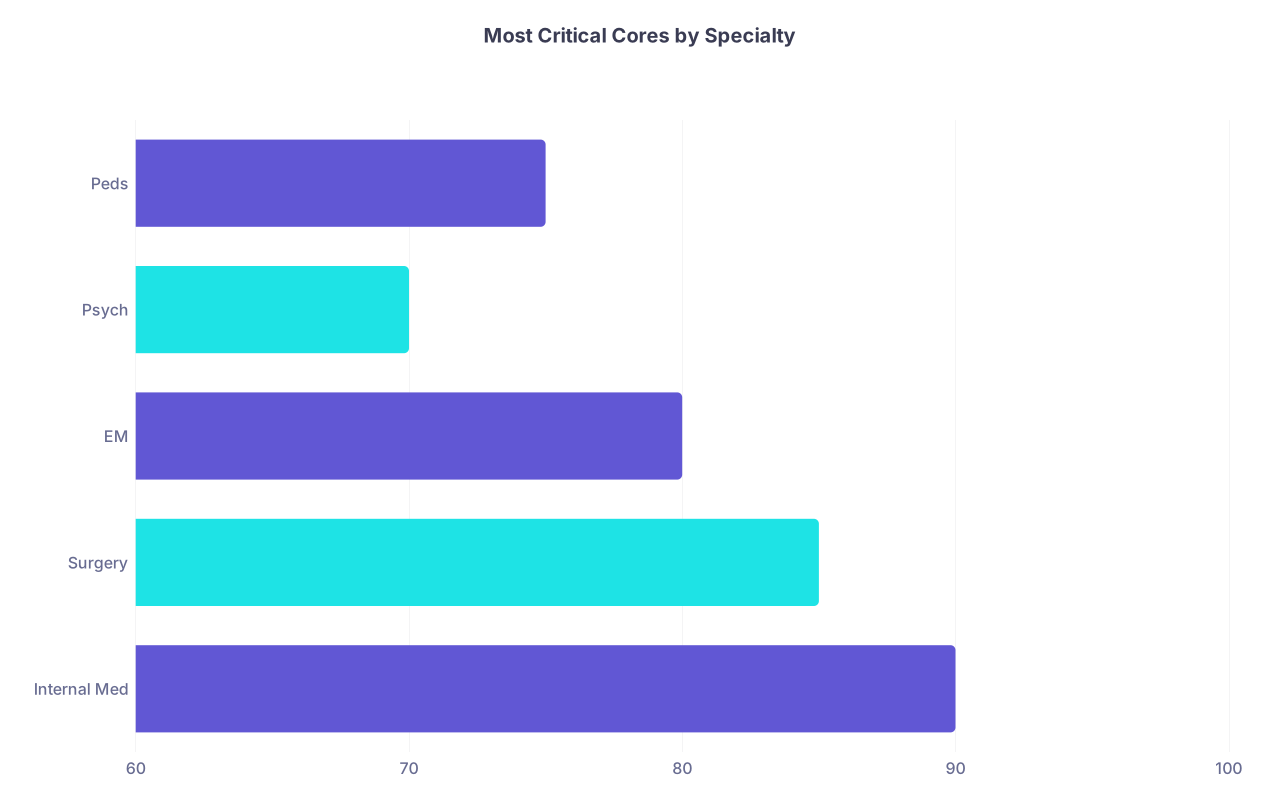
| Category | Value |
|---|---|
| Internal Med | 90 |
| Surgery | 85 |
| EM | 80 |
| Psych | 70 |
| Peds | 75 |
If You’re Aiming for Internal Medicine
At this point you should, by ERAS submission:
- Have:
- Medicine core done by June
- At least one Medicine Sub‑I by August/September
- Schedule:
- ICU sometime MS4 (but not during peak interview season)
- Letters:
- 2 IM letters (one Sub‑I, one core or subspecialty)
- 1 additional from research or related field
Bad idea: First and only Medicine Sub‑I in November. That letter won’t help you for interviews.
If You’re Aiming for Surgery
You need to look committed and durable.
At this point you should:
- Finish Surgery core by early MS3 or mid‑MS3 at the latest.
- Do:
- At least one Surgical Sub‑I by July/August of MS4.
- An away rotation at a program of interest in July–September.
Avoid:
- Front‑loading all light rotations and saving surgery for last.
You’ll look undecided and your technical skills will lag.
Letters:
- 2 Surgery letters (home + away, or 2 home)
- 1 from a Medicine or ICU attending can help show you’re not just an OR person.
If You’re Aiming for EM, Anesthesia, Psych, or Peds
The pressure is different but the timing is still critical.
For EM:
- Two EM rotations before ERAS if possible (home + away).
- At least one by July/August to generate a SLOE.
- Don’t push your first EM month to September if you can avoid it.
For Anesthesia:
- Strong IM and Surgery cores early.
- Anesthesia electives and ICU before application to show genuine interest.
For Psych:
- Psych core by mid‑MS3.
- One inpatient psych or CL psych Sub‑I by August–September.
For Peds:
- Peds core by mid‑MS3.
- Peds Sub‑I or NICU/PICU month before ERAS if you can handle the workload.

Putting It All Together: A Model Month‑by‑Month Flow
Let me lay out a concrete, example timeline for a student targeting Internal Medicine, starting cores in March MS3 and applying that next year.
| Month (Relative) | Rotation Focus | ERAS / Step Actions |
|---|---|---|
| MS3 Mar–Apr | Surgery Core | Explore interests |
| MS3 May–Jun | Medicine Core | Identify potential letter writers |
| MS3 Jul–Aug | Peds + Psych | Start Step 2 resources |
| MS3 Sep–Oct | FM + OB/GYN | Narrow to IM as target |
| MS3 Nov–Dec | Elective (Cardiology) | Plan Step 2 window |
| MS3 Jan–Feb | EM or other elective | Draft experiences list |
| MS4 Mar | Medicine Sub-I | Request IM letter #1 |
| MS4 Apr | ICU or subspecialty IM | Study for Step 2 |
| MS4 May | Lighter elective + Step 2 exam | Start ERAS entries |
| MS4 Jun | Away IM or second Sub-I | Request IM letter #2, PS draft |
| MS4 Jul | Outpatient elective | Finalize ERAS, confirm letters |
| MS4 Sep | Lighter elective | Submit ERAS, prep for interviews |
| MS4 Oct–Jan | Flexible electives | Interview season |
You’ll tweak the months based on your school calendar, but the logic stands:
- Early solid exposure
- Sub‑I and away before ERAS matters
- Lighter blocks during Step 2 and interview spikes

Final Checkpoints: If You’re Reading This Late
If it’s already late MS3 or early MS4 and your schedule is a mess:
- Move your Sub‑I and at least one specialty elective as early as you can, even if it means swapping.
- Protect a Step 2 study and exam window that doesn’t collide with your heaviest block.
- Make September a lighter month for ERAS submission tasks.
Do whatever it takes to avoid:
- First real exposure to your target specialty after ERAS is submitted.
- No Sub‑I in your chosen field before applications go out.
- Taking Step 2 during an ICU month.
Key Takeaways
- Your rotation order is not cosmetic; it directly affects letters, Step 2 timing, and how serious you look to programs.
- Aim to complete your target specialty core and at least one Sub‑I before ERAS submission, with letters requested by August.
- Protect lighter months around Step 2 and early ERAS, and avoid heavy ICU/ward blocks during interview season.