
The Unwritten Rules Attendings Use to Judge Sub‑I Readiness
Attendings decide if you’re “sub‑I ready” in about 48 hours, and it has almost nothing to do with how smart you sound on rounds.
Let me tell you what actually happens behind the curtain. Because the story students believe—“If I read a ton and crush my presentations, I’ll be treated like an intern”—is only half the truth. The other half lives in those side comments in the workroom, the eye contact (or lack of it) when you talk, and whether the resident sighs in relief or dread when you walk onto the unit.
You’re not just doing a strong clerkship. You’re auditioning for a job. These “unwritten rules” are what attendings and senior residents use to decide: Would I trust this person as my intern on July 1?
If you want a strong letter that actually moves the needle for residency, you need to play the game they’re actually playing—not the one the syllabus describes.
How Attendings Quietly Sort Students in the First Week
Here’s the uncomfortable truth: by the end of day two or three on a core clerkship, most attendings already have you mentally sorted into one of three buckets.

I’ve sat in workrooms and heard versions of this at places like Hopkins, MGH, and solid community programs alike:
- “She’s basically functioning like an intern already. Give her more patients.”
- “He’s fine, just needs a lot of direction.”
- “We should probably keep the patients with him simple.”
What gets you into that first category—the “functioning like an intern” group—is not one magic behavior. It’s a pattern. Attendings and senior residents are subconsciously (and sometimes very consciously) scoring you on a few internal checkboxes:
| Domain | What They’re Really Asking |
|---|---|
| Reliability | Do you do what you say, every time? |
| Clinical thinking | Can you build a basic, safe plan? |
| Ownership | Do you act like these are *your* patients? |
| Communication | Are you easy and efficient to work with? |
| Work ethic | Are you present and engaged without drama? |
No one tells you this. The evaluation form talks about “medical knowledge” and “professionalism.” But when the attending sits at the computer filling in your grade, those vague domains get translated into something much more concrete and much more personal: Would I be okay if this person signed out to me and then went home?
That’s “sub‑I ready.” That’s the bar.
Rule 1: Reliability Beats Brilliance, Every Single Time
I’ve watched attendings give higher evaluations to a C+ knowledge student than an A+ gunner. Why? Because the C+ student was relentlessly reliable.
Here’s how they test this without telling you they’re testing it:
- The attending says, “Can you follow up the CT and let us know before rounds end?”
- The senior says, “Flag me the second that potassium recheck comes back.”
- A nurse asks, “Can you let the team know family wants a meeting today?”
On paper, this is basic clerical work. In reality, it’s an early stress test of whether you can be trusted with patient‑critical tasks. Intern work.
The unwritten scoring system in the attending’s head looks like this:
- You say you’ll do something, you do it, and you close the loop efficiently → “Trustworthy.”
- You say you’ll do something, you forget, or you half‑do it and never update anyone → “Not sub‑I ready. Needs babysitting.”
- You’re vague about what you did or didn’t do when asked → “Potentially unsafe.”
That last one—vagueness—is death. I’ve watched an attending at a big Midwest academic program downgrade a student from “Honors” level to “High Pass” after a single interaction where the student said, “I think they ordered that lab,” when they actually hadn’t checked.
If you want to look sub‑I ready, you adopt intern‑level reliability:
- You write down tasks as they come.
- You time‑box them in your head. Labs by 9:30. Imaging by 10. Dispo by noon.
- You close the loop out loud: “I called radiology, CT is scheduled for 2 PM, I’ll check back after it’s done.”
No drama. No excuses. Just predictable execution.
Rule 2: “Owning” Patients Is Not a Buzzword, It’s the Core Metric
Attendings use the word “ownership” constantly. Most students nod like they understand, then interpret it as “I care a lot” or “I read about the disease.” That’s not wrong, but it’s incomplete.
When attendings ask in resident meetings, “Does she own her patients?” they’re asking something brutal and simple:
“If I walked onto the unit at 3 AM with a crashing patient of hers, would she be the most up‑to‑date person on that patient, other than the intern?”
On a good team, the student with real ownership is unmistakable. They:
- Know the updated vitals, new labs, recent imaging.
- Have thought ahead about what might happen next.
- Are one step ahead on dispo, follow‑ups, and barriers.
They sound like this on rounds:
“Mr. Garcia’s creatinine came down from 2.1 to 1.7 overnight after we held the lisinopril and gave 1 L of LR. He’s still net positive 1.2 L this admission. If he tolerates PO and his pressures stay in the 120s, I think we can restart his lisinopril at a lower dose tomorrow. I’ve already queued up outpatient nephrology follow‑up—earliest is 3 weeks out.”
That’s sub‑I‑ready talk. It’s concrete, anticipatory, and shows that this is their patient, not just a name on their list.
Contrast that with the student who presents facts but no ownership:
“Mr. Garcia’s creatinine is better. We held some meds and gave fluids. He’s doing okay.”
Attendings won’t call you out. They’ll just silently put you in the “not quite there yet” bucket.
The checkboxes behind “ownership”
When I’ve seen attendings evaluate this, they’re subconsciously tracking:
- Does this student seem surprised by new information about “their” patient?
- Do they bring up issues before residents have to ask?
- Do they notice when something doesn’t make sense in the chart?
- Do they move things forward (consults, imaging, dispo) without hand‑holding?
That’s why sub‑Is often get very strong letters. A good sub‑I looks indistinguishable from a low‑maintenance intern by Week 2. The unwritten rule is this: if you want residency‑level respect (and letters), you have to act like the patients are yours before the role officially says they are.
Rule 3: Your Plan Can Be “Wrong” and Still Impress Them
Students obsess over giving the “correct” plan. Attendings obsess over whether you have a plan at all.
I’ve seen a student on medicine say: “I’m not sure what to do,” three days in a row. Smart kid, lots of reading, could quote trial acronyms. Got a very lukewarm evaluation. Meanwhile, another student on the same rotation routinely offered plans that weren’t perfect, but structured and safe. He walked out with an Honors and a letter that basically said, “We’d hire him as an intern tomorrow.”
Behind closed doors, this is how attendings talk about it:
- “Her plan was off, but she had a framework and listened to feedback. She’s thinking like a doctor.”
- “He just reports data and looks at me for next steps. That’s still a student mindset.”
Being sub‑I ready isn’t about being right. It’s about being brave enough to stake out a reasonable plan and then update it when someone smarter corrects you.
A sub‑I‑level plan sounds like:
“Given his rising O2 requirement, I’d like to broaden his antibiotics from ceftriaxone and azithro to cefepime and vanc, get ABG, and call the ICU if he needs more than 6 L. I’d also repeat a chest X‑ray to rule out new effusion or worsening consolidation. I’m not sure if we should add steroids yet; I’d like your input on that.”
Notice: clear structure, clear thresholds, explicit acknowledgment of uncertainty. That’s what makes attendings comfortable. That’s what tells them, “This student can generate options and ask for help at the right time.”
Rule 4: Being “Low Maintenance” Is a Superpower
Students underestimate how much their “vibe” affects evaluations.
When the residents are drowning, the student who quietly handles pages from nurses (within scope), prints discharge papers, calls the family to confirm follow‑up, and doesn’t need to be asked five times? That’s the one the attending hears about later.
The unwritten rule from residents to attendings is simple: “Is this person net‑positive for the team, or are they just one more body we have to manage?”
There is a whole, unspoken resident evaluation of you that never reaches your ears:
- “He disappears whenever things get busy.”
- “She hangs around the workstation but doesn’t ask, ‘What can I take off your plate?’”
- “He needs three layers of direction for simple tasks.”
- “She shows up early, stays late when needed, and doesn’t complain.”
The attending hears a distilled version of that in about 30 seconds during mid‑rotation feedback. And a lot of them believe their residents over their own impressions, because the residents worked with you when no one was watching.
Sub‑I ready = residents trust you. Attendings trust their residents. That chain is how your grade and your letter really get decided.
Rule 5: Emotional Self‑Management Signals “I Can Survive Intern Year”
Attendings are not just assessing your brain. They’re quietly watching your emotional regulation.
They’ve seen enough intern meltdowns to know exactly what red flags look like as a student:
- Defensiveness when given feedback.
- Visible sulking after being corrected.
- Throwing other team members under the bus.
- Over‑apologizing and spiraling after small mistakes.
I saw a strong student on surgery at a top‑20 program knock herself out of an Honors because of this. She got flustered, snapped at a nurse, and then tried to spin it during feedback. The attending’s comment in the eval system was short and lethal: “Good fund of knowledge, but emotional response to stress raises some concern about readiness for intern role.”
That comment will follow her into her MSPE. Programs read that stuff carefully.
Being sub‑I ready is being able to:
- Hear blunt feedback.
- Say, “Got it. I’ll fix that.”
- Actually fix it.
- Move on without theatrics.
Attendings love students who can take a hit and adjust without drama. Because that’s intern year in a nutshell.
Rule 6: Quiet Situational Awareness > Loud Performances
There’s a certain student archetype every attending recognizes: the one who shines in conference, delivers TED‑talk‑style presentations, and then misses the fact that a patient’s escalating O2 needs have been ignored for three hours.
Sub‑I readiness is more about being able to read the room—and the unit—than about performing for the room.
This is where your “clerkships that help with residency match” actually come into play. The students who crushed medicine wards, hard ICU rotations, and busy ED months tend to get this earlier:
They watch where the bottlenecks are. They anticipate pages. They know when the senior looks stressed, that’s not the time to ask for elaborate teaching on hyponatremia. Instead, they say: “Hey, can I grab vital sign updates and pending imaging results so we’re ready for sign‑out?”
Attendings absolutely notice this. And they remember it when they’re reading applications and trying to match a vague face to an LOR months later.
How This Ties Directly Into Your Residency Match
You’re not doing this just for personal development. You’re trying to build a narrative for programs: “I already operate at near intern level. You’re not gambling on me.”
The attendings write that story in your letters—if you give them the material.
Look at how these elements translate into concrete language in a strong letter:
- Reliability → “We could consistently count on her to follow through on tasks without reminder. More than once, the team depended on her to ensure key labs and imaging were completed on time.”
- Ownership → “He took thorough ownership of his patients, often catching subtle issues in labs and vital signs that others had missed.”
- Planning → “She routinely presented thoughtful assessment and plans that demonstrated intern‑level clinical reasoning.”
- Low maintenance → “He functioned more like a sub‑intern than a student; residents frequently commented that he made the team’s work easier.”
- Emotional stability → “Even under high stress and long hours, she remained calm, professional, and receptive to feedback.”
That’s the language that gets attention in program director meetings. Not “great to work with” fluff. Concrete signals of sub‑I readiness.
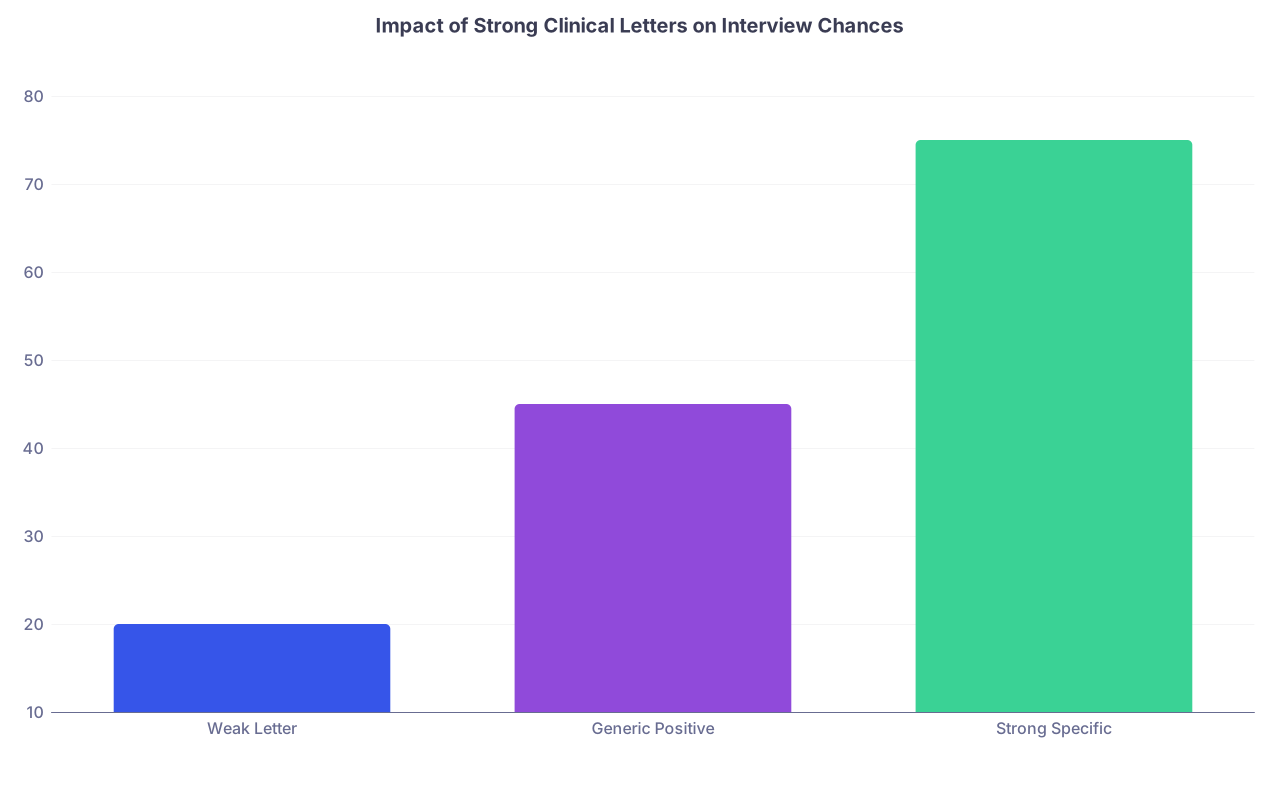
| Category | Value |
|---|---|
| Weak Letter | 20 |
| Generic Positive | 45 |
| Strong Specific | 75 |
Are those numbers approximate? Of course. But ask any program director: a strong, specific letter from a rotation where you clearly acted sub‑I ready absolutely bumps you from the maybe pile to the interview pile at many programs.
How to Signal Sub‑I Readiness Before You’re Technically a Sub‑I
Students always ask, “So do I just wait until my sub‑I to do all this?” No. The attendings who will write your best letters will often come from your earlier core clerkships and audition rotations.
You can start behaving like a sub‑I without overstepping:
- Ask, “Can I be the primary student on 2–3 patients and follow them as if I’m the intern, including calling family, coordinating with nursing, and drafting notes?”
- Tell the resident on Day 1: “I’d like feedback early and often. My goal is to be at sub‑I level by the end of this rotation.”
- After a week, ask your resident privately: “If this were my sub‑I, what would I need to be doing differently to be considered intern‑ready?”
You’ll be shocked at how blunt they’ll be when you ask that last question sincerely.

| Step | Description |
|---|---|
| Step 1 | Start Core Clerkship |
| Step 2 | Basic Student Tasks |
| Step 3 | Take Ownership of 1-2 Patients |
| Step 4 | Start Proposing Full Plans |
| Step 5 | Ask for Resident-Level Feedback |
| Step 6 | Function Like Sub-I on Core |
| Step 7 | Formal Sub-Internship |
| Step 8 | Strong Letters & Match Signal |
If you can reach step F before G—functioning like a sub‑I before your actual sub‑I—you’re exactly the kind of student who stands out in the residency pile.
One More Hard Truth: Some Attendings Don’t Notice, Residents Do
Not every attending is tuned in. Some are half on autopilot, in clinic a lot, or simply not that invested in student development.
But residents always notice. And residents talk.
When it’s time for sub‑I selection, away rotation recommendations, or quiet emails to friends at other programs saying, “This student is legit, take them seriously,” it’s the residents pushing your name.

So if you find yourself with a disengaged attending, don’t throw the rotation away as “lost.” Treat it as a resident‑audition block instead. Ask your senior:
- “What would make you say, ‘I’d want this person as my intern’?”
- “Where am I on that spectrum right now?”
- “What do I need to fix in the next week to get closer?”
Residents are brutally honest when asked directly and respectfully. Use that.
FAQ: The Unwritten Rules, Clarified
1. Do I need to know everything about my patients to look sub‑I ready?
No. You need to know the right things and be honest about what you don’t know. You should know vitals trends, key labs, imaging, overnight events, meds affecting the current problem, and disposition barriers. If you’re fuzzy on esoteric pathophys, that’s fine. If you’re fuzzy on whether your patient is still on oxygen or what their code status is—that’s a problem.
2. How many patients should I carry to look “intern‑like” without drowning?
On a busy medicine service, three to four full‑complexity patients, truly owned, is enough to impress. I’ve seen students try to carry six or seven and do a mediocre job on all of them. Attendings aren’t counting raw numbers. They’re asking, “Are the patients this student follows being managed safely and thoughtfully?” Depth over breadth wins here.
3. What if my resident is micromanaging and won’t let me step up?
Then you make it easy for them to loosen the reins. Over‑communicate early, execute perfectly on small tasks, and ask for defined responsibility: “Could I try drafting the plan for this patient and run it by you before rounds?” If they’re still controlling everything by Week 2, tell the attending privately (and non‑whiny): “My goal is to reach sub‑I readiness. Is there a way I can take more structured ownership of a couple patients so I can work toward that?” Good attendings will create that space for you.
Key points to remember: attendings and residents judge “sub‑I readiness” on reliability and ownership more than raw knowledge; being low‑maintenance and emotionally steady under pressure is a huge, underrated signal; and if you start acting like an intern before your sub‑I, your letters and your match options will look very different.