
The myth about chair’s letters is simple: students think one glowing letter can save their application. It cannot. But it absolutely can hurt it.
Let me walk you through how chair’s letters from clerkships are actually created, who really writes them, what gets put in, and how program directors quietly use them when they are deciding whether you rise, fall, or disappear from their rank list.
What a Chair’s Letter Really Is (Not What You Were Told)
At most schools, the “Chair’s Letter” is sold to you as: a personalized, holistic assessment from the department chair, capturing your performance and potential for the specialty.
That’s the brochure version.
Here’s the reality I’ve watched play out across places like mid-tier university hospitals, big-name academic centers, and community affiliates:
- The chair rarely knows you personally.
- The factual backbone of the letter comes from your clerkship evaluations and a spreadsheet.
- The narrative language is 60–80% templated.
- One or two specific sentences can make or break how a program director interprets your entire clinical record.
The important part is not the letter’s existence. It’s the signal buried inside the sameness.
When you read your own chair’s letter (if your school lets you), you’ll probably think: “This is… fine?” That’s by design. These letters are built to be safe and standardized. The outliers—truly outstanding or quietly damning—are where the real decisions get made.
How Chair’s Letters Are Actually Produced
Let me strip away the ceremony and show you the pipeline behind that “prestigious” department letter.
Step 1: The Spreadsheet Phase
At the start of application season, the department coordinator or education office pulls your data:
- Shelf scores
- Clinical evaluation ratings
- Honors/High Pass/Pass breakdown by rotation
- Narrative comments from attendings and residents
- Any professionalism flags, remediation, leaves
- Class rank or quartile if your school reveals it
- Research, AΩA / Gold Humanism, leadership roles, etc.
This goes into a master document or database. I’ve literally watched an admin assistant at a major academic program open a color-coded Excel file and say, “We need to get through 62 of these this week.”
For most students, your identity at this stage is a row in a table and some numerical/rating fields.
| Component | Source |
|---|---|
| Clerkship grades | Registrar / Med Ed office |
| Shelf scores | NBME reports |
| Narrative comments | Clerkship evaluation system |
| Professionalism | Student affairs / deans |
| Research & awards | CV you submit |
If you think the chair is sitting down with your evaluations spread across their desk in deep contemplation—no. Your file is pre-digested before it ever hits their inbox.
Step 2: The Template
Almost every department uses a template. I’ve seen versions from medicine, surgery, psych, EM, OB, peds. They all read like:
“I am pleased to write in support of [Student Name], a [fourth-year] medical student at [School], who is applying to [Specialty]. [He/She/They] is an [adjective] student who has performed [descriptor] throughout the clinical years.”
Then you get a standardized paragraph about performance compared with peers, sometimes a line about shelf scores, sometimes a line about professionalism, then a conclusion sentence signaling strength of endorsement.
The real “writing” happens in about three places:
- The comparative language
- The specificity (or lack of it) in the clinical description
- The closing strength statement
Everything else is window dressing.
Who Actually Writes It (Hint: Often Not the Chair)
Here’s the part nobody tells you as a student: the person whose name is on the letter is often not the person who wrote the first draft.
Common patterns I’ve seen:
- Education fellows or chief residents drafting letters for borderline or complicated cases.
- An associate program director or clerkship director writing the bulk, then the chair superficially “customizing.”
- Administrative staff merging templated language with your metrics, then sending to the chair for a 30–60 second final pass.
At one large IM department I know, the workflow is blunt:
- Admin runs a mail merge with stock paragraphs based on your overall quartile.
- Clerkship director quickly edits 10–15 a day, changes a sentence or two.
- Chair signs remotely, maybe modifies 1 out of 20 if someone is extremely strong or there’s a landmine.
So when your dean’s office tells you, “You’ll meet with the chair so they can get to know you for the letter”? The chair might care about that meeting. Or they might immediately forget most of it and rely on your evals.
The only students the chair truly “knows” and writes from scratch about:
- The rockstars who did research in their lab, worked on departmental projects, or were on their radar for two+ years.
- The problem cases—professionalism issues, failed rotations, major remediation—where the school wants tight message control.
Everyone else gets the system version.
The Hidden Grading Scale Inside Chair’s Letters
Program directors read these letters in a completely different dialect than students. Where you see “supportive,” they see “damning with faint praise.”
Let me translate the code.
1. Comparative Language: This Is the Real Grade
Phrases like:
- “Among the top 10% of students I have worked with in the last X years”
- “Among the top third of students in this class”
- “Comparable to our typical entering residents”
- “An average student in our class”
- “Performed adequately on all clerkships”
Directors know that truly strong departments will not put “top 10%” casually. At many places you can count on one hand the number of students who get that level of praise each year.
Here’s how those phrases really land:
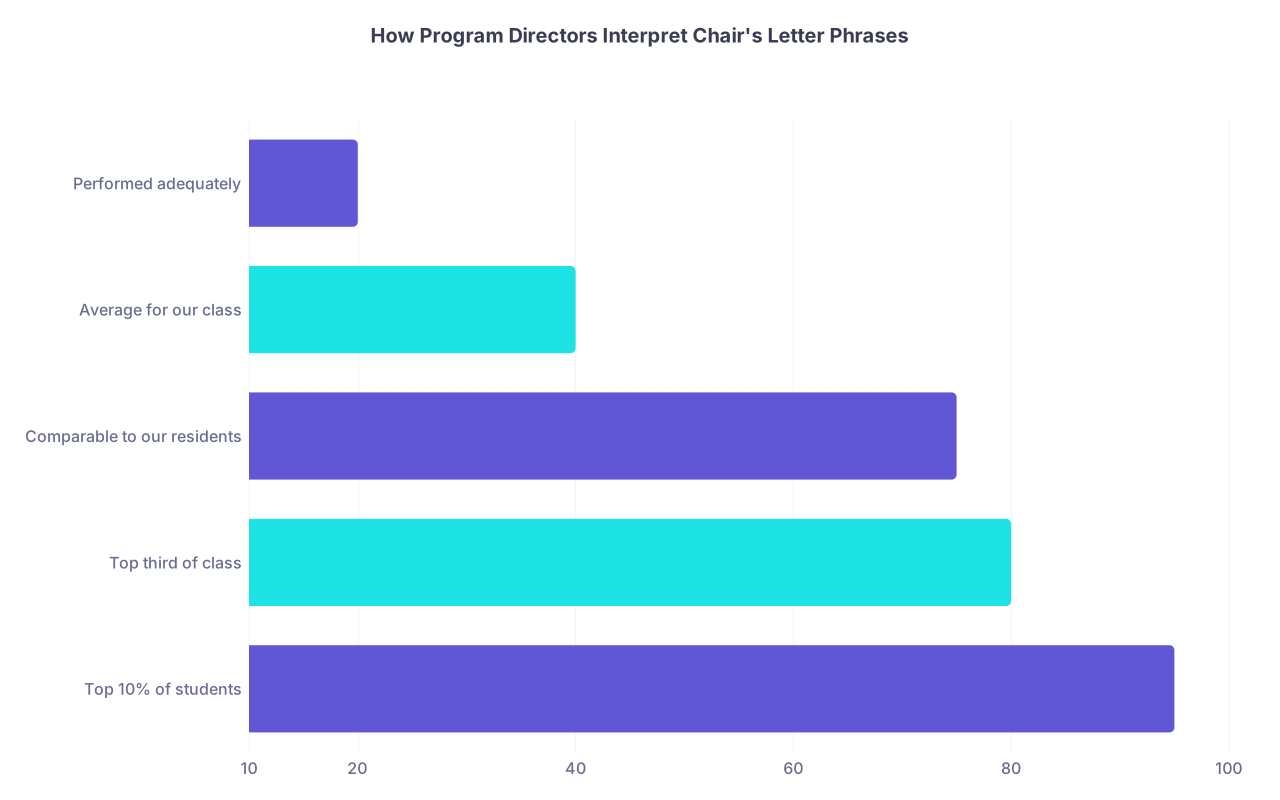
| Category | Value |
|---|---|
| Top 10% of students | 95 |
| Top third of class | 80 |
| Comparable to our residents | 75 |
| Average for our class | 40 |
| Performed adequately | 20 |
That “value” is not a probability; think of it more as how positively PDs react to that language on a 0–100 scale.
- “Top 10%” = green flag. You just moved up a pile.
- “Top third” = solid. Not a superstar, but strong.
- “Comparable to our residents” = careful praise. Reads like: technically capable, maybe not dazzling.
- “Average for our class” = yellow flag at competitive programs. Might be fine in many community settings.
- “Performed adequately” = soft red flag for specialties with any competitiveness.
2. Specificity vs. Vagueness
Program directors notice if your chair’s letter says:
“On her medicine clerkship, she routinely identified subtle exam findings, generated prioritized differentials, and followed through on complex care plans with minimal prompting.”
versus:
“He completed his medicine clerkship and received strong evaluations from his supervisors.”
Specific behaviors, concrete actions, and discipline-specific skills suggest the writer either knows you or cares enough to look you up. Generic language plus no comparative data? That letter is functionally neutral at best.
3. The Closing Line: This Is the Signal
The last two sentences are where chairs hide what they really think.
Here’s the unofficial translation guide program directors share with each other at meetings and in back-channel emails:
“I recommend her without reservation for your residency program.”
→ Strong endorsement.“I strongly recommend him for a position in your residency program.”
→ Strong as well, especially paired with “top X%” earlier.“I recommend her for a position in your program.”
→ Neutral. Not harmful, not helpful. Safe.“I believe he would be a good addition to your program.”
→ Soft. Sometimes code for: fine, but not exciting.“I support his application to residency training.”
→ That’s the lowest level of support without being negative. Program directors do not like seeing this on a supposedly “supportive” letter.
Yes, these few verbs—recommend, strongly recommend, support—get dissected that closely by people reading hundreds of files.
How Different Specialties Use Chair’s Letters
Not all specialties care equally. And the patterns are predictable.
Medicine, Surgery, OB/GYN, Pediatrics
Core disciplines and many subspecialties actually read these letters.
For competitive IM, general surgery, OB, and some peds programs, the chair’s letter is the “sanity check” on your MSPE and clerkship evals. The unspoken use case:
- “Do the numbers and the narrative match?”
- “Is there any sign this student was difficult, lazy, or unsafe?”
- “Is this someone their own department would be comfortable calling a top-tier trainee?”
If there’s misalignment—stellar board scores but “average” clinical language, or several honors but only “adequate” phrasing—that gets noticed.
I’ve sat in rank meetings where someone says, “Her chair’s letter is just ‘average for our class,’ but she has straight honors. What’s the story?” That question can cost you spots on the list if nobody can answer it.
Emergency Medicine: The SLOE World
EM is different because they already live and die by SLOEs (Standardized Letters of Evaluation). The “chair’s letter” is often a departmental SLOE or something functionally similar.
What matters there:
- Global assessment box checked (top 10%, top third, etc.)
- Comparative ranking statements to other EM applicants from the same school
- Any whiff of “needs direction,” “limited work-pace,” or “requires frequent redirection”
EM PDs are brutal in how they weigh small negative signals. A single lukewarm line in a departmental SLOE can sink an otherwise numerically strong applicant.
Psych, Neuro, FM, Path, Anesthesia
Many of these specialties absolutely read the letter, but they lean more on:
- “Will this person be a problem resident?”
- “Are they reasonably bright and teachable?”
- “Do they play well with others?”
For them, a boring but positive chair’s letter is enough. They only get twitchy with:
- Professionalism mentions
- Repeated concerns about independence
- Hints of poor communication, conflict with team, or poor reliability
What Goes In Your Letter From Clerkship Performance
You want to know how much your actual Day 1–Day 28 behavior on the wards matters here. The answer: more than you think, but filtered.
1. Grades and Shelf Scores
These are the scaffolding. Typical patterns:
- Consistent honors and high shelves: triggers the “top 10% / top third” language.
- Mixed evaluations with average shelves: forces neutral or “average” wording.
- A fail or remediation: absolutely discussed in coded or explicit form.
Programs also look for directionality. If your early clerkships were rough but then you have a clear upward trend, a good chair will sometimes highlight that: “She showed steady and marked improvement in clinical reasoning and independence over the course of the year.”
2. Narrative Comments from Attendings and Residents
Here’s where clerkship day-to-day reality sneaks into the chair’s letter.
When a student’s file is being assembled, someone scrolls through all the tiny narrative blurbs written by the resident you helped pre-round or the attending you presented to at 7 pm when everyone was tired.
They look for:
- Recurrent praise: “hardworking,” “excellent team member,” “takes ownership,” “strong fund of knowledge.”
- Recurrent red flags: “quiet,” “needs to read more,” “struggles with efficiency,” “needs significant direction,” “defensive when given feedback.”
I’ve watched people copy-paste almost verbatim an attending comment into a chair’s letter because it was so strikingly positive—or so concerning.
The point: that one cranky attending who wrote you up as “unreceptive to feedback” on surgery? If it stands alone, it might be ignored. If it harmonizes with other minor concerns, it finds its way, in softened form, into your letter.
3. Professionalism Stories
These are handled with surgical care.
If there was a professional lapse—late notes, missed pages, an unreported absence, conflict with staff—that’s not usually written as, “This student had professionalism problems.” No competent department wants to nuke you outright unless they absolutely have to.
Instead, you’ll see language like:
- “He has worked to improve his time management and communication skills.”
- “With ongoing mentorship, she will continue to grow in reliability and independence.”
- “We discussed expectations around punctuality and preparation early in the year, and he responded to feedback.”
Program directors read those lines and say, “Okay, there was an issue.” They don’t always blacklist you for it. But you’re no longer in the top tier if you’re up against equally strong candidates with clean narratives.
How Program Directors Actually Use Chair’s Letters in Selection
Let me take you into the room.
You’d think every file is read front to back. Not true. The chair’s letter gets pulled in specific situations.
1. The Borderline Invite
Your board scores are slightly below their usual cut. Your school is not well known. Or your MSPE is bland.
Someone at the meeting or on the screening committee says, “What does the chair say?”
If your letter has “top third,” clear strengths, and a strong closing endorsement, that alone can push you into the interview pile.
If your letter is lukewarm, vague, or clearly “average,” the default becomes: pass.
2. The Discrepancy Case
You look amazing on paper. Then the MSPE summary has strange language. Or your transcript shows a single pass among all honors.
The PD scrolls to your chair’s letter asking one question: “Is the story consistent?”
- If the chair confirms you’re excellent, that odd P might be chalked up to a bad fit, weird rotation, or grading quirk.
- If the chair is only mildly positive, suddenly that P looks like a real signal.
3. The Rank Meeting Tie-Breaker
Picture late January. The committee is fighting over whether you’re #18 or #33 on the list. Someone pulls up your file vs. a nearly identical candidate.
What breaks the tie? Often:
- A “top 10%” line vs. just “strong member of the class.”
- That one sentence about how “She functions at or above the level of an intern in her organization and ownership of patient care.”
- Or the absence of any enthusiasm at all.
I’ve watched rank lists change by 10+ spots after a senior PD rereads the chair’s letter and says, “No, this student’s letter is much stronger. Move them up.”
How Much You Can Actually Influence Your Chair’s Letter
You can’t script your own chair’s letter. But you can heavily influence the raw material it’s built from and, occasionally, the narrative direction.
1. Your Clerkship Behavior Is the Draft
All those clichés about “work ethic” actually show up in this one document. Things that consistently earn students stronger language behind the scenes:
- Showing up early, pre-charted, and actually knowing your patients cold.
- Being the person who volunteers for unpleasant but necessary tasks.
- Owning follow-up: “I’ll call the family,” “I’ll re-page radiology,” “I’ll check on that micro result.”
- Asking for feedback early enough to change something, not on the last day at 4 pm.
Departments notice the students that residents fight to work with again. And yes, I’ve heard clerkship directors say, “All the residents loved her. She’s going to get a great line in the chair’s letter.”
2. Being on the Chair’s Radar (For Real Reasons)
You don’t need to be best friends with the chair. But if you:
- Do a meaningful research project with them or their close collaborator
- Lead a departmental initiative, interest group, QI project
- Present at grand rounds or a local conference with their name attached
Then when your name pops up, you’re not just “Row 47 in Excel.” You’re a story.
That’s where truly personalized language comes from.
3. Strategic Meeting Before the Letter
If your school allows a meeting with the chair before the letter is written, don’t treat it like a formality. You’re giving them a lens.
Be succinct but pointed about:
- What rotations best showcase your strengths
- Any red-flag-looking events with context and proof of growth
- Your genuine interest and trajectory in the specialty
I’ve literally watched a chair edit a letter after a meeting to add, “He has shown particular strength in critical care settings and has expressed a genuine commitment to pursuing a career in academic pulmonary/critical care.” That line came directly from a well-prepared 15-minute conversation.
4. Repairing Damage: Limited, But Not Zero
If you know you have a professionalism event or a failed rotation, involve your dean’s office or a trusted faculty mentor early. Sometimes:
- Your remediation performance can be framed as a positive growth story.
- A department can consciously decide to emphasize improvement and insight rather than just the incident.
You do not get to erase what happened. But you can influence whether the letter reads like “risk” or “resilience.”
The Harsh Truth: What Chair’s Letters Cannot Do
Let me be clear about the limits.
A chair’s letter cannot:
- Rescue a catastrophically weak record for a competitive specialty.
- Completely scrub a well-documented history of poor professionalism.
- Magically convert a non-competitive step score/class rank into a Harvard-level match.
But it can:
- Move you from “meh” to “yes” for interviews at solid programs.
- Bump you up within a rank list cluster.
- Quiet doubts about an isolated poor evaluation or weird grade.
- Sink you quietly if the language is subtly negative or guarded.
Years from now you will not remember the exact adjectives in your chair’s letter. You will remember how you showed up on wards when nothing “important” seemed to be at stake. That’s actually when the letter started being written.