
It is early January of your third year. You just got your first clinical eval back from internal medicine. On paper, your scores are “solid.” No failures. No professionalism flags. But the comments feel… lukewarm. Words like “reliable,” “quiet,” “adequate fund of knowledge.”
You were hoping for “outstanding,” “among the best students,” “I would love to have them as a resident.” Instead, you got the kind of bland language that admissions committees skim past.
Here is the problem: by the time you realize your clerkships are not building a convincing residency story, it is often too late to fix. You do not fail anything. You just never quite stand out. And that is exactly how strong paper applicants quietly get buried in the pile.
Let me walk you through the clerkship mistakes I have seen sink otherwise strong residency applications—without a single dramatic incident, warning letter, or “big” error.
Mistake #1: Treating Clerkships as “Grades” Instead of Auditions
The biggest mental error: thinking you are there to pass a test, not to earn a job offer.
Clerkships are not MCAT 2.0. They are months-long interviews where:
- Residents are asking: “Would I want to be stuck on nights with this person?”
- Attendings are asking: “Would I trust this person with my patients under my license?”
- Program directors are reading: “Would I be willing to hire this student for 3–7 years?”
If you approach rotations like a series of hoops to jump through—finish notes, answer pimp questions, get the shelf score—you get exactly that reflected back: “Did fine, no concerns.”
The damaging behaviors that flow from this mindset:
- Doing the minimum visible work needed for a good grade rather than being useful to the team.
- Obsessing over shelf prep at the expense of bedside presence and initiative.
- Avoiding responsibility because you “do not want to mess up” rather than asking for graduated responsibility.
Red flag phrases I have seen in evals from students with this mindset:
- “Low initiative”
- “Needed frequent direction”
- “Did not progress in independence over the rotation”
How to avoid this:
- Ask, directly, in week 1: “What does an outstanding student look like on this service? What do your top students do differently?”
- Once daily, ask the senior: “What can I take off your plate today that would actually help?”
- Keep a running list of tasks where you can increase responsibility: calling consults, writing admit notes, updating families, pre-rounding independently. Do not wait to be handed these—ask for them.
The goal is simple. Your residents should feel slightly nervous about losing you at the end of the block because you made their life easier. Grades follow that. Strong letters follow that. Rank list spots follow that.
Mistake #2: Being Invisible When You Think You Are Being “Low Maintenance”
You think you are being respectful. Not annoying the intern. Not hovering. Not “taking up too much of the team’s time.”
What they see is a student who disappears.
I have watched this play out:
- Team arrives. Student is “off getting coffee.”
- New admission comes in. Student hangs back because “I did not want to get in the way.”
- Afternoon gets busy. Student goes to the library to “study for shelf” rather than ask, “Do you need me to do anything before I head out?”
The result? Weak, generic evals. Not because people disliked the student. Because no one remembers them doing anything notable.
Concrete signs you are drifting into invisibility:
- Residents consistently forget to assign you patients.
- You leave the hospital at the same time as the early post-call resident. Every day.
- You are rarely, if ever, the one making first contact with a new patient.
To avoid becoming invisible:
- Always be physically present at:
- Pre-rounds
- Rounds
- New admissions (or at least offer to help)
- Family meetings for your patients
- Verbally claim responsibility:
- “I will follow Ms. J’s labs and update you if there are any changes.”
- “Can I be the primary for this new CHF admission?”
- At around 3–4 pm, explicitly ask: “Anything else I can do before I head out? Notes, discharges, calls?”
You do not need to be a loud extrovert. But you must be visible as someone engaged and reliable. Quiet and engaged is fine. Quiet and absent gets you forgotten.
Mistake #3: Failing to Build Relationships That Turn Into Letters
Here is where strong CVs go to die: students grinding through rotations with no intentional plan for letters of recommendation.
They rotate, they work, they leave. On to the next service. They assume, “If I do a good job, they will write me a strong letter later.”
That is not how this works.
Three killers:
Waiting too long to ask
You finish IM in November. You decide to apply to IM in August. You email the attending you worked with once a week, nine months ago. Best case, you get a lukewarm letter. Worst case, “Sorry, I do not remember you well enough.”Never signaling interest in the specialty
Attendings do not magically know you want a letter. If you never once say, “I am very interested in pediatrics,” do not be surprised when your peds attending writes a generic evaluation-style letter, not an advocacy letter.No “anchor” person
You spend a month with a team, but no one person sees you consistently. You bounce between attendings, show up late to teaching rounds, never check in with the clerkship director. There is no natural letter writer watching your growth.
How to avoid this:
- On rotations in your probable specialty, identify potential letter writers by the end of week 1:
- Someone who actually watches you work (not just once a week)
- Someone who teaches, gives feedback, and seems invested in students
- Around week 2–3, have a quick, direct conversation:
- “I am strongly considering applying to [specialty]. I want to make sure I am meeting expectations. Is there anything I should focus on improving over the rest of the rotation?”
- Near the end of the rotation, if feedback is reasonably positive:
- “I am planning to apply to [specialty]. Would you feel comfortable writing me a strong letter of recommendation?”
- Use the word “strong.” It gives them an escape hatch if they cannot.
Also—do not “save” all your letter hunting for aways. Home institution letters still carry weight, often more than a random away attending who barely knows you.
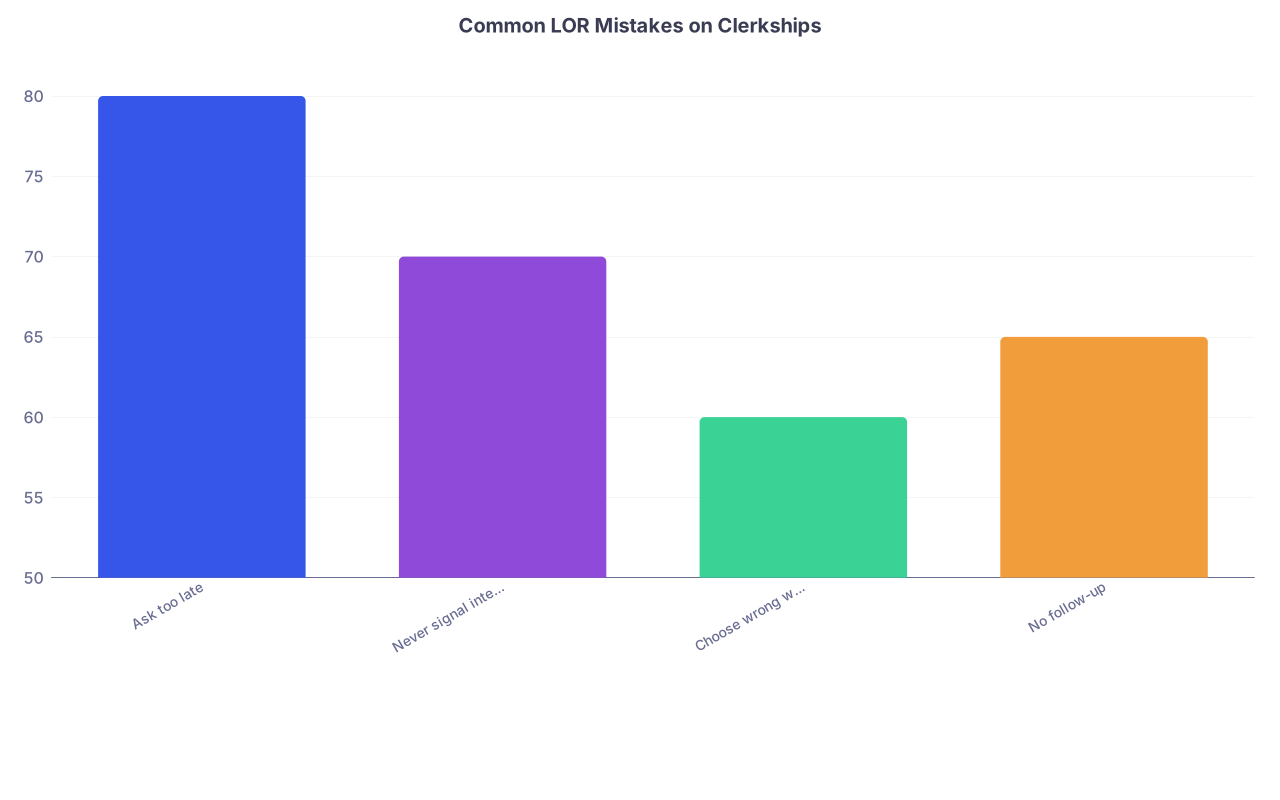
| Category | Value |
|---|---|
| Ask too late | 80 |
| Never signal interest | 70 |
| Choose wrong writer | 60 |
| No follow-up | 65 |
Mistake #4: Letting One Bad Rotation Bleed Into the Rest
Everyone has a rough clerkship somewhere:
- A surgical team that eats students alive.
- A malignant senior who never learned to teach without humiliation.
- A rotation where family illness or personal crisis hits you mid-block.
The mistake is not “having a bad block.” The mistake is allowing that one experience to:
- Change your baseline work ethic.
- Poison your attitude on the next rotation.
- Leave unexplained patterns in your MSPE or evals.
I have seen this: one toxic surgery month turns a previously enthusiastic student into a clock-watcher on medicine, then disengaged on psych, then “checked out” on family medicine. By the time they wake up, they have half a year of “below peers in initiative” comments.
Danger signs you are letting a bad block metastasize:
- You start saying things like, “It does not matter what I do, they will still write the same thing.”
- You pull back from patient care and lean only on book studying.
- You stop asking for feedback because you “do not want to hear it.”
To avoid long-term damage:
Contain the damage in real time
If things are going off the rails:- Meet with the clerkship director early, not in the final week.
- Ask specifically: “What do I need to do by the end of this block to pass / to avoid a negative remark in my dean’s letter?”
- Document big events (absences for illness, major conflicts) and copy advising.
Reset between blocks
On day 1 of the next rotation, act like you are starting fresh. New service, new chance. Do not pre-dispose yourself to failure by expecting it.Address patterns explicitly in your application if needed
If you truly had a prolonged issue (illness, family crisis, leave), work with your dean’s office to decide whether and how to explain it. It is far better than leaving unexplained mediocre performance strung across multiple blocks.
One bad eval will not sink you. A “story” of disengagement over 3–4 rotations absolutely can.
Mistake #5: Ignoring Professionalism Micro-errors That Add Up
Very few students get destroyed by a single catastrophic professionalism incident. What kills more often is the pattern.
The micro-errors that seem “small” in isolation:
- Repeatedly showing up 5–10 minutes late to rounds.
- Leaving early without telling anyone.
- Being hard to reach by pager or phone.
- Having incomplete notes at 4 pm when others are ready to sign out.
- Arguing with nurses or coming off dismissive with staff.
Doctors talk. Nurses talk more. Clerkship coordinators and directors piece together a pattern.
This is how a pattern shows up later in your MSPE or in back-channel emails:
- “Reliable when directly supervised, but requires close oversight.”
- “Appropriate to proceed to residency with continued development in professionalism.”
- “There were occasional concerns with punctuality and follow-through.”
Translation: red flag.
Do not make these mistakes:
- Assuming staff feedback “does not matter” because “they are not grading me.”
- Dismissing “just one” late arrival or “just one” missed lab check as trivial.
- Snapping at a nurse because you are tired, then failing to repair the interaction.
To avoid death by professionalism paper cuts:
- Treat every rotation like you are on probation for your dream job.
- If you know you are running late, text/page the intern before they wonder where you are. Not after.
- If you have a conflict with staff, be the one to fix it:
- “I am sorry that came off wrong earlier. I appreciate your help with my patients.”
Tiny professional lapses are low drama. They are also exactly the kind of thing program directors fear: habits that will continue into residency.
Mistake #6: Misplaying Electives and Aways
Your fourth-year schedule can massively help—or quietly hurt—your residency application.
Two big strategic errors here:
Error A: “Fun shopping” electives instead of signal-building
I have seen students apply to competitive specialties with:
- No sub-internship in that specialty at their home program.
- No meaningful elective time in that field.
- Minimal or zero exposure on their transcript.
Then they are shocked when PDs ask, “Are you sure you understand what this specialty involves?” Translation: your clerkship choices did not convince them.
You cannot fix that in September of fourth year. The time to plan is late third year when you are scheduling 4th year.
Error B: Treating aways like travel opportunities or checkboxes
Away rotations are double-edged swords:
- Strong away: huge positive signal and often an interview at that program.
- Mediocre away: at best, neutral; at worst, it confirms you are mid-tier in a competitive pool.
Common away disasters:
- Going too early without basic clerkship skills.
- Going to too many aways, diluting your impact and exhausting yourself.
- Going to a hyper-competitive “brand-name” place where their baseline for “strong” is brutal, and you end up as “average.”
| Strategy | Risk Level | Comment |
|---|---|---|
| 1–2 targeted aways in reach tier | Low | Best balance of risk and benefit |
| 3–4 aways across country | High | Fatigue, variable performance |
| No aways in competitive specialty | Moderate | Missed chance to signal interest |
| Early away before core clerkships | Very High | Skills not ready, high exposure |
Avoid these by:
- Doing at least one home sub-I in your intended specialty first, if at all possible.
- Targeting aways to realistic programs, not only prestige magnets where you are below their typical Step/research profile.
- Treating each away as a month-long interview, not a vacation in scrubs.
Mistake #7: Mismanaging Feedback and Never Actually Improving
The students who stall out in clerkships have a specific pattern with feedback:
- They avoid it.
- When forced to hear it, they get defensive or quietly crushed.
- They do not create a plan to change anything.
So attendings write: “Accepts feedback.” Which is code for, “They did not argue.” That is not the same as, “Incorporates feedback and shows growth”—which is how you end up in the ‘strong’ pile.
The damaging behaviors:
- Nodding along when someone gives feedback, then making zero visible changes.
- Explaining away every criticism as “personality mismatch” or “they were malignant.”
- Waiting until the last day to ask, “Is there anything I can improve on?” when it is too late to demonstrate change.
To avoid this:
- In week 1, explicitly ask: “I want to get better at this quickly. Can you let me know early if you see specific things I should adjust?”
- When you get feedback, respond with:
- One sentence of acknowledgment: “That makes sense.”
- One sentence of plan: “For the rest of this week, I will [do X differently].”
- Then actually do it—and do it obviously:
- If they said your presentations are disorganized, actively say the next day: “Today I focused on tightening the assessment and plan like you suggested.”
Letters that say “demonstrated clear growth over the rotation” carry real weight. That only appears if you treat feedback as something to operationalize, not survive.
Mistake #8: Assuming Shelf Scores Alone Will Save You
You can crush shelves. 90th percentile, honors across the board. That helps. It does not rescue bad or bland clinical narratives.
I have seen applications like this:
- Step 2 CK: 255+
- Shelves: strong.
- Clerkship comments: “quiet,” “adequate,” “did what was asked,” “pleasant to work with.”
That combination sends a clear message to PDs: strong test taker, but unproven as a clinician and teammate. In competitive fields, that is not enough.
Typical miscalculations:
- Studying so obsessively for shelves that you consistently leave early or skip patient follow-up.
- Using “I have to study” as an all-purpose excuse to avoid extra responsibility.
- Viewing real patient interactions as “time away from UWorld,” rather than the actual point of your training.
Protect yourself from this trap:
- On busy rotations, anchor your day around:
- Patient care and visibility during peak hours.
- Shelf prep outside of that (pre- or post-hospital, days off).
- If workload is genuinely unsustainable, discuss with your senior or clerkship director, not silently disengaging and hoping your shelf score offsets it.
- Remember what letters actually highlight:
- Work ethic
- Initiative
- Communication
- Clinical reasoning Shelves say nothing about those.
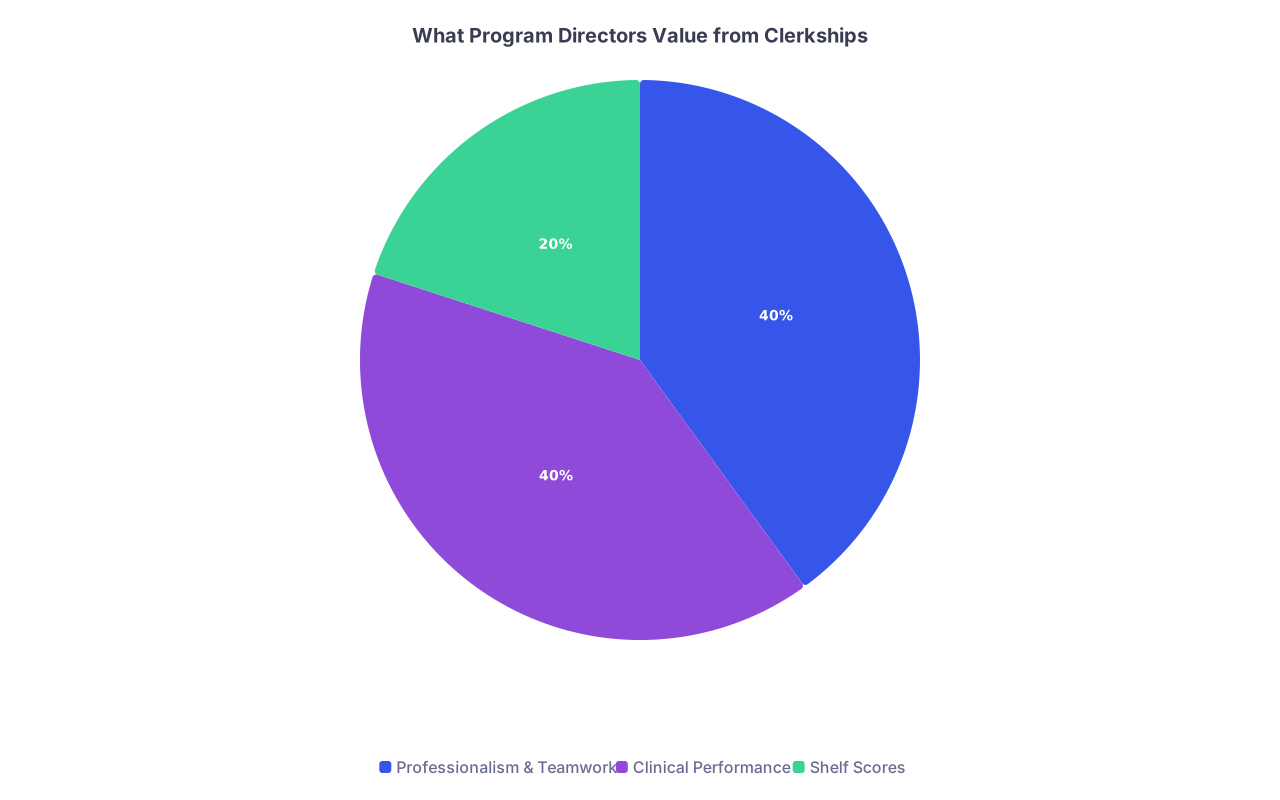
| Category | Value |
|---|---|
| Professionalism & Teamwork | 40 |
| Clinical Performance | 40 |
| Shelf Scores | 20 |
Mistake #9: Failing to Align Your Clerkship Story with Your Target Specialty
Your application is ultimately a narrative. Strong applicants make their clerkship choices and performances line up with the story they want PDs to believe.
Weak ones have disjointed signals:
- Applying to OB/GYN with no strong OB/GYN evals and your best comments in psychiatry.
- Applying to surgery when your surgery eval says “struggled with early mornings and physical demands of the OR.”
- Applying to emergency medicine with no EM sub-I and your only EM letter from a random community month.
Do not assume PDs will “infer” your interest. They use what you actually did.
How to avoid this mismatch:
- Decide your likely specialty by late third year (you do not need 100% certainty, but you need a direction).
- Make sure you have:
- At least one strong core clerkship eval in that field.
- One sub-I in that field (home or away) if the specialty expects it.
- At least 2 letters from that specialty, ideally from people who saw you on core or sub-I.
And be realistic. If your two weakest rotations by far were in a particular field, and you hated the work, do not force it solely because of “prestige” or “lifestyle.” PDs can sniff that mismatch instantly.
FAQ (Exactly 3 Questions)
1. If I already have one mediocre clerkship eval, is my residency application doomed?
No. A single lukewarm eval rarely destroys an application, especially if it is early in third year. The problem is patterns. If you respond by aggressively seeking feedback, increasing visibility, and generating clearly stronger evaluations on subsequent rotations—especially in your target specialty—you can offset that first misstep. What worries PDs is seeing no upward trajectory.
2. How many away rotations should I do for a competitive specialty?
For most students, 1–2 carefully chosen aways is optimal. More than that increases fatigue, risk of a weak performance, and often does not add signal. Focus on doing a strong home sub-I first, then choose away sites that are realistic fits where you would actually rank the program. Treat each away like a month-long interview, not a tour of famous hospital logos.
3. My attendings are very hands-off. How can I stand out when no one seems to be watching?
You create visibility. Proactively ask for patients, volunteer for specific tasks, and check in with seniors at key times (“Anything else before I head out?”). Ask for mid-rotation feedback and act on it where they can see the change. Hand-offs, concise presentations, and helping interns with real workload (discharge summaries, follow-up calls) all demonstrate value even on a laid-back service.
Key takeaways:
- Clerkships are extended job interviews, not just exams. Being visible, reliable, and teachable matters as much as test scores.
- Plan deliberately for letters and sub-Is in your target field; do not assume “someone will remember you” later.
- Small professionalism and engagement lapses compounded across rotations create the quiet, forgettable narrative that sinks strong paper applicants.