
What happens when your evals say “one of the best students I’ve ever worked with”… and your shelf exam report quietly screams “below the 10th percentile”?
Let me be blunt: that mismatch is a problem. A big one. And ignoring it is how excellent clinical students quietly sabotage their residency applications.
You’re in the clerkship phase, you’ve figured out how to impress residents and attendings, you’re collecting “outstanding,” “excellent team player,” “reads ahead,” all the phrases you’re supposed to want. Then the NBME shelf scores come back.
Borderline. Or flat-out low.
Too many students make the same mistake: they tell themselves, “Program directors care more about comments than tests.” Or, “It’s just a bad test day.” And they move on, without a plan.
That’s how you let low shelf exams undermine an otherwise strong application.
Let’s walk through the landmines so you do not do that to yourself.
The Ugly Truth: Programs Notice Shelf Scores More Than You Think
I’ve sat in rooms where applications were being reviewed. Here are two things you do not want to hear about yourself:
- “Comments look good, but these shelf scores are weak across the board.”
- “I’m not convinced this student can handle in‑training exams.”
No one says this to your face. They just quietly drop you down the rank list.
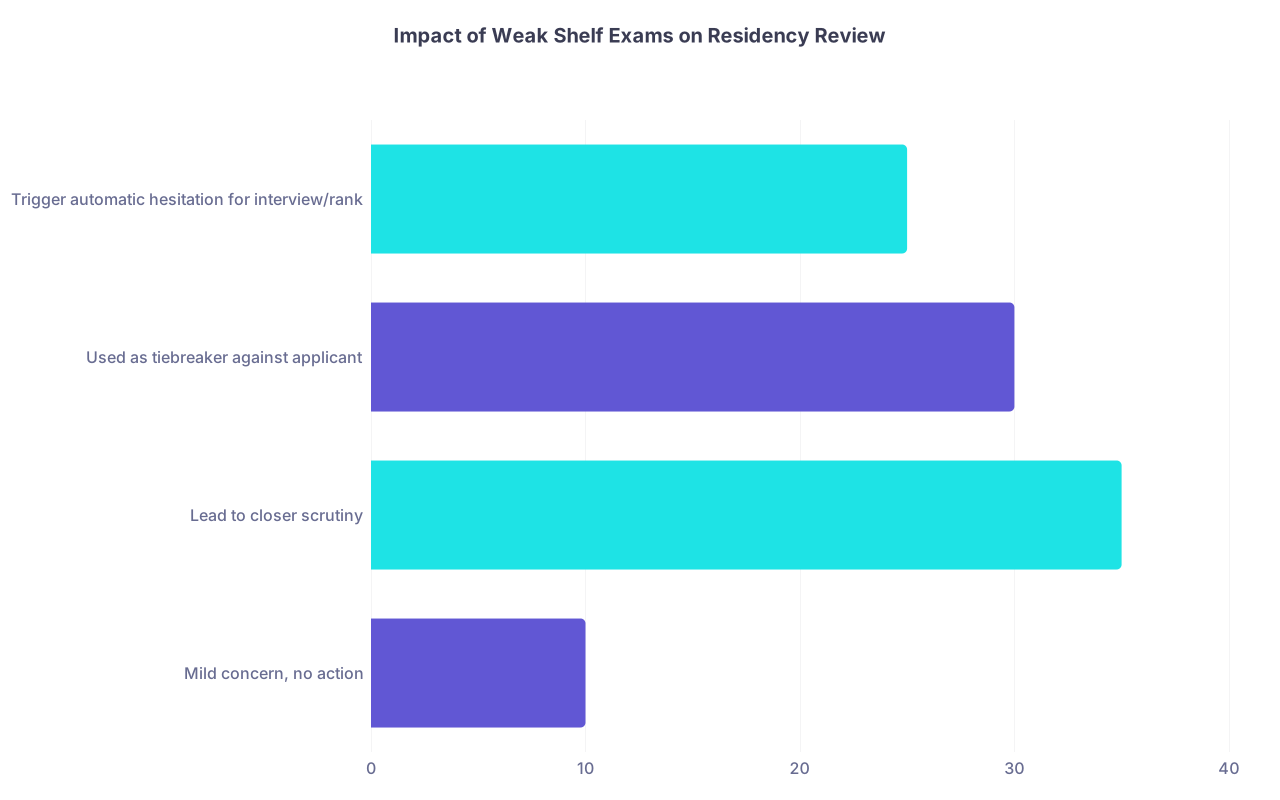
| Category | Value |
|---|---|
| Mild concern, no action | 10 |
| Lead to closer scrutiny | 35 |
| Used as tiebreaker against applicant | 30 |
| Trigger automatic hesitation for interview/rank | 25 |
Here’s the part students underestimate: shelf exams are not just “grades for the rotation.” They’re used (directly or indirectly) as:
- Evidence of how you’ll perform on:
- Step 2 CK
- In‑training exams
- Board certification exams
- A proxy for:
- How deeply you actually understand medicine
- Whether your knowledge is broad or just “whatever came up on rounds”
And some schools now report shelf performance or NBME subject exam percentiles directly in the MSPE or on the transcript. Even if it’s “hidden,” program directors can usually infer something from:
- Honors unavailable due to exam criteria
- Comments like “did well clinically but struggled with standardized exams”
If you think you can bury weak shelves under glowing comments, you’re lying to yourself. Programs read both. And when they don’t line up, they trust the numbers more than you think.
Mistake #1: Treating Shelf Exams Like an Afterthought
- You show up early.
- You preround thoroughly.
- You read UpToDate on your patients.
- You care about patients and get praised for it.
Then you “squeeze in” shelf studying when you’re exhausted, on post‑call, or on your one afternoon off.
You’re making the wrong trade.
The trap looks like this:
Overinvesting in “looking good” on the wards
- Memorizing presentations word‑for‑word
- Over-preparing for one attending’s style
- Staying ridiculously late to “show dedication”
Underinvesting in building actual testable knowledge
- Not doing consistent UWorld/AMBOSS questions
- Pushing all serious studying to “the last week”
- Skimming random notes instead of structured practice
Here’s the irony:
Strong shelf prep actually helps your clinical performance. Why?
- You recognize patterns faster.
- Your plans are more complete.
- Your assessments sound like real medicine, not guesswork.
But students flip the priorities. They chase short-term praise and sacrifice the long-term metric that programs rely on.
Don’t make that trade. Comments help, but they don’t erase a trend of weak exam performance.
Mistake #2: Assuming “Great Comments” Cancel Out Weak Numbers
They don’t. They mitigate. Sometimes. If you’re lucky. That’s it.
Here’s how this really plays out when an application is reviewed:
| Profile Type | Clinical Comments | Shelf Scores | Common PD Reaction |
|---|---|---|---|
| A | Excellent | Strong | “Reliable, top candidate” |
| B | Good | Strong | “Solid, safe pick” |
| C | Excellent | Weak | “Like them, but worried about exams” |
| D | Mixed | Weak | “Pass” |
Profile C is you if you ignore shelves. Loved on the wards, weak on exams. Programs don’t immediately reject you—but a red flag appears:
“Why does this student look great in person and consistently underperform on standardized measures?”
Possible interpretations they quietly consider:
- Is the home institution inflating clinical grades?
- Is this student just charming but not actually strong on knowledge?
- Will this person struggle on in‑training exams and boards?
None of those help you.
And if you’re aiming at competitive fields—Derm, Ortho, EM, ENT, Urology, even solid IM or Pediatrics at big academic centers—patterns of weak standardized performance are deadly.
Residency is full of standardized testing:
- In‑training exams every year
- Board certification exams
- Sometimes specialty-specific exams
Programs don’t want to babysit someone’s exam anxiety and remediation through all of that.
You don’t want to be the resident constantly pulled aside for “we need to talk about your test performance.”
Mistake #3: Ignoring Patterns Across Rotations
One bad shelf? That happens. Two? Now it’s a pattern. Three or more? That’s a serious problem you cannot shrug off.
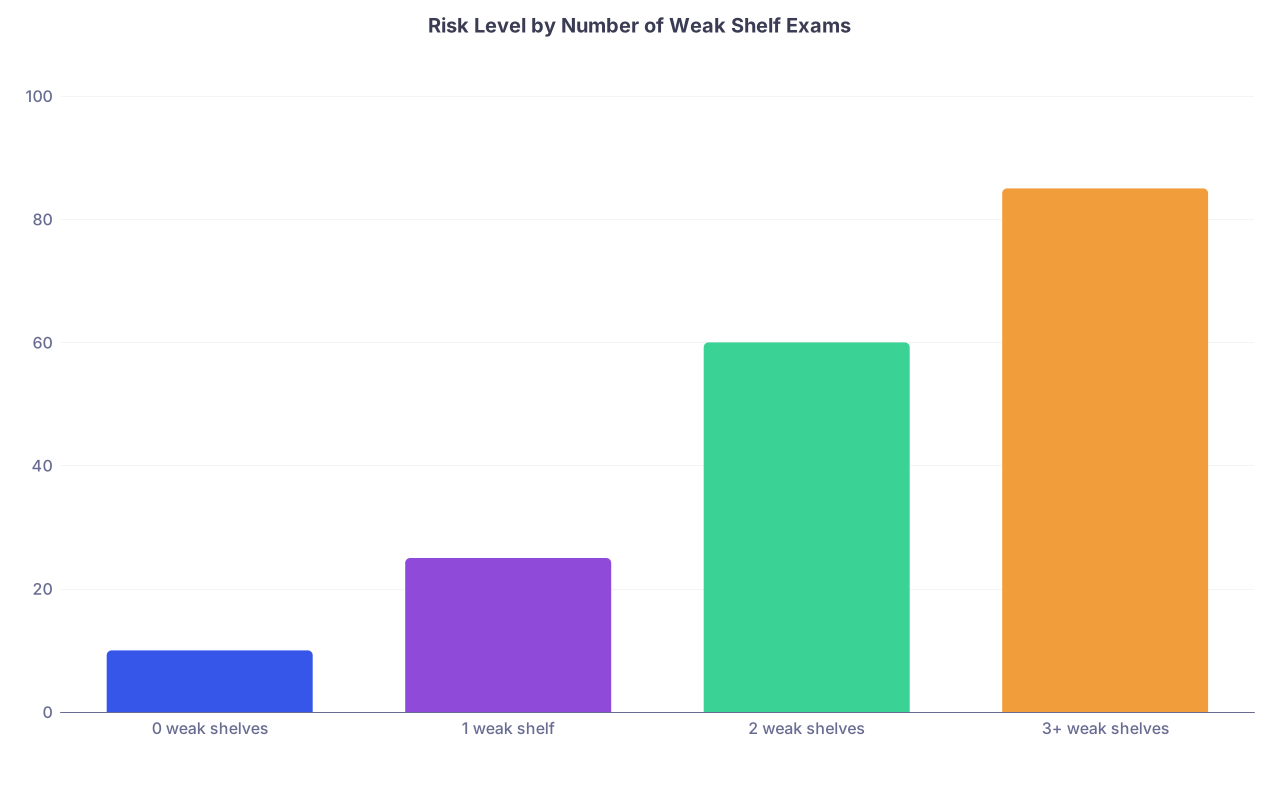
| Category | Value |
|---|---|
| 0 weak shelves | 10 |
| 1 weak shelf | 25 |
| 2 weak shelves | 60 |
| 3+ weak shelves | 85 |
(Rough relative “concern level” as I’ve seen it discussed—not official, but very real.)
Students make two dangerous moves here:
- They normalize it.
- “Everyone says the Peds shelf is weird.”
- “Our OB shelf is notoriously brutal.”
- “Psych shelf is just random.”
Every school has its myths. Some are even partly true. But when your scores are consistently below national averages, the problem is not “the exam.” It’s your strategy.
- They never dig into why.
- Not enough questions?
- Wrong resources?
- Ineffective note-taking?
- Poor time management?
- Test anxiety?
- Reading but not retaining?
Instead, they just move on to the next clerkship and repeat.
If you’ve got:
- Two or more shelves < 25th percentile
- Or repeated “Borderline Pass” notes in different rotations
You do not have a “bad luck with tests” problem. You have a system problem.
And if you don’t fix it before Step 2 CK and before you apply, programs will assume that same pattern will follow you into residency.
Mistake #4: Thinking Step 2 CK Alone Will “Fix” the Narrative
I’ve heard this line too many times:
“Yeah, my shelves weren’t great, but I’ll crush Step 2 CK and that’ll make up for it.”
Sometimes that works. Sometimes it doesn’t. Here’s when it backfires:
- You take Step 2 late, so programs don’t see the score when they’re deciding on interviews.
- You underperform on Step 2 because the same shelf problems persist.
- Your Step 2 is fine, but not stellar enough to erase months of weak subject performance.
Programs compare:
- Your shelf trends
- Your Step 2 score
- Your MSPE comments about exams, if any
If they see:
- Weak shelves + meh Step 2 → pattern confirmed.
- Weak shelves + strong Step 2 → “What changed? Why the sudden jump? Is this stable or a one-off?”
Better than nothing, but not bulletproof.
You’re much safer if you:
- Start improving shelf performance before Step 2.
- Use each shelf as a mini-assessment and correction point.
- Let programs see a trajectory: weak → improving → strong.
That story sells way better than “struggled on all shelves, one big Step 2 score out of nowhere.”
Mistake #5: Not Using Shelves as a Dry Run for Residency Expectations
Here’s the part most students miss: shelf exams aren’t just hoops to jump through. They’re rehearsal. For exactly the thing programs are terrified of: residents who can’t pass boards.
Residency programs live and die by board pass rates. Accrediting bodies track them. Low pass rates get attention. Bad attention. Nobody wants that.
Programs look at you and think:
- “Will this person pass their boards the first time?”
- “Will we need to spend extra time and resources on remediation?”
- “Will this student become one of our statistics we have to explain?”
Your shelf exams are their only early clues.
If you struggle with:
- Time management on shelves
- Retaining key management steps
- Distinguishing “nice to know” from “must know”
- Translating textbook knowledge into test answers
Expect those same issues to show up again:
- On in‑training exams
- On specialty boards
- When you’re tired, on call, making real decisions
You do not want to discover that weakness when you’re a PGY2 with people depending on your orders at 3 a.m.
Fix it now. On shelves. When the stakes are still adjustable.
Mistake #6: Studying Like It’s Step 1, Not Like It’s Clinical Medicine
A lot of shelf underperformance comes from completely wrong study style.
Common errors:
Passive reading only
You “read a chapter” from Case Files or Blueprints and call it a day. That’s not studying. That’s exposure.No question-based learning
Shelves are question-based exams. If you’re not doing 800–1200 high-quality questions per core clerkship (varies by rotation length), you’re trying to box with one hand tied.Zero review of incorrects
Skimming the question and saying “oh yeah, I see that now” is useless. You need to:- Write down patterns
- Note real-life anchors for memorization
- Ask, “What would this look like in my patient tomorrow?”
Not tying knowledge to cases
You read one thing, see another thing, and never connect them. The result? On test day, everything feels “vaguely familiar” but nothing is solid enough to pick confidently.

Shelf exams reward:
- Pattern recognition
- Management algorithms
- Knowing what’s first, best, and next
You get that from:
- UWorld / AMBOSS / NBME practice exams
- Deliberate review of missed questions
- Constant linking of “this question” to “that patient I saw”
Mistake #7: Failing to Strategically Explain or Contextualize Weak Shelves
You’re not completely powerless if you already have low shelves on your record. But pretending they don’t exist? That’s the worst move.
You need a plan to:
Understand the cause
- Did they cluster during a major life event? (Illness, family crisis, etc.)
- Did you change strategies and then improve?
- Was test anxiety eventually addressed?
Show a trajectory
- Early shelves weak → later shelves stronger
- Shelf weaknesses → Step 2 CK improvement
Decide where to address it
- MSPE addendum from your Dean’s office (sometimes)
- Personal statement (selectively, and only if you can show clear improvement)
- Interview answers when they ask about “a time you struggled academically”
The wrong move is:
- Over-explaining
- Blaming everyone and everything but yourself
- Or pretending the numbers aren’t visible
Programs respect:
- Ownership
- Insight
- A concrete change in behavior and results
They’re much more forgiving of, “I struggled early, recognized the problem, got help, and here’s the evidence it’s fixed” than, “I don’t test well, but I’m great clinically.”
So What Should You Actually Do?
Let’s strip this down into what to change now, not six months from now.
1. Treat Every Core Shelf as a High-Stakes Exam
Because it is. Behave accordingly:
- Build a rotation-specific study plan on day 1
- Know:
- Your primary resource (UWorld/AMBOSS)
- Your secondary (Case Files, online videos, etc.)
- When you’ll do questions (daily quota)
2. Quantify Your Prep
Stop “studying a lot” and start tracking:
- Number of questions completed
- Percentage correct
- Number of practice NBMEs taken and scores
If your data shows:
- You’re barely touching questions
- Your scores are stuck
You adjust mid-rotation, not after the shelf.
3. Fix One Limiting Factor at a Time
For repeated low shelves, figure out your main bottleneck:
- Time? → Practice timed blocks, no pausing.
- Knowledge gaps? → Tag weak systems and hit targeted review.
- Test anxiety? → Practice exam days that simulate test conditions; seek counseling or performance coaching.
- Fatigue? → Stop trying to cram after 16-hour days only; protect at least one focused hour when you’re not half-dead.

| Step | Description |
|---|---|
| Step 1 | Identify weak shelf pattern |
| Step 2 | Adjust study plan next rotation |
| Step 3 | Comprehensive review of strategy |
| Step 4 | Meet with advisor or dean |
| Step 5 | Define question targets & resources |
| Step 6 | Take practice NBME |
| Step 7 | Maintain & refine |
| Step 8 | Address test anxiety/time issues |
| Step 9 | One or multiple shelves? |
| Step 10 | Improving scores? |
4. Get Honest Feedback Early
Don’t suffer in silence.
Talk to:
- A trusted faculty mentor
- Your clerkship director
- Your dean of students
Say explicitly:
“My clinical evals have been strong, but I’m underperforming on shelf exams. I need help fixing this before it affects my residency applications.”
If the person you talk to hand-waves it away—find someone else. Not all advice is good. You want someone who understands Step 2, shelf scaling, and residency expectations.
5. Use Later Rotations to Prove the Fix
If you early-rotation shelves are weak, you want:
- Mid/late IM, Surgery, or Neuro shelf: significantly better
- Step 2 CK: clearly stronger than your early shelves predicted
That creates a narrative you can stand on:
- “I struggled early, realized my methods were wrong, changed them, and my later metrics prove it.”
Red Flags You Should Not Ignore
You’re in dangerous territory if:
- You’ve failed a shelf exam. At all.
- You have two or more shelves under the 25th percentile.
- Your school has limited you from Honors in multiple rotations due to low exams.
- You’re avoiding looking at your score reports.
These are not “little bumps.” These are “change course now or pay for it at Match time” warnings.

If that’s you, immediate action items:
- Book a meeting with your dean or academic support office this week.
- Build a specific shelf/Step 2 remediation plan.
- Time your Step 2 so that a strong score is in by the time programs review applications.
FAQ: Shelf Exams and Your Residency Application
1. If my clinical comments are outstanding, can I still match well with average or slightly below-average shelf scores?
Yes, you can still match—if your scores are not consistently weak and your Step 2 CK is at least solid. Great comments plus okay shelves plus a respectable Step 2 is workable, especially in less hyper-competitive specialties and at community programs. The problem is when shelves are chronically low or show a downward trend. Then even effusive comments won’t fully protect you. Your goal isn’t perfection—it’s avoiding a pattern that makes programs question your exam reliability.
2. I already have multiple low shelf scores. Should I delay my application or change specialties?
Changing specialties purely because of shelves is usually premature and, frankly, panic-driven. First step: fix your approach and prove you can improve on later shelves and Step 2. If you’re targeting something highly competitive (Derm, Ortho, ENT, etc.) and you’ve got multiple weak shelves plus a mediocre Step 2, then yes—you may need to recalibrate and aim at a specialty where your overall package is competitive. But don’t guess. Sit down with a knowledgeable advisor who actually understands match data and program expectations before blowing up your plans.
3. How many practice questions should I aim for per core clerkship to avoid weak shelves?
For most core rotations, a reasonable minimum is around 800–1000 high-quality questions (UWorld + AMBOSS or similar) for longer rotations like IM and Surgery, and 500–800 for shorter ones like Psych, Neuro, or Family Med. The key isn’t just the raw number—it’s:
- Doing them consistently throughout the rotation
- Reviewing incorrects in depth
- Not saving everything for the last week
If you’re doing fewer than ~400–500 questions for a major core and calling that “prepped,” you’re probably underprepared unless you have an unusually strong baseline.
Open your most recent shelf score report right now. Don’t flinch. Compare it to your clinical comments from that same rotation. If there’s a gap, write down one concrete change you’ll make for your next clerkship’s shelf prep—and schedule exactly when you’ll start it.