
What happens when a program director reads your MSPE and sees a vague comment about a “challenging” surgery rotation you never mention anywhere in your application?
They do not assume it was fine.
They assume it was bad. Then they wonder why you tried to bury it.
That is the mistake I see over and over: students trying to hide weak rotations instead of owning them, explaining them, and using them to show growth. You are not fooling anyone. But you can absolutely hurt yourself by pretending those rotations do not exist.
Let’s walk through how this plays out, why it backfires, and how to handle weak rotations the right way so they do not tank your residency application.
The Reality: Programs Will See Your Weak Rotations Anyway
Let me be blunt. If you had:
- A low pass in medicine
- A marginal or “needs improvement” comment in surgery
- A professionalism flag in OB
- A failed clerkship you remediated
…that information is already baked into your record.
You cannot hide it from residency programs. Attempts to do so make you look evasive, not stronger.
Here is where weak rotations show up whether you like it or not:
-
- Every clerkship grade and often narrative comments
- Grade distributions (“Upper-third, Middle-third, Lower-third”)
- Specific red flags: remediation, professionalism concerns, withdrawals
Transcript
- Honors/High Pass/Pass/Fail for each core rotation
- Any course repeats or leaves of absence
Letters of Recommendation
- Some faculty will allude (politely) to earlier struggles: “He showed marked improvement compared to earlier rotations”
So when you:
- Never mention your weakest core rotation anywhere
- Talk only about “my strength across all clerkships”
- Pretend everything was seamless
…you create a mismatch between your story and your documents. Program directors hate mismatches. They read thousands of applications a year. They are very good at spotting what you are not saying.
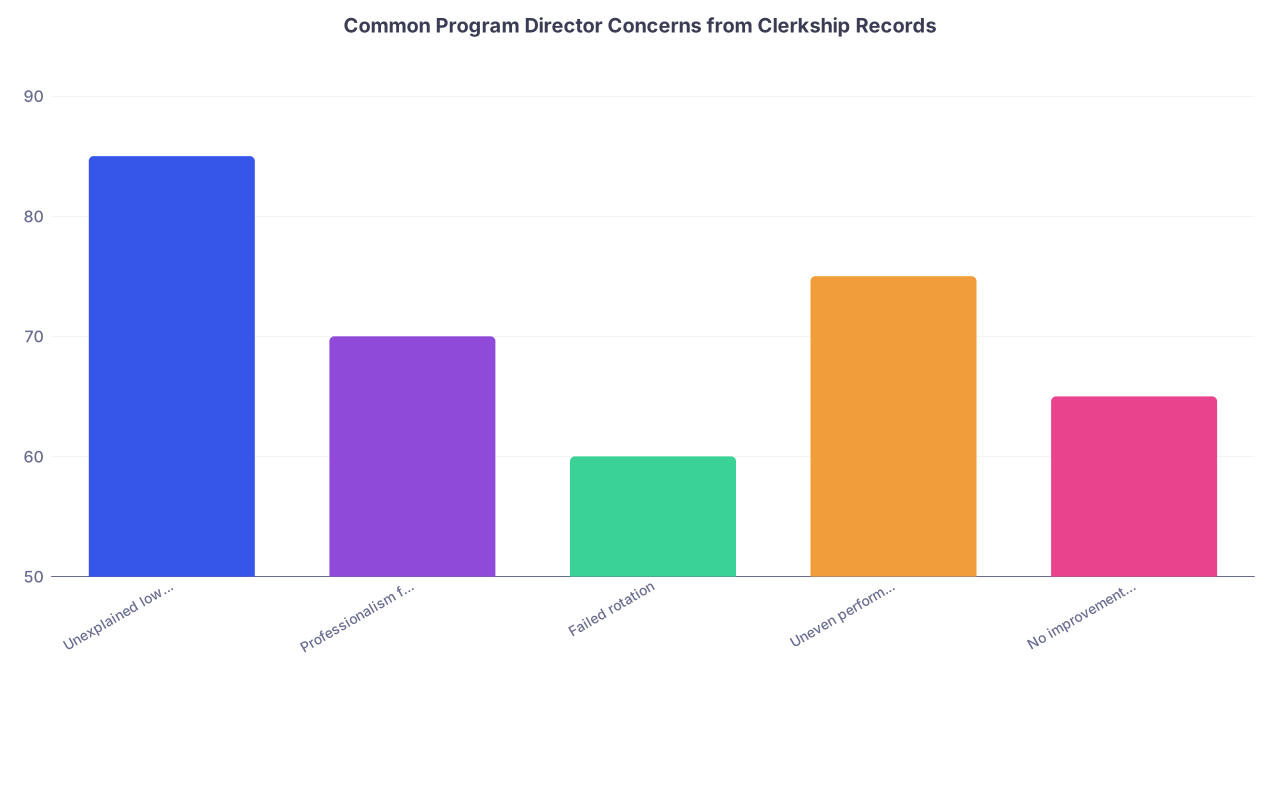
| Category | Value |
|---|---|
| Unexplained low grade | 85 |
| Professionalism flag | 70 |
| Failed rotation | 60 |
| Uneven performance | 75 |
| No improvement over time | 65 |
Those numbers reflect a pattern I have heard in real meetings: unexplained issues make committees nervous. More nervous than the issues themselves.
The Classic Mistakes Students Make With Weak Rotations
I have watched students sabotage themselves the same ways year after year. Learn from them.
1. Pretending the Rotation Never Happened
Example pattern:
- Low Pass in Surgery
- Dean’s Letter: “Performance was inconsistent; required more supervision than typical at this level”
- Application:
- No mention of surgery anywhere
- No discussion of clinical struggles
- Personal statement: “I have consistently excelled in clinical environments”
That last sentence? Suicide. Programs will compare it to the MSPE and think: “Either they did not read their own letter, or they think we will not.”
What you are signaling:
- Lack of self-awareness
- Poor insight
- Maybe even arrogance
2. Blaming Everyone Except Yourself
Equally bad: the “my eval was unfair” narrative.
I have heard versions like:
- “That attending just doesn’t like students.”
- “The team was toxic.”
- “The residents expected way too much.”
You might be 30–40% right. Sometimes the environment is garbage. But when your explanation is 100% external, program faculty tune out. They have all heard the same story.
The instant you sound like you are attacking your evaluator, you raise a different red flag: is this someone who will be difficult to supervise?
3. Over-explaining in the Wrong Places
Another common mistake: turning your personal statement into a legal defense brief.
Two full paragraphs on why your medicine rotation grade “does not reflect your true abilities” is not growth. It is desperation.
Overkill looks like:
- Long, emotional justifications
- Detailed step-by-step blaming: schedule, COVID, family, evaluator bias
- Repeating the same explanation in personal statement, every ERAS text box, and every supplemental essay
You look obsessed with one grade instead of focused on your overall development.
4. Sending Mixed Messages in Letters
This one is subtle, but I have seen it sink applications.
Scenario:
- You did poorly in OB. No mention of it anywhere.
- You ask your medicine attending for a LOR and say, “Please don’t mention any of my earlier struggles.”
- The attending, who is actually honest and supportive, writes:
- “She struggled on her early rotations but grew remarkably over the year into one of our stronger students.”
Your attempt to “hide” the issue just led to a letter that directly contradicts your silence. You would have been far better off addressing it yourself in a measured way.
Why “Owning” Weak Rotations Actually Helps You
You do not get penalized for being human. You get penalized for looking oblivious or dishonest.
When you handle a weak rotation correctly, you can actually earn points with programs. Here is why:
1. Programs Care More About Trajectory Than Perfection
A single bad clerkship with clear improvement afterward is survivable. Common scenario:
- Surgery: Pass, rough comments
- Medicine: High Pass
- ICU Sub-I: Honors, strong letter
That tells a story:
“They were overwhelmed at first, then adjusted, then excelled.”
Program directors like that story. It looks realistic. It suggests resilience.
2. Insight and Accountability Signal Maturity
When you say, in composed language:
- What went wrong
- What you learned
- How you changed your behavior
…you show you are coachable.
Residency is four years of people telling you you need to do better. They want residents who can take a hit, adjust, and keep moving. Not people who will collapse or argue every critique.
3. You Control the Narrative Instead of Letting the MSPE Do It For You
If you say nothing, the only “voice” explaining your weak rotation is:
- A one-line summary in the MSPE, written by someone who met you once
- Possibly an evaluator who never saw your later improvement
If you address it, even briefly, you can frame it as:
- Part of a larger development arc
- Something that changed your approach to learning
- A catalyst, not a permanent label
How to Own a Weak Rotation Without Letting It Define You
The goal is not to center your entire application on that one bad month.
The goal is to:
- Acknowledge it
- Take responsibility for your piece
- Show concrete improvement
- Then move on
Step 1: Decide If It Needs Explicit Addressing
Not every less-than-Honors grade needs an essay. Do not overcorrect.
You probably need to address it if:
- You failed a core rotation
- You got a Low Pass or marginal in a rotation directly related to your chosen specialty
- The MSPE includes very clear concerns:
- “Frequently late”
- “Required repeated reminders about documentation”
- “Struggled with basic clinical reasoning”
You probably do not need a detailed explanation if:
- You got mostly High Passes with one Pass and no concerning narrative language
- The “weak” rotation is in a field unrelated to your specialty and not flagged in the MSPE
Step 2: Use the Right Location to Address It
Do not scatter explanations everywhere. Be strategic.
Good places:
- Personal statement: 2–4 concise sentences, integrated into a paragraph about growth
- Program-specific supplemental questions that ask about “challenges” or “adversity”
- Advisor/Dean letter: sometimes they can contextualize in the MSPE addendum
- Interviews: short, direct verbal explanation when (not if) they ask
Bad places:
- Every single text box that says “anything else?”
- Random comments field in ERAS that nobody actually reads carefully
- Emailing programs unsolicited long explanations

Exact Language You Can Use (So You Do Not Ramble or Sound Defensive)
Students often either under-explain (“Yeah, that surgery grade was weird”) or over-explain with a page of backstory. You need disciplined, neutral language.
Here is a template that works without sounding robotic:
- Name the issue clearly
- Own your part
- Describe specific changes
- Point to evidence of improvement
Example 1: Weak Core Rotation in Your Target Specialty
Let us say you want Internal Medicine, but your core IM rotation was a Pass with comments about organization.
You might write in your personal statement:
“My core internal medicine rotation was a turning point. I struggled at first with organization and prioritizing tasks on a busy inpatient service, which contributed to a lower grade than I hoped. After candid feedback from my attending, I changed how I pre-rounded, created structured problem lists, and rehearsed presentations in advance. On subsequent rotations, including my medicine sub-internship, those changes translated into more efficient patient care and stronger evaluations.”
What you did not do:
- Attack the attending
- Make excuses about the hospital
- Ignore it and hope no one noticed
You framed it as: problem → insight → action → evidence.
Example 2: Failed Rotation, Later Remediated
This is serious, but survivable if handled directly.
“During my initial surgery rotation, I failed to meet expectations in clinical reasoning and situational awareness, and I did not pass the rotation. That experience was humbling and difficult, but it forced me to reevaluate how I prepared for cases and sought feedback. I remediated the rotation with a new pre-reading system, daily goal-setting with my senior resident, and more frequent check-ins. The second time through, I not only passed but received specific comments about clearer presentations and improved reliability. That experience changed how I approach any new clinical challenge.”
Again: you accept responsibility, describe concrete behavior changes, and point to documented improvement.
Example 3: Professionalism Concern
Do not dance around this one. Vague language looks evasive.
“Early in third year, I received feedback about punctuality and responsiveness to pages that raised legitimate professionalism concerns. That was a serious wake-up call. I met with my clerkship director, adjusted how I managed my schedule and notifications, and asked residents on subsequent rotations for direct feedback on reliability. I have had no further professionalism concerns, and recent evaluations note consistency and follow-through as strengths.”
You are telling programs: “Yes, there was an issue. No, it is not still happening.”

| Step | Description |
|---|---|
| Step 1 | Weak Rotation |
| Step 2 | Plan explanation |
| Step 3 | No explicit explanation |
| Step 4 | Choose location: PS, supplement, interview |
| Step 5 | State issue clearly |
| Step 6 | Own responsibility |
| Step 7 | Describe changes |
| Step 8 | Point to later improvement |
| Step 9 | Address it? |
How to Back Up Your Story With Your Application Strategy
Words alone will not save you if the rest of your application contradicts them. You need the rest of your choices to reinforce the “I learned and improved” narrative.
1. Get Letters From Rotations That Show Improvement
If surgery was weak but your sub-I was excellent, you should absolutely get a letter from:
- The sub-I attending
- Or a senior resident (for programs that accept resident letters) who saw your growth
Ask them explicitly:
- “I had some early struggles in [rotation X]. You saw me later in the year. If you feel it is accurate, would you be comfortable commenting on how I improved over time?”
You are not scripting them. You are inviting them to speak to the trajectory.
2. Choose Experiences That Demonstrate You Did the Work
If your issue was:
- Organization → later you took on chief role for a student-run clinic
- Punctuality → you consistently handled early morning pre-rounding on a demanding sub-I
- Clinical reasoning → you sought extra case discussions, joined a morning report teaching role, etc.
Then highlight those. Not with cheesy spin, but as concrete actions in your experiences section.
3. Make Sure Your Advisor Knows the Full Story
Do not try to spin your story with your advisor. That backfires.
Sit down and say:
- “Here is what happened on that rotation. Here is how I responded. Here are my later evals. How should we frame this in my MSPE and application so programs see the full arc?”
Better they help you with consistent messaging than write a vague MSPE sentence that undercuts you.

Common Patterns That Freak Program Directors Out (And How to Avoid Them)
Here is what unnerves committees. Avoid these patterns like a bad central line attempt.
| Problem Pattern | Safer Alternative |
|---|---|
| Weak rotation never mentioned; MSPE shows serious concerns | Brief, direct acknowledgment in PS or interview with clear improvement |
| Student blames attendings/system exclusively | Mixed explanation: owns behavior change, mentions context only briefly |
| Overly emotional or defensive essay about a single rotation | Calm, factual description of struggle within a broader growth narrative |
| No later evidence of improvement in similar settings | Seek and highlight strong later evals, sub-I, or related rotations |
| Different stories told to advisor, LOR writers, and in PS | Single, consistent version of events shared with all parties |
Programs are not looking for robots. They are looking for consistency and credibility.
Handling Questions About Weak Rotations During Interviews
Assume this will come up. Be ready. Do not improvise.
You want a 30–60 second answer that mirrors the written framing:
Structure:
- Briefly name the issue
- Own it
- Describe tangible changes
- Point to later evidence
Example:
“On my OB/GYN rotation, I had difficulty keeping up with the pace of the service and my grade reflected that. Looking back, I was not as efficient in pre-rounding and I hesitated to ask for help when I was behind. After feedback from my senior, I changed how I organized my pre-rounds and started checking in earlier when I was stuck. On my subsequent medicine sub-I, those changes helped a lot; I was able to manage a larger patient load and received strong evaluations for reliability and thoroughness.”
Stop there. Do not keep apologizing. Do not over-explain unless they ask follow-ups.
If they push further (“Why do you think you struggled there specifically?”), keep it grounded:
- “The learning curve in third year hit me harder than I expected at first. I was still figuring out how to translate reading into real-time decisions. Once I got more deliberate about pre-reading and asking for mid-rotation feedback, my performance stabilized.”
Calm. Measured. You are not begging them to forgive you. You are showing them you process feedback like an adult.
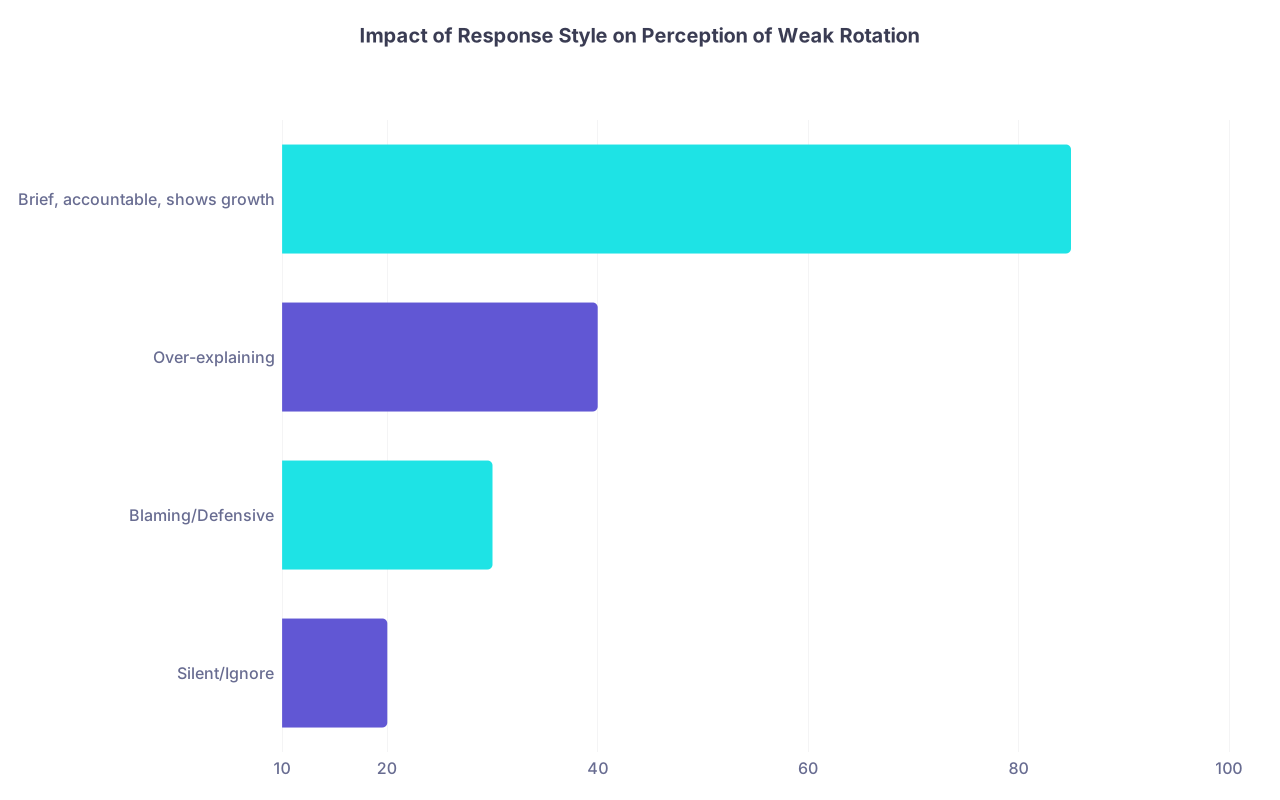
| Category | Value |
|---|---|
| Silent/Ignore | 20 |
| Blaming/Defensive | 30 |
| Over-explaining | 40 |
| Brief, accountable, shows growth | 85 |
A Quick Reality Check: How Much Can One Weak Rotation Hurt You?
It depends. Roughly speaking:
- One Pass with mild comments in a non-target specialty
- Annoying, not fatal. Usually not worth a big explanation.
- One weak core rotation in your desired field with clear improvement afterward
- Needs brief framing, but very survivable.
- Multiple weak rotations with no upward trend
- Bigger problem. Then your focus should be on:
- Smaller or less competitive programs
- Strong Step 2 / COMLEX 2 scores
- Very targeted letters and clear evidence of change
- Bigger problem. Then your focus should be on:
- Professionalism failure or repeated failures
- Major concern. You must be absolutely transparent, have strong support letters, and be ready for hard questions.
The mistake is not the weak rotation itself. The mistake is pretending it did not happen or acting like it says nothing about you.

Final Warnings: Do Not Make These Last Two Errors
Two final mistakes that will quietly wreck your credibility.
1. Letting Your Parents or Friends Rewrite the Story
I have seen too many personal statements clearly edited by non-medical parents who want to “protect” their child:
- “My grade does not reflect my capability because the attending was under unusual personal stress.”
- “The environment was not conducive to learning.”
You sound like a plaintiff, not a future resident. Get feedback from people who actually read MSPEs. Not your uncle the attorney.
2. Waiting Until ERAS Season to Deal With This
If your weak rotation just happened:
- Book a meeting with your clerkship director or advisor immediately.
- Ask:
- “How is this likely to appear in my MSPE?”
- “What can I do in the next year to demonstrate growth that programs will respect?”
Then go do it. You cannot “spin” your way out later if your performance never actually changed.
Key Takeaways
- Programs will see your weak rotations anyway. Trying to hide them makes you look evasive, not strong.
- A brief, accountable explanation plus clear evidence of improvement is far safer than silence or blame.
- One bad rotation does not destroy your match chances. Denial, inconsistency, and defensiveness do.