It’s late January. You’ve just finished a brutal medicine sub-I, survived on 4 hours of sleep and cafeteria coffee, and you finally get that email: “New evaluation available.” You open it, scroll through the generic anchors, and see phrases like “hard-working,” “pleasant to work with,” “solid fund of knowledge.”
You shrug. Looks fine.
Then match season comes. You’re on interview number seven, and the PD casually asks, “Tell me about your sub-I at University Hospital. How did that go?”
What you do not see is what they’ve already read from that same evaluation, and what their friend—the faculty who wrote it—already told them off the record.
Let me walk you through what really happens behind the curtain.
The Real Hierarchy of Sub-I Signals
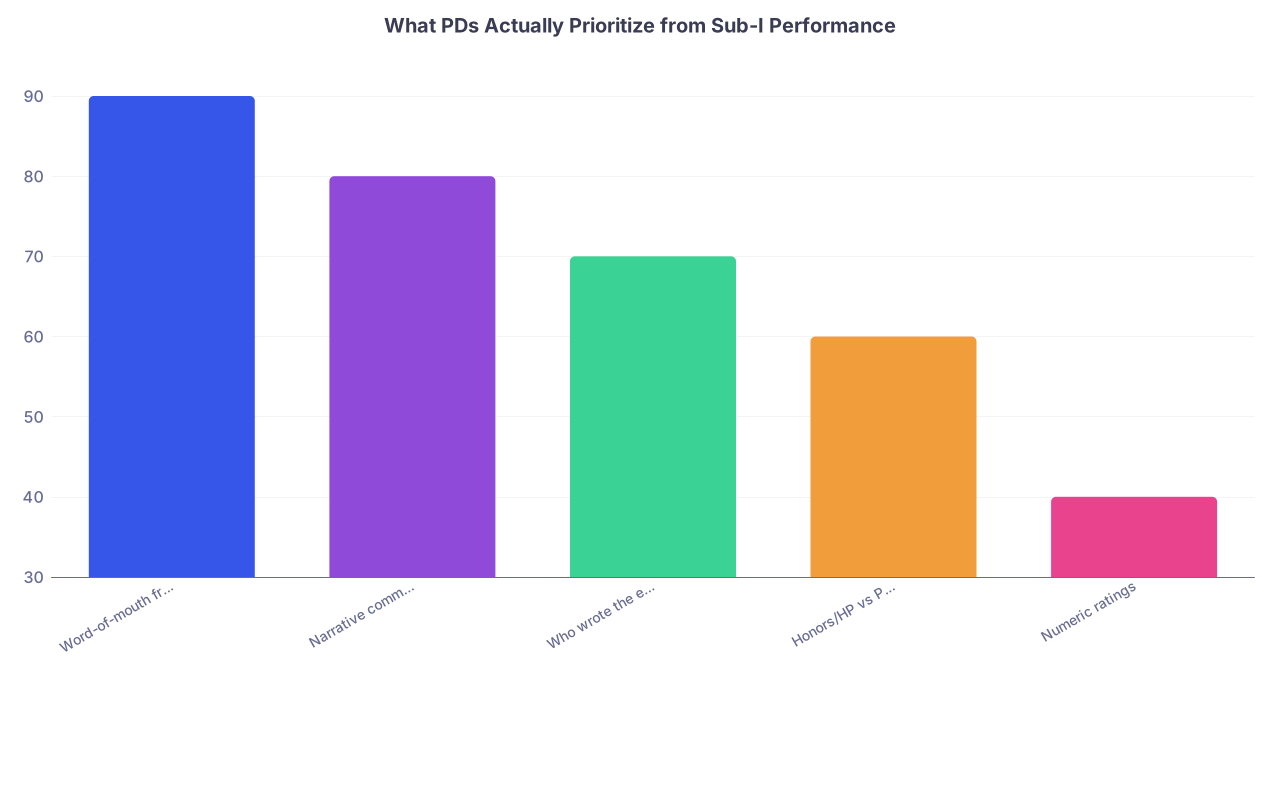
| Category | Value |
|---|---|
| Word-of-mouth from attendings | 90 |
| Narrative comments | 80 |
| Who wrote the eval | 70 |
| Honors/HP vs Pass | 60 |
| Numeric ratings | 40 |
Here’s the dirty little secret: the formal sub-I “evaluation” you see on your portal is not the main thing that moves the needle. It’s a piece, but not the king.
Program directors care about four layers, in this order, when it comes to your sub-I:
- What their trusted attendings say about you off the record
- The narrative comments in your evaluation and in your letter
- Who wrote it (and whether the PD knows or respects that person)
- The grade label: Honors, High Pass, Pass
- Those 1–9 or 1–5 checkbox ratings you obsess over
You lose sleep over whether you got a “4” instead of a “5” on “clinical reasoning.” PDs skim that. They’re not blind to numbers, but they know every school uses a different scale and half the faculty click down the middle anyway.
What matters is the story your sub-I tells when all pieces are put together.
What the Language in Your Evaluation Really Signals

Attendings use code. Not formally, but patterns develop. PDs recognize them instantly.
Let me decode some of the most common phrases.
The “Strong but Not a Star” File
“Hard-working,” “diligent,” “reliable”
Translation: Solid worker bee. Did the grunt work without complaint. Did not blow anyone away with insight or presence, but no red flags. This is often a quiet compliment. PDs like reliable. Programs run on these people.“Pleasant to work with,” “great team player”
Translation: Socially fine, no drama. If these are the only positive descriptors, PDs assume you were nice but forgettable clinically. If paired with “excellent clinical reasoning” or “outstanding ownership,” then it turns into a strong holistic endorsement.“Good fund of knowledge for level of training”
Translation: You met expectations. No one is calling you a future star, but you were not behind. Many mid-tier successful residents had exactly this comment on multiple evals. Stable, not flashy.
The “We Would Take This Person Tomorrow” File
“Would welcome as an intern / would be delighted to have on our team as a resident”
This is the nuclear compliment. PDs lock onto it. When a faculty member explicitly says they’d take you as an intern, that jumps you into a different pile.“Functioned at the level of an intern by the end of the rotation”
PDs know this can be exaggerated, but when it comes from a known hard-grader or a specific ICU or cards attending, it has real weight. Implies you were writing notes, making plans, following up, anticipating issues.“Outstanding ownership of patients”
This is one of those phrases that triggers interest. “Ownership” is code for: they actually felt like your patients, not just names on your list. You noticed low urine output before anyone asked. You arranged the family meeting. You followed up on that pending MRI at 2100.“One of the top students I’ve worked with in the last X years”
PDs are not sophisticated statisticians about this. They don’t ask, “how many students do you see?” They just hear: top tier.
The “We’re Being Polite About Problems” File
This is where students are often completely fooled. The eval looks positive to you. It isn’t.
“Will benefit from continued development in…”
Translation: This was a problem on the rotation. Not theoretical future growth. We saw this weakness.“Required more supervision than typical for level”
Translation: We did not trust you. Could be knowledge gaps, poor judgment, slow to pick up workflows, or repeated misses on basic tasks.“Improved after feedback”
Translation: There was an issue big enough that we had to sit you down. You didn’t implode, which is good, but the PD will assume at least one notable concern.“Appreciated when prompted” / “engaged when asked”
This is code for: passive, not initiative-taking. Showed up, did what was asked, but wasn’t proactive. PDs worry about this because interns who wait to be told everything become unsafe when things get busy.“Good fund of knowledge, but hesitant to make decisions”
Translation: They know stuff; they just don’t act. This terrifies surgical PDs and worries medicine PDs. Interns must make a choice, propose a plan, not just regurgitate UpToDate.
Program directors read between every single one of these lines. They’ve had years of practice.
Who Wrote It: The Hidden Weight Behind a Name
| Evaluator Type | Typical Impact on PD Interpretation |
|---|---|
| Department chair / PD / APD | Very high |
| Known strong faculty teacher | High |
| ICU / wards “hawk” attending | High (especially for work ethic) |
| Random community preceptor | Moderate to low |
| Fellow-only primary evaluator | Variable, usually moderate |
Here’s something students underestimate: the signature at the bottom is part of the evaluation.
PDs don’t treat all attendings equally. They just don’t.
If your sub-I evaluation is from:
A department chair, program director, or well-known APD
Even a short, measured “performed at a very high level; would welcome as a resident” goes a long way. These people grade a lot of students, they see a wide spectrum, and PDs trust they’re not easily impressed.The notorious ICU attending who is known for eating interns
A “did very well” from this person might be stronger than “excellent” from a chronic over-praiser. PDs factor in the culture of that rotation.A random community doc no one has heard of
It’s not that it’s worthless, but it’s not going to outweigh a lukewarm eval from a core inpatient faculty member the PD knows well. PDs discount unknowns.
At the same time, PDs absolutely talk to each other. A quick hallway conversation between your future PD and your sub-I site PD often sounds like:
“Hey, you had Patel on your wards in July, right? Good? Any issues?”
“Yeah, she was actually really strong. We’d be happy to keep her.”
That 10-second exchange is more powerful than any “4.7/5” on “professionalism.”
Sub-I Grades vs. Narrative: Which Matters More?
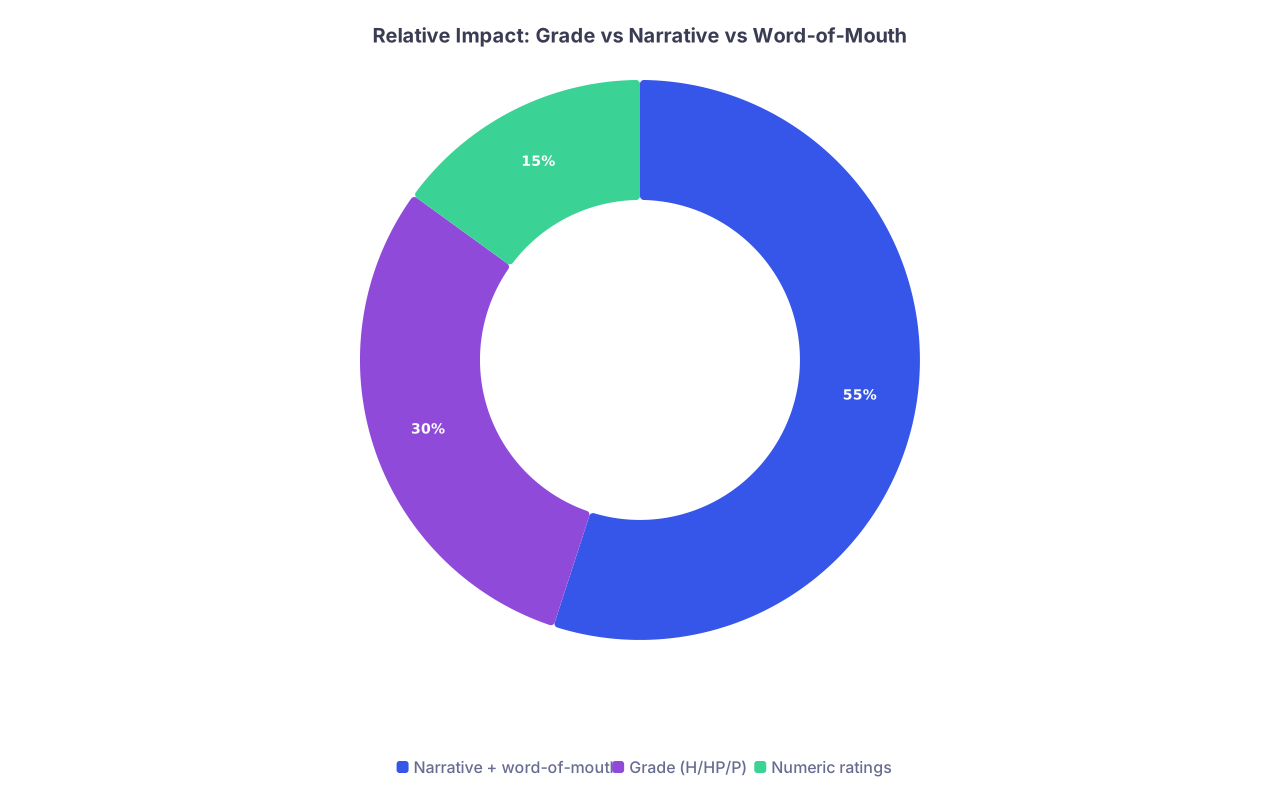
| Category | Value |
|---|---|
| Narrative + word-of-mouth | 55 |
| Grade (H/HP/P) | 30 |
| Numeric ratings | 15 |
You see “Honors” and feel safe. You see “High Pass” and feel doomed. That’s not how PDs actually think, especially in competitive, oversubscribed specialties.
They know grading systems are wildly inconsistent. They ask a different question:
Does this sub-I evaluation convince me that this person will not crumble as an intern at 2 a.m.?
Here’s the hierarchy as I’ve seen it argued in ranking meetings:
Honors + glowing narrative + strong letter from same rotation
That’s the trifecta. You move into the “we should rank this person high” pile. People remember your name.High Pass + excellent narrative + “would take as an intern” language
Often ranks better than a generic Honors with bland comments. An HP with “top 10% of students” and “functioned like an intern” turns heads.Honors + bland narrative
This is where PDs shrug. Honors inflation is rampant. If the words don’t tell a compelling story, they assume you were fine but not special, or the rotation gives Honors to everyone who shows up.Pass + specific context in the MSPE
If there’s an outlier grade, PDs look for explanations. New grading system, harsh rotation, documented family emergency, illness, remediation completed. A single Pass is not an automatic death sentence if the rest of the application screams growth and reliability.
They are pattern readers. One outlier is a question. Multiple lukewarm patterns are a decision.
How PDs Cross-Reference Your Sub-I with the Rest of Your File

| Step | Description |
|---|---|
| Step 1 | Read sub-I grade |
| Step 2 | Scan narrative comments |
| Step 3 | Check MSPE for explanations |
| Step 4 | Look at who wrote it |
| Step 5 | Compare to other clerkship evals |
| Step 6 | Consider for higher rank tier |
| Step 7 | Middle or lower rank tier |
| Step 8 | Any red flags or hedging? |
| Step 9 | Consistent high performance? |
No PD is reading your sub-I in isolation. They’re pattern-matching across your entire application.
Here’s how the thought process usually goes in a ranking meeting or when screening:
They see your Step scores and transcript.
“Okay, decent scores, no Step landmines. How did they actually perform?”They jump to the MSPE clerkship summary.
Looking for: any “concerns,” any repeated behavioral patterns, any remediation.They compare your core medicine or specialty sub-I with your earlier clerkships.
- If you struggled early but your sub-I is strong: “Good, they grew.”
- If your early clerkships are great but your sub-I is meh: “What happened when responsibility increased?”
They look at your letters.
If your sub-I letter and the formal eval both highlight the same strengths (“ownership,” “communication,” “work ethic”), PDs believe it. Consistency builds trust.They triangulate with your interview.
Does the person sitting across from them fit the person described on paper? If the eval says “quiet but reliable” and you’re trying to act like a gregarious extrovert on the interview trail, they notice the mismatch.
What Makes a Sub-I Evaluation Truly Stand Out

There are three types of sub-I evals PDs remember months later when rank lists are built.
1. The “Mini-Intern” Narrative
This is the one that says, clearly and concretely, “we stress-tested this person and they held up.”
You’ll see language like:
- “Took primary responsibility for 4–6 complex patients”
- “Independently pre-rounded, wrote thorough notes, and called consults with appropriate preparation”
- “Anticipated issues and communicated proactively with the team”
- “Was trusted to cross-cover with supervision appropriate for a sub-I”
The key is autonomy plus trust. PDs want someone who has already been treated a bit like an intern and didn’t fall apart.
2. The “Rescue Under Pressure” Story
Faculty love to brag about the student who rescued a situation.
That might be:
- You caught early sepsis on a patient whose vitals were “just a little off”
- You noticed the wrong dose on a chemo order and escalated
- You flagged a social situation that was about to explode at discharge
When any of that makes it into your narrative—“caught a subtle change,” “advocated effectively for patient”—PDs hear: situational awareness, judgment, and courage to speak up.
3. The “Culture Fit” Signal
This is more subtle but powerful. Words like:
- “Humility,” “takes feedback well,” “calm under pressure”
- “Builds strong rapport with nursing and ancillary staff”
- “Boost to team morale,” “positively impacted team culture”
Programs are terrified of bringing in toxic, arrogant, or fragile interns. They pay attention to any indication that nurses liked you, that you owned mistakes, that you didn’t turn into a martyr or a ghost when tired.
When I’ve sat in meetings, a single attending saying, “The nurses kept asking if we could get her back” has more weight than another “Honors” stamp.
Hidden Red Flags PDs Pick Up That You Probably Missed
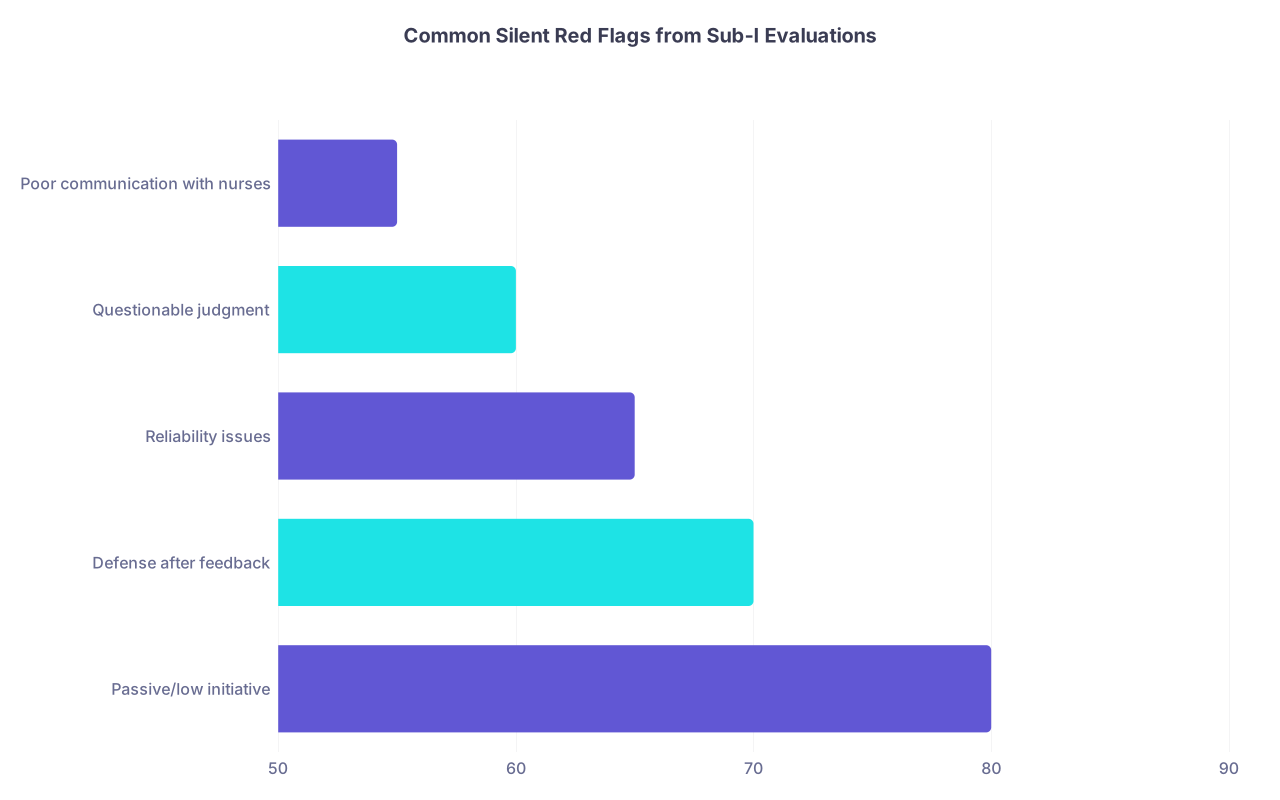
| Category | Value |
|---|---|
| Passive/low initiative | 80 |
| Defense after feedback | 70 |
| Reliability issues | 65 |
| Questionable judgment | 60 |
| Poor communication with nurses | 55 |
Some red flags are obvious: “unprofessional,” “missed multiple days,” “dishonest.” Those tank you outright.
The more common ones are quieter, and they’re often buried in otherwise “good” evals.
Watch for phrases like:
“Needed frequent reminders to complete tasks”
PD takeaway: You dropped the ball. Often.“Occasional difficulty prioritizing tasks”
PD translation: On busy days, we could not rely on this person. Might be unsafe.“At times appeared overwhelmed with patient load”
PD hears: When we gave them 3–4 patients, they cracked. Interns routinely manage more.“Sometimes defensive in response to feedback”
This is a torpedo. You get labeled as “hard to coach.” Way worse than being a little slow at first.“Communication with nursing staff improved over the rotation”
Translation: It was rocky. Could be tone, responsiveness, or basic courtesy.
None of these might stand out to you when you skim the eval. PDs read them with a highlighter—mentally if not literally.
How Your Behavior on Sub-I Writes That Evaluation Before Anyone Types a Word
Let me flip the script: instead of just decoding what’s written, I’ll tell you the behaviors that tend to produce the strongest hidden signals in an eval.
PDs and attendings consistently call out the same types of things when they rave about a sub-I:
You made the intern’s life easier, not harder.
This isn’t romantic. It’s real. If the intern can trust you to actually keep the to-do list moving—check labs, follow up on consult notes, update families—you automatically move into a different category.You always knew your patients cold.
Not “I think they might have had a CT?” You knew the story, the last K value, the trending creatinine, why that antibiotic was chosen, what the plan was if things worsened.You proposed plans, not just problems.
“Mr. J’s BP has been 80s/50s for the last hour” is fine. “Mr. J’s BP has been 80s/50s; I repeated it manually, ordered a bolus per protocol, and I’m concerned he may be septic given his new fever—should we broaden antibiotics now?” That’s different. That’s future-intern energy.You didn’t disappear when things got hard.
Plenty of students look good at 9 a.m. table rounds. The ones who are still engaged, asking, “What else can I help with?” at 5:30 p.m. on a heavy admit day—those are the names that come up when PDs ask, “Any standouts this year?”
All of that becomes the subtext behind “outstanding ownership” or “strong work ethic.”
Where This Leaves You in the Residency Match

Here’s the bottom line.
Your sub-I evaluation is not just another box in your MSPE. It’s one of the few points in your file where people saw you under something close to intern-level expectations. PDs know that. They weigh it accordingly.
They’re trying to answer one core question:
If I give this person a pager and 8–10 patients on July 1, will my residents thank me or hate me?
They use your sub-I evaluation—formal comments, informal whispers, the reputation of who wrote it—to make that call.
So as you look back on your evals, or plan upcoming sub-Is, don’t obsess over the numeric anchors. Ask yourself:
- Did I take ownership like these were my patients?
- Did I make my intern and resident’s lives easier?
- Did I stay curious and propose plans, not hide in the background?
- Did I leave behind a clear, specific story someone would be excited to tell a PD?
Because that’s what really gets inferred. The story. Not the checkbox.
With these truths in your pocket, you’re better prepared to treat every sub-I like a month-long interview. The next step is understanding how to turn those strong rotations into letters and narratives that actually move you up a rank list—but that’s a conversation for another day.