Program directors trust your clerkship comments more than your shelf scores.
But they use your shelf scores faster.
Let me unpack that, because this is one of those things students consistently misunderstand and nobody on the faculty side bothers to explain clearly.
You’re told to crush your shelves. You’re told honors is everything. You’re told narrative comments are “subjective” and scores are “objective.” On paper, sure. In the actual residency selection room? That’s not how it plays out.
How PDs Actually Look at Your Clerkship Performance
Here’s the sequence in real life when a PD or selection committee member opens your application. I’ve watched this happen in internal medicine, surgery, EM, peds, and psych meetings:
They click into your MSPE or transcript and:
- Scan the grade distribution: how many Honors / High Pass / Pass.
- Glance at shelf ranges or percentiles if they’re there.
- Then slow way down at the actual narrative comments.
The cognitive order is speed → filter → meaning.
Scores and grades are fast. Comments give meaning. One screens. One decides.
Why comments carry more “truth value” behind closed doors
Faculty know the dirty secret: multiple-choice performance is noisy. A tired call night, a bad version of the exam, a student who memorizes question stems but can’t present a patient to save their life — we’ve all seen it. So when we’re actually arguing about who to rank high, nobody is passionately defending, “But their shelf was 88th percentile!”
They’re saying things like:
- “Look at this: ‘Top 5% of students I’ve worked with in 10 years.’ That’s real.”
- “Multiple attendings said ‘functions at intern level.’ That’s someone I trust at 3 a.m.”
- “On sub-I: ‘I would happily have them as a resident in our program.’ That’s gold. They’re in the top of the rank list.”
The moment an attending sees “one of the best students I’ve worked with” written several times, the shelf score stops mattering unless it’s disastrously low.
But. Shelves still shape your destiny in ways you don’t see, because they often determine those very grades that gatekeep the strong comments.
The Real Role of Shelf Scores: Gatekeeper, Not King
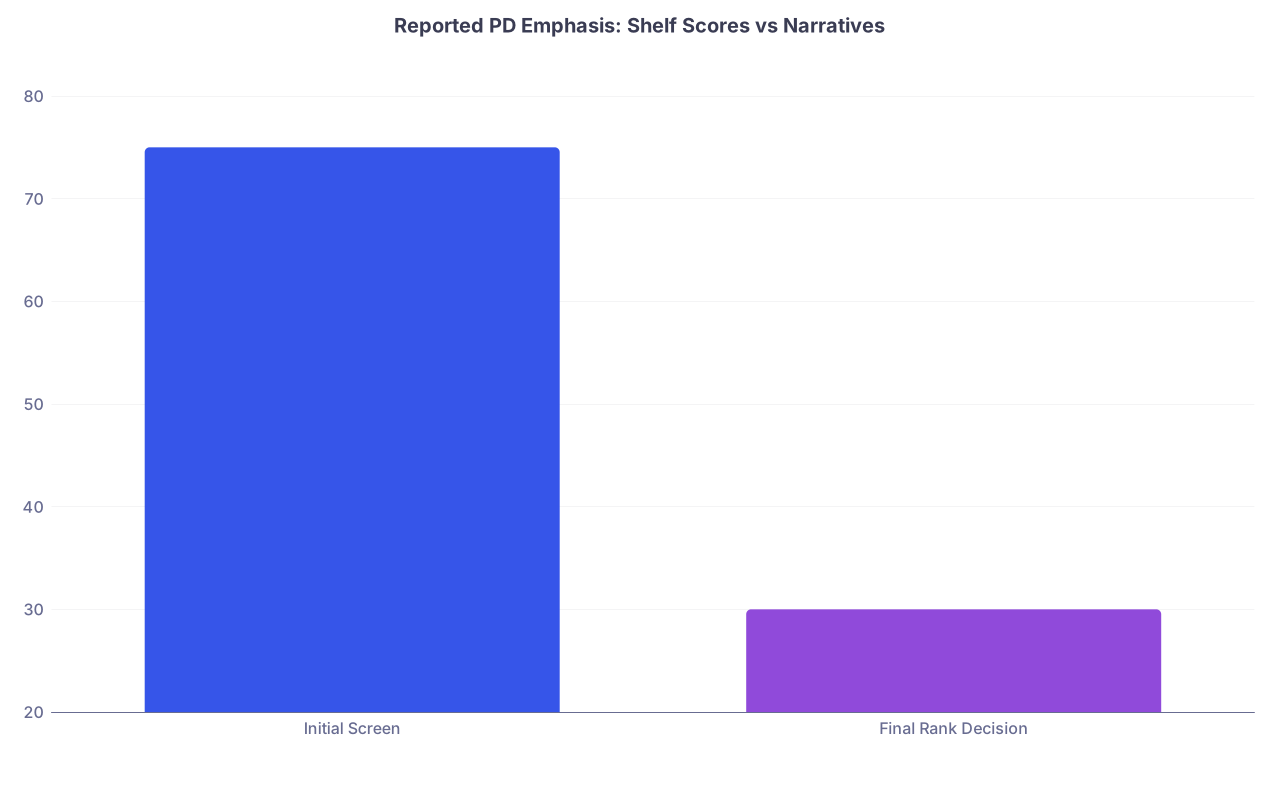
| Category | Value |
|---|---|
| Initial Screen | 75 |
| Final Rank Decision | 30 |
Behind the scenes, shelves are used in three main ways:
- To decide who gets Honors/High Pass on core clerkships.
- To screen applicants before any human actually reads your comments.
- To trigger red flags when scores are low in your own chosen specialty.
How programs bake shelves into grades
Most schools do some version of this, whether they admit it or not:
| Component | Weight Range |
|---|---|
| Clinical evaluations | 40–60% |
| Shelf/Final exam | 30–50% |
| Assignments/OSCE/etc | 10–20% |
I’ve sat in clerkship directors’ offices where they openly say: “If their shelf is below X percentile, they’re basically out of the running for Honors unless they’re unbelievably strong clinically.”
So what happens? A stellar clinical student with average test-taking ends up with a string of High Passes instead of Honors, then weaker comparative language in the MSPE. Not because they weren’t one of the best people to work with. Because a behind-the-scenes formula pushed them down a band.
By the time that application hits a PD’s desk, all they see is: “Good student, consistently High Pass.” Shelf didn’t “decide” their fate in the PD’s eyes. It silently downgraded them before the PD ever showed up.
Shelf as a fast screening tool
Program coordinators and PDs don’t have time to deeply analyze 1,000 applications. So they do this:
- Use filters: COMLEX/USMLE cutoffs, sometimes Step 2 > a certain number.
- Quickly scan clerkship grades: wants to see no glaring pattern of weak performance.
- If shelves are shown as percentiles, a string of sub-20th percentiles raises eyebrows.
At this stage, no one is really parsing your comments. They’re bulk-sorting.
Once you’re through that layer, the narrative becomes king.
What Comments Actually Signal to PDs
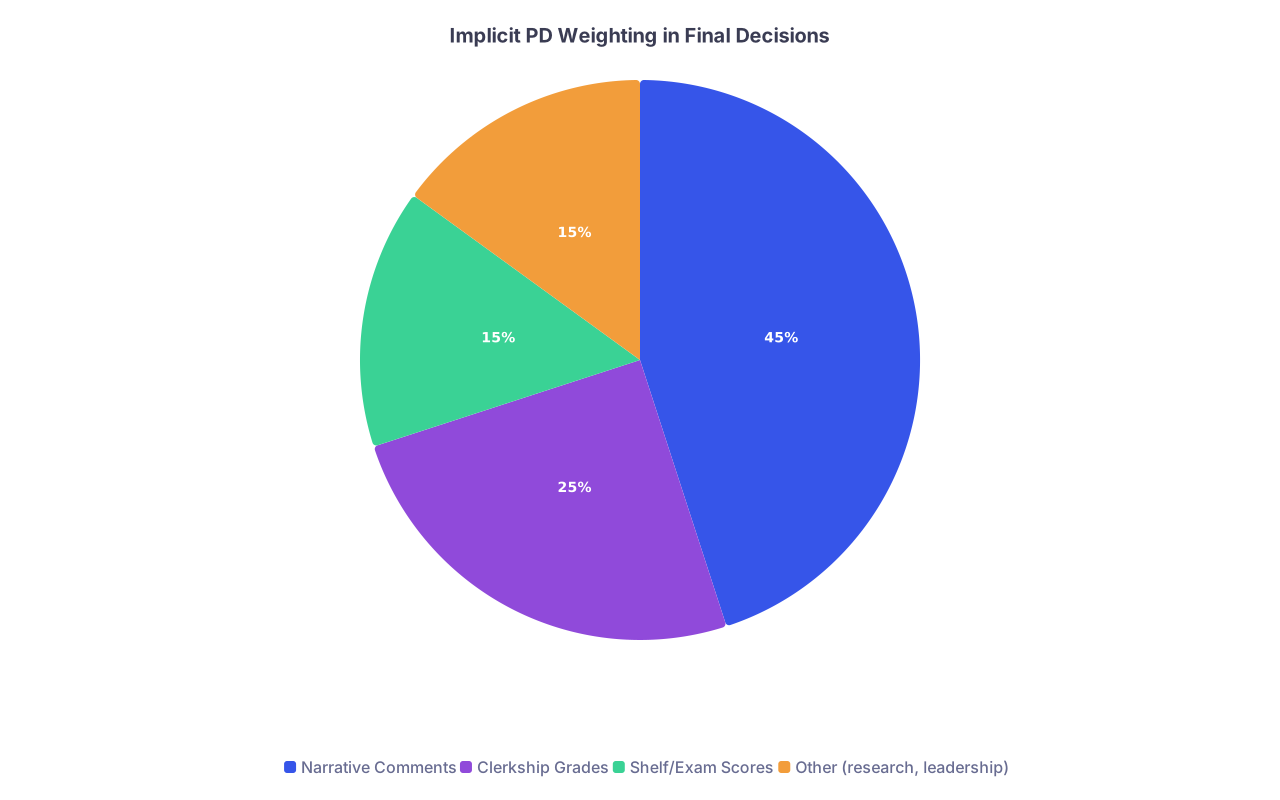
| Category | Value |
|---|---|
| Narrative Comments | 45 |
| Clerkship Grades | 25 |
| Shelf/Exam Scores | 15 |
| Other (research, leadership) | 15 |
Let me tell you how comments are actually read in committee. People don’t read them like literature. They hunt for signal phrases. Pattern recognition.
Here are the coded messages we’re looking for, even if nobody says this out loud.
1. Comparative language: where you rank among peers
Anything that compares you to a cohort is disproportionately powerful:
- “Top 10% of students I have worked with” → interpreted as: safe, strong, likely to succeed.
- “One of the strongest students this year” → top 5–10% at that institution.
- “Outstanding medical student” with no comparison → good, but not elite.
- “Met expectations” / “Performed at the expected level” → that’s borderline damning. Reads as: average, do not fight for this one.
When I see repeated comparative language across multiple clerkships, that’s stronger than any 90th percentile shelf. Because it suggests sustained excellence in actual clinical work, not a single test.
2. Autonomy and “intern-ready” descriptors
PDs care about who is going to reduce their residents’ pain at 2 a.m.
Phrases that push you up the rank list:
- “Functioned at the level of an intern by end of rotation.”
- “Required minimal supervision for day-to-day tasks.”
- “Proactively identified and addressed patient issues.”
Phrases that quietly push you down:
- “Will be an excellent resident with further development.” (Translation: not ready yet.)
- “Eager learner who will benefit from additional structure.” (Translation: needs handholding.)
- “Pleasant and hardworking, though somewhat tentative.” (Translation: will slow down the team early on.)
Nobody in that room cares if you got an 85 or 92 on the shelf if three attendings say you already think like an intern.
3. Team dynamics and likeability
This is the part students underestimate.
PDs are reputationally on the hook if they bring in a toxic or high-maintenance resident. The fastest way to tank your rank position is anything hinting at interpersonal problems.
Red-flag phrases, even if softened:
- “At times, had difficulty incorporating feedback.”
- “Assertive style that may be perceived as abrasive.”
- “Had occasional tension with team members but was responsive to discussion.”
I’ve seen applicants with near-perfect shelves get dropped 20–30 spots on a rank list because of those sentences. The committee never says, “We’re afraid they’re difficult”; they say, “We’re not sure about the fit,” or “There are some concerns about professionalism.”
On the flip side:
- “Beloved by staff and residents.”
- “A joy to work with.”
- “Improved team morale.”
Those comments will rescue you from an average shelf history.
4. Specialty-specific signaling
Your target specialty pays the most attention to:
- Comments from that specialty’s clerkship.
- Comments from your sub-internships / acting internships.
- Comments from away rotations.
When we’re discussing a borderline candidate for, say, internal medicine, someone will inevitably say: “But look at their medicine sub-I — ‘strongest sub-I of the year, absolutely would take as a resident.’ That’s it. They’re fine.”
Your psych comments won’t save you in ortho. Your OB shelf won’t sink you in EM. But your internal medicine and sub-I comments will make or break you for IM, no matter what people claim about “holistic review.”
Where Shelf Scores Actually Hurt You
Shelves rarely help beyond getting you honors and showing you’re not a liability. But they can hurt you in three clear scenarios.
1. Pattern of weakness in your chosen field
One low shelf? Nobody cares. Two low shelves? People notice but often shrug.
A pattern of poor performance in the field you’re applying to? That gets discussed.
Example: applying to IM with this pattern:
- Medicine shelf: 12th percentile, Pass
- Sub-I comments: “Required significant guidance,” “Struggled with organization”
- Other shelves are fine
Now people in the room start asking, “Are they choosing the right specialty?” That’s where shelves reinforce the doubt raised by weak comments.
If, however, your medicine comments are glowing and your shelf is low, many PDs will say out loud: “I trust the attendings more than the exam.”
2. Very low outlier raises a professionalism/effort question
If one shelf is dramatically low (bottom 5–10%), and especially if your school flags failures or retakes, PDs wonder: Did they blow this off? Were there personal issues? Is this a one-off?
Here’s the nuance you don’t hear: a single poor shelf with strong comments on that rotation is often excused as “bad test day.” A poor shelf plus middling or weak comments is what really sinks you.
3. Competitive specialties use them as a blunt instrument
For derm, ortho, neurosurg, plastics, urology, ENT — heavy filter specialties — shelves are just part of a high-bar ecosystem. Combined with Step 2, they become a quick “do not bother” tool.
Nobody’s in the meeting weeping over your 60th vs 80th percentile. But in a pool where everyone has publications, honors, and AOA, it’s just another small way to push you slightly down the pile if there’s any blemish.
How to Use This Knowledge While You’re Still on Clerkships
You can’t go back and change your shelves, but you can absolutely shape your comments and how they read.
Make it easy for attendings to write the right phrases
Most comments are written in a rush. Attending opens the eval, vaguely remembers you were “nice,” and picks some stock language. Your job is to leave them with clear, concrete memories.
You want them thinking:
- “This is the student who always knew the overnight events before rounds.”
- “This is the one who called me about that subtle lab trend at 7 p.m.”
- “This is the one who stayed late to help admit that complicated patient without being asked.”
Those become lines like:
- “Took ownership of patients and consistently knew all details of their care.”
- “Demonstrated outstanding initiative and follow-through.”
- “Went above and beyond for the team and patients.”
Those lines carry more weight than a 90th percentile shelf every single time in final rank discussions.
Clarify your specialty interest during relevant rotations
This is a subtle but important trick students rarely use.
When you’re on the clerkship or sub-I of your chosen field, you don’t need to give a TED Talk. But say, plainly, to at least one attending:
“I’m strongly considering [specialty] and would really value honest feedback on whether you think I’m on the right track.”
Two things happen:
- They actually pay more attention to you, because now they realize their words might land in your MSPE.
- If they like you, you’re more likely to get lines like, “Will be an outstanding [specialty] resident,” which PDs love to see.
If you never say it, you often end up with generic “good student” comments that are forgettable in a stack of 700 applications.
If your shelves are weak, you double down on narrative and relationships
If you’re already past clerkships and your shelves are mediocre, the move is:
- Crush your sub-I’s and away rotations.
- Ask for letters from attendings who actually saw you work hard and independently.
- Make sure your behavior screams “intern-ready and safe.”
PDs will forgive a mediocre shelf record if your late-phase clinical story is: massively improved, now clearly strong, clear fit for the field.
I’ve seen it over and over: a student with some average or weak early shelves, then a medicine sub-I comment reading “one of the best sub-interns we’ve had in years.” They matched into solid university IM programs. Not because anyone forgot the shelves. Because the more recent, higher quality data (real work on a busy service) outweighed them.
How PDs Weigh It All on Rank Day

| Step | Description |
|---|---|
| Step 1 | Application Reviewed |
| Step 2 | Discuss Concerns |
| Step 3 | Focus on Clinical Performance |
| Step 4 | Mitigate Concern, Rank Lower-Mid |
| Step 5 | Rank Low or Do Not Rank |
| Step 6 | Read Clerkship & Sub-I Comments |
| Step 7 | Rank Higher |
| Step 8 | Rank Middle or Lower |
| Step 9 | Shelf/Step Red Flags? |
| Step 10 | Narrative Strong? |
| Step 11 | Intern-Ready & Team Player? |
In those long, painful rank meetings, shelves show up mainly as background context and tie-breakers. Comments decide who people are willing to fight for.
Literal quotes I’ve heard in those rooms:
- “Yeah, shelves are so-so, but look at these comments. Everyone loved working with them.”
- “Their test scores scare me less than a comment about being ‘hard to coach.’”
- “This sub-I eval is as good as it gets. I don’t care that their surgery shelf was weak — we’re not hiring a surgeon.”
When people remember you by name in that room, it’s because of narrative. Either someone actually knows you, or your comments were so strong that you became a “story” in the committee’s mind. No one tells a story about a shelf percentile.
Quick Reality Check: What Matters More, Practically?
If you want a one-sentence hierarchy for final decision-making (not initial screening):
Narrative comments from core clerkships and sub-I’s > Overall clerkship grades > Shelf scores.
But for getting to the table at all, shelves and Steps help you get past the first cut. You need them to be “good enough,” then you win with how people describe working with you.


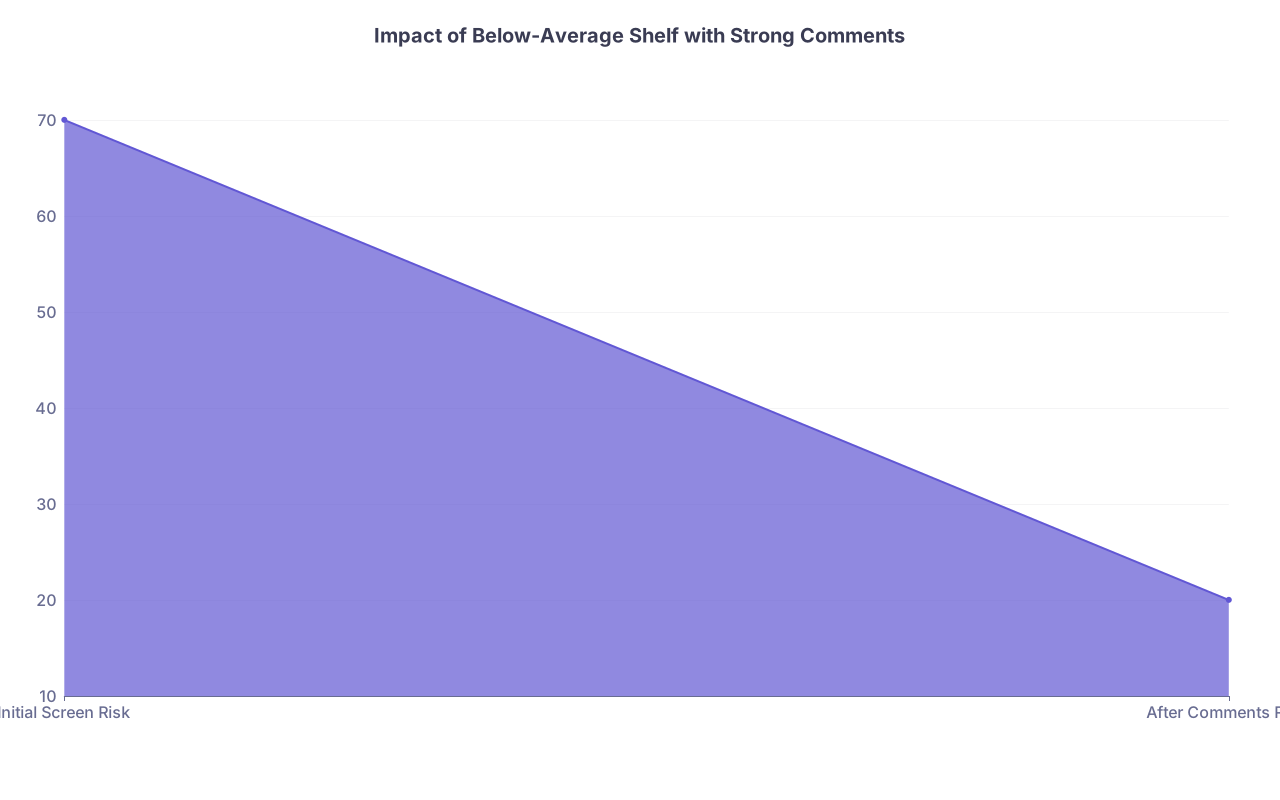
| Category | Value |
|---|---|
| Initial Screen Risk | 70 |
| After Comments Read | 20 |