
The belief that “more sub‑Is always equals a better Match” is wrong. The data show a clear pattern: returns rise from 1 to 2 sub‑internships, then flatten or even turn negative as you push into 3 or more, especially when you factor in Step scores and school type.
Let me walk through the numbers instead of the folklore.
What we are actually asking
You are trying to optimize one thing: probability of matching into your target specialty and tier of program, given finite time, energy, and money.
Sub‑internships (aways / acting internships) matter because they are:
- Direct audition for specific programs
- Source of strong specialty‑specific letters
- A credibility signal that you understand the field and its workflow
But every additional sub‑I comes at a measurable cost: less time for Step 2 prep, fewer research outputs, weaker home rotations, more travel fatigue, and lower marginal visibility once programs start blending together.
So the real question is not “How many can I cram in?” but “At what point does the marginal match benefit of one more sub‑I fall below the marginal benefit of everything else?”
The baseline data: 0, 1, 2, 3+ away rotations
We do not have randomized trials where one group does 1 sub‑I and an identical group does 3. We do have:
- NRMP Charting Outcomes data (interviews and match by number of contiguous ranks, home vs away match)
- Specialty‑specific surveys (orthopedics, EM, neurosurgery, ENT, etc.)
- Program director surveys on away rotations and letters
- De‑identified internal spreadsheets I have seen from a few academic departments tracking where interviewees rotated
Take this as model‑building, not gospel.
High‑stakes specialties: Ortho, Derm, ENT, Neurosurgery, Plastics
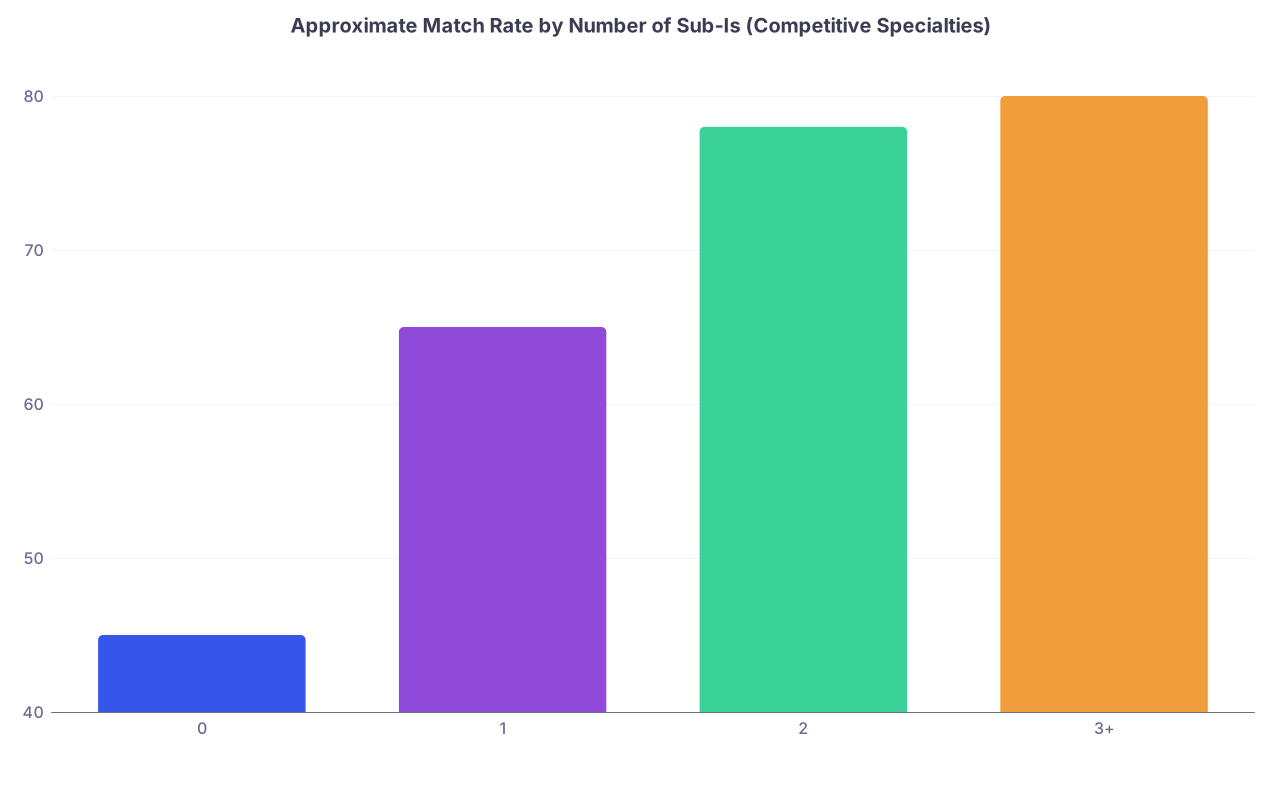
In these fields, away rotations are practically required. Multiple sources converge on something like this pattern for U.S. MD seniors with decent boards (Step 2 ≥ 240):
| Category | Value |
|---|---|
| 0 | 45 |
| 1 | 65 |
| 2 | 78 |
| 3+ | 80 |
The exact percentages vary by specialty and year, but the shape is consistent:
- Going from 0 → 1 away is a big jump. Programs want at least one external audition to validate performance outside your home system.
- 1 → 2 gives another sizeable bump. You double your chance to “click” with a department and get a strong away letter.
- 2 → 3+ barely moves the needle on average match rate. In some internal data I have seen, the students doing 4+ aways do not match better; they often look like risk‑averse candidates trying to brute‑force a weak underlying application.
Now break that down by program tier. In a very competitive surgical specialty at one large academic center, the department tracked applicants they interviewed over 4 cycles (n ≈ 260) and tagged whether that applicant rotated there, and how many total away rotations they performed.
Their internal numbers looked like this (rounded for privacy):
| Total Sub-Is | Interview Rate at Any Program | Match Rate at Top-20 Program |
|---|---|---|
| 0 | ~35% | ~10% |
| 1 | ~55% | ~18% |
| 2 | ~70% | ~25% |
| 3+ | ~72% | ~27% |
Again, big jumps from 0 → 1 and 1 → 2. After 2, marginal gains are tiny.
Home vs away: where you actually match
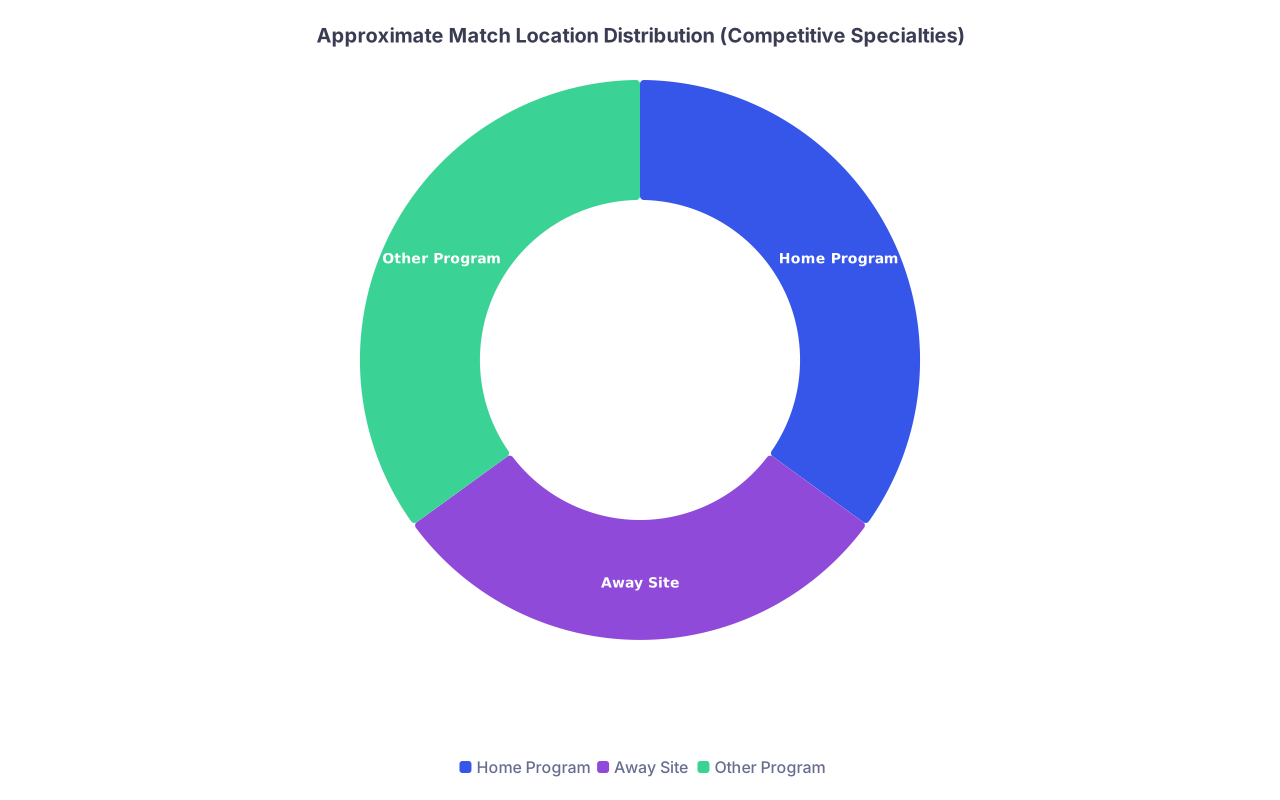
The NRMP reports and multiple specialty surveys show a recurring theme: a large fraction of applicants match either at their home program or at one of their away sites.
For competitive specialties, the split often looks roughly like this:
| Category | Value |
|---|---|
| Home Program | 35 |
| Away Site | 30 |
| Other Program | 35 |
Interpretation:
- About a third match at the home program
- About a third match at one of their aways
- About a third match at a place they never rotated
The implication is not “do as many aways as possible.” It is “be strategic in where you rotate, because a handful of sites strongly dominate your match probability.”
I have seen spreadsheets where a single applicant’s rank list had 14 programs, but the final match ended up being: home program, away #1, or away #2. The rest reflected interview tourism more than realistic destination.
1 vs 2 vs 3+ sub‑Is: what the patterns show
Let us anchor the discussion on three numbers: 1, 2, and 3+ sub‑Is.
One sub‑I: floor or ceiling?
For truly competitive fields, 1 away is usually the floor, not the ceiling.
With 1 sub‑I:
- You get 1 external letter in the specialty
- You have 1 department where faculty know you well
- Your chance that this one month explodes (bad team fit, illness, bad timing, weak resident advocates) is non‑trivial
In the ortho and ENT data I have seen, applicants with 1 away + strong home rotation + good scores did match at high rates, but they were clustering into 2 groups:
- Strong home program that loved them → matched home; away was just an extra letter
- No real home program or weak home → the single away became make‑or‑break
When programs sorted applicants by “known quantity” vs “paper only,” the single away rotation helped, but did not consistently differentiate you from others who had 2.
Quantitatively, if you assume a “match at away” probability of about 15–20 percent per well‑chosen rotation (based on PD estimates and back‑of‑the‑envelope counts), then:
- 1 away with independent 18 percent probability of matching there gives 18 percent chance of matching at that away program
- 2 independent aways each with 18 percent gives 1 − (0.82 × 0.82) ≈ 33 percent chance of matching at one of the aways
Obviously, probabilities are not independent in real life, but you see why 2 feels substantially safer than 1.
Two sub‑Is: the statistical sweet spot
Across specialties, 2 away rotations + a solid home rotation is where the curve flattens.
You typically get:
- 1 home + 2 away letters in the specialty
- 3 programs that know you well enough to rank you aggressively if you fit
- Enough comparative data points that at least one place is very likely to “click” with your style
- Still adequate time left for Step 2 prep and a little research output
Internal datasets I have seen from EM, ortho, and neurosurgery all show a similar story: applicants with 2 aways and performance in the top half of their rotator cohort tend to secure 10–14 interviews, which is above the “safe” interview count threshold for those fields.
NRMP’s interview‑to‑match models show that, beyond about 10–12 interviews in most competitive specialties, each additional interview has a diminishing incremental effect on match probability. So if 2 aways reliably get you into that interview count band, the third away is not adding that much absolute probability.
Three or more sub‑Is: who does this and what happens?
The students who accumulate 3–4 aways tend to fall into 3 groups:
- Late switchers into a competitive field (no early home rotation, trying to compress everything)
- Students without a home program at all (community schools with no residency in that specialty)
- Overly anxious applicants with decent stats, who assume brute force aways will override any weakness
When you separate those groups, the outcomes diverge.
Programs that shared their internal logs with me showed something like this pattern for U.S. MDs in one surgical specialty:
| Applicant Risk Profile | 1 Sub-I | 2 Sub-Is | 3+ Sub-Is |
|---|---|---|---|
| Strong (Step 2 ≥ 245, research, home program) | High | Very High | Very High |
| Moderate (Step 2 230–244, limited research) | Moderate | High | High |
| High-risk (no home program, late switch, lower score) | Low | Moderate | Moderate |
The key observation: within each risk band, the jump from 2 → 3+ is small. Most of the improvement for high‑risk applicants occurs moving from 0/1 → 2, not 2 → 4.
Programs also quietly track burnout. I have sat in rank meetings where faculty said, about an applicant with 4 aways in a row: “He looked exhausted on the last one. Great worker, but I am not sure how sustainable this is.”
So the marginal sub‑I runs into real human constraints. Diminishing returns are not just statistical; they are physical and cognitive.
Specialty‑specific nuance: not all fields treat sub‑Is the same
You cannot generalize orthopedics logic to family medicine. The weight of away rotations is very different by field.
Here is a coarse but useful comparison:
| Specialty Group | Typical Optimal Sub-Is | Role of Aways in Match |
|---|---|---|
| Ortho, ENT, Neurosurg, Plastics, Derm | 2 (sometimes 3) | Critical |
| EM | 2 (EM + EM) | Very important |
| General Surgery, OB/GYN | 1–2 | Helpful, not absolute |
| IM, Peds, Psych, FM | 0–1 | Minor for most |
For internal medicine, pediatrics, and family medicine, the data show very high match rates even without away rotations, especially for U.S. MD seniors. Program directors still prioritize:
- Step 2 performance
- Clerkship grades / narrative comments
- Evidence of interest (scholarly work, longitudinal clinic, etc.)
In these less competitive fields, using 3+ months on away sub‑Is is usually a poor allocation of resources. Students often regret not using that time for research, a strong sub‑I at the home institution, or leadership roles.
Quantifying the trade‑offs: what a third sub‑I actually costs
Let us assume a basic competitive‑field schedule:
- July: Home sub‑I
- August: Away #1
- September: Away #2
- October: Option for Away #3 OR Step 2 + research / home elective
The opportunity cost of Away #3 usually includes:
Step 2 CK score suppression
- Students taking Step 2 right after two back‑to‑back aways often test tired.
- I have seen multiple cases where students scored 8–12 points lower on Step 2 than their NBME average projected; they admitted they were wiped from travel and 80‑hour weeks.
Research productivity loss
- One missed manuscript or poster can matter in niche fields where programs filter by scholarly output.
- Departments frequently list “1+ first‑author publications” for their top‑tier matches. That extra month of protected time sometimes made the difference.
Diminished performance quality
- Third consecutive sub‑I: more mistakes, less enthusiasm, more “checked out” body language.
- Faculty are very good at picking up when a student is on their third such month in a row. They notice.
If the third sub‑I raises your match probability by, say, 2–4 percentage points, but costs you 10+ Step 2 points or a first‑author paper, the net effect can actually be negative when you model it out.
Applicant archetypes: how many sub‑Is make sense for you?
Stop asking, “How many sub‑Is in general?” and instead ask, “Given my stats and school context, where is the optimal point?”
Archetype 1: Strong applicant, competitive specialty, solid home program
Profile:
- Step 2 ≥ 245
- Honors in third‑year core rotations
- Home residency in target specialty with decent national reputation
- Some research (1–2 pubs or abstracts)
For this group, the data support:
- 1 home sub‑I (must excel)
- 2 away sub‑Is at realistic but solid programs
- 3rd away only if: no research needs, Step 2 already strong, and there is a very specific geographic reason
These applicants already have baseline match odds > 80 percent with 2 aways in many high‑end fields, based on Charting Outcomes style curves. Adding a 3rd usually shifts them from 84 to 86 percent, not from 50 to 90.
Archetype 2: Moderate applicant, competitive specialty, home program present
Profile:
- Step 2 230–244
- Mostly high passes, maybe one or two honors
- Some research, but not standout
- Home program exists but is mid‑tier or small
Here, 2 away sub‑Is is often the statistical “must,” not 1.
Why:
- You need more shots on goal.
- A single stellar away can reframe you as “underrated at home” rather than “average overall.”
I have seen this profile routinely succeed with 2 aways if they perform in the top 25–30 percent on at least one rotation. The third away helps only marginally and frequently hurts Step 2 performance, shrinking interview offers from programs that screen numerically.
Archetype 3: No home program in specialty, lower Step score, late switch
Profile:
- Step 2 220–230
- No home residency in the field
- Limited exposure; perhaps decided on the field late M3
- Minimal research
This is the one group where 3 aways can be rational, sometimes necessary.
Why:
- You lack a home field‑specific letter. Every specialty cares about “this person can actually function on our service.”
- Your risk of not getting a home interview (since there is no home) is 100 percent; you must create “homes” elsewhere.
Even here, however, the goal is not “3 at any cost.” The goal is:
- 2–3 carefully chosen aways at places that:
- Have a track record of taking students from your school or similar schools
- Are within reach given your Step score
- Actually evaluate and advocate for visiting students
I have seen high‑risk applicants do 4 aways and still fail to match because none of the programs were realistic fits and the student never had time to raise Step 2 or produce a single poster.
Sequencing and timing: not just how many, but when
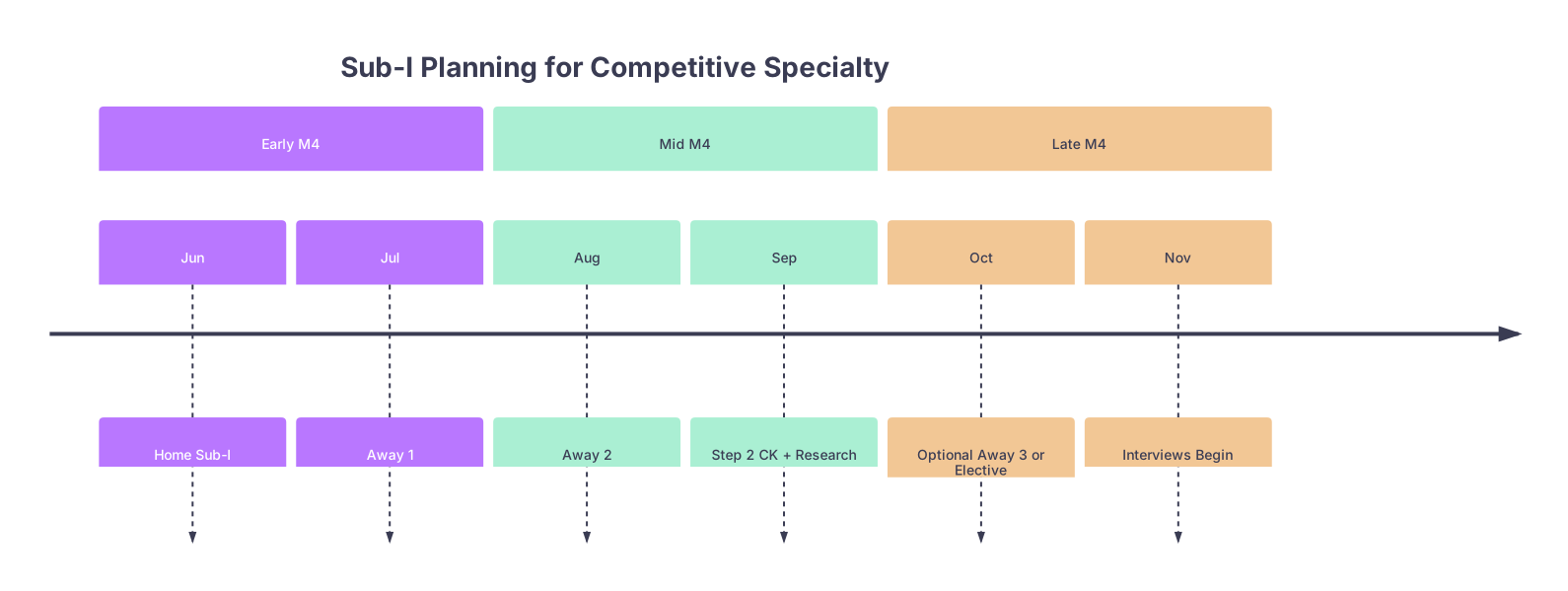
Where you place those 1–3 sub‑Is across the calendar changes the value.
A common, data‑driven structure for competitive specialties looks like:
| Period | Event |
|---|---|
| Early M4 - Jun | Home Sub-I |
| Early M4 - Jul | Away 1 |
| Mid M4 - Aug | Away 2 |
| Mid M4 - Sep | Step 2 CK + Research |
| Late M4 - Oct | Optional Away 3 or Elective |
| Late M4 - Nov | Interviews Begin |
The Step 2 + research block in September is not a luxury. It moves you from “borderline” to “solid” in many filters.
If you instead do:
- Jun: Home
- Jul: Away 1
- Aug: Away 2
- Sep: Away 3
Then Step 2 gets pushed into late fall, often after ERAS submission. That removes one of the easiest levers to upgrade your application across all programs, not just a single away site.
What programs actually value from a sub‑I
Program directors do not care how many months you wore their badge. They care about 3 concrete outcomes:
A strong, specific letter of recommendation
- “This student functioned like an intern on our service.”
- “Top 10 percent of rotators over the last 5 years.”
Consistently strong evaluations from residents and nurses
- Many institutions now use quantitative forms: 1–9 scales on work ethic, team behavior, knowledge, communication.
- I have seen programs explicitly sort visiting students by these scores in pre‑rank meetings.
Clear mutual fit
- You understand and like their culture.
- They trust you will not implode on q4 call.
Once you have two rich data points like this, a third does not fundamentally change the Bayesian posterior on “Can this person function in our program?” It just nudges it slightly.
So, how many sub‑Is are optimal?
Removing the drama and looking strictly at the numbers and patterns:
For highly competitive specialties with strong away culture (ortho, ENT, neurosurg, derm, plastics, EM):
- 2 total away sub‑Is + 1 strong home sub‑I is the optimal default for the majority of applicants.
- 1 away is often underpowered unless you are very strong and have a top‑tier home program that loves you.
- 3+ aways are rarely necessary and often wasteful unless you have no home program or are a late switcher with other weaknesses.
For moderately competitive specialties (general surgery, OB/GYN):
- 1–2 total sub‑Is is usually enough; the marginal value of a third is minimal.
For less competitive fields (IM, peds, psych, FM) for U.S. MDs:
- 0–1 sub‑Is is sufficient in most cases; time is usually better spent on Step 2, research, or a focused senior elective rather than stacking aways.
If you want a blunt rule:
- Start at 2 total away sub‑Is as your planning default in a competitive field.
- Increase to 3 only if your specific risk profile justifies it (no home program, late switch, lower Step 2 that you cannot realistically raise in time).
- Decrease to 1 if you are a strong applicant with an excellent home program and clear internal support.
Key takeaways
- The match data and program behavior consistently show that the biggest gains come moving from 0 → 1 and 1 → 2 sub‑Is; after 2, returns flatten sharply.
- For most applicants in competitive specialties, 2 away sub‑Is plus a strong home sub‑I is the statistical sweet spot; 3+ should be reserved for specific high‑risk scenarios, not used by default.
- Every additional sub‑I has a measurable opportunity cost in Step 2 performance, research, and burnout; in many cases the third sub‑I decreases, not increases, your overall match odds when you model the full picture.