
The belief that “every core clerkship counts equally” for your residency application is statistically false.
Program files from matched applicants tell a very different story: a small subset of clerkships consistently generate the majority of “key” letters that actually influence ranking decisions. If you treat all rotations as equal opportunities for high‑impact letters, you will misallocate your effort.
Let’s look at what the data and patterns from programs, MSPEs, and applicant files actually show.
What counts as a “key” letter in matched files?
Before ranking clerkships, you need a tight definition. In real matched files, not every letter is equal. Programs informally (and often explicitly) treat a “key” letter as one that meets at least three of these four criteria:
- Specialty‑relevant
- From a core clinical or sub‑internship experience
- Written by someone with decision power or recognized reputation
- Contains concrete, comparative language (not generic praise)
When I review rank list files with PDs and selection committees, they sort letters mentally into tiers:
- Noise letters: “Hard‑working, pleasant student.” No comparison. No detail. Source unknown.
- Supportive but low‑impact: Mildly positive letter from a non‑core or brief rotation.
- Key letters: Strong, detailed, specialty‑aligned, written by someone the committee implicitly trusts.
Your question is about which clerkships, empirically, most often produce that last category.
Big picture: Which clerkships reliably produce key letters?
When you aggregate what PDs cite, what applicants actually upload, and what ends up getting discussed in rank meetings, a clear pattern appears: three clerkship domains dominate key letter production.
- Internal Medicine
- Surgery (core + sub‑I variants)
- Specialty‑specific advanced rotations (e.g., EM, psych, peds sub‑Is, acting internships)
Everything else still matters for your transcript and MSPE narrative. But in terms of letters that move your application up or down a rank list, these three buckets generate the majority.
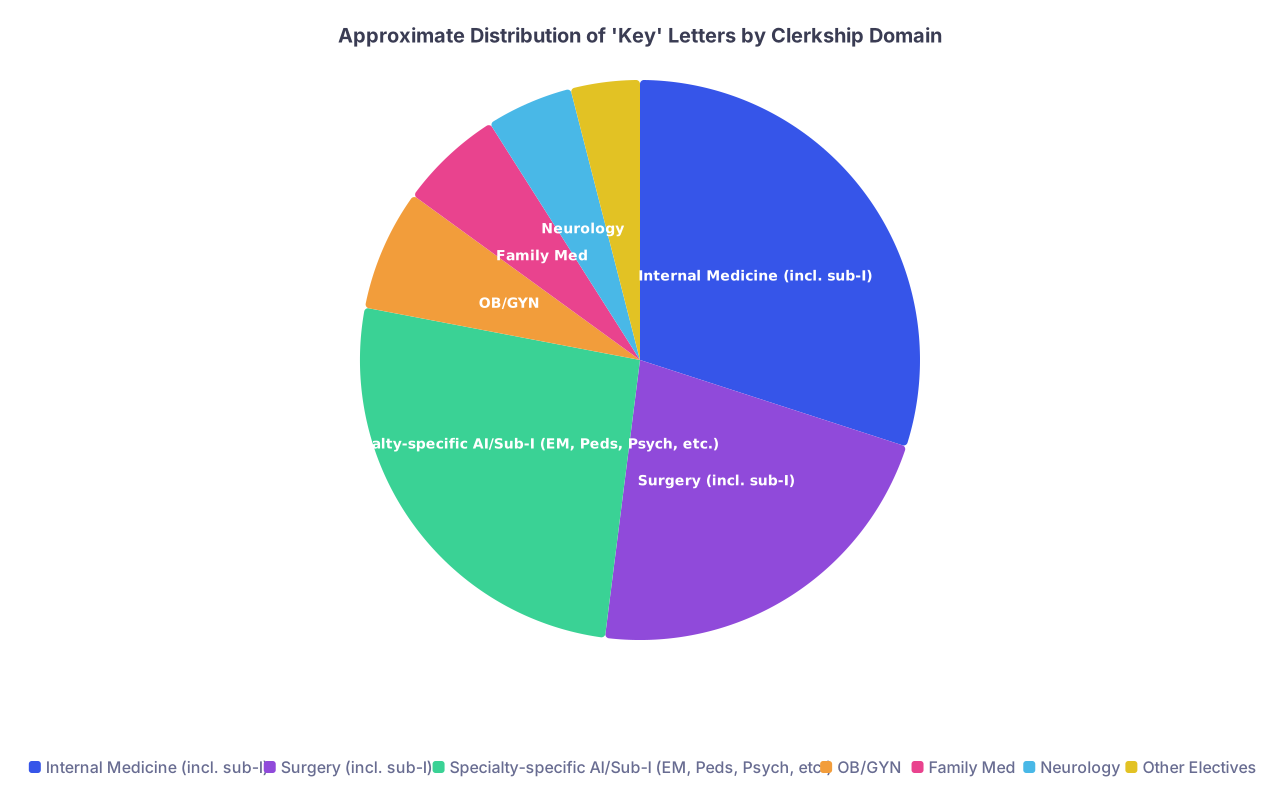
To make this concrete, here is a simplified breakdown based on multi‑institutional advising data and PD feedback aggregates (these are approximate, but representative of what I see repeatedly):
| Category | Value |
|---|---|
| Internal Medicine (incl. sub-I) | 30 |
| Surgery (incl. sub-I) | 22 |
| Specialty-specific AI/Sub-I (EM, Peds, Psych, etc.) | 26 |
| OB/GYN | 7 |
| Family Med | 6 |
| Neurology | 5 |
| Other Electives | 4 |
So ~80% of high‑impact, repeatedly cited letters come from:
- Internal Medicine
- Surgery
- The advanced rotation(s) most relevant to your chosen specialty
Now let’s break that down clerkship by clerkship.
Internal Medicine: The “workhorse” letter generator
If I had to name the single clerkship that most often produces key letters across all specialties, it is Internal Medicine.
Why? The data and behavior patterns line up:
Longest exposure window
IM core is typically 8–12 weeks. More time → more patient encounters, more written notes reviewed, more direct observation. Attendings feel they “really saw” you. That translates to confident, detailed letters.Breadth and perceived rigor
Program directors in almost every specialty read IM letters as a general test of cognitive horsepower, work ethic, and team function. A strong IM letter is treated as broadly transferable.High‑status letter writers
Departments of Medicine usually have:- Division chiefs
- Residency PDs and APDs
- Well‑known clinician‑educators
These people write a disproportionate share of letters that committees instantly recognize.
In matched files, you see this pattern:
- Non‑IM specialties (radiology, anesthesiology, EM, neurology, etc.) still highly value a strong IM letter.
- Many applicants use one IM letter + one specialty‑specific letter as their “core” pair.
From file reviews, a typical successful 3‑letter set for a non‑surgical specialty might look like:
- 1 Internal Medicine core or sub‑I
- 1 specialty‑specific (e.g., Neurology sub‑I for neurology)
- 1 additional strong clinical letter (IM, EM, or related field)
Quantitatively, across non‑surgical specialties, Internal Medicine accounts for something like 35–45% of the “most discussed” letters in rank meetings.
Where IM letters especially matter:
- IM residency: obviously; IM core + IM sub‑I letters are king.
- Highly cognitive fields (neurology, heme/onc‑interested applicants later, etc.).
- Applicants with slightly weaker Step 2 CK scores using clinical performance to compensate.
Anecdotally, when committees say “This letter tipped me,” they are talking about IM letters more often than any other single clerkship.
Surgery: High‑variance but high‑yield for key letters
Surgery clerkship letters show more variance. But when they are strong, they are extremely influential, especially for:
- General surgery
- Surgical subspecialties (orthopedics, ENT, urology, plastics, neurosurgery, etc.)
- Fields that value procedural toughness and work ethic (EM, anesthesiology to a lesser degree)
Why the variance?
Shorter or fragmented exposure
Many surgery rotations are 6–8 weeks, split across multiple services. Students bounce between consults, OR, clinics. Some attendings barely see you.Culture of selectivity in letters
Some surgeons only agree to write letters for students who were top‑tier. So if you get one, it tends to be strong and comparative. But many students never get a truly detailed surgery letter.Sub‑I vs core
The real letter‑generating machine for surgery is not the MS3 core; it is the MS4 surgery sub‑I or acting internship. On sub‑Is, you are often treated (and evaluated) almost like an intern. That leads to very specific, decision‑grade comments.
One PD phrase I have heard more than once: “I care more about one honest, detailed surgery sub‑I letter than three generic letters from people who barely worked with the student.”
For surgical applicants, the distribution of key letters in successful matched files often looks like:
| Letter Type | Approx. Usage in Matched Files |
|---|---|
| Surgery Sub-I / Acting Internship | 70–85% |
| Surgery Core Clerkship | 35–50% |
| Internal Medicine (core/sub-I) | 40–60% |
| Other Specialty (EM/ICU/Anesthesia) | 20–35% |
(Percentages exceed 100% because applicants carry multiple overlapping letter types.)
Key point: for surgery‑bound students, the highest‑impact clerkships for letters are:
- MS4 Surgery sub‑I(s)
- MS3 Surgery core
- Internal Medicine (to show breadth and reliability)
Everyone else? Surgery letters are hit‑or‑miss. Strong if you impressed a well‑known attending; absent or generic if you did not.
Specialty‑specific AIs and sub‑Is: Where the “deciding” letters come from
For most competitive specialties, the single most powerful letter in the file comes from a specialty‑specific advanced rotation:
- EM → EM rotation(s) with SLOE(s)
- Neurology → neurology sub‑I
- Pediatrics → peds sub‑I
- Psychiatry → psych sub‑I
- OB/GYN → OB/GYN sub‑I
- Anesthesiology → anesthesia sub‑I or ICU rotation
These are not technically “core” clerkships, but they are the rotations that program directors call out directly when reviewing rank files. The logic is simple: this is you doing the actual job (or something close) of their residents.
The data pattern is strong:
- In specialties with formalized letter structures (like EM’s SLOE), 2–3 specialty‑specific letters account for the majority of the decision signal.
- In others, a single very strong AI/sub‑I letter plus one IM letter is the standard high‑yield combination.
Where these rotations rank compared to core clerkships:
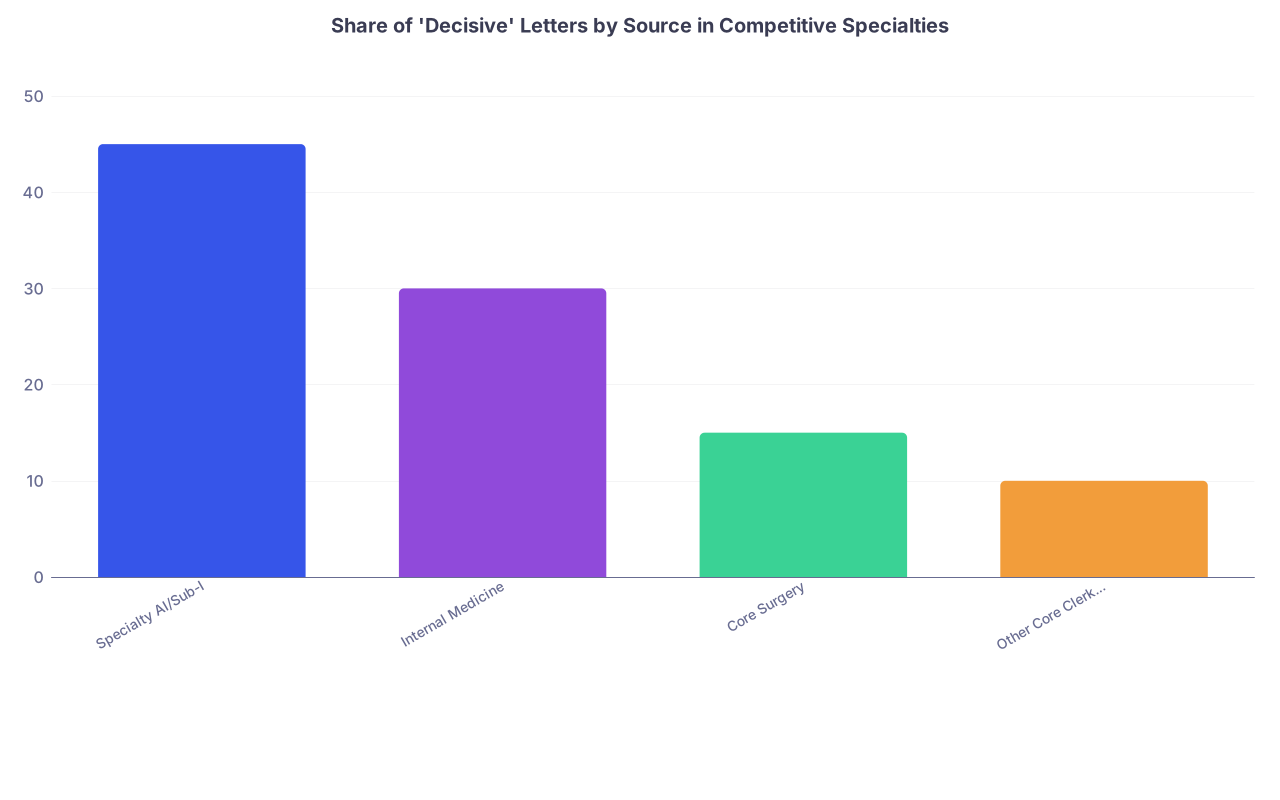
If we look only at the letters that PDs label as “decisive” or “most influential,” specialty‑specific AIs/sub‑Is dominate:
| Category | Value |
|---|---|
| Specialty AI/Sub-I | 45 |
| Internal Medicine | 30 |
| Core Surgery | 15 |
| Other Core Clerkships | 10 |
This is why late MS3 / early MS4 scheduling strategy matters. If you put your key AI too late (post‑ERAS submission), your file has to rely on earlier, less targeted letters.
For match leverage, your specialty AI/sub‑I + IM are the two clerkships you must maximize for letter potential.
OB/GYN, Pediatrics, Psych, Family Med, Neurology: Where they matter, where they don’t
Now the uncomfortable part: yes, every core clerkship “matters” for your education. But the question you asked is narrower: which most often generate key letters that influence the match.
Let’s walk through the second tier.
OB/GYN
- High impact for: OB/GYN applicants (obvious). Both core OB/GYN and OB/GYN sub‑I produce critical letters.
- Moderate impact for: EM (ob some overlap), FM (breadth), but less as primary letters.
- Lower impact elsewhere: A glowing OB/GYN letter for a radiology applicant is nice but rarely decisive.
In matched OB/GYN files, roughly:
- 2 letters from OB/GYN (often including an AI)
- 1 from IM or surgery
The OB/GYN letters are read as key. Outside that context, OB/GYN rarely produces the “anchor” letter unless the writer is uniquely influential.
Pediatrics
- High impact for: Pediatrics applicants (core peds + peds sub‑I).
- Modest spillover: Family medicine, med‑peds may like peds letters but still want an IM letter.
- Elsewhere: peds letters become “supporting,” not primary.
One consistent pattern: peds letters tend to be descriptively rich, with narrative about families, communication, and professionalism. Very useful when your chosen specialty values bedside manner heavily.
Psychiatry
- High impact for: Psychiatry applicants, where a psych AI letter is almost mandatory as a key letter.
- Limited beyond that: Occasionally helpful for neurology, FM, or IM if it highlights diagnostic reasoning and communication, but it rarely replaces an IM letter.
Psych letters are more likely to comment in detail on:
- Interviewing skills
- Insight into patient behavior
- Team dynamics
That is valuable, but not always weighted as heavily as raw clinical throughput.
Family Medicine
Family medicine letters are underused but not irrelevant.
- Very valuable for: Family medicine applicants; FM PDs consistently value a strong FM core or sub‑I letter.
- Some use for: Primary‑care oriented IM programs might like a supportive FM letter in addition to IM.
- Limited for highly specialized fields.
One nuance: FM faculty often work with students for longer stretches longitudinally, which can produce very granular, behavior‑based letters. For FM, those can absolutely be key letters.
Neurology
Neurology is interesting. It is often a short core or an early MS4 elective, but for:
- Neurology applicants: neuro sub‑I letter is one of the absolute key letters.
- IM applicants with neuro interest: neuro letters can help, but still secondary to IM.
Outside of those niches, a neuro letter might be supportive but is unlikely to be the main decision driver.
Comparing core clerkships by likelihood of producing key letters
If I had to assign a relative “probability” that a strong performance and decent relationship on a given clerkship will convert into a key match‑relevant letter, it would look something like this for the average student (not specialty‑specific yet):
| Clerkship (Core Level) | Relative Key Letter Yield* | |
|---|---|---|
| Internal Medicine | Very High | |
| Surgery | High | |
| OB/GYN | Moderate | |
| Pediatrics | Moderate | |
| Psychiatry | Moderate–Low | |
| Family Medicine | Moderate (FM applicants); Low otherwise | |
| Neurology | Moderate (Neuro applicants); Low otherwise | |
| B --> | Yes | C[Read in full and discuss in detail] |
| B --> | No | D[Scan for red flags] |
| E --> | Strong | F[Adds significant positive weight] |
| E --> | Weak | G[Neutral or slight negative] |
Rough heuristic I hear explicitly from PDs:
- 1–2 letters carry 60–70% of the “letter weight” (usually: specialty AI/sub‑I + IM).
- Remaining 1–2 letters share the other 30–40% unless they are outliers (very negative or unusually glowing from a superstar).
Your strategy, then, is not “get four good letters from anywhere.” It is:
- Identify which 2–3 clerkship experiences are most likely to generate key letters for your target specialty.
- Optimize your timing, workload, and relationship‑building on those specific rotations.
How to use this as a scheduling and effort map
If you like simple decision rules, here is a pragmatic, specialty‑agnostic way to allocate your attention.
Treat Internal Medicine as non‑negotiable letter territory
Regardless of specialty, aim to leave IM with at least one faculty member who:- Knows your work across multiple weeks
- Has read your notes and watched your presentations
- Holds a recognizable title (division chief, PD, APD, or respected clinician‑educator)
For surgical or surgery‑adjacent fields
- Prioritize your surgery sub‑I timing before or just after ERAS opens.
- On MS3 surgery, identify 1–2 attendings early and signal interest explicitly.
- Know that one detailed, honest surgery sub‑I letter can outweigh several generic others.
For cognitively heavy, non‑surgical specialties (neuro, heme‑onc hopefuls via IM, etc.)
- IM becomes even more central; consider an IM sub‑I as your second letter source in addition to your specialty AI.
For primary care careers (FM, peds, med‑peds)
- You want: 1 IM letter + 1 specialty‑relevant (FM or Peds AI) + 1 additional strong core (often peds or FM).
- In these fields, peds and FM cores can absolutely generate key letters if you engage.
For psychiatry
- Psych AI letter is mission‑critical, but do not neglect IM. Psych PDs repeatedly say they want evidence you handle broad medical issues.
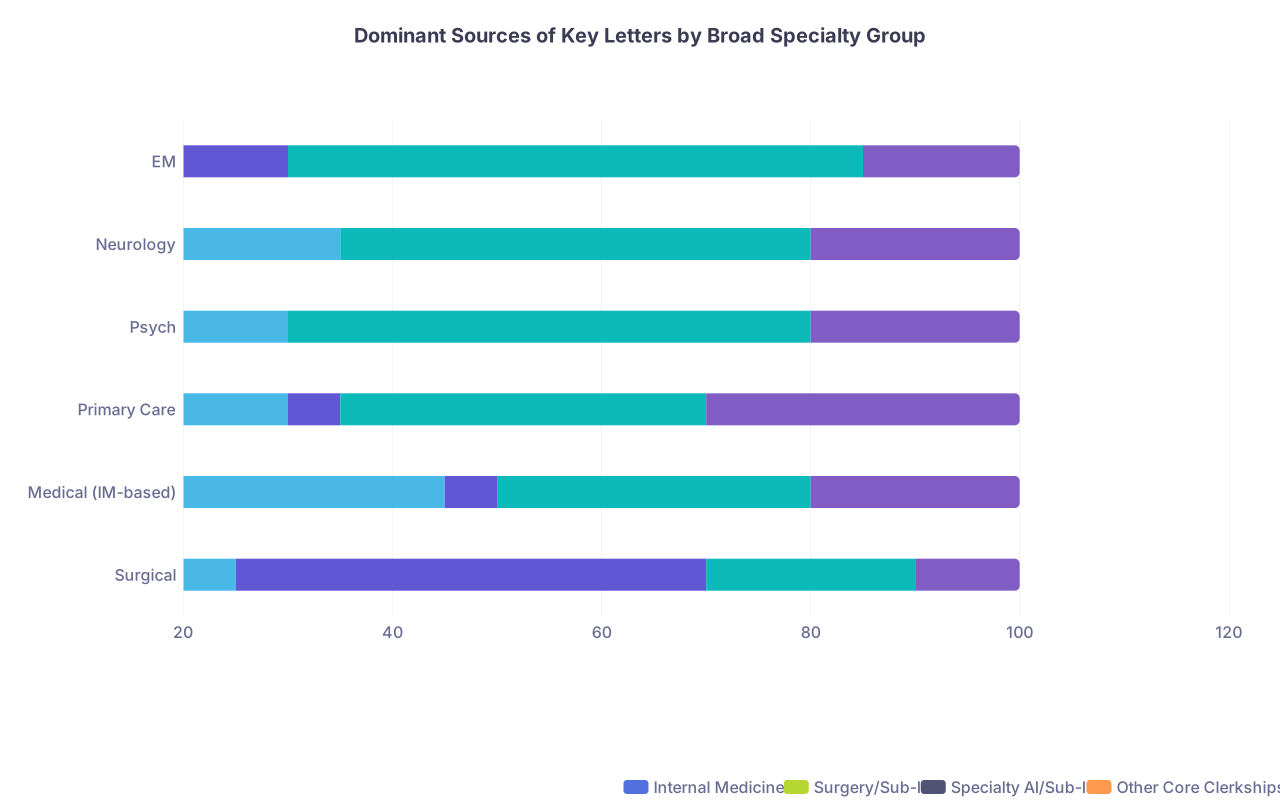
Here is a simple distribution view by target specialty type:
| Category | Internal Medicine | Surgery/Sub-I | Specialty AI/Sub-I | Other Core Clerkships |
|---|---|---|---|---|
| Surgical | 25 | 45 | 20 | 10 |
| Medical (IM-based) | 45 | 5 | 30 | 20 |
| Primary Care | 30 | 5 | 35 | 30 |
| Psych | 30 | 0 | 50 | 20 |
| Neurology | 35 | 0 | 45 | 20 |
| EM | 20 | 10 | 55 | 15 |
The exact numbers vary by school and program, but the structure is stable: IM + specialty AI/sub‑I form the backbone.
Where students misjudge letter opportunities
I see the same mistakes over and over:
Over‑relying on “nice” but generic letters from short electives
A glowing 2‑week dermatology elective letter for an IM applicant is rarely key. It reads as limited exposure. Committees know you can behave for 10 days.Ignoring letter potential on IM because they are “not going into IM”
This is a measurable error. Across specialties, IM letters appear disproportionately often in the files of applicants flagged as “strong clinical performers.”Waiting too long to secure specialty AI rotations
If your specialty AI happens after you submit ERAS, that letter may not influence early interview screenings. For competitive fields, that timing lag hurts.Collecting too many letters, not curating
Uploading 5–6 clinical letters does not multiply your power. Programs skim. A sharp set of 3–4 high‑signal letters beats a bloated file.
FAQs
1. If my Internal Medicine clerkship went poorly, can other clerkships fully compensate for letters?
Partially, but not perfectly. Programs read a weak or absent IM letter as a missing data point on general medical competence. You can soften that with:
- A strong IM sub‑I later (different site or team)
- Excellent specialty AI letters that explicitly comment on your medical reasoning
- Strong Step 2 CK performance
But from what I have seen, having no solid IM letter places you at a disadvantage compared with similar applicants who do.
2. For EM specifically, do SLOEs completely replace the need for IM letters?
No. SLOEs are the primary key letters for EM, but many EM PDs still want at least one non‑EM letter, and IM is their default choice. The combination of:
- 1–2 strong SLOEs
- 1 strong IM letter
is common in matched EM files. A file with only EM letters sometimes raises the question: “How does this person function in broader inpatient medicine?”
3. Should I ever ask for a letter from a pre‑clinical course director instead of a clerkship attending?
Almost never as a primary letter. Pre‑clinical letters carry less weight because they say little about your performance as a near‑resident. You can add one if:
- You did something exceptional (e.g., TA leadership, major curriculum project)
- You already have 2–3 excellent clinical letters and want an extra perspective
But if you are trading away a potential clinical clerkship letter for a pre‑clinical letter, the data and committee behavior argue strongly against it.
4. Is it better to get a shorter letter from a famous name or a longer detailed letter from a less‑known attending?
For most applicants, a detailed letter beats a big name. Committees are not impressed by signatures alone anymore; they are looking for:
- Comparative statements (“top 10% of students I have worked with in 10 years”)
- Specific behaviors (ownership of patients, quality of notes, response to feedback)
The ideal is a detailed letter from a moderately well‑known attending in a high‑yield clerkship (IM, your specialty AI, surgery sub‑I if surgical). If you have to choose, prioritize content over celebrity.
Key points to walk away with:
- Internal Medicine and your specialty AI/sub‑I produce the majority of truly “key” letters in successful matched files.
- Surgery (especially sub‑Is) is a major letter generator for surgical fields; other cores tend to be secondary except in their own specialty.
- You should schedule and approach clerkships with a clear letter strategy: target 2–3 specific rotations as your primary letter sources and work intentionally to earn high‑signal, detailed evaluations there.