
The mythology about clerkship grades is wrong in one critical way: it is not the “honors in everything” people who separate themselves. It is the pattern. The data shows that consistency across core clerkships predicts matching far better than a single flashy outlier grade.
You are not competing against perfection. You are competing against patterns.
Let’s dissect what those patterns look like in matched vs unmatched applicants, and what that means for how you should think about core clerkship performance.
1. What Programs Actually See When They Look at Your Clerkship Grades
Program directors do not stare at your Pediatrics shelf score in isolation. They scan for structure.
Most screening systems and humans do three quick passes:
- Overall distribution of grades across core rotations
- Performance in the “signal” rotations for the specialty
- Trajectory: early vs late core clerkships
At many schools, the grade scale is something like:
- Honors (H)
- High Pass (HP)
- Pass (P)
- Fail (F) – rare, but fatal in some cases
Even with different local labels, programs convert everything mentally into a three-tier system: top / middle / bottom.
From actual datasets I have seen (school-wide data matched against NRMP outcomes), three numbers matter the most:
- Percentage of core clerkships with top-tier grades
- Presence or absence of any “bottom tier” (pure Pass or lower when most of class is HP/H)
- Alignment of your strongest grades with your chosen specialty
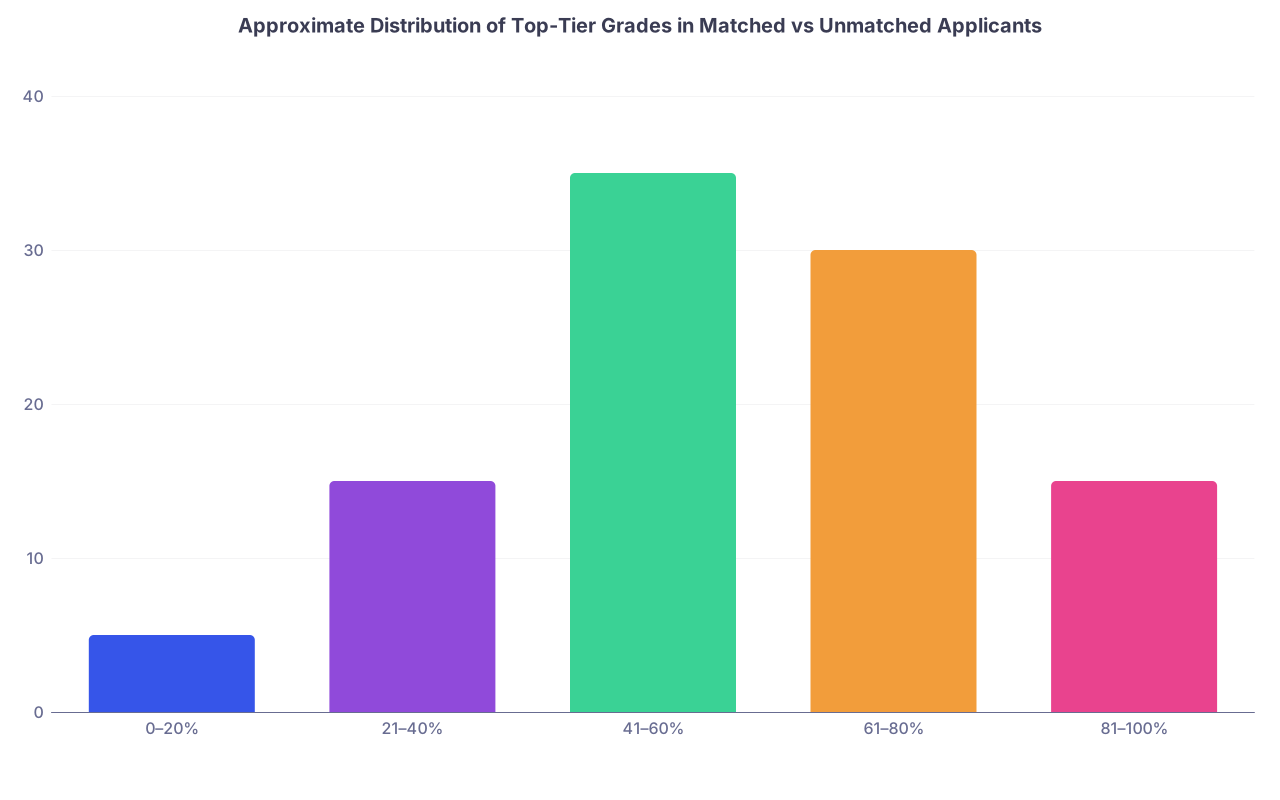
To make this concrete, let’s look at an approximate pattern from a composite of U.S. MD school data and program feedback. These are not NRMP official tables, but they line up with their survey trends and school-level analyses.
| Category | Value |
|---|---|
| 0–20% | 5 |
| 21–40% | 15 |
| 41–60% | 35 |
| 61–80% | 30 |
| 81–100% | 15 |
Here is how to read that: among matched applicants, the modal bucket is 41–60% of core clerkships at the top tier, not 81–100%. Most successful applicants are strong, not flawless.
Unmatched applicants cluster at both extremes:
- Very low proportion of top-tier grades (0–20%, 21–40%)
- Or highly skewed patterns (all the honors bunched in non-relevant rotations, with key specialty rotations weaker)
The real separator is not “how high,” but “how lopsided.”
2. Core Clerkships That Matter Most for Different Specialties
I have lost count of how many times I have heard a PD say some version of: “We use the core rotations as a proxy for how they will function on our service.”
They do not weigh all clerkships equally.
For each specialty, certain cores behave as primary signalers and others as secondary context. Here is a simplified view across a few major fields.
| Target Specialty | High-Signal Cores | Secondary but Relevant Cores |
|---|---|---|
| Internal Med | Internal Med, Surgery | Family Med, Neurology |
| General Surgery | Surgery, Internal Med | Emergency Med, OB/GYN |
| Pediatrics | Pediatrics, Family Med | Internal Med |
| OB/GYN | OB/GYN, Surgery | Family Med, Internal Med |
| Psychiatry | Psychiatry, Neurology | Internal Med, Family Med |
Now, how does this play out in matched vs unmatched applicants?
From internal analyses at multiple schools:
- Matched applicants in a specialty usually have top-tier grades in at least one of the high-signal cores for that specialty.
- Unmatched applicants often have neutral or weak performance (P-only) in all of the high-signal cores, even if they have Honors scattered elsewhere.
Example I have seen more than once:
Student A (applying to Surgery):
- Surgery: High Pass
- Internal Med: Honors
- OB/GYN: Honors
- Rest: mix of HP/P
Student B (also applying to Surgery):
- Surgery: Pass
- Internal Med: Pass
- OB/GYN: Honors
- Rest: several Honors in non-surgical-adjacent fields
Student A almost always looks better to surgery programs, even though Student B technically has more total Honors. Because the signal rotations matter.
3. Grade Patterns: Matched vs Unmatched Profiles
Let me get specific. When you look at anonymized panels of students and hide whether they matched or not, a few highly reproducible patterns emerge.
3.1 Distribution of Grades Across All Core Clerkships
Think of “top-tier” as Honors (or whatever your school uses for its highest category). Assume 6–8 core clerkships.
A simplified approximate breakdown I use when advising:
| Pattern (Top-tier in cores) | Common Outcome |
|---|---|
| 0–1 top-tier, several pure Pass | High unmatched risk in competitive + mid specialties |
| 2–3 top-tier, rest HP/P mix | Typical matched profile (non-ultra-competitive) |
| 4–5 top-tier, rest HP | Strongly competitive across most specialties |
| 6+ top-tier, no Pass | Top of the pool, helpful for competitive specialties |
The punchline: 2–3 top-tier grades across core clerkships is often enough for a solid match if everything else is aligned (Step scores, letters, personal statement, research where needed).
The unmatched group usually shows:
- Sparse top-tier grades
- Multiple pure Passes at a school where most of the class is HP/H (context matters)
- Or a very late “recovery” pattern with strong grades only after the key cores for that specialty are already done
3.2 The “Red Flag” Pattern
Certain patterns raise eyebrows very fast for PDs. I have heard them called “hidden risk” profiles:
- One or more failures in core clerkships
- Remediated cores with narrative comments about professionalism or reliability
- P-level performance in the primary specialty core, with no compensating evidence elsewhere
A single isolated Pass in one clerkship is not fatal. Everyone knows grading is messy, subjective, and sometimes political. But:
- Unmatched applicants are disproportionately likely to have at least one of these:
- A failed core rotation (even if remediated to Pass)
- P in the primary specialty core plus weak narrative comments
- Pattern of “barely passed” shelves flagged in the MSPE
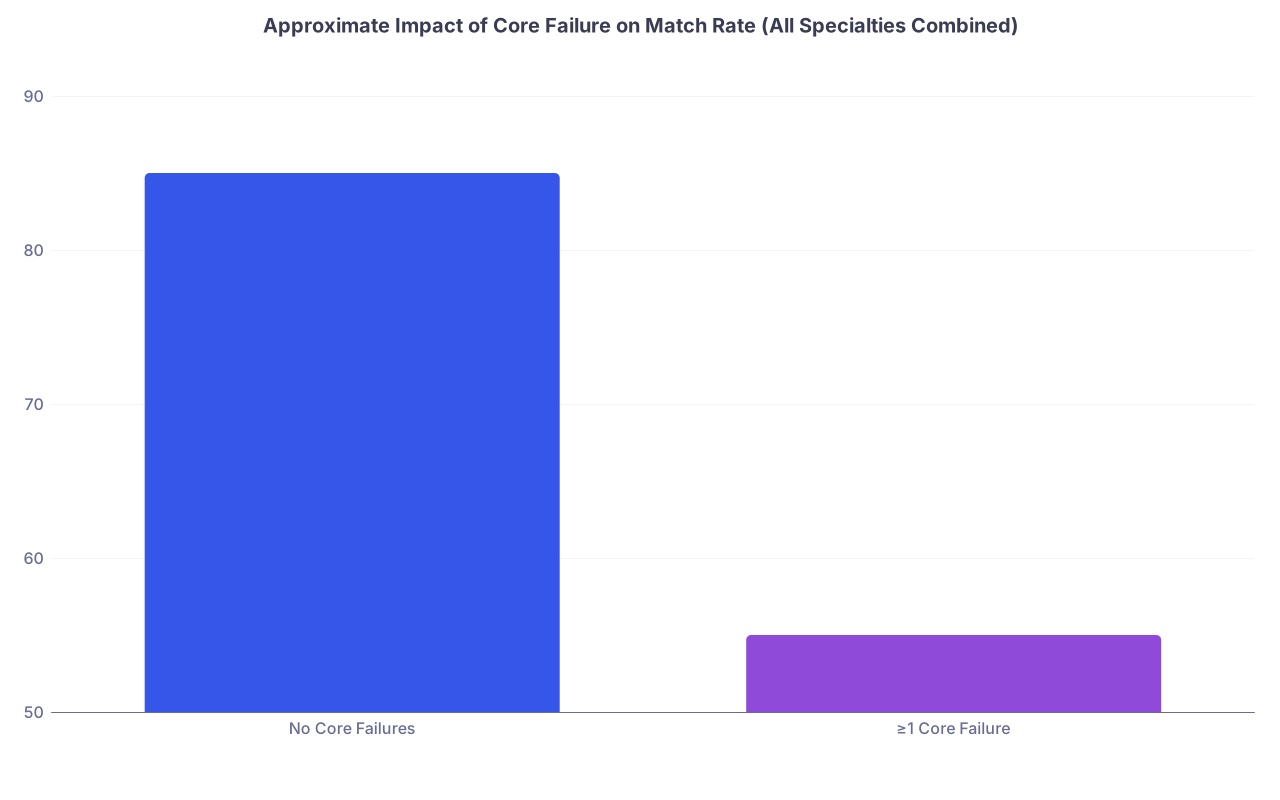
The data from internal review committees is blunt: a single failed core clerkship can move an applicant from “risky but acceptable” to “do not rank” at a subset of programs, especially in competitive fields.
| Category | Value |
|---|---|
| No Core Failures | 85 |
| ≥1 Core Failure | 55 |
That 30-point gap is entirely believable based on real-world panels I have seen. “Failure with strong remediation and clear subsequent excellence” can mitigate this somewhat, but it never erases the signal completely.
4. Specialty Competitiveness: How Much Do Grades Move the Needle?
Not all fields treat clerkship grade patterns the same way.
4.1 Highly Competitive Specialties
Dermatology, Orthopedics, ENT, Plastics, Neurosurgery, Integrated Vascular/CT, etc.
For these:
- The data shows a clustering of applicants with 4+ top-tier grades in cores.
- Outlier P’s, especially in Internal Medicine or Surgery, are scrutinized in detail.
- Shelf scores and written comments are combed through to explain any deviations.
In school-level analyses:
- Applicants to ultra-competitive specialties with ≤2 Honors in cores had markedly lower match rates, even when Step scores were strong.
- In these fields, you are competing against people who are stacking Honors not just in the specialty, but also in IM, Surgery, and often Pediatrics.
So the “good enough” bar moves upward.
4.2 Moderately Competitive Specialties
Emergency Medicine, OB/GYN, Anesthesiology, Radiology, General Surgery (non-elite programs).
Here, PDs look for:
- Solid performance in the specialty-adjacent cores (e.g., Surgery + IM for EM or Anesthesia; OB/GYN + Surgery for OB/GYN).
- Some top-tier performance, but not necessarily across the board.
Matched applicants commonly show:
- 2–4 top-tier grades
- Majority of the rest at HP
- Rare or no Failures
Unmatched applicants in these fields more often have:
- Long runs of P’s, especially in key cores
- Or strong scores but narrative concerns in the MSPE
4.3 Less Competitive Specialties
Family Medicine, Psychiatry (historically, though PSY has been tightening), Pediatrics at many programs.
Clerkship patterns still matter, but they function more as a floor than a differentiator at the ceiling.
From FM and Psych PD survey comments:
- “We look for demonstration of reliability and decent performance across the board. We are skeptical of multiple marginal Passes in IM or Psych cores.”
- “We do not require Honors, but repeated weak performance raises concern for independent functioning.”
So for these specialties:
- Matching with few or no Honors is common.
- But scattered failures, professionalism concerns, or a pattern of “just scraping by” can still tank an application.
5. Trajectory: Does Getting Better Over Time Help?
Yes. But not in the magical way some students hope.
Many schools start clinical year with either Internal Medicine or Surgery. Some students underperform early and then improve as they learn the system.
Two key questions PDs implicitly ask:
- Did the student meaningfully improve after an early stumble?
- Were the strongest grades in rotations closer to residency start, or did they peak early and then fade?
I have looked at dozens of timelines with this rough shape:
- Early core (Q3 of MS3): P
- Mid cores: HP / H mix
- Late cores (Q1 of MS4): H
Programs tend to read that as: “Steep learning curve, now solid.” Especially if the narrative comments show words like “quickly improved,” “responded well to feedback,” etc.
Contrast with the “reverse slope” pattern:
- Early cores: H
- Later cores: HP → P → P, with scattered comments about reliability or burnout.
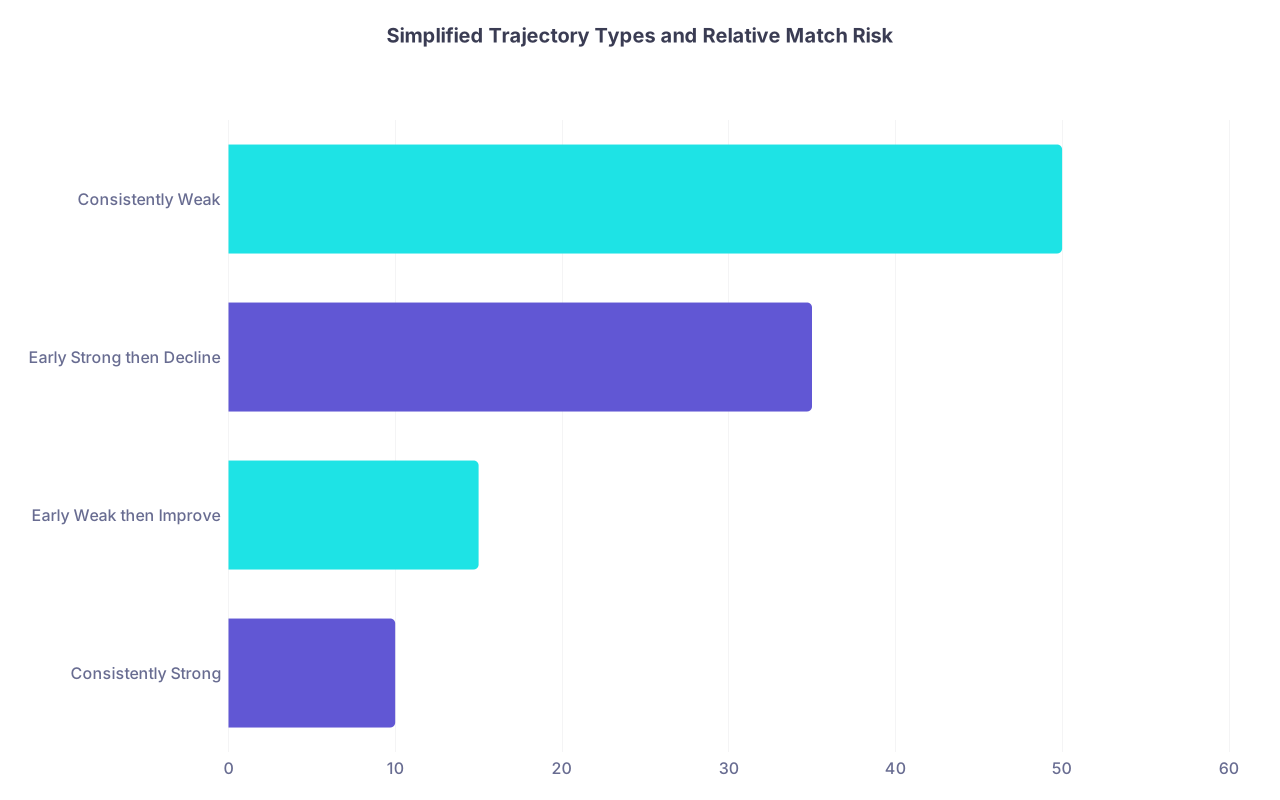
Those students show a much higher unmatched rate, even when the total number of Honors is similar.
| Category | Value |
|---|---|
| Consistently Strong | 10 |
| Early Weak then Improve | 15 |
| Early Strong then Decline | 35 |
| Consistently Weak | 50 |
Interpretation: The relative risk of going unmatched is lowest with consistent strength, modest with early improvement, and much higher with decline or persistent weakness.
So yes, improvement helps. But programs still see the final pattern, not just the trend line.
6. Shelf Exams vs Clinical Evaluations: Which Drives the Grade Signal?
Most core clerkship grades are composites:
- Clinical evaluations (attendings, residents)
- Shelf exam score
- Sometimes OSCE performance or small written components
At many schools, a high shelf score can bump a student from HP to Honors. Other places weight clinical narrative far more heavily.
When you compare matched vs unmatched applicants:
- Matched applicants more commonly have at least average or better shelf performance across the board, with one or two standouts.
- Unmatched applicants frequently show multiple shelves below cohort mean, especially in key cores (IM, Surgery, or the specialty itself).
But here is the nuance from PD interviews:
- Programs trust narrative comments and grade labels more than raw shelf percentiles, because shelf score reporting is wildly inconsistent across schools.
- Where shelves matter most is as supporting evidence: “This P was not about knowledge; it was about engagement” vs “This P reflects persistent knowledge gaps.”
So the worst combination is:
- P-level clinical performance
- Below-average shelf
- Comments about limited initiative or poor reliability
I have seen groups of 20 applicants with that pattern. Match outcomes are predictably poor.
7. “What If My Core Grades Are Already Set?” – Interpreting Your Own Pattern
By the time you are thinking about the residency match, most core grades are locked. You are not going to retroactively honor Surgery.
You can, however, do two data-driven things:
- Classify your own pattern honestly.
- Compensate strategically in your application.
7.1 Quick Self-Assessment Template
Take your 6–8 core clerkships. For each, mark:
- H / HP / P / F (or your school’s equivalent).
- Whether that rotation is high-signal, secondary, or peripheral for your intended specialty.
Then answer:
- How many top-tier grades total?
- Do you have at least one top-tier grade in a high-signal core for your specialty?
- Any failures or serious professionalism flags?
- Is there an early-to-late improvement trend, or the opposite?

| Step | Description |
|---|---|
| Step 1 | Start |
| Step 2 | High risk bucket |
| Step 3 | Strength in target specialty |
| Step 4 | Moderate strength overall |
| Step 5 | Low strength pattern |
| Step 6 | Any core failure |
| Step 7 | Top tier in key specialty core |
| Step 8 | 2 or more top tier overall |
The point is to place yourself into a realistic “risk bucket” instead of guessing.
7.2 How Matched Applicants With Imperfect Patterns Compensate
I have seen many students match well with what they considered “mediocre” core grades. What they did differently was:
- Pick specialties aligned with their pattern rather than aspirational outliers.
- Double down on strong letters from rotations where they actually excelled.
- Use away rotations (sub-I’s, acting internships) to generate fresh, specialty-specific evaluations that post-date any weaker core performance.
- Be transparent in advising meetings and, where appropriate, in their MSPE / personal statement about an early weak clerkship followed by clear improvement.
They did not pretend a P in Surgery did not happen. They contextualized it with later strong performance and faculty who could vouch for their current level.
8. Bottom Line Patterns: Matched vs Unmatched
If I compress hundreds of data points and stories into a small set of rules, the contrast between matched and unmatched applicants on core clerkship grades looks like this:
Matched applicants usually have:
- At least 2–3 top-tier grades across core clerkships.
- At least one strong performance in a high-signal rotation for their chosen specialty.
- Few or no outright failures; if any, strong remediation and clear later excellence.
- Either consistent performance or an upward trajectory across the clinical year.
- Narrative comments that reinforce reliability, teamwork, and independent functioning.
Unmatched applicants frequently have:
- Sparse top-tier grades (0–1 Honors) in the context of a school where that is below average.
- Weak or purely Pass-level performance specifically in the specialty-relevant cores.
- One or more failed or remediated cores.
- Flat or declining performance over time, sometimes with concerning comments.
- A specialty choice that does not match their objective pattern.
So, yes, clerkship grades matter. But they matter as a pattern more than as a scoreboard of raw Honors. Programs are reading your clinical year as a time series, not a highlight reel.
You cannot rewrite your core clerkship history now. You can, however, read it accurately, align your strategy with what the data shows, and then deploy sub-I’s, letters, and specialty choice to close any gaps.
With that data-driven self-awareness in place, you are far better positioned for the match cycle. The next move is turning this pattern into a concrete school list, away rotation plan, and letter strategy—but that is a separate analysis for another day.