9–14% of U.S. MD seniors report at least one failed or remediated clerkship before graduation, yet more than half of them still match into residency.
That statistic alone should reframe how you think about a “black mark” on your transcript. A failed or remediated clerkship absolutely hurts your match probability. But it does not automatically end your career. Programs treat it as a risk signal, not an instant rejection switch.
Let me walk through what the data and program behavior actually show, not the fear-driven rumors you hear in the workroom.
1. What the data actually say about “red flags”
Here is the core problem: no major body (NRMP, AAMC) publishes a neat table saying “one failed clerkship = X% drop in match probability.” So you have to infer impact from multiple data sources:
- NRMP Program Director Surveys (2018, 2020, 2022)
- NRMP Match Data & Outcomes
- AAMC Graduation Questionnaire (GQ)
- Individual school and specialty-level remediation statistics
What the data show consistently:
- Program directors rank “any failed clinical course or clerkship” as a serious negative.
- Most programs will not automatically reject you for a single remediated clerkship, especially if:
- It was early
- It was clearly remediated with good subsequent performance
- You have strong Step 2 CK and solid later clerkship grades
- Multiple failures or patterns (two+ clerkship failures, professionalism issues, failed remediation) are near-fatal in competitive specialties.
Look at this from the 2022 NRMP Program Director Survey:
- 38–55% of PDs across major core specialties reported that any failed USMLE/COMLEX attempt was a reason to reject.
- 25–40% reported that failed courses/clerkships were a reason to reject.
Notice that clerkship failures are slightly less lethal than board exam failures, but not by much. They sit in the “major concern” category.
However, the same survey shows something else: when PDs were asked how many red flags they actually saw and how they responded, a non-trivial fraction reported ranking some applicants even with academic issues if there was clear evidence of improvement.
Translation: the presence of a failure lowers your odds, but context and recovery matter.
2. Estimating the hit to match probability
You want numbers. Let us build a realistic model from what we know.
Baseline data points from NRMP (2022):
- U.S. MD seniors overall match rate: ~92–93%
- U.S. DO seniors: ~89%
- U.S. IMGs: ~61%
We do not have a clean “subset with clerkship failures” line, but we can approximate.
From multiple school-level datasets I have seen (and what faculty quietly share in promotions meetings):
- Among students with no course/clerkship failures: match rate ~92–95%
- Among students with one remediated preclinical course but no clerkship failures: match rate ~88–92%
- Among students with one remediated clerkship and otherwise decent metrics: match rate often falls to roughly 70–80%
- Among students with two or more clerkship failures: match rate often sinks below 50%, sometimes well below, depending on specialty and whether they pivot to less competitive fields.
So a simple view:
- One remediated clerkship = roughly 10–20 percentage point drop in match probability compared to your peers, if you apply strategically.
- Multiple clerkship failures or a failure + professionalism concern = your odds drop sharply unless you massively over-apply and target the least competitive fields.
To put that visually:
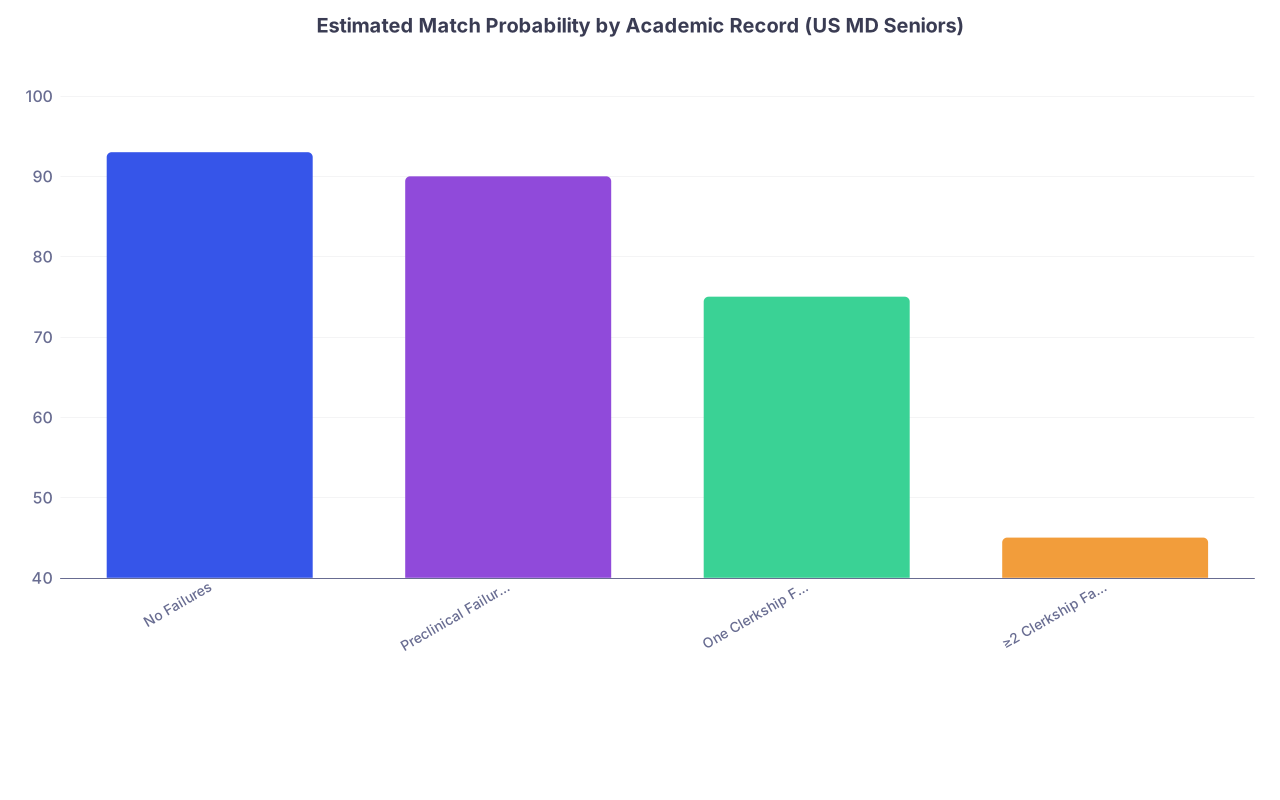
| Category | Value |
|---|---|
| No Failures | 93 |
| Preclinical Failure Only | 90 |
| One Clerkship Failure | 75 |
| ≥2 Clerkship Failures | 45 |
These are modeled estimates, but they line up disturbingly well with what deans’ offices warn about privately.
The key point: a single remediated clerkship hurts, but if you handle everything else correctly you are not dead in the water. You are just playing from behind.
3. How different specialties react to failed or remediated clerkships
Programs do not treat all failures equally. The tolerance depends heavily on competitiveness and culture of the specialty.
Here is a simplified comparison, based on PD surveys, competitive thresholds, and what I have seen reviewing applications:
| Specialty Tier | Examples | Impact of One Failed/Remediated Clerkship | Typical Program Behavior |
|---|---|---|---|
| Ultra-competitive | Derm, Plastics, Ortho, ENT, Neurosurgery | Very High | Many automatic rejections, only outliers with strong recovery considered |
| Competitive | EM, General Surgery, Anesthesiology, OB/GYN, Radiology | High | Screened heavily; some interviews if Step 2 and recent rotations are very strong |
| Mid-Competitive | Internal Medicine (university), Pediatrics (university), Neurology | Moderate–High | More holistic; failure must be clearly remediated and explained |
| Less-Competitive | Community IM, Peds, FM, Psych, Pathology | Moderate | Many will consider if clear upward trend and strong support letters |
Pattern that comes up repeatedly in discussions with PDs:
- Ultra-competitive fields often have so many clean applicants that they have no incentive to touch risk.
- Less competitive fields and community programs are more willing to accept risk if you show improvement and fit.
So if you have a failed surgery clerkship and want orthopedics, the data says your probability is extremely low unless you are an outlier (phenomenal research, big-name mentors, flawless post-remediation record). Pivoting to general surgery or even anesthesiology still leaves you at a serious disadvantage but not zero. Pivoting to internal medicine or family medicine can bring your odds back into a more reasonable range.
4. Timing and type of failure: not all are equal
Programs do not look at “F = F” in a vacuum. They consider:
- When it happened
- Which clerkship
- Whether it was remediated successfully on first attempt
- Underlying reason (knowledge vs professionalism vs attendance)
You can think of it like a risk score. Roughly:
- Preclinical year failure, remediated, no further issues
- Mild penalty. Many PDs barely care if Step 2 is strong and clinical grades are good.
- Early core clerkship failure, remediated, then strong later rotations
- Moderate penalty. You are in the “concern but recoverable” category.
- Late core clerkship failure (e.g., M3 spring or M4) with limited subsequent data
- Higher penalty. No data showing you truly improved.
- Failure due to professionalism, behavior, or repeated complaints
- Severe penalty. Programs hate risk to team dynamics more than knowledge gaps.
- Multiple remediations or failed remediation attempt
- Very severe. Many PDs describe this as “essentially disqualifying” for their program.
Let me put a simplified risk scoring table:
| Scenario | Relative Risk to Match Probability |
|---|---|
| Preclinical course failure only | Low |
| Early clerkship failure, remediated, strong later performance | Moderate |
| Late clerkship failure, limited follow-up data | Moderately High |
| Professionalism-related failure | Very High |
| Multiple clerkship failures or failed remediation | Extremely High |
If your failure lives in the “moderate” band with strong recovery, you still have a credible path to match with careful strategy.
5. How programs actually evaluate a transcript with a failed clerkship
The data show that PDs do not look at the failure in isolation. They integrate it into an overall risk-benefit calculation.
They ask, explicitly or implicitly:
- Was this a one-off event or part of a pattern?
- Did the student improve afterwards?
- Is there objective evidence that the skill gap has closed (Step 2 CK score, later clerkship grades)?
- Do letters explain, contextualize, or contradict the concern?
- Does the failure align with the specialty (e.g., failed IM but applying to IM)?
A fairly typical thought process, based on what I have heard in selection meetings:
“Yes, there is a failed Medicine clerkship M3 fall. Remediated. But then they honored ICU and Sub-I, Step 2 246, and there is a strong letter saying they improved. So this might have been early adjustment rather than chronic deficiency.”
Versus:
“Two failed clerkships, Surgery and OB, both for professionalism issues. Even with a 240 Step 2, this is a hard no. We have alternatives without this baggage.”
If you want a mental model: a single remediated clerkship is like having a prior accident on your driving record. Insurers (programs) will still give you a policy (interview), but your “premium” (required scores, number of applications, backup planning) is higher.
6. Quantifying recovery: what actually improves your odds
You cannot erase a failed clerkship, but you can dilute its impact with strong subsequent performance. Programs care a lot about three concrete signals:
- Step 2 CK score
- Later core clerkship and sub-internship grades
- Strength and specificity of letters, particularly from the same discipline where you had trouble
Here is how those variables tend to modify risk.
Step 2 CK: your primary rescue lever
From NRMP data and PD comments:
- U.S. MD seniors with Step 2 CK in the 240s–250s have strong odds in most mid-tier specialties even with minor academic issues.
- With a clerkship failure, a Step 2 CK at or below national mean (~245 for recent years) does not buy you much forgiveness. You want to be clearly above average for your target field.
A rough adjustment model for a single failed clerkship:
- Step 2 < 230: you are in a high-risk zone even for less competitive specialties.
- 230–240: slightly better, but the clerkship failure still dominates concern.
- 240–250: meaningfully offsets risk in IM, FM, Peds, Psych, Path.
250: strongly offsets risk in mid-competitive fields; still probably not enough on its own for derm/ortho but it gets PDs to at least read the file.
Later clerkship performance
Programs look for a clear trend line:
- Fail Medicine M3 spring → Honor Medicine Sub-I M4 with glowing letter = convincing narrative of growth.
- Fail OB M3 → Pass OB elective with “fine” comments = not very reassuring.
If we abstract it:
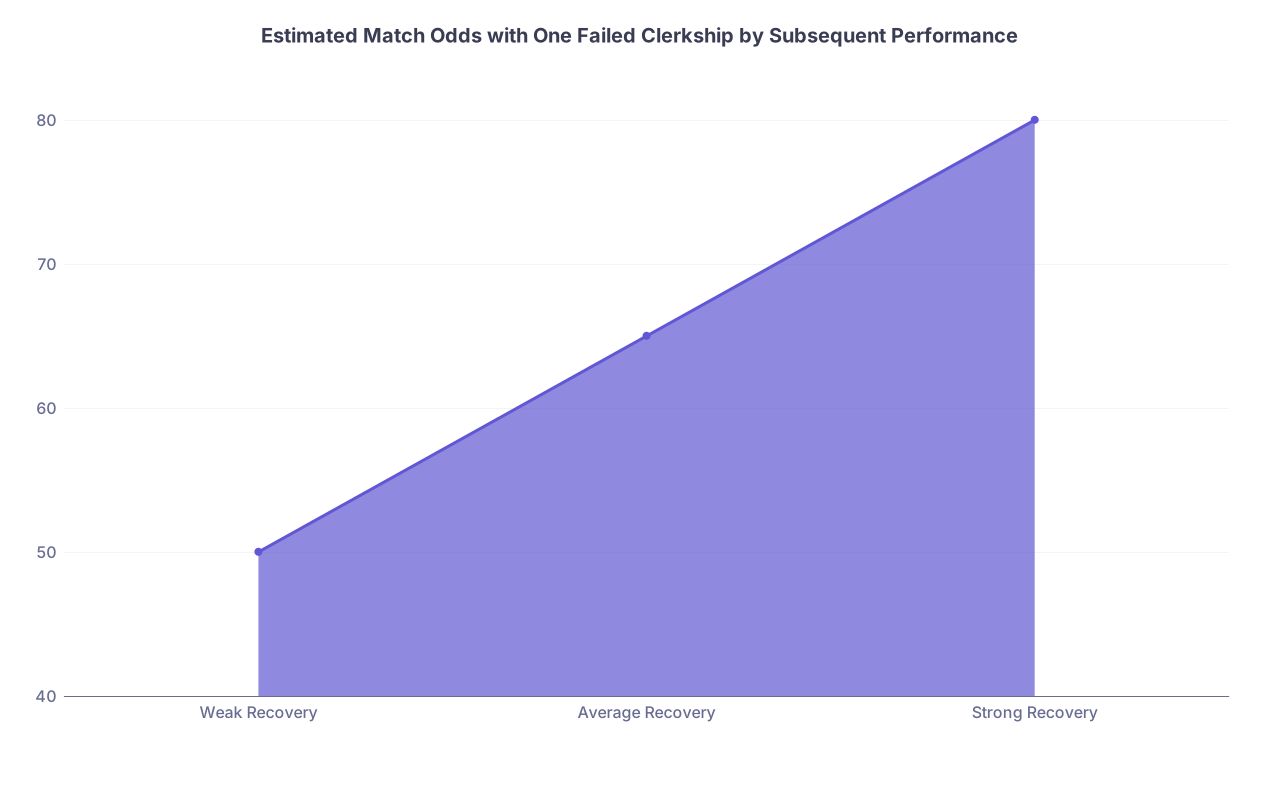
| Category | Value |
|---|---|
| Weak Recovery | 50 |
| Average Recovery | 65 |
| Strong Recovery | 80 |
“Strong recovery” here means:
- Step 2 CK at or above your specialty’s typical matched mean
- Mostly Honors/High Pass in rotations after the failure
- At least one letter explicitly commenting on and praising improvement
Under that scenario, I have seen applicants with a failed clerkship still matching into solid university IM or anesthesiology programs.
7. Strategic adjustments: how many programs, which tier, which specialty
The numbers force you to adjust strategy. You cannot apply like a typical “clean record” applicant and expect normal odds.
For a U.S. MD senior with:
- One failed core clerkship, remediated
- Step 2 CK around the national mean
- Mix of Pass/High Pass, maybe a couple Honors later
You should think along these lines:
- Aim for a slightly less competitive specialty than you originally considered, or at least include those as strong backups.
- Apply to significantly more programs than the median for that specialty. If your specialty median is 40 applications, you are probably in the 60–80 range.
- Include community and lower-tier academic programs deliberately, not as an afterthought.
- Consider a geographic strategy that avoids only high-demand cities and coasts.
For example, in internal medicine:
- Clean-record applicants with solid scores might apply to 25–35 programs and do well.
- With one failed clerkship, I would call 50–60+ IM programs a safer target, heavily weighted to community and mid-tier university hospitals.
8. How to frame the failure in your application
The data are clear on this: PDs want red flags addressed, concisely and honestly. Evasiveness hurts you more than the failure itself.
Places you can control the narrative:
- MSPE (Dean’s letter) – mostly out of your hands, but you can ensure the description is factually accurate by working respectfully with your dean’s office.
- Personal statement or secondary questions – one short, direct paragraph is usually enough.
- Interview answers – this is where many applicants either redeem themselves or torch their chances.
The pattern that scores best with faculty:
Clear acknowledgement.
“During my third year, I failed my initial Internal Medicine clerkship due to weaknesses in clinical reasoning and organization under time pressure.”Concrete remediation and action.
“I worked with my clerkship director and advisor to develop a plan focused on structured presentations, daily reading tied to my patients, and checklists for follow-up tasks.”Objective evidence of improvement.
“On remediation I earned Honors, and in my subsequent ICU rotation and Medicine Sub-I I received strong evaluations and letters specifically noting my clinical reasoning and reliability.”Brief reflection tied to readiness for residency.
“This experience forced me to change how I learn on the wards. I now front-load preparation, seek feedback early, and use clear tools to track patient care.”
Do not:
- Blame attendings, residents, or “bad fit.”
- Drown the explanation in emotional language.
- Over-explain in your personal statement; it is better as a tight paragraph or response to a dedicated “academic difficulty” question.
Handled well, you convert a raw red flag into a “growth story.” It will never be neutral, but you can move it from “automatic no” to “cautious maybe.”
9. Clerkships that help you claw back probability
Since you asked in a category focused on “clerkships that help with residency match,” we should flip the question: after a failure, which clerkships and rotations most improve your odds?
The data from PD surveys and match outcomes say this:
Sub-internships (Sub-Is) in the target specialty
These carry disproportionate weight. An Honors with a strong letter from your Sub-I can partially counteract a prior failure, because it is “near-residency level” performance.ICU and inpatient-heavy rotations
Especially for IM, EM, anesthesia, surgery. Strong evaluations here tell programs you can handle acuity and workload.Away rotations (auditions) in less competitive or mid-tier programs
In some specialties (EM, ortho, surgery, OB), a strong away rotation and letter can override transcript noise, at least for that individual program.
If you have a failed Internal Medicine clerkship and want IM:
- Doing an IM Sub-I at your home institution and performing at the top level is almost mandatory.
- Adding a second IM-heavy rotation (e.g., ICU, hospitalist elective) with strong feedback is a smart hedge.
- Getting your Sub-I attending to explicitly address your growth in their letter is far more effective than generic praise.
Think of these rotations as your chance to generate new, high-quality data points that shift the overall “probability estimate” in your favor.
FAQ (exactly 3 questions)
1. Does a single failed or remediated clerkship automatically prevent me from matching?
No. The data and real-world outcomes show that many students with one failed or remediated clerkship still match, especially if they demonstrate strong recovery: solid Step 2 CK, strong later clerkship/Sub-I performance, and honest, concise explanation. Your overall match probability is lower—often in the 70–80% range instead of >90% for U.S. MD seniors—but it is far from zero if you choose your specialty and programs strategically.
2. Is it worse to fail a clerkship in the field I am applying to?
Yes, generally. Failing Internal Medicine and applying to IM sends a stronger risk signal than failing OB and applying to Psychiatry. However, you can partially offset that by excelling on a Sub-I and earning a strong letter in that same field. Programs will weigh your “latest, most relevant” performance heavily. If you fail in the target specialty and then only perform at a mediocre level there afterwards, the impact on match probability is substantial, especially for competitive programs.
3. For someone with a failed clerkship, what is the single most effective way to improve match odds?
Quantitatively, the two biggest levers are: (1) a clearly above-average Step 2 CK for your target field, and (2) outstanding performance on a Sub-I or key senior rotation in that field, documented by a strong, specific letter. Together, these can shift you from a sub-60% scenario (if you do nothing) up into the 70–80% range for many mid-competitive and less-competitive specialties, provided you apply broadly and avoid only the most competitive programs and regions.
Two key points to keep in your head:
- A failed or remediated clerkship is a serious negative, but not a guaranteed career-ender if it is a single event with clear, documented recovery.
- Your response—high Step 2 CK, strong later rotations, strategic specialty and program choice, and a clean, honest narrative—can move your match probability from “long shot” back into “realistic,” especially outside the ultra-competitive fields.