Why Away Rotations Matter So Much for Caribbean IMGs in Interventional Radiology
As a Caribbean IMG targeting Interventional Radiology (IR), away rotations are not optional; they are strategic weapons. IR is a small, competitive specialty. Most program directors have limited experience with Caribbean medical school residency applicants, and your CV will be screened alongside U.S. MD and DO students from well-known schools.
Well-planned away rotations (also called visiting student rotations) can:
- Get your foot in the door at IR programs that historically accept IMGs (including SGU residency match–friendly institutions).
- Generate strong, targeted letters of recommendation (LORs) from U.S.-based IR faculty.
- Show program directors you can function smoothly in a U.S. academic system.
- Help you understand realistic competitiveness for the IR match and whether to dual apply (e.g., DR + IR, or DR + prelim).
If you come from a Caribbean medical school (SGU, AUC, Ross, Saba, etc.), you often need to over-demonstrate your capabilities. Thoughtful planning of away rotations residency choices—the locations, timing, number of rotations, and your performance—will directly influence your IR match chances.
This article breaks down a stepwise away rotation strategy specifically for Caribbean IMGs targeting Interventional Radiology residency in the United States.
Understanding the IR Training Pathway and Its Implications for IMGs
Before building a strategy, you need to understand how IR training is structured, because it determines where and how you rotate.
The Current IR Pathways
Integrated IR Residency (IR/DR)
- 6-year program (PGY-1 through PGY-6).
- Includes a preliminary clinical year and Diagnostic Radiology plus dedicated IR years.
- Very competitive, small number of spots, and many programs are cautious with IMGs.
Independent IR Residency
- For residents who first match into Diagnostic Radiology (DR), then apply into IR during DR training.
- Mostly relevant after you match into DR; less relevant for your MS4/IMG away rotation planning, but important to understand.
Early Specialization in IR (ESIR)
- DR residents get IR-heavy training, allowing them to reduce the duration of independent IR training later.
- Again, relevant after matching into DR.
What This Means for Caribbean IMGs
- Direct Integrated IR residency is often the dream but is extremely competitive.
- A more realistic path for many Caribbean IMGs is:
- Match into a Diagnostic Radiology residency that:
- Is IMG-friendly.
- Has strong IR faculty or ESIR pathways.
- Offers later opportunities to transition into an IR track.
- Match into a Diagnostic Radiology residency that:
Your away rotations should therefore serve two parallel goals:
- Strengthen your candidacy for Integrated IR at a few carefully selected programs.
- Build broad competitiveness for Diagnostic Radiology residencies with solid IR exposure.
Planning Your Away Rotations: Timeline, Number, and Target Programs

When to Start Planning
As a Caribbean IMG, you need a longer runway than many U.S. students:
18–24 months before graduation
- Clarify your interest in IR (via observerships, research, shadowing).
- Start identifying IMG-friendly radiology and IR programs.
12–15 months before graduation
- Take and ideally have scores ready for USMLE Step 1 (and Step 2 CK).
- Begin listing target institutions for away rotations.
8–12 months before expected away rotation start
- Submit applications through VSLO/VSAS or institutional portals.
- Have updated CV, transcripts, immunization records, Step scores, and school approval ready.
Because Caribbean medical school calendars differ, confirm with your Dean’s office the exact window when you are eligible for away rotations (often “final year” or after certain core clerkships).
How Many Away Rotations Should You Do?
The “how many away rotations” question is crucial, especially considering cost and fatigue.
For a Caribbean IMG interested in IR, a reasonable target is:
- 2–3 away rotations total, with:
- 1–2 IR-focused rotations (Integrated IR or strong IR divisions).
- 1 radiology rotation (Diagnostic Radiology elective, possibly at a different institution).
Trying to do 4+ away rotations may:
- Add diminishing returns.
- Increase burnout.
- Create scheduling conflicts with required home rotations and Step 2 CK timing.
However, if your Caribbean medical school offers minimal U.S. clinical radiology exposure, leaning toward the higher end (3) can be justified, budget permitting.
Prioritizing Program Types
As a Caribbean IMG, think in tiers:
Tier 1: “Realistic Target” Programs
Features:
- Accept or have previously matched IMGs in DR and occasionally IR.
- Mid-sized academic centers or strong community programs affiliated with universities.
- Known to be SGU residency match–friendly or open to Caribbean graduates in other specialties.
Goal of rotations here:
- Earn powerful letters.
- Show that you can perform like (or better than) U.S. students.
- Become a “known quantity” when your ERAS application arrives.
Tier 2: “Reach” Programs (but not impossible)
Features:
- Strong academic IR programs.
- Possibly fewer IMGs historically, but not explicitly closed off.
- Offer ESIR or integrated IR programs.
Goal:
- Test your ceiling.
- If you perform exceptionally, you may be considered despite being a Caribbean IMG.
Tier 3: “Backup/insurance” Programs
Features:
- Strongly IMG-friendly DR programs.
- May not have integrated IR, but have decent IR exposure or opportunities for independent IR later.
Goal:
- Strengthen your DR match chances if IR-integrated proves out of reach.
Aim for at least one away rotation at a Tier 1 realistic target program, rather than putting all your hopes in ultra-competitive “name-brand” places with very few IMGs.
Choosing the Right Rotations: IR vs DR, Academic vs Community, and Logistics
IR vs Diagnostic Radiology Rotations
A balanced approach for Caribbean IMGs:
1 IR elective rotation
- Dedicated time on IR service: consults, procedures, inpatient rounding.
- Ideal for IR-specific LOR and mentorship.
1 Diagnostic Radiology rotation
- Covers reading rooms, CT/MR, US, plain films, and maybe a day or two observing IR.
- Broadens your application for DR residency, which remains your highest-probability entry point into the IR pipeline.
If you can only do one away rotation:
- Choose an institution with strong IR and DR where you can interact with both IR and DR faculty, even if your elective is officially labeled as an IR or DR rotation.
Academic vs Community Settings
Academic Medical Centers
Pros:
- Integrated IR programs more likely available.
- More structured teaching.
- Strong letters carry weight nationally.
- Research opportunities.
Cons:
- More competitive.
- Often fewer IMGs.
Large Community or Hybrid Programs
Pros:
- Often more IMG-friendly.
- High procedure volume in IR.
- Staff may be more approachable and eager to teach.
- Realistic match targets for Caribbean IMGs.
Cons:
- Name recognition may be less.
- Some may not have integrated IR but may still feed into independent IR later.
Strategy:
For a Caribbean IMG, an ideal mix might be:
- 1 academic IR rotation.
- 1 community or hybrid DR rotation with strong IR exposure and IMG-friendly culture.
Academic Requirements and Visa Considerations
Programs may have specific requirements for Caribbean medical school residency applicants on visiting student rotations:
- Proof that your Caribbean school is accredited and recognized.
- Completion of core clerkships (IM, Surgery, OB/GYN, Pediatrics, Psychiatry, etc.).
- USMLE Step 1 (and sometimes Step 2 CK) scores.
- Health, immunization, and malpractice coverage proof.
- Visa/immigration status (for non-U.S. citizens, J1/B1/B2 or other status).
- Some programs cannot host students without particular visa categories.
Start gathering these documents months in advance so you can apply the day applications open.
How to Excel on Your Away Rotations: Day-to-Day Strategy
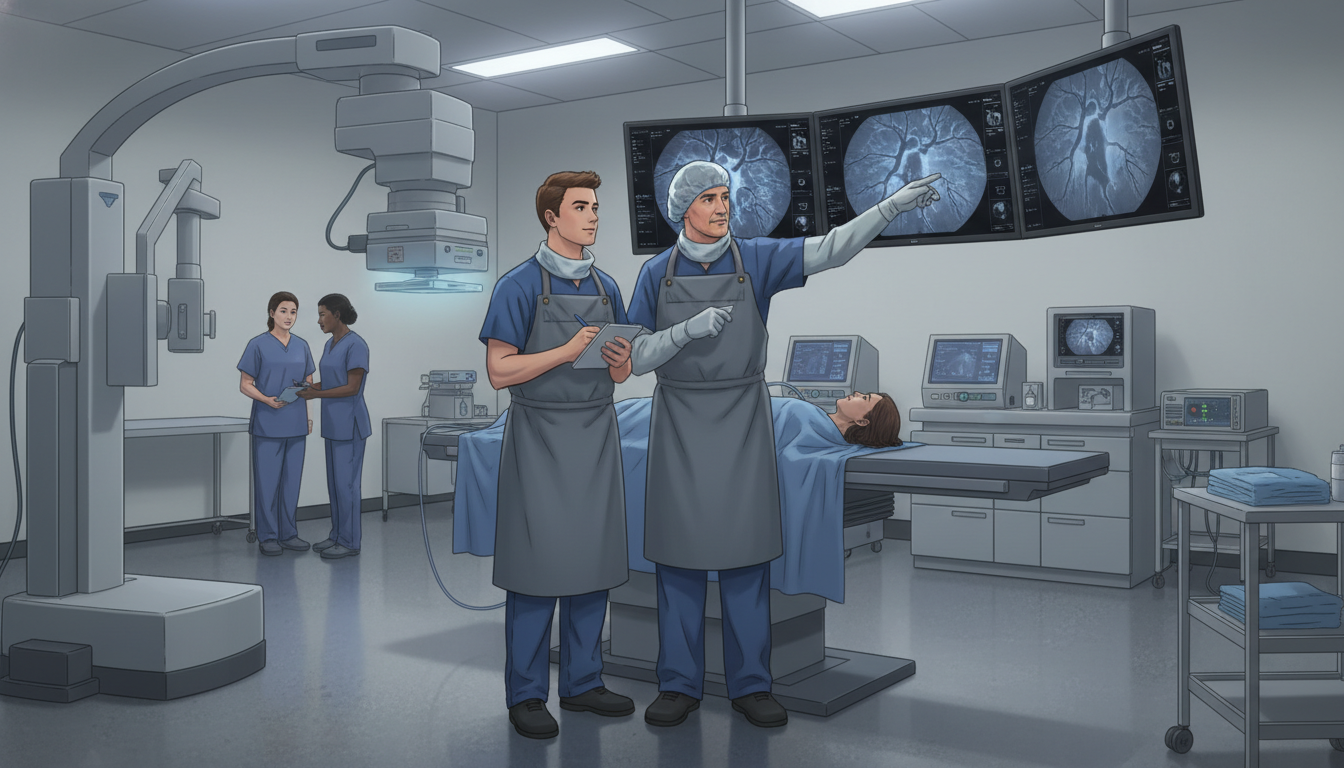
Performance on away rotations residency experiences often matters more than your school name for IR match prospects. You must be memorable in the right way.
1. Learn the Basics Before You Arrive
Before day one of an IR or DR rotation, review:
IR basics:
- Common procedures: paracentesis, thoracentesis, biopsies, port placements, embolizations, TIPS, GI/GU interventions.
- Indications, contraindications, and high-yield complications.
Diagnostic Radiology basics:
- Systematic approaches to chest X-rays, abdominal imaging, CT head trauma, and basic ultrasound.
Useful pre-rotation resources:
- “IR in Practice” style summary guides.
- Free online IR introductory resources (SIR resident/student sections).
- Pocket radiology atlases.
You don’t need to be an expert, but you must not be a blank slate.
2. Show Up Prepared, Early, and Reliable
- Arrive 10–15 minutes early every day.
- Review relevant patient charts before cases when possible.
- Carry:
- A small notebook.
- A pen.
- Hospital login info.
- List of your patients or active cases.
Being reliable is a non-negotiable for IR, where procedures and emergencies can be unpredictable.
3. Be Proactive but Not Overbearing
In the IR suite:
- Introduce yourself to techs, nurses, PAs, and residents on day 1.
- Ask:
“What’s your preferred way for a student to help? Are there tasks I can take ownership of?” - Volunteer for:
- Gathering consent forms (with supervision).
- Helping set up rooms with basic supplies.
- Writing preliminary consult notes (if allowed).
- Calling floors to coordinate patient transport (after staff approval).
In DR reading rooms:
- Ask to sit within eyesight of the attending or resident.
- Offer to:
- Pre-dictate or pre-read cases (if allowed).
- Look up relevant clinical history.
- Present a brief one-line summary of imaging findings.
4. Ask Smart Questions
Avoid:
- Questions you could easily look up on the spot.
- Interrupting in the middle of high-stakes parts of procedures.
Better approach:
- Observe first, write down questions, then ask between cases or when the attending invites questions.
Example:
- Instead of: “What is TIPS?”
- Try: “I understand TIPS is a shunt between the portal and hepatic veins to reduce portal hypertension. In this patient, was the main indication refractory ascites or prior variceal bleeding?”
This demonstrates:
- Initiative in self-learning.
- Higher-level thinking.
- Respect for the attending’s time.
5. Demonstrate Work Ethic and Team Orientation
What IR faculty often comment on in LORs:
- “This student stayed late without being asked.”
- “They were the first to offer help with floor work.”
- “They never complained during busy call nights.”
Concrete behaviors:
- Offer to stay for late/evening cases at least several times during the rotation, especially high-yield procedures.
- Help residents with non-glamorous tasks (notes, calling consults, checking labs).
- Thank techs and nurses; they often informally report on “who the good students are.”
6. Nail the End-of-Rotation Ask: Letters and Advocacy
In week 3 of a 4-week rotation:
Identify 1–2 faculty (ideally IR attendings) who:
- Have seen your work consistently.
- Have interacted with you on multiple cases or days.
Ask directly and professionally:
“Dr. X, I’ve really valued this rotation and your teaching. I’m planning to apply to Diagnostic Radiology with a strong interest in Interventional Radiology and especially hope to match at programs like this one. Would you feel comfortable writing me a strong letter of recommendation based on my performance here?”
This wording:
- Gives them an out if they cannot write a strong letter.
- Signals seriousness without pressure.
Also ask:
- “Are there specific programs where you think I should apply as a Caribbean IMG? Are there faculty you’d be comfortable emailing on my behalf?”
Faculty advocacy and “behind-the-scenes” emails can matter in IR, which is a small community.
Integrating Away Rotations into Your Overall IR Match Strategy as a Caribbean IMG
Away rotations should not exist in isolation. They must connect with your broader IR match plan.
1. Step Scores and Academic Metrics
For IR and DR, Caribbean IMGs are often screened first by numbers:
- Aim for Step 2 CK strong enough to offset any Step 1 vulnerabilities.
- If Step 1 is pass/fail, Step 2 becomes even more critical.
Your away rotations cannot completely compensate for very low scores, but they can distinguish you among candidates with similar metrics.
2. Research and Scholarly Work
Not strictly mandatory, but:
- IR is academically oriented.
- Even small projects (case reports, QI projects, poster presentations) can:
- Give you talking points.
- Show engagement with IR beyond shadowing.
Use away rotations to:
- Ask about ongoing IR projects you can contribute to remotely after the rotation.
- Join QI initiatives (e.g., reducing contrast use, procedural workflows).
3. Personal Statement and ERAS Application
Leverage your away rotations strongly in your narrative:
- Highlight specific IR cases or experiences that shaped your commitment.
- Mention mentorship and letters (without naming names).
- Emphasize what you learned about the realities of IR (call, emergencies, longitudinal care).
For Caribbean IMGs, program directors often read applications wondering: “Have they really seen what this specialty is like in the U.S.?”
Your away rotations provide clear evidence.
4. Dual-Application Strategy
Given competitive IR match statistics:
- Many Caribbean IMGs pursue:
- Integrated IR at a few realistic/aspirational programs.
- Wide DR application list (including IMG-friendly programs).
- Away rotations can help you:
- Identify which programs are more open to Caribbean graduates.
- Tailor your DR applications toward sites with strong IR support, ESIR, or independent IR pipelines.
Example Strategic Scenario
You are a 4th-year SGU student with:
- Step 1: Pass.
- Step 2 CK: Mid–230s.
- Some IR research with a faculty mentor.
Possible plan:
- Do an IR elective at a mid-sized academic center that has:
- Integrated IR.
- ESIR opportunities.
- A known track record with SGU residency match candidates (even if in other specialties).
- Do a DR rotation at a large community program where:
- DR takes IMGs.
- There is at least one IR-focused attending.
Outcomes:
- Two strong U.S. LORs (one IR, one DR).
- Concrete experience to cite in IR match interviews.
- Realistic DR backup programs where faculty already know you.
Frequently Asked Questions (FAQ)
1. As a Caribbean IMG, do I absolutely need an away rotation to match into Interventional Radiology?
You can theoretically match without an away rotation, but your odds are significantly lower. Away rotations prove you can function in a U.S. academic or community environment, generate powerful letters, and help you identify IMG-friendly programs. For a Caribbean IMG targeting IR, at least one U.S.-based IR or DR away rotation is highly recommended.
2. Should I focus only on IR electives, or is a Diagnostic Radiology rotation just as important?
Both matter. IR electives build direct specialty credibility and IR-specific letters. However, because many Caribbean IMGs enter IR via a Diagnostic Radiology pathway, a DR rotation at an IMG-friendly program with robust IR can be equally or even more valuable for actually securing a spot that leads to IR later.
3. How many away rotations are ideal for a Caribbean IMG interested in IR?
In most cases, 2–3 away rotations are optimal:
- 1 IR-focused rotation (preferably academic or hybrid).
- 1 DR-focused rotation (often at an IMG-friendly program).
- Optionally, a third rotation if you need additional U.S. radiology exposure or want to target another specific institution. More than 3 usually yields diminishing returns and increases financial and logistical strain.
4. Should I only apply to “top-name” IR programs for my away rotations?
No. Very prestigious IR programs are often saturated with U.S. MD students and may have limited experience with Caribbean graduates. You can include one ambitious choice, but you should prioritize realistic, IMG-friendly programs—centers where your rotation can transform you from “Caribbean IMG on paper” into a known, trusted candidate who has already performed well in their environment.
By approaching away rotations strategically—choosing the right mix of IR and DR sites, focusing on IMG-friendly programs, and maximizing your day-to-day performance—you can significantly improve your chances of a successful IR match or a strong DR match that keeps the IR pathway open. As a Caribbean IMG, your rotations are not just experiences; they’re critical auditions that can define your residency trajectory.