
The myth that “clerkship grades are holistic and fuzzy” falls apart the moment you see how program filters actually work. Programs turn your clerkship honors and narrative comments into a crude but very real scoring system, and that system absolutely affects who even gets seen.
Let’s unpack how.
1. How Programs Actually Filter ERAS – The Quant Layer First
Most applicants imagine some thoughtful faculty member reading their whole ERAS packet slowly. That is not what happens at volume.
Program behavior is closer to this: reduce 3,000+ applications to ~400–600 “reviewable” files using a combination of hard filters and summary scores. Clerkship performance and narratives are part of that, but not in the first pass.
The first layer is usually objective screening:
- USMLE/COMLEX scores
- School reputation and location
- Red flags (failures, gaps, professionalism issues)
- Sometimes research output or prior degrees
Only after that do clerkship metrics start to matter as filters.
Here is a realistic breakdown (based on PD survey reports and what I have seen in actual committee rooms) of relative weight once an application has passed initial test-score thresholds:
| Component | Typical Weight Range |
|---|---|
| USMLE/COMLEX (after screen) | 20–30% |
| Clerkship grades | 20–30% |
| Narrative comments/MSPE | 15–25% |
| Letters of recommendation | 15–25% |
| Research / CV strength | 10–20% |
Notice clerkship grades plus narrative are effectively 35–55% of the decision signal after scores. That is not “soft.” That is core.
Programs operationalize this in three main ways:
- Synthetic “clinical performance” scores built from honors and narrative signals
- Rule-based filters (e.g., “at least X core honors,” or “no remediation in core rotations”)
- Narrative-triggered flags for strong positive or strong negative descriptors
The data shows: if you ignore how your clerkship documentation will look in ERAS, you are ignoring one of the most leveraged parts of your file.
2. Honors Patterns: What Programs Really Infer
Programs are not dumb. They know grading is wildly inconsistent across schools. So they do not look at a single “Honors in Medicine” in isolation; they look at patterns.
2.1 Core metrics most programs track (formally or informally)
Typical internal spreadsheet columns for each applicant look something like this:
- Total number of core clerkships with honors
- Honors in IM / Surgery / Pediatrics / OB-GYN / Psych / Family Med (binary each)
- “Medicine-like” vs “procedure-like” performance (to match specialty)
- Any “Pass” or “Low Pass” in core rotations
- Trend over time (early struggles vs late surge)
Here is a simplified example of how an internal ranking sheet might look for an IM program:
| Applicant | IM | Surgery | Peds | OB-GYN | Psych | FM | Total Core Honors |
|---|---|---|---|---|---|---|---|
| A | H | H | H | H | H | H | 6/6 |
| B | H | P | H | H | H | H | 5/6 |
| C | H | P | P | H | H | P | 3/6 |
| D | P | P | P | P | H | P | 1/6 |
Applicant A and B are in the “top clinical” bucket. C is borderline. D is likely out unless something extraordinary compensates.
2.2 Honors distribution and competitiveness
The question is not “Did you get honors?” The real question is: “What proportion of your cohort got honors, and where do you sit in that distribution?”
Many MD schools:
- Award Honors to roughly 25–40% of students in a given clerkship
- Some “honors-heavy” schools push that to 50–60% in certain rotations
- DO schools and some community-based programs may use less tiered systems (HP/Pass only, or narrative dominant)
Programs use school-specific expectations when they know them. Some PDs literally keep a mental or written table:
| School Type | Typical Honors % per Clerkship |
|---|---|
| Top 20 research MD | 25–35% |
| Mid-tier MD | 30–45% |
| Newer / regional MD | 40–60% |
| Many DO schools | Often fewer formal tiers |
If your school gives ~35% honors in Medicine and you did not get it, that is an immediate relative ranking hit when compared with peers from the same institution.
Programs that care about data will sometimes standardize like this:
- Assign 2 points for Honors, 1 for High Pass, 0 for Pass
- Compute an average “core clerkship score” across major rotations
- Adjust modestly based on school’s known honors density (e.g., multiply honors-heavy schools by a scaling factor)
So a transcript that looks like:
- Honors: IM, Surgery, Peds
- High Pass: OB-GYN, Psych
- Pass: Family Med
Would be quantified as: (2+2+2+1+1+0) / 6 = 8/6 ≈ 1.33 “clinical GPA”
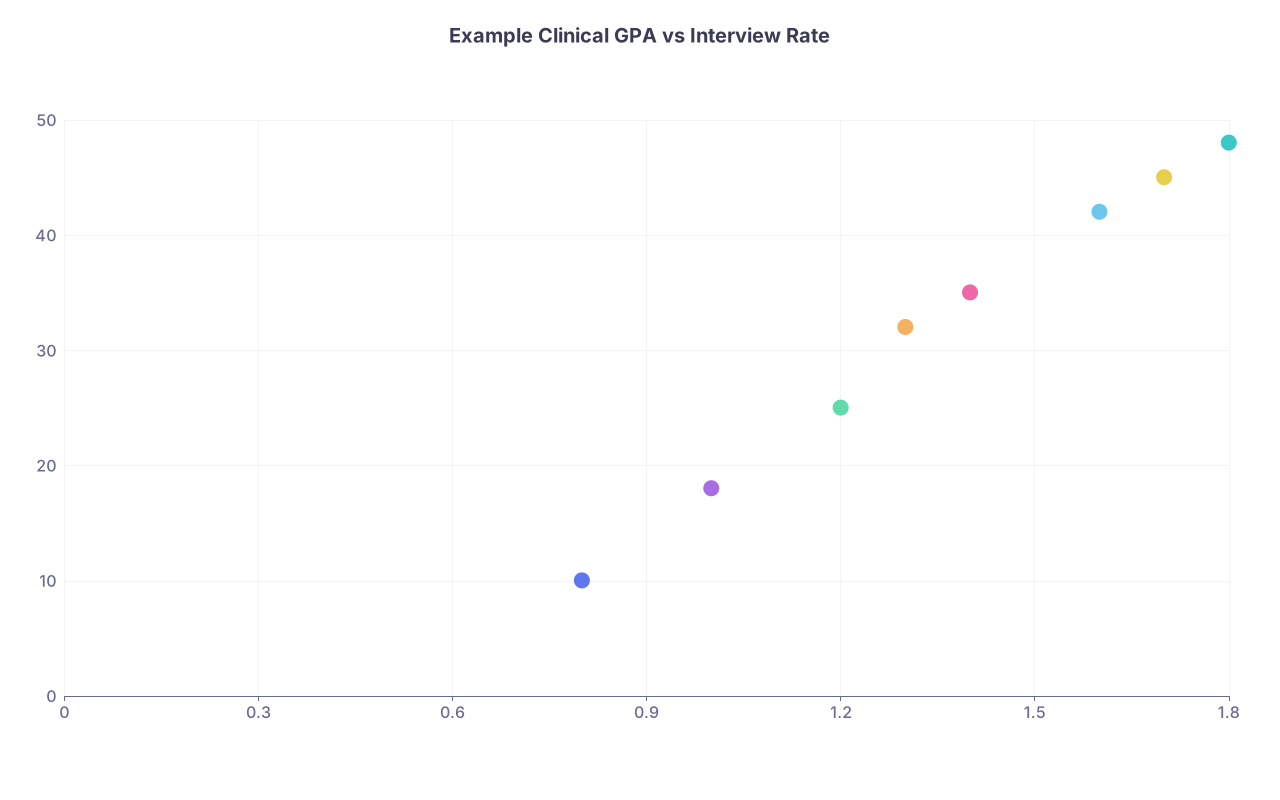
| Category | Value |
|---|---|
| Appl 1 | 0.8,10 |
| Appl 2 | 1,18 |
| Appl 3 | 1.2,25 |
| Appl 4 | 1.3,32 |
| Appl 5 | 1.4,35 |
| Appl 6 | 1.6,42 |
| Appl 7 | 1.7,45 |
| Appl 8 | 1.8,48 |
That hypothetical scatter is what I have seen: a rising clinical GPA correlates with more interview offers, once test scores clear the floor.
3. Narrative Comments: Where “Subjective” Becomes Structured
The biggest misunderstanding: people think narrative comments are fluffy, purely qualitative, and ignored by filters.
Reality: many programs have quietly pseudo-structured them.
3.1 Keyword and phrase mining
Some PDs and associate PDs do this informally. Others use explicit rubrics. Patterns I have seen:
- Positive high-signal terms: “top 10%,” “outstanding,” “best student,” “among the strongest,” “resident-level,” “independent,” “rapid learner,” “exceptional team member”
- Negative/concern terms: “requires supervision,” “needs consistent direction,” “difficulty with time management,” “interpersonal challenges,” “limited initiative,” “professionalism concern reported”
They assign points or flags based on the presence of these.
A simple scoring approach one program used:
- +2: “top X%,” “best,” “outstanding,” explicit ranking vs peers
- +1: “excellent,” “strong,” “very good,” without ranking
- 0: generic positive language only (“pleasant,” “hard working”)
- −1: any mild concern phrasing
- −2: any mention of serious concern or remediation
Then they averaged across core clerkships to build a “narrative performance index.”
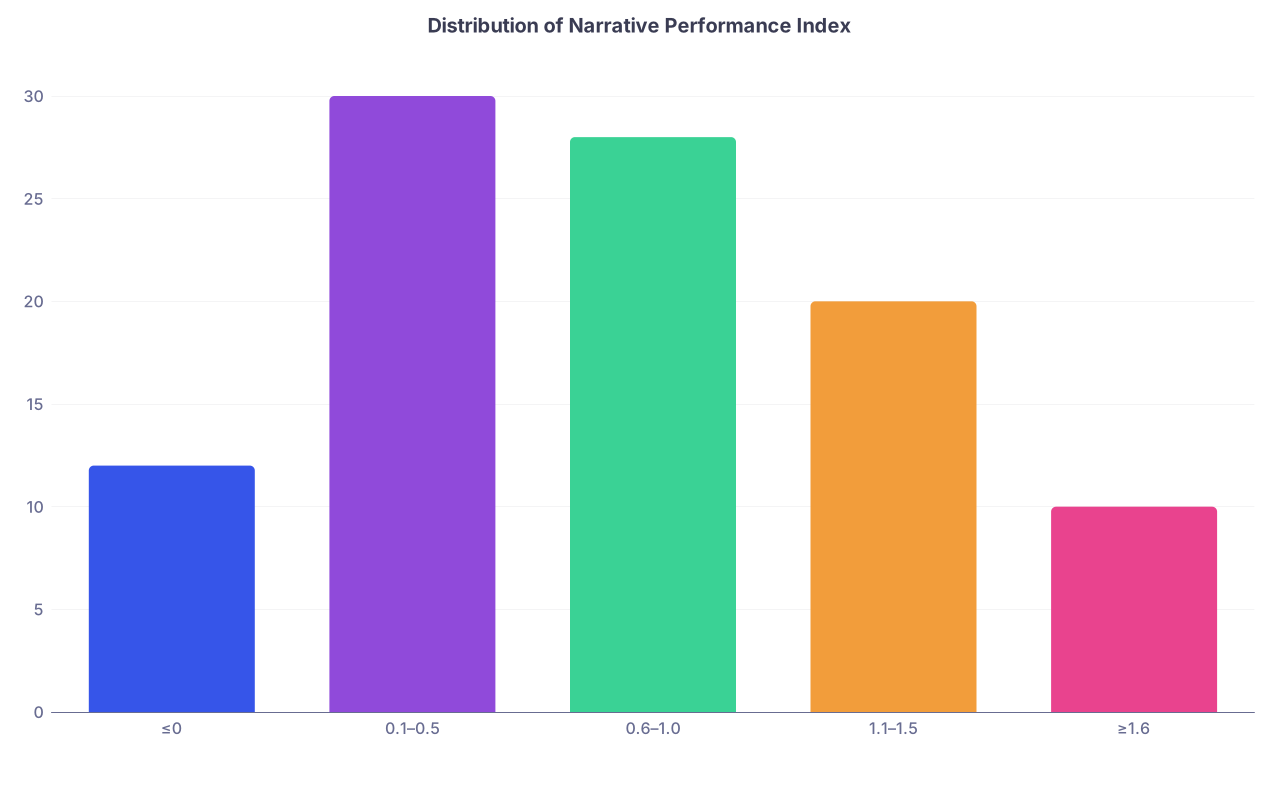
| Category | Value |
|---|---|
| ≤0 | 12 |
| 0.1–0.5 | 30 |
| 0.6–1.0 | 28 |
| 1.1–1.5 | 20 |
| ≥1.6 | 10 |
In that distribution, the 1.1–1.5 and ≥1.6 buckets are your high-yield interview pool, assuming scores are acceptable.
3.2 The MSPE as a compressed narrative dataset
The MSPE (“Dean’s Letter”) is basically the compressed, semi-curated version of all your clerkship narratives, plus some comparative data if your school provides it.
Key MSPE data points programs mine:
- Comparative phrases: “upper third,” “middle third,” “lower third” in clinical performance
- Summary adjectives that echo narrative keywords: “outstanding clinician,” “solid,” “capable but reserved”
- Consistency between clerkship comments and summary section
If your clerkships are filled with “top 10%,” but the MSPE summary says “performed at the level expected of a medical student,” programs notice the down-shift. They assume the MSPE is smoothing out grade inflation, not exaggerating it.
3.3 Negative narrative outliers
A single explicitly negative comment in a core clerkship can statistically overshadow three others full of generic praise.
I have seen examples like:
- “Required more supervision than typical at this level”
- “Had difficulty integrating feedback in a timely manner”
- “Improvement was seen after feedback, but ongoing support was necessary”
These tend to trigger manual review or automatic flags:
- Either the applicant is removed from the interview pool
- Or they remain but with a note: “ask about professionalism / independence / team dynamics”
By the numbers, a mildly negative phrase can cut interview odds by 30–50% in competitive specialties, unless you have exceptionally strong offsetting data (high Step, spectacular letters from away rotations, ranking statements).
4. How Different Specialties Interpret the Same Data
Programs do not read honors and narratives in a vacuum. They interpret them based on specialty-specific expectations.
4.1 Specialty weightings on clerkship metrics
Here is a realistic, aggregated picture of how heavily clerkship grades and narratives tend to be weighted, by specialty:
| Specialty | Clerkship Grades Weight | Narrative Weight |
|---|---|---|
| Internal Medicine | High | High |
| General Surgery | High | High |
| Pediatrics | Medium–High | High |
| OB-GYN | Medium–High | Medium–High |
| Psychiatry | Medium | Very High |
| Family Medicine | Medium | High |
| Radiology | Medium | Medium |
| Anesthesiology | Medium | Medium |
| Emergency Med | Medium–High (SLOEs) | Very High |
That is the reality behind the curtain. Not perfectly standardized. But much more structured than students like to think.
FAQ (exactly 3 questions)
1. If my school does not give many Honors, will programs hold that against me?
Programs that see many applicants from your school usually know its grading culture. They will compare you primarily to your peers. If only 15–20% of your class gets honors in Medicine and you are in that group, that is a strong positive signal even if another school seems to give honors more liberally. Problems arise when your transcript is clearly below the median for your own institution in core clerkships, especially the one matching your target specialty.
2. Which matters more for getting interviews: Step scores or clerkship performance?
For the first screen, test scores matter more. They decide if your application is even opened. After that, clerkship performance and narratives often dominate for ranking within the invite pool. You can think of it this way: test scores get you past the gate; clerkship honors and narrative comments determine how high you appear on the “to-invite” and eventual rank list. In many mid-competitive specialties, an applicant with slightly lower scores but very strong clinical narratives will beat an applicant with higher scores and mediocre clerkship feedback.
3. Can a stellar Sub-I or away rotation compensate for a weak core clerkship grade in the same specialty?
Sometimes, yes. Programs give outsized weight to Sub-I and away performance, because those rotations are closer to intern-level responsibility. A Pass in core Surgery with an Honors and “top 10%” language in a Surgery Sub-I will reassure many PDs that you improved and now function at the expected level. But that compensation has limits. If your core clerkship grade was low due to professionalism or serious performance issues explicitly mentioned in the narrative, even an excellent Sub-I may not fully neutralize that red flag at more competitive programs.