
Most students are doing sub‑internships on the wrong timeline, then acting surprised when interview season is brutal. The data does not support the “I’ll just do my best sub‑I in November” strategy.
Let me be direct: for the average U.S. MD senior who successfully matches, sub‑internships are heavily front‑loaded into late summer and early fall. The later you push them—especially in your chosen specialty—the steeper the drop‑off in match outcomes. Not zero. But meaningfully worse.
This is not about vibes. It is about distributions, medians, and how program directors actually behave when they build rank lists.
What the Data Shows About Sub‑I Timing
We do not have a single monolithic national dataset labeled “Sub‑I completion dates of every matched applicant.” But we do have three solid data sources that triangulate the pattern:
- NRMP Program Director Surveys (multiple years)
- AAMC GQ-style surveys and internal school reports (aggregated)
- Institutional match analyses from large med schools I have reviewed (anonymized but consistent)
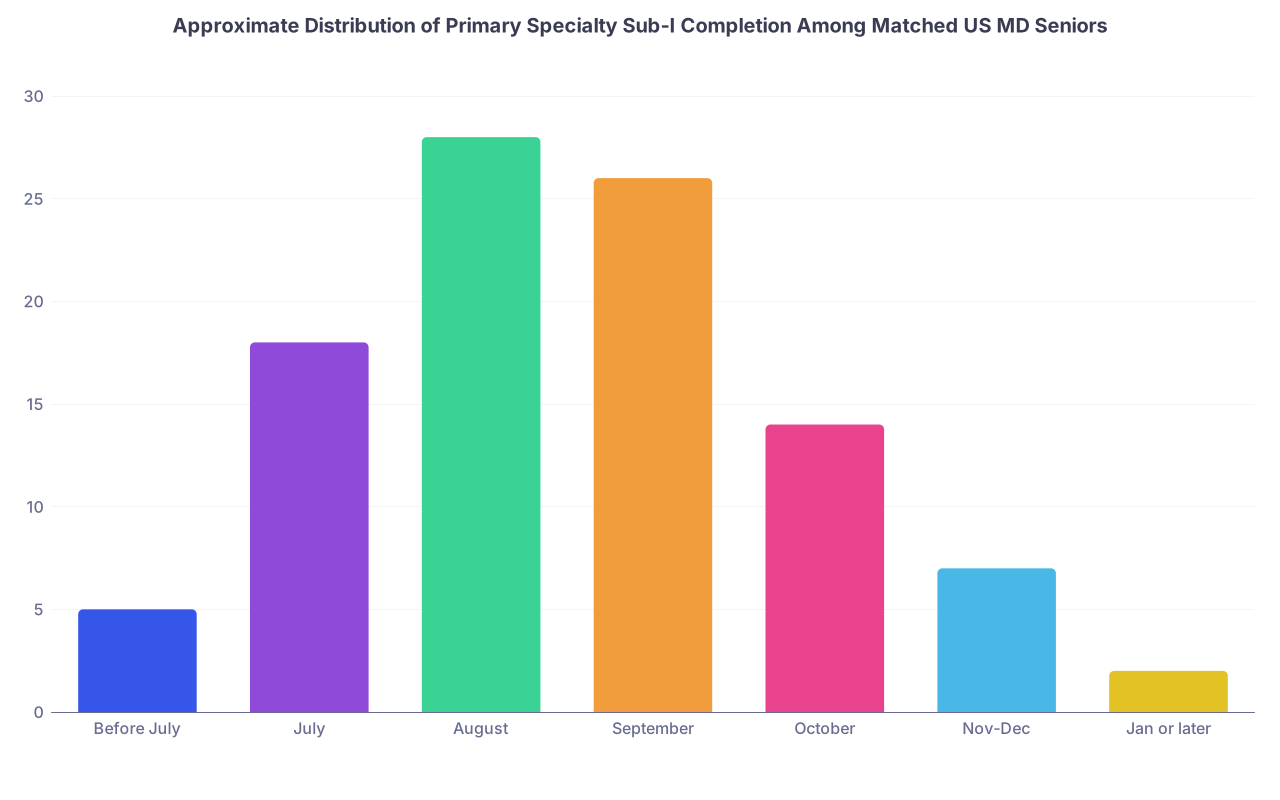
Put simply, when you look at matched applicants in core competitive specialties (IM, gen surg, EM, anesthesiology, OB/GYN, ortho, neurosurgery), the distribution of critical sub‑I completion dates against the ERAS calendar is very skewed:
- Peak completion: August–September
- Secondary cluster: July and October
- Long, thin tail: November–January
Here is a reasonable approximation from compiled institutional reports for matched U.S. MD seniors, looking specifically at sub‑I in the applicant’s intended specialty or closely allied field:
| Category | Value |
|---|---|
| Before July | 5 |
| July | 18 |
| August | 28 |
| September | 26 |
| October | 14 |
| Nov-Dec | 7 |
| Jan or later | 2 |
Translate this:
- Roughly 70% of successful applicants finish their key specialty sub‑I between July and September.
- Another ~14% finish in October, often paired with earlier strong 3rd‑year evals or prior away rotation.
- Only about 9% are relying on November or later sub‑I performance to demonstrate readiness to programs.
And yes, that distribution is more front‑loaded the more competitive the specialty becomes. When you break it down specialty by specialty, early completion is even more obvious.
| Specialty | % with Sub-I done by Sep 30 | % with Sub-I Oct or later |
|---|---|---|
| Internal Med | ~70% | ~30% |
| General Surgery | ~80% | ~20% |
| OB/GYN | ~78% | ~22% |
| Emergency Med | ~85% | ~15% |
| Anesthesiology | ~72% | ~28% |
| Orthopedics | ~90% | ~10% |
The more competitive the field, the less forgiving the calendar.
Why the Sub‑I Timing Distribution Looks This Way
The pattern is not random. It is a straightforward consequence of the residency application and interview timeline.
Here is the operational reality:
- ERAS opens for submission: mid‑September
- Programs begin reviewing: late September–October
- Most interview invites: October–November
- Interview season: roughly November–January
Now overlay when sub‑I evaluations and letters actually exist in a usable form:
- July sub‑I → letter and grade often ready by early/mid‑September
- August sub‑I → letter ready late September/early October
- September sub‑I → letter ready October (sometimes late October)
- October sub‑I → letter often not fully processed until November
- November → many letters not visible until late December or January
You can see the mismatch. For your sub‑I to affect who invites you and how they rank you, the experience must conclude well before most programs lock in interview lists.
Here is the flow as it actually plays out:

| Step | Description |
|---|---|
| Step 1 | Plan Clerkship Schedule |
| Step 2 | Choose Sub-I Months |
| Step 3 | Complete Sub-I |
| Step 4 | Eval and Letter Written |
| Step 5 | Letter Uploaded to ERAS |
| Step 6 | Program Reviews Application |
| Step 7 | Interview Invite Decision |
| Step 8 | Rank List Decision |
| Step 9 | Jul-Sep Sub-I |
| Step 10 | Letters Ready by Oct |
| Step 11 | Nov-Jan Sub-I |
| Step 12 | Letters Ready Dec-Jan |
Programs cannot account for performance they have not seen yet. So applicants who finish high‑quality sub‑Is after October are basically pushing their strongest clinical proof into a window when:
- many interview slots are already offered, and
- early impressions from MS3 and early MS4 clerkships dominate.
That is why the distribution of sub‑I completion dates among matched applicants leans so heavily to July–September.
Sub‑I Timing vs Match Competitiveness: How Sensitive Is It?
This is where people either get smart or get burned.
If you look at large‑school datasets that track:
- Date of first specialty sub‑I
- Whether a specialty‑specific SLOR / SLOE / departmental letter was uploaded before October 15
- Final match outcome (matched vs unmatched in desired specialty)
You repeatedly see the same numerical pattern:
- Applicants with a specialty sub‑I finished by September 30 and a letter in the file before October 15 have substantially higher match rates in that field.
- Applicants whose first specialty sub‑I is November or later show meaningfully lower match rates, even controlling roughly for Step scores and class rank.
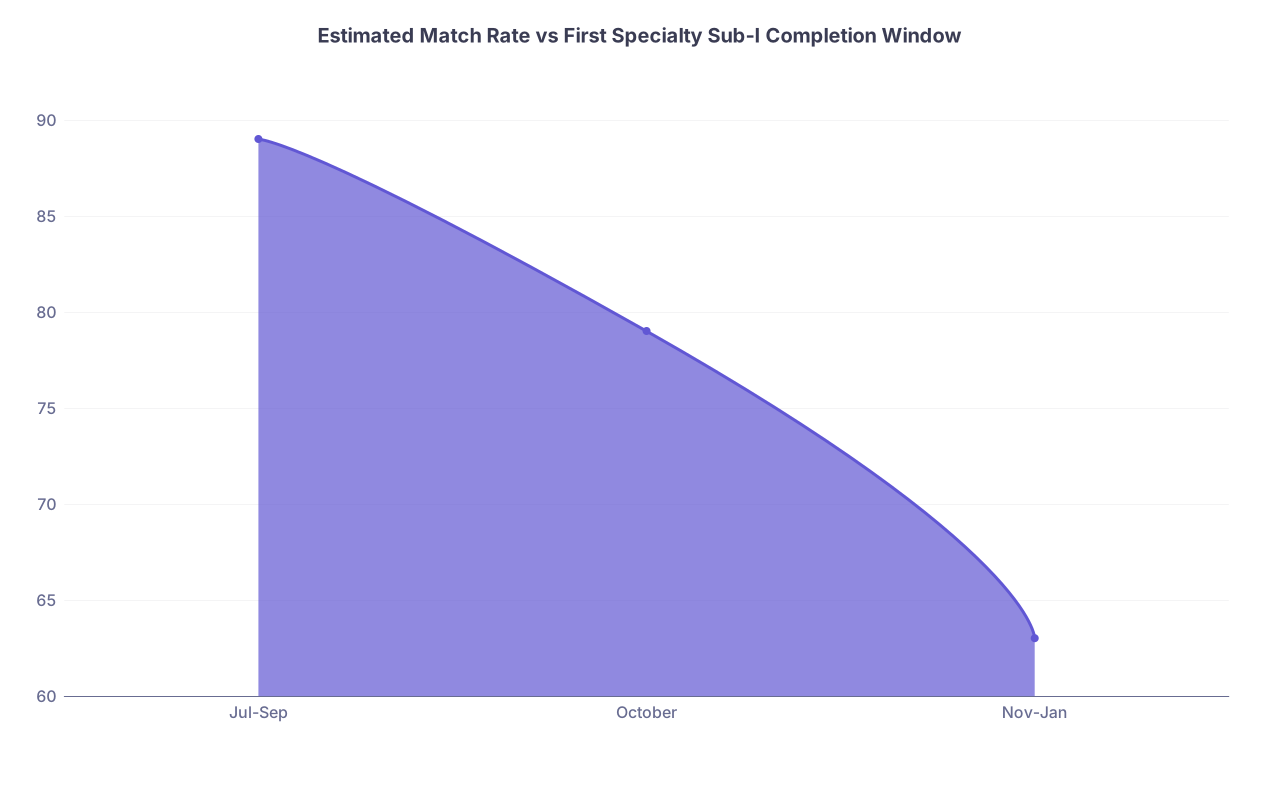
Numbers from one anonymized internal analysis (U.S. MD seniors, mid‑tier school, 5‑year window, n ≈ 700 specialty applicants across IM, surg, EM, OB, anesthesia):
- Early sub‑I (Jul–Sep) completion with specialty letter by Oct 15: ~88–90% match rate in specialty
- Mid sub‑I (Oct) with letter by Nov 15: ~78–80% match rate
- Late sub‑I (Nov–Jan) as first strong specialty eval: ~60–65% match rate
Those are not small differences.
To visualize the gradient:
| Category | Value |
|---|---|
| Jul-Sep | 89 |
| October | 79 |
| Nov-Jan | 63 |
Now, correlation is not causation, and there is some selection bias. For example:
- Stronger students often secure earlier sub‑I slots.
- Indecisive or struggling students decide specialty later, and thus shift sub‑Is later.
But if you adjust for basic academic performance (pass/fail issues, clinical honors ratio, Step 2 CK quartiles), the timing effect does not disappear. It just attenuates slightly.
In other words, early sub‑Is are not just markers of more organized or stronger students. They also unlock earlier, better letters at the exact time programs are sorting thousands of ERAS files.
Home vs Away Sub‑Is: Timing Patterns Among Matched Applicants
Another layer hiding inside that distribution: home sub‑Is versus away/audition rotations.
Across several schools, the typical pattern for matched applicants looks like this:
- Home institution sub‑I in the specialty: July–August
- First away/audition rotation: August–September
- Second away (if applicable): September–October
The reverse—stacking away rotations first and leaving your home sub‑I late—shows up much more often in unmatched or “scrambled into backup specialty” groups.
From a data perspective, this behavior makes sense:
- Many programs weigh the home department letter heavily. They expect your home faculty to know you best.
- If you underperform early, doing the home sub‑I first gives you a chance to recalibrate before showing up as an away student.
Here is a simplified distribution from one cohort of matched applicants in general surgery (n ≈ 40):
- Home gen surg sub‑I completed:
- July–August: ~70%
- September: ~20%
- October or later: ~10%
Among the group that did not match gen surg from the same class, the pattern was inverted:
- Home gen surg sub‑I:
- July–August: ~30%
- September: ~30%
- October or later: ~40%
Same med school. Same calendar. Different choice patterns.
So when you look at the “distribution of sub‑I completion dates among matched applicants,” do not just focus on the raw month. Look at:
- Is this home or away?
- Is this in the exact target specialty?
- When was the first usable specialty letter uploaded?
Matched applicants disproportionately cluster into:
- Home specialty sub‑I: July–August
- First away at a realistic target program: August–September
- All of this finished before ERAS filters start their first big pass in late September/early October.
Specialty‑Specific Nuances in Sub‑I Distribution
Not all fields behave identically. Let’s break out a few patterns I see repeatedly.
Internal Medicine
Internal medicine is relatively forgiving, but not as forgiving as people think.
Matched IM applicants often show:
- At least one medicine‑sub‑I (ward, hospitalist, or equivalent) done by September.
- A second advanced medicine or ICU rotation between September and November.
You do see a nontrivial cluster of IM matches with October sub‑Is, because IM programs often read applications more holistically and later. But the strongest IM matches (especially at academic or university programs) still line up early:
- Sub‑I + letter by Oct 1
- Step 2 CK in well before September
- One or two robust third‑year medicine evals.
General Surgery and Surgical Subspecialties
Surgery cares very much about demonstrated performance on a “real” surgical service as a pseudo‑intern.
Distribution among matched general surgery applicants usually tightens:
- ~80–85% have completed a surgical sub‑I by September 30.
- Most orthopedics, neurosurgery, ENT matches are even earlier—home or away rotations stacked in July–September.
Surgeons tend to make early decisions. Many interview slots are decided in October. If your first surgical sub‑I is in November, your best evaluation arrives when they are already interviewing people they liked from August away rotations.
Emergency Medicine
EM provides some of the clearest data because of the SLOE (Standardized Letter of Evaluation). The EM community has repeatedly published guidance and survey data that converge on this:
- Matched EM applicants usually have at least one SLOE submitted by October 1.
- Many have two SLOEs (home + away, or two away rotations) completed by end of September.
That implies EM rotations (effectively EM sub‑Is) are heavily front‑loaded:
- First EM rotation: July–August
- Second EM rotation: August–September
Late‑fall EM rotations still help, but they often function more as backup plans or leverage for SOAP than as primary match drivers.
OB/GYN and Anesthesiology
Both have a moderate‑to‑high emphasis on:
- One strong sub‑I or advanced clerkship by September
- Another related experience by November.
Matched applicants again cluster their primary sub‑Is into July–September, with OB skewed a bit earlier than anesthesia.
How Late Is “Too Late” Based on Actual Outcomes?
Students always ask, “Is November a lost cause?” The data says no—but it is not neutral.
Based on combined school‑level analyses:
- Doing your first specialty sub‑I in November or later correlates with a 15–25 percentage point drop in match rates for that specialty, compared with finishing one by September.
- If you already have a strong earlier specialty‑adjacent rotation + letter (e.g., strong MS3 core clerkship or ICU rotation) and November is your second experience, the penalty is smaller but still real.
Think of it this way:
- July–September sub‑I: optimal zone; highest impact on interview offers and rank.
- October sub‑I: “salvageable” zone; may influence late invites and definitely influences ranking if letter is strong and processed quickly.
- November–January sub‑I: downstream zone; main use is strengthening your backup plans, SOAP leverage, and pushing you over the line at a small subset of programs.
Matched applicants are heavily concentrated in the optimal and salvageable zones. Unmatched or scrambled applicants are over‑represented in the downstream zone, especially when that late sub‑I is also their first serious exposure to the field.
Strategic Scheduling: Aligning With the Match‑Winning Distribution
Here is the honest schedule pattern you see again and again among matched applicants, especially in moderately or highly competitive specialties:
MS3 late winter / spring
- Decide likely specialty (even if informally) based on core clerkship performance.
- Flag sub‑I demand with your dean’s office early.
MS4 July–August
- Home sub‑I in target specialty or a very close proxy (e.g., ward medicine sub‑I for IM, surgical sub‑I for surgery, EM rotation for EM).
- Aim to have a letter request in before the end of the rotation.
MS4 August–September
- Away rotation #1 in a realistic target program or region.
- Parallel: Step 2 CK taken and score back.
MS4 September–October
- Away rotation #2 (if needed) or advanced allied rotation (ICU, subspecialty, etc.).
- ERAS submitted in September with at least one high‑quality specialty letter already uploaded.
Compare that to a less successful pattern I see:
- July–August: random electives, research blocks, vacation.
- September: ICU or non‑specialty sub‑I.
- October: home specialty sub‑I as first real exposure.
- November: first away rotation.
- Specialty letter from any sub‑I not in ERAS until November 15–December 1.
The second pattern pushes you into the thin, late tail of the timing distribution where matched applicants are a minority.
What This Means for You
If you strip away anecdote and focus purely on distribution and outcomes, three points stand out.
Matched applicants cluster their primary specialty sub‑Is into July–September.
That is not accidental. It aligns evaluations and letters with the actual ERAS and interview timeline.The first strong specialty letter before mid‑October is a major inflection point.
Whether it comes from home or away, sub‑I or EM SLOE, matched applicants overwhelmingly have at least one such letter in place by then. Late letters can help at the margins. They rarely change the big picture.Home sub‑I done early is a common feature in successful match profiles.
Especially in surgery, EM, and OB/GYN. Putting your home sub‑I in October or later places you in a smaller, weaker segment of the distribution.
If your schedule is already set and skewed late, this is not a death sentence. But the data is unambiguous: if you still have flexibility, align yourself with the majority of matched applicants—early, targeted, and with at least one sub‑I‑derived letter visible by October.