
The thing that decides if your away rotation “helped your chances” is not your smile, your handshake, or your Instagram-worthy scrub cap. It’s the two-minute feedback form an attending fills out on their phone while walking to the elevator.
Let me tell you what they actually get asked about you—and what they really write. Because the form isn’t what you think it is, and neither is the game you’re playing.
The Hidden Gatekeeper: The Away Rotation Evaluation Form
Every away rotation feeds into a system—MedHub, New Innovations, E*Value, some clunky homegrown thing. You see none of it. But program coordinators, PDs, and CCC members live in those systems.
Here’s the first uncomfortable truth:
For most away rotators, nobody remembers every detail of what you did. The form becomes your memory.
When the rank list meeting comes around and someone says, “That student from Mayo—were they any good?” no one is pulling up your Instagram. They’re pulling up your rotation evaluation. Those anonymous radio buttons and short comments carry more weight than your personal statement.
Most schools use some variation of the same structure:
- A dozen or so “domains” rated on a 1–5 scale
- A global “would you want this student in your program”–type question
- One or two comments boxes (“strengths,” “areas for improvement”)
- Maybe a professionalism flag option
You think they’re grading your medical knowledge. They’re not. They’re grading whether they’d trust you as an intern who won’t make their life harder.
Let’s break down exactly what those forms ask—domain by domain—and how attendings really interpret you.
The Core Domains: What They Actually Click On You
I’ve seen these forms for medicine, surgery, EM, ortho, OB, you name it. The wording varies, the categories do not.
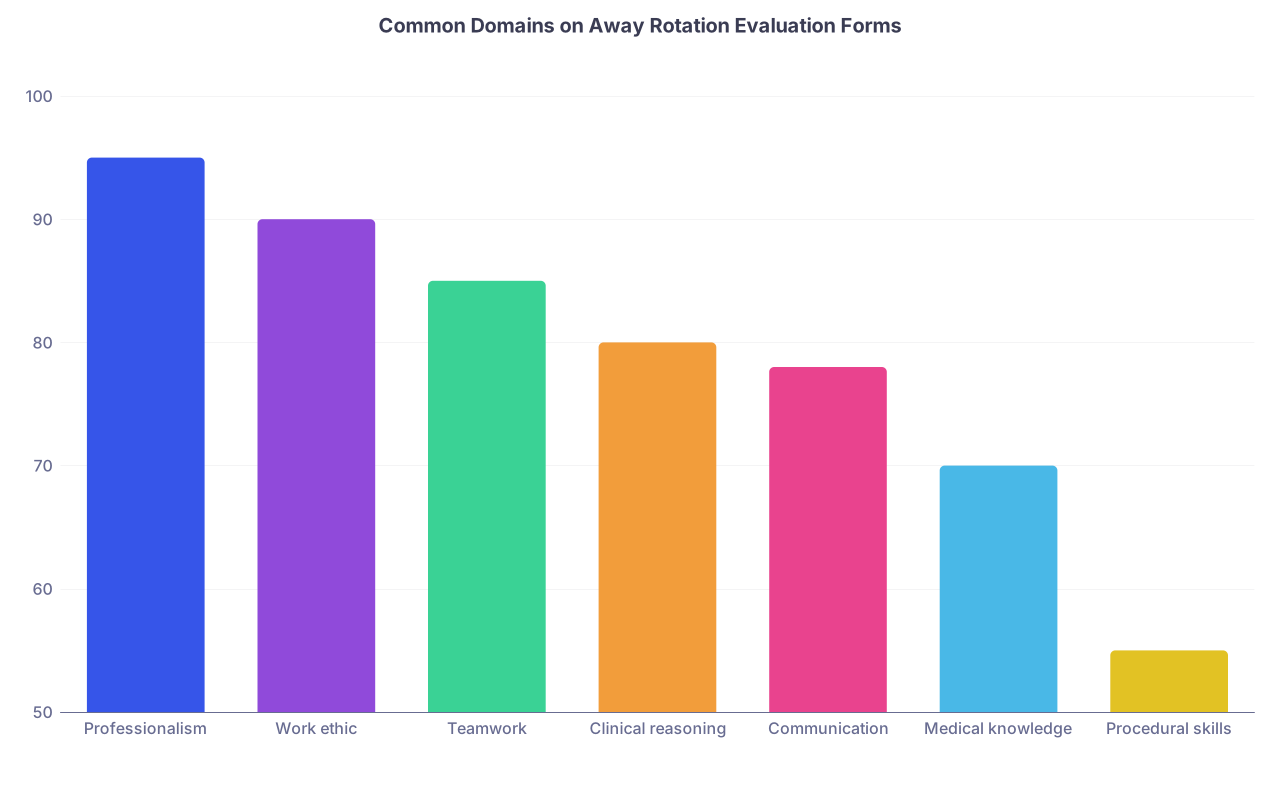
| Category | Value |
|---|---|
| Professionalism | 95 |
| Work ethic | 90 |
| Teamwork | 85 |
| Clinical reasoning | 80 |
| Communication | 78 |
| Medical knowledge | 70 |
| Procedural skills | 55 |
The percentages there are roughly how often those domains show up on real eval forms. Let’s walk through what each one really means.
Professionalism
This is the first domain and the last one anyone forgets.
The form language is something like:
“Demonstrates reliability, integrity, respect, and accountability.”
Translation:
Do I trust you with my patients and my pager at 2 a.m.?
They’re not overthinking this. They’re asking themselves:
- Were you on time. Every day.
- Did you disappear. Even once.
- Did any nurse complain about you.
- Did you ever look annoyed, roll your eyes, or act “above” scut.
- Did you respond when paged or messaged, quickly and politely.
- Did you follow up when you said you would.
Here’s something students don’t realize: one small professionalism hit nukes your entire away. I’ve sat in meetings where someone says, “She was actually pretty smart but we had a professionalism comment,” and that applicant’s name quietly slides further down the list.
On the form, this usually ends up as:
- 5 – “Exemplary professionalism”
- 4 – “Consistently professional”
- 3 – “Generally professional with occasional lapses”
- 2 or 1 – “Concerns”
You want 4–5 and no comments in this section. A neutral professionalism section is a win. Glowing is a bonus.
Work Ethic / Initiative
The form says:
“Demonstrates initiative, is self-directed, assumes responsibility for learning and patient care.”
What attendings are really scoring:
- Did you volunteer for tasks without being begged
- Did you see extra patients in clinic/ED when appropriate
- Did you prep on your days off or show up obviously unprepared
- Did you look bored or ready to go home at 2 p.m.
- Did you ask, “Is there anything else I can help with before I head out?”
I’ve watched an attending finish a clinic, open the evaluation page, and say out loud:
“Good kid, but doesn’t love work. 3 for initiative.”
That “3” doesn’t read neutral in a rank meeting. It reads: “They’ll do the minimum.”
Clinical Reasoning / Problem-Solving
The form:
“Formulates appropriate differential diagnoses and management plans.”
The real filter: Are you thinking like an intern yet, or like a third-year still waiting to be spoon-fed?
They’re not grading you on being right. They’re grading you on having a structured thought process.
They notice:
- Do you present “laundry lists” or organized differentials
- Do your plans sound like “what UpToDate said” or like they belong on this patient
- Do you update your thinking when new data comes back
- Can you give a clear assessment: “This is a 64-year-old with X, I’m most concerned about Y, I want to do Z”
Students with average knowledge but clear reasoning routinely get 4s and 5s here. Students who memorize guidelines and regurgitate them without tailoring to the patient get 3s.
If you’re on a surgical or EM away, this domain is heavily weighed. On the back end, some forms even show weightings when committees pull reports.

The Domains You Underestimate (But They Don’t)
Teamwork / Interpersonal Skills
The form:
“Works effectively within the healthcare team; respectful and collaborative.”
No one tells you this: most of your teamwork grade comes from people you don’t see in the rank meeting—nurses, residents, unit coordinators.
Here’s how it plays out behind the scenes:
- The senior resident gets an email: “Please evaluate Student X on your service.”
- Before they click anything, they remember that one day you thanked the nurses, or that one day you ignored a nurse calling your name while you stared at Epic.
- They think about whether you made sign-out easier or harder.
- They remember whether they wanted you on their call nights.
I’ve heard this line too many times:
“Technically fine, but kind of weird with the team” → 3 for teamwork, maybe a slightly lukewarm comment.
Also, beware of seeming like you’re only trying to impress attendings. Nurses, techs, and residents notice exactly who you suddenly become charming for when the attending walks in. That doesn’t help you. It hurts you.
Communication Skills
The form phrases:
“Communicates effectively with patients and staff; gives organized presentations.”
The more competitive the specialty, the more this matters. Because what PDs know is this: bad communicators are dangerous at 3 a.m.
They look for:
- Can you present in under 3 minutes without losing the plot
- Do you adjust your language between patients and physicians
- Do you answer questions directly or wander
- Can you call consults or hand off patients without residents wanting to grab the phone from you
This is why so many of you hear, “Work on tightening your presentations.” That’s evaluation-form code for, “If I click ‘5’ here, I’m lying.”
If you want straight 4–5s in this domain: practice lean, structured, one-breath presentations. Nobody wants to hear a 10-minute monologue about a straightforward appendicitis.
Medical Knowledge
Here’s the part nobody says out loud: “Medical Knowledge” is less predictive of whether you get ranked highly than you think—unless you’re obviously weak.
The form might say:
“Demonstrates appropriate level of knowledge; applies knowledge to patient care.”
What they care about most:
- Do you know the basics for common problems in that specialty
- When you do not know, do you say so and then go read, and does it show the next day
- Are your gaps fixable with normal residency training—or are they worrisome
Attendings roll their eyes at the shelf-exam robot who knows every obscure fact but can’t reason through a sepsis patient.
If you’re average but teachable, you get a 4. If you’re above average and humble, you get a 5. If you’re average and arrogant, you get a 3.
Technical / Procedural Skills (surgery, EM, some subspecialties)
The form:
“Demonstrates appropriate technical skills; shows dexterity and safety.”
Reality: Most attendings are grading your trajectory, not your current skill.
They ask themselves:
- Did you listen and adjust when coached
- Are you careful with tissue, instruments, and sharps
- Do you look awkward but improving, or just absolutely unsafe
- Did you practice suturing or knot tying on your own time and did it show
In surgery especially, the unwritten rule: a motivated, safe, teachable student can be molded. An overconfident, rough student is dangerous. The form reflects that.
The Two Questions That Matter Most
Most forms bury the real decision behind all the Likert-scale noise.
Some version of these two questions shows up almost everywhere:
- “Overall clinical performance”
- “Would you recommend this student for residency in this specialty/program?”
That second one is the entire game.
Here’s what the scale really means when faculty or residents click it:
- 5 – Strongly recommend / would be delighted to have as a resident
- 4 – Recommend / would be happy to have
- 3 – Recommend with reservations / neutral
- 2 – Would not recommend for this program
- 1 – Serious concerns
You want to be in the 4–5 zone. A “3” is the kiss of death for a competitive program. On paper it looks fine. In the room it sounds like, “They’re okay, but we have better options.”
I’ve seen PDs sort applicants by “Would recommend as resident?” averages pulled from away rotations and home sub-Is. If your competing applicants all have 4.5+ and you’re sitting at a 3.6, you’re not going to win that fight.
| Numeric Score | What The Form Says | What Faculty Usually Mean |
|---|---|---|
| 5 | Strongly recommend / Top candidate | We should recruit this person aggressively |
| 4 | Recommend | Solid; I’d be happy if they matched here |
| 3 | Recommend with reservations / Neutral | Fine, but not pushing for them |
| 2 | Do not recommend for our program | I’d rather they go somewhere else |
| 1 | Serious concerns | Absolutely not |
How Fast These Forms Really Get Filled Out
Here’s another behind-the-scenes truth: your future often gets decided in under three minutes.
Most attendings and residents complete evaluations in bulk. They’ll get a reminder email at the end of the month:
“10 pending evaluations: Student A, Student B, Student C…”
They sit down between cases or after clinic, open all 10, and rate them from memory. That’s it.

| Step | Description |
|---|---|
| Step 1 | End of Rotation |
| Step 2 | System Emails Evaluators |
| Step 3 | Resident/Attending Opens Eval Queue |
| Step 4 | Clicks Ratings Based on Overall Impression |
| Step 5 | Checks Brief Notes or Asks Team |
| Step 6 | Adds Short Comment or Leaves Blank |
| Step 7 | Submits in Under 3 Minutes |
| Step 8 | Remembers Student Clearly? |
This is why one or two strong, memorable impressions matter more than you think. And why consistent, boring competence without any presence can hurt you. If they barely remember you, nobody is pushing for a “5 – top candidate.”
Comments: The Sentences That Follow You
The numeric boxes get skimmed. The comment boxes get quoted.
Most evaluation forms have two:
- “Strengths”
- “Areas for improvement” (or “Suggestions for growth” if someone in admin tried to be kind)
Here’s the part nobody tells students: committees know how to read through polite academic language. “Areas for improvement” comments are coded.
Here’s what phrases usually mean when read in a rank meeting:
- “Quiet but hardworking” → Not proactive, didn’t stand out
- “Appropriate medical knowledge for level” → Average
- “Will benefit from continued growth in efficiency” → Slow, long presentations, needs hand-holding
- “Does best with clear expectations” → Struggles with ambiguity, not great at taking initiative
- “Pleasant team member” with no mention of clinical ability → Nice but not strong clinically
- “Strong fund of knowledge and works well with team” → That’s a real compliment
- “We would be happy to have them as a resident” → That’s gold. People remember that line.
Years later, when someone says, “That student had great letters,” this is partly what they’re referring to—even if the evaluation form itself is technically “internal.”

How These Evaluations Feed Your Residency Application
Here’s the pipeline you don’t see.
- You do an away.
- Attendings/residents fill out evaluation forms.
- The clerkship director or site director sees aggregate scores and comments.
- When you ask for a SLOE/letter, they pull your evaluations and use them as raw material.
- The language from those forms bleeds directly into your letter.
- During application season, PDs put enormous trust in those SLOEs/letters—especially in EM, ortho, ENT, derm, and other competitive fields.
- At rank meetings, when someone is on the fence, the group goes back to those same comments and scores.
So no, the form is not “just for the school.” It is scaffolding for your letters, and a shadow record of how you performed compared to other rotators.
Some specialties formalize this even more:
- EM SLOEs: direct translation of those domains (knowledge, work ethic, team function, etc.) into a standardized letter.
- Ortho/ENT/Neurosurg: smaller worlds; people literally email or text, “What did you think of X?” That conversation is shaped by what they remember from the evals when they wrote your letter.
What You Should Actually Optimize On an Away Rotation
Stop playing the wrong game. You’re not auditioning for “smartest student.” You’re auditioning for “resident my team won’t dread taking call with.”
If you want the domains and global questions to fall in your favor, you optimize for this:
Professionalism with zero friction.
Dead on time. Answer your pages. Own your mistakes. If you screw something up, you tell the resident before anyone else finds it. That alone gets you 4–5s in professionalism.Visible, sustainable work ethic.
You do not have to live in the hospital. You do have to look like you’re hungry to learn and help when you are there. “Anything else I can help with?” at the end of the day is not optional.Structured, concise communication.
You should be able to present a new admission in 2–3 minutes and have your A/P sound like it came from an intern, not a preclinical student.Being the teammate, not the guest.
You aren’t a visitor. You’re a temporary member of the team. Help with signout, check labs unasked, grab the ultrasound machine, wipe down the stretcher, whatever the team does—you do.One or two memorable positives.
Teach a five-minute chalk talk you prepared. Own one interesting patient and follow them obsessively. Do one thing so well that when the evaluation pops up weeks later, they think, “Oh yeah, that was the student who…”
Those are the things that tilt “Would you want this person as a resident?” from 3 to 4–5.