
The clerkship that quietly decides more ties on rank lists than any other is not surgery, not internal medicine, not pediatrics. It’s your medicine sub‑internship (sub‑I) – or whatever your school calls the acting internship.
Let me tell you what actually happens behind closed doors when programs split hairs between similar applicants. It is not some mystical holistic gestalt. It’s people in a conference room saying things like:
“On his sub‑I, the residents said they’d happily work with him again. That’s all I need.”
Or:
“Her IM clerkship was fine, but the sub‑I eval basically said she disappeared on call. Drop her below the line.”
You want the insider answer to “What clerkship moves me up or down when my scores, research, and letters look like everyone else’s?”
It’s the medicine sub‑I, especially at their hospital or something equivalent in complexity.
Let’s pull the curtain back.
Why the Medicine Sub‑I Is the Real Tie‑Breaker
Program directors love to talk publicly about holistic review, board scores, research, and “mission fit.” All true. But when they’re staring at a stack of applicants who all hit those marks, they reach for the most predictive data point they have:
“How did this person function when they were basically a baby intern?”
That’s exactly what a medicine sub‑I is.
Not a generic core internal medicine rotation.
Not an outpatient elective with 3 patients a day and long lunches.
They want to see you on a busy inpatient service doing intern‑level work, with:
- Overnight or long‑call coverage
- Cross‑cover responsibilities
- Your own list of moderately sick patients
- Real orders, real pages, real chaos
Because that’s the closest simulation of what you’ll be on July 1: a PGY‑1 who can either help the team or sink it.
I’ve sat in rank meetings where two applicants looked identical on paper:
- Same Step 2 score (say 245 vs 246)
- Similar research output
- No professionalism issues
- Solid letters
And the deciding comment was:
“Applicant A’s sub‑I eval: ‘Functions at or above intern level, residents strongly recommend.’ Applicant B: ‘Good student, needs more supervision than typical intern.’ Easy. A goes up.”
That’s it. That’s the tie‑breaker.
What PDs Actually Look For On a Sub‑I
This is the part no brochure will tell you, but every PD thinks.
They don’t care whether you can quote obscure journal articles on rounds every morning. They care whether they’d trust you at 3:00 a.m. with five cross‑cover pages and one nurse who’s clearly done with everyone.
On a medicine sub‑I, PDs and residents are subconsciously grading you on a few ruthless questions:
- Would I feel safer or more stressed if this person were my intern?
- Would I willingly be on nights with them? More than once?
- Will they make our seniors’ lives easier or harder?
- Do they crumble when things get busy or stay steady?
Your eval text and your letters either answer those questions in your favor or quietly tank you.
Here’s how this plays out practically.
On a sub‑I, attendings and residents are paying attention to:
- Can you manage a list without constant prompting?
- Do you notice the patient getting subtly worse before someone else does?
- Do you call for help early when needed, or do you bury problems?
- Do you write notes and place orders on time so the day actually moves?
- Do the nurses roll their eyes when your name shows up on the team sheet, or do they grab you first because you get things done?
You don’t see all of this written in your eval. But PDs read between every line.
The Hidden Power of Sub‑I Narrative Comments
The grades themselves (“Honors”, “High Pass”) are blunt instruments. Nearly useless on their own in competitive specialties because everyone at the top has Honors anyway.
What actually moves you on a rank list is the language attached to your performance.
Here’s the real translation guide PDs and selection committees use, even if they don’t admit it out loud.
| Eval Phrase | PD Translation |
|---|---|
| "Functions at or above intern level" | Top tier; can be trusted Day 1 |
| "Requires minimal supervision" | Strong; safe to give real autonomy |
| "Pleasure to work with" | Team loves them; low drama |
| "Quiet but reliable" | Fine, but probably not a superstar |
| "Improved with feedback" | Some concern; needed more hand‑holding |
| "Will make a solid intern" | Safe choice, not exceptional |
And here’s the part that hurts:
A single vague but lukewarm or subtly negative line in a sub‑I evaluation can hurt you more than a slightly lower Step score.
Example of a very bad tie‑breaker line the committee remembers:
“At times seemed overwhelmed by patient volume; will need close guidance initially.”
You’ll never see that on an official PDF that your dean glosses over. But the PD sees it, circles it, and you quietly slide down 20 spots.
Why Internal Medicine Beats Out Every Other Clerkship
You might be thinking: “But I’m going into [derm, surgery, EM, psych]. My key clerkship should be that specialty, right?”
Yes and no.
Your home specialty rotation matters for getting interviews and for big jumps up or down on the list. But the tie‑breaker for many programs, even non‑IM ones, is still your medicine sub‑I.
Here’s the ugly secret many students don’t realize:
- Surgery PDs: They want to know you can manage post‑op patients, sepsis, fluids, delirium, and the medicine side of everything. They look heavily at your IM sub‑I, especially your ability to handle wards.
- EM PDs: They care if you can handle volume, think broadly, and stabilize admitted patients. Again: medicine‑style thinking. Sub‑I matters.
- Anesthesia, Neuro, Radiology: They want mature, clinically safe interns who can survive a prelim or transitional year. Sub‑I is the stress test.
- Even psych PDs at strong academic centers quietly look to IM comments to decide: “Will this person completely fall apart when their psych patient gets septic?”
Your home specialty rotation shows “fit.”
Your medicine sub‑I shows “floor.” As in: what is the minimum safe level we can expect on Day 1.
From a PD’s mouth in one of those closed rooms:
“If they can’t hack it on a busy medicine service, I don’t care how artistic their derm interest is. They’re going to be unsafe with sick patients.”
That’s why IM sub‑I wins as the most common tiebreaker.
How the Rank Meeting Actually Uses Your Sub‑I
Let’s walk through a real‑world scenario. Strip out the fake “we don’t compare applicants” talk. Here’s what happens.
You’ve got two applicants for a categorical IM spot:
- Both from mid‑tier US MD schools
- Step 2: 242 vs 244
- Both AOA, research roughly equal
- Both had good interviews, no red flags
Conversation sounds like this:
Faculty 1: “Any strong feelings between these two?”
Faculty 2: “Check their sub‑Is.”
Chief: “Applicant 1: ‘Above intern level, quickly independent, residents would love to work with again.’ Applicant 2: ‘Good clinical reasoning, sometimes needed reminders to follow up tasks, improved over the month.’”
PD: “We’re splitting hairs. Move Applicant 1 above. Next.”
This took 45 seconds. Your entire year of effort distilled down to a single sub‑I paragraph when you’re up against similar peers.
For non‑IM specialties, the pattern is similar, just with more weigh on the home specialty rotation. But when they’re torn?
“Look at their IM sub‑I. Who do the residents actually want on their night float?”
That line gets said more often than you’d like to believe.
How To Structure Your Fourth Year Around This Reality
If you’re serious about matching well, you stop thinking of sub‑I as “just another rotation” and treat it like the practical audition it is.
A basic, sane strategy:
- Do an early medicine sub‑I (summer/early fall) at your home institution or, if you’re gunning for a specific program, at a comparable or higher‑acuity hospital.
- If you’re applying to IM itself, have at least one sub‑I in general wards, not just ICU or cardiology. ICU is nice, but the true intern job is wards.
- For non‑IM specialties, a strong IM sub‑I at home still matters. Many prelim positions and advanced programs will look at that more than your short, curated specialty elective.
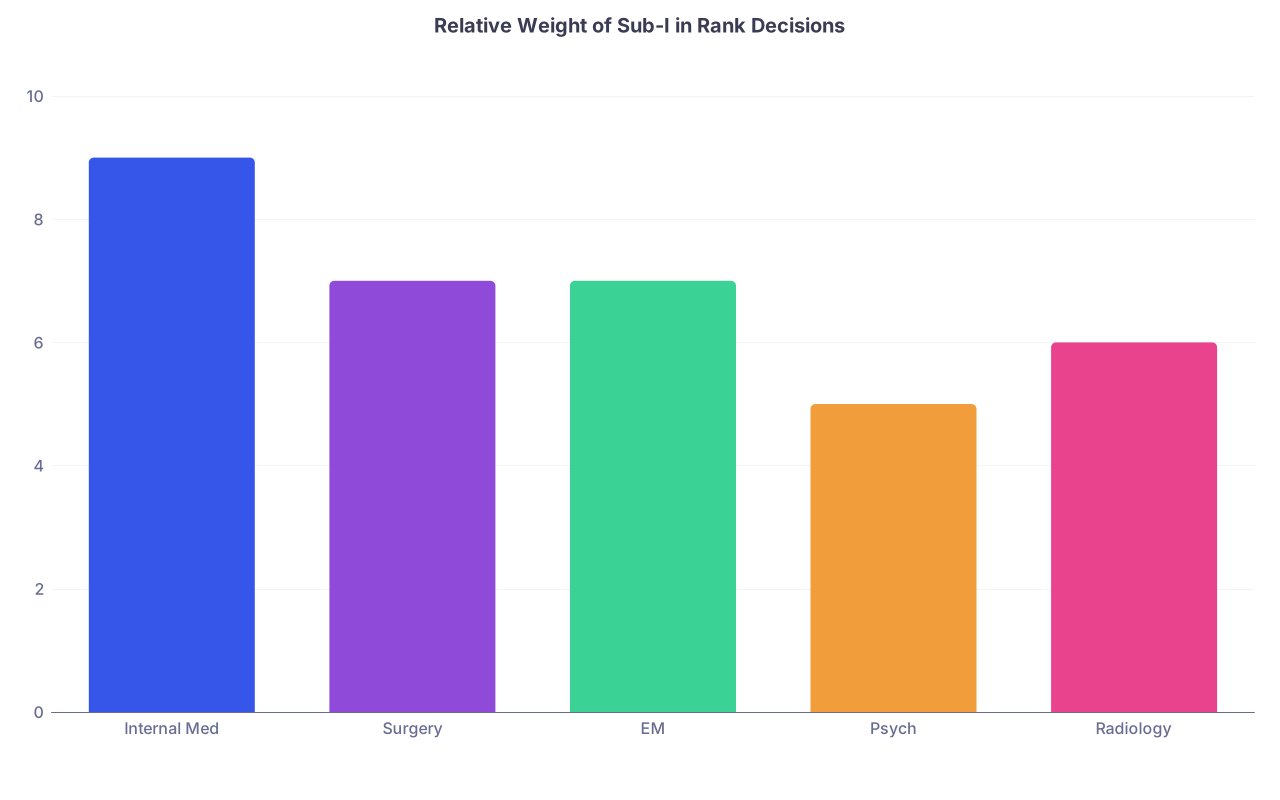
| Category | Value |
|---|---|
| Internal Med | 9 |
| Surgery | 7 |
| EM | 7 |
| Psych | 5 |
| Radiology | 6 |
Scale 1–10. These numbers obviously aren’t published, but they reflect how PDs talk in rank meetings.
If you’re forced by scheduling to do just one sub‑I before ERAS is in, make it medicine. You’ll get more universal currency out of that performance than almost any other rotation.
What High‑Impact Performance on a Sub‑I Actually Looks Like
Students always ask, “What does it mean to ‘perform like an intern’?” Faculty rarely define it clearly. So let me spell out what attendings and seniors are actually watching for.
1. You own your patients
Owning patients doesn’t mean perfection. It means:
- You know vitals, labs, imaging updates without being asked
- You’ve already thought about “What could go wrong in the next 12–24 hours?”
- You pre‑emptively tee up orders, consults, and discharges
- You chase down missing data without being begged
An attending hears: “I already called the son to clarify DNR status and documented it” and mentally upgrades you by a full grade.
2. You move the list
Residents are graded informally on whether they “move the list” – whether the team’s note‑writing, discharges, and plans actually progress.
Sub‑Is who move up the rank list:
- Write concise, useful notes that don’t need complete re‑writes
- Put in orders early so the day flows
- Help close charts instead of adding chaos
If your resident has to rewrite every note and fix every order, your eval will be “pleasant, still developing.” That phrase is death as a tie‑breaker.
3. You’re teachable under pressure
Everyone screws up on a sub‑I. PDs don’t penalize that nearly as much as you think. What they punish is defensiveness and blame‑shifting.
Scenario I’ve seen:
- Student misses an overnight rise in creatinine.
- Senior points it out on rounds.
Two reactions:
- Version A: “You’re right, I didn’t trend it overnight. I’ll go check his I/Os and meds now, and I set a reminder to review labs before sign‑out.”
- Version B: “The labs came back late… the nurse didn’t page… I thought the intern was looking too…”
One of those becomes “improves rapidly with feedback; excellent insight.”
The other becomes “needs closer supervision early on.”
Guess who wins the tie.
How To Engineer a Sub‑I That Generates a Killer Letter
You want your medicine sub‑I not just to be solid but to produce the kind of letter that makes PDs sit up now, not just nod politely.
Here’s how the savvy students do it.
Pick the right service
A sleepy, low‑acuity community floor with 4 patients per intern won’t show anything. You want a busy teaching service where interns routinely carry 8–10 patients. Yes, it’s brutal. That’s the point.Tell your resident on Day 1 what you’re aiming for
Literally say: “I’m applying to [X]. I want you to give me intern‑level responsibility and honest feedback. I’d rather be corrected early and often than have you silently fix things behind me.”Now they know you’re serious. And they know you won’t fall apart when they push you.
Ask once, early, for specific improvement points
Around end of week 1: “What are 2–3 concrete things that, if I improved this month, would make you feel comfortable having me as your intern?”That question does two things:
- Forces them to notice you.
- Plants the idea of “I’d want them as my intern” in their brain—language that often shows up verbatim in your eval.
Make your best work visible without bragging
Residents and attendings miss half of what you do. You need to surface the right things casually:
- “I called the outside hospital and got their echo uploaded; the summary is in my note if you want to glance at it.”
- “I prepped the discharge paperwork and med list; can we review it before rounds end?”
That’s not bragging. That’s making sure your effort isn’t invisible.
How Much a Weak Sub‑I Can Hurt You
You can survive a mediocre core clerkship. A lukewarm family med rotation won’t kill your application. But a weak medicine sub‑I?
That will quietly follow you.
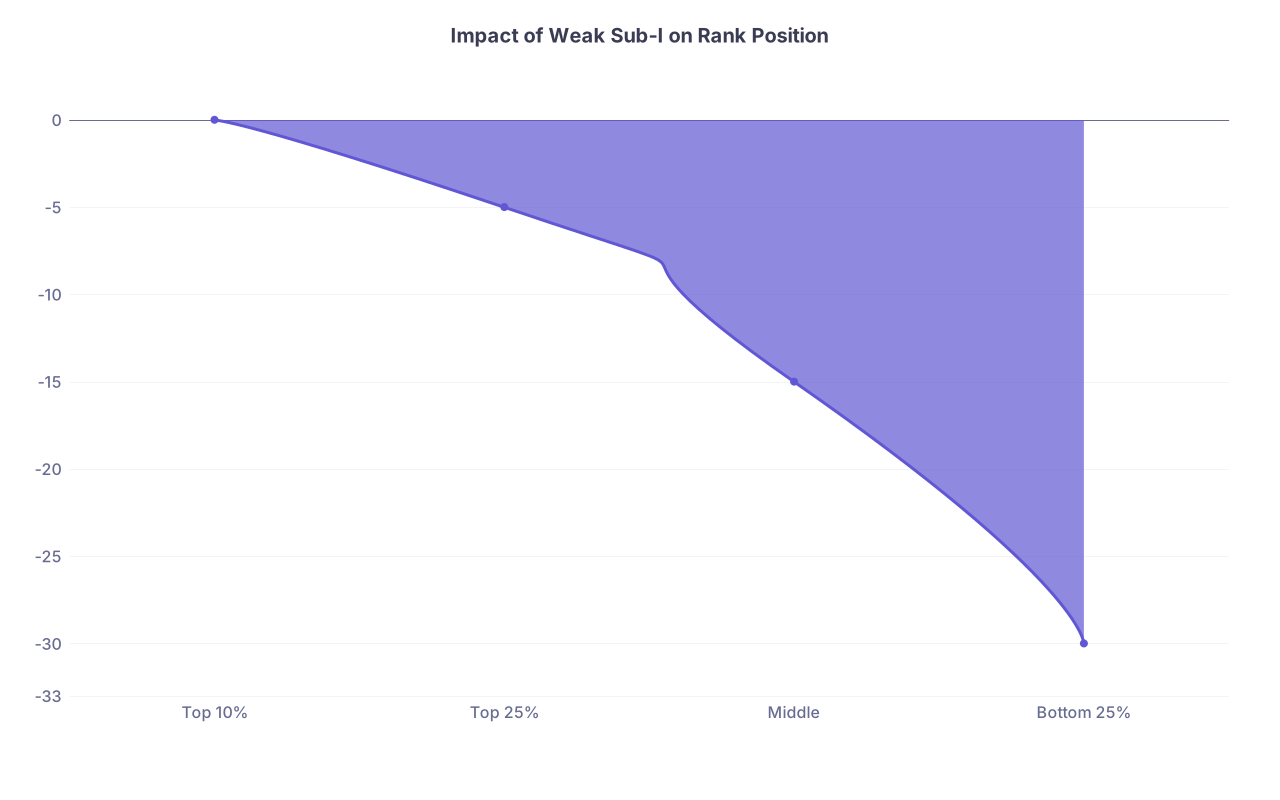
| Category | Value |
|---|---|
| Top 10% | 0 |
| Top 25% | -5 |
| Middle | -15 |
| Bottom 25% | -30 |
Interpretation (this is how PDs talk, not a formal metric):
A clearly strong sub‑I can push you up into the top decile of a rank list if the rest of your app is competitive.
A clearly poor sub‑I can drop you an entire tier.
I’ve seen:
- Applicant with a 260+ Step 2, big‑name research, but an eval saying essentially “struggled to manage tasks even with help.” They still matched – but much lower on their list than they expected.
- Another with a 235 Step 2 but a sub‑I letter from a respected ward attending that said, “I would gladly have them as my intern right now.” That applicant matched at a “reach” program that normally screens at 240+.
The numbers get you in the room.
The sub‑I decides whether people pound the table for you or shrug.
If Your Medicine Sub‑I Is Already Done And Wasn’t Great
This is the part everyone avoids talking about, but you deserve honesty.
If your medicine sub‑I already happened and you know you were just okay – not a disaster, but not a star – you’ve got a few levers left.
Do a second sub‑I, and crush it.
Another inpatient rotation (medicine at a different site, ICU, heme/onc wards) with a stronger performance can generate a better narrative letter. PDs will weigh the most recent, strongest signal more heavily.Get a letter that directly counters the weakness.
If your sub‑I eval implied you were slow, get a later attending to write, “Among the fastest‑developing sub‑interns I’ve worked with; by the end of the month was managing an intern‑level list efficiently.”Clarify context – carefully – in your dean’s letter or advisor meetings.
Sometimes your school will allow contextual phrasing: “Early in the year, [Student] had a challenging sub‑internship but took feedback seriously and showed clear subsequent growth on later inpatient rotations.” Programs like improvement; they hate stagnation.
Do not whine in your personal statement about an “unfair” sub‑I grade. That will hurt you more than the grade itself.