
The belief that “more away rotations = better match chances” is not just wrong. It is dangerous.
If you are thinking about stacking 3–4 away rotations “to show commitment,” you are walking straight toward one of the most common, quietly disastrous clerkship mistakes in the residency application process.
Let me be clear: away rotations can absolutely help you. They can also quietly ruin your energy, your Step 2 performance, your letters, and your reputation. I have watched strong applicants turn themselves into borderline ones by overdoing away rotations.
You are not being strategic if you simply grab every VSLO slot you can find. You are being afraid. And fear-based scheduling is a terrible way to approach the match.
Let’s walk through where people go wrong—and how you avoid doing the same thing.
The Core Problem: You Think More Rotations = More Love
The number one error: treating away rotations like lottery tickets.
“I’ll do four away rotations so at least one will like me.”
“I’m applying ortho, everyone says you need 3+ aways.”
“If I do more, programs will see how committed I am.”
This is how you burn yourself out, collect mediocre evaluations, and show up to interview season with less gas in the tank than your competitors.
Here is the uncomfortable truth: after a certain point, each additional away rotation has sharply diminishing returns and sharply increasing risk.
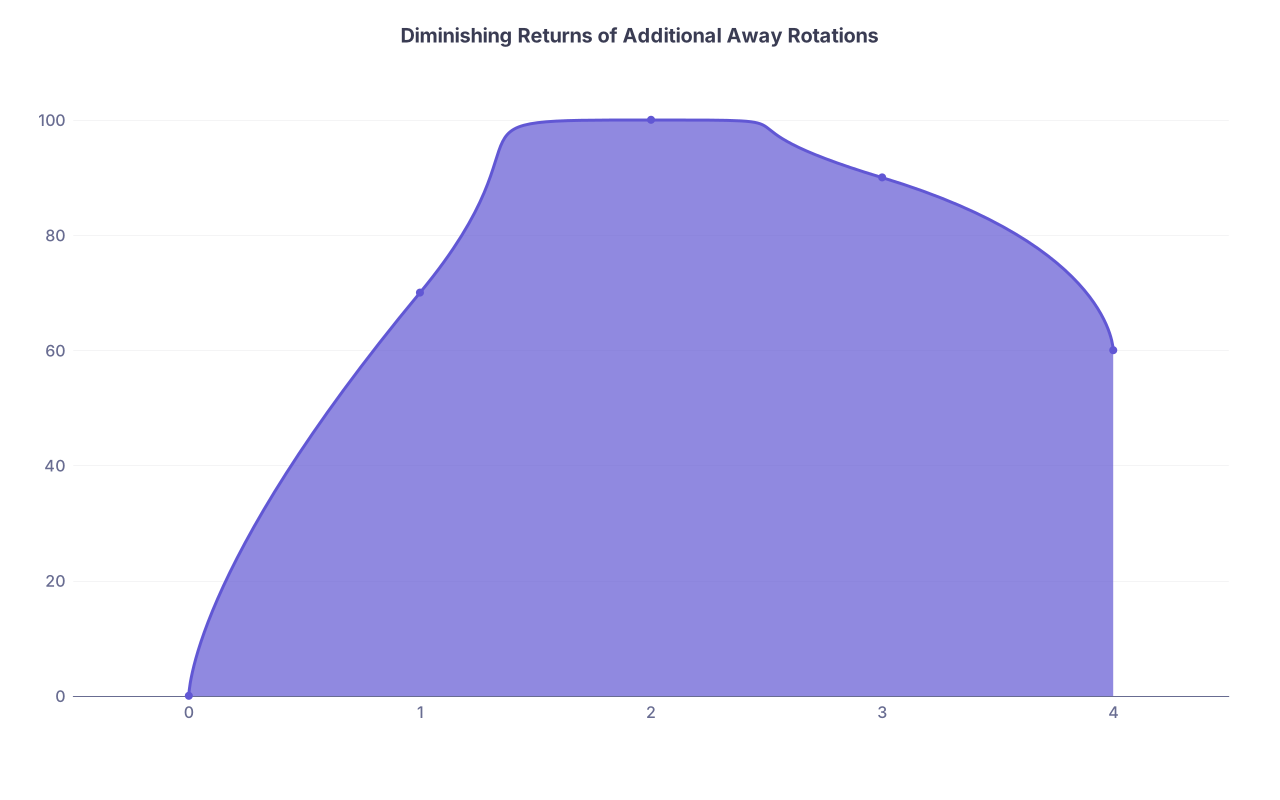
| Category | Value |
|---|---|
| 0 | 0 |
| 1 | 70 |
| 2 | 100 |
| 3 | 90 |
| 4 | 60 |
Interpretation:
– Going from 0 → 1 away rotation is a big gain.
– 1 → 2 can still help, especially in competitive specialties.
– 2 → 3 often adds minimal benefit.
– 3 → 4 can actively harm your overall application.
And that harm does not show up as some obvious catastrophe. It shows up as:
- Tired, flat interviews because you have been living out of suitcases since July.
- A Step 2 CK score 10–15 points lower because you tried to cram studying between 14-hour trauma calls at a hospital you will never rank.
- Vague, tepid away rotation evaluations that say nothing memorable about you.
You do not get extra points for suffering. Programs care about your performance, not your martyrdom.
Hidden Costs of Too Many Away Rotations
Most students only calculate the “potential upside” of aways. Smart students calculate the downside.
1. Your Performance Drops After Week 6–8
By the time you are on your third away in a row, you are not “a hustler.” You are exhausted.
You start making the mistakes that matter:
- Missing pre-round data because you overslept after writing four discharge summaries at midnight.
- Snapping barely-perceptible attitude when a resident gives you the same feedback for the third time.
- Letting your notes get sloppier, stopping your pre-reading, going to bed instead of skimming another UpToDate article.
Faculty and residents can tell when you are running on fumes. They may not say it, but they will not write you a top-tier letter from that third or fourth away. At best, you get “hardworking, pleasant, punctual.” Translation: forgettable.
2. You Cannibalize Your Own Application
Every month you spend on an additional away, you are giving up something else. Usually something more important.
Here is what gets sacrificed when you overload aways:
- Step 2 CK study time
- Dedicated time to polish your ERAS application and personal statement
- Potential home institution letters (from people who actually know you well)
- Research or scholarly projects that demonstrate sustained commitment
- Bandwidth to be a normal human being before interview season hits
| Extra Away Month | What Usually Gets Sacrificed |
|---|---|
| July | Step 2 CK prep time |
| August | ERAS/personal statement work |
| September | Research or home letters |
| October | Rest before interview season |
You cannot be “on” 100 percent of the time for four straight months and also study, write, apply, and function like a rational person. Something gives. For too many people, that “something” is their Step 2 score or their letters from people who have actually seen them over time.
3. You Create More Opportunities To Be Average
This part stings, but it needs to be said.
Every away rotation is a high-stakes audition. That means every extra one is a new chance for:
- A personality mismatch with the team
- A random bad call night where you look disorganized
- Being compared to another student who happens to shine more that month
- A resident who just does not like you and quietly tanks your narrative comments
You want a small number of very strong impressions. Not five months of “yeah, they were fine.” When programs call each other, you want them hearing, “Yes, take that student,” not “I mean, they were okay.”
When More Rotations Directly Hurt Your Match Chances
Let me walk through some scenarios I have seen that should scare you a little.
Case 1: The Competitive Specialty Overloader
Student A, applying ortho, decided to do:
- 1 home ortho sub-I
- 4 away ortho rotations at mid- and high-tier programs
On paper, “smart.” Show commitment. Cast a wide net.
Reality:
- By the third ortho away, he was mentally done. Showed up late one post-call day. Got quiet, less enthusiastic.
- At the fourth away, his Step 2 score came back: 236. Below what many ortho programs wanted. He had underperformed because he refused to carve out a real study block.
- Letters: home letter strong; first away strong; second away decent; third and fourth basically wallpaper.
He matched—barely—at a program from his first away. He also admitted later that if he had done 2 aways instead of 4 and taken time to actually prepare for Step 2, his entire rank list would have looked different.
Case 2: The “Maybe I’ll Change My Mind” Wanderer
Student B was “90% sure” about EM but also “kind of likes anesthesia.” So she did:
- July: EM away
- August: EM away
- September: Anesthesia away
- October: EM at home
On the September anesthesia away, she realized she did not like it. That month did nothing for her EM application. Meanwhile, her ERAS was rushed, her letters got delayed, and she was still editing her personal statement in early October. She submitted late, with one fewer strong EM letter than she could have had if she had stayed focused.
She ended up matching, but not at the level of programs she was capable of. Why? Because she treated clerkships like a career exploration fair at the exact moment she should have been locking in.
If you are still at the “explore different fields” stage, you are not ready to blow 3–4 away rotations on experimentation.
How Many Away Rotations Actually Make Sense?
This varies by specialty, but there are some fairly reliable guardrails.
| Specialty | Reasonable # of Aways |
|---|---|
| Internal Medicine | 0–1 |
| Pediatrics | 0–1 |
| EM, Gen Surgery | 1–2 |
| Ortho, Derm, ENT | 2 (occasionally 3) |
| Neurosurgery | 2–3 max |
If you are planning more than this, you need an actual justification beyond, “I am anxious.”
“Everyone else in my class is doing it” is not a justification. Neither is “I want programs to see my face.” Programs are not impressed by desperation; they are impressed by focused, high-quality work and strong letters.
The Smart Way To Use Away Rotations
You avoid overdoing aways by being strategic, not emotional.
1. Define Your Goal for Each Rotation
Every away should have a clear primary purpose. For example:
- “I want a letter from a well-known faculty member in this field.”
- “This is a geographic area I am very serious about.”
- “This institution is a true reach, but if I impress them, it changes my ceiling.”
- “My home program is weak in this specialty; I need external validation.”
If you cannot define a sharp goal for each planned away, you have too many.
2. Limit Yourself to 2 High-Yield Aways First
For most competitive fields, this is the sweet spot:
- Home sub-I (where many applicants ultimately match)
- 2 aways at serious target programs—places you could realistically see yourself
Third away should be the exception, not the rule. Reasons to consider a third:
- Your home institution does not have the specialty.
- Your first away rotation was clearly a bad fit (toxic culture, no exposure).
- You are making a tightly defined geographic play (e.g., partner’s job, family situation).
Not: “I am nervous therefore more.”
Timing Mistakes That Wreck You
You can do the right number of away rotations and still sabotage yourself by placing them in the wrong months.
1. Ignoring Your Step 2 CK Timeline
One of the dumbest patterns I see: students scheduling a brutal away rotation in the exact month they were planning to take Step 2.
Aways and Step 2 do not mix well. On most aways you are:
- On unfamiliar EMR
- Trying to impress new attendings
- Staying later than necessary to look committed
- Spending evenings pre-reading, not doing UWorld
If Step 2 CK is a critical piece of your application (and for most people it is), you protect real study time. Actual weeks. Not fantasy evenings after 14-hour days.
2. Cramming Aways Too Close to ERAS Deadlines
Another quiet disaster: students on an away in August, scrambling to polish their ERAS, personal statement, and program list from a hospital call room. Bad idea.
Applications that look rushed…are. Clunky personal statement. Typos in experiences. Incomplete program list. These are not fatal alone, but they add up, especially when combined with mediocre letters because you spread yourself thin.
Plan it so that:
- Your core writing for ERAS is done before your busiest away months.
- At least one trusted mentor at your home institution has reviewed your materials.
- You are not trying to beg letter writers for last-minute uploads while they are barely learning your name.
Red Flags You Are Overdoing Away Rotations
Here is a quick sanity check. If any of these statements are true, you are probably in the danger zone:
- “I do not really know why I chose Program X for an away, but it was available.”
- “I am planning to study for Step 2 in the evenings after my away shifts.”
- “I am still not totally sure about my specialty, but my away calendar is full.”
- “I am doing 3–4 aways because my classmates in this field are.”
- “I did not leave any real time between my last away and the start of interviews.”
If you recognize yourself in more than one of these, change your schedule now while you still can.
How To Back Off Without Hurting Yourself
Sometimes the bravest, smartest move is canceling an away.
Here is how you do that without burning bridges:
Decide which away is lowest yield.
Typically: no real geographic tie, not a realistic match target, or redundant with another similar program.Cancel early and professionally.
A polite, concise email: family/logistical/financial reasons, gratitude for the opportunity, hope to apply and be considered in the future. Do not overexplain.Reallocate that month intentionally:
- Dedicated Step 2 CK study
- High-impact home rotation for letters
- Time to finish a paper or project that will actually be on your CV
- Breathing space before interviews so you show up sharp instead of cooked
You are not weak for doing this. You are treating your application like a strategic campaign instead of an endurance contest.
What Programs Actually Notice (That You Are Ignoring)
Programs care much more about the following than whether you did three vs four away rotations:
- Strength and specificity of your letters
- Your Step 2 CK score (for many specialties, this is huge now)
- Your clinical performance over time, especially at your home institution
- Whether you seem like a normal, collegial human on interview day
- Evidence that you finish what you start (research, leadership, projects)
If your obsession with collecting aways undermines any of those, you are actively hurting yourself.
Your goal is not to be the applicant who “worked the hardest.” Your goal is to be the applicant who appears consistently excellent.
A Simple Decision Flow: Do You Need Another Away?
Use this as a blunt instrument. Be honest with your answers.

| Step | Description |
|---|---|
| Step 1 | Considering another away? |
| Step 2 | Probably do NOT need more |
| Step 3 | Consider 1 more targeted away |
| Step 4 | Home program in specialty? |
| Step 5 | Have 1 home + 1-2 aways scheduled? |
| Step 6 | Have 2-3 aways scheduled? |
If you land on “Probably do NOT need more” and you still want to add another away, ask yourself plainly: am I doing this because of fear?
Fear is not a strategy.
Common Specialty-Specific Myths That Push Students to Overdo It
Ortho, ENT, Neurosurgery, Derm
Myth: “You must do 3–4 aways or you will not match.”
Reality: Most successful applicants do 2 (sometimes 3 in neurosurg). What they really have are:
- At least one excellent home or away letter
- A Step 2 CK score in range
- Sustained specialty interest (research, involvement)
- Solid interview performance
I have seen applicants with 4 aways and no truly strong letter lose spots to applicants with 2 aways and one or two fantastic letters.
EM
Myth: “More SLOEs from more institutions are always better.”
Reality: 2 strong SLOEs beat 3–4 average ones. EM PDs read these obsessively. Vague or lukewarm comments from extra aways can quietly drop you down a rank list.
Medicine, Pediatrics, Psychiatry
Myth: “I need aways to be ‘competitive enough’ for academic programs.”
Reality: These fields often value sustained performance at your home institution more than random short stints elsewhere. One targeted away for geography or a specific niche interest can help. Four will just raise questions.
The Energy Problem No One Talks About
Rotations do not just drain time. They drain social and emotional energy. That matters more than you think.
Interview season is a performance. You need to:
- Be personable with strangers over and over
- Remember programs, faculty names, and details
- Write thoughtful thank-you emails
- Ask smart questions when you are exhausted on Zoom or in person
If you roll into November after four intense aways, you will look and sound burned out. Meanwhile, your classmates who did a sane number of aways are fresher, sharper, and more like themselves.
You are not a robot. Your future PDs can see the difference.

Bottom Line: Use Aways Like a Scalpel, Not a Hammer
Away rotations are powerful. Like any powerful tool, they cause damage when used blindly.
If you remember nothing else, remember this:
- A small number of well-chosen, well-executed away rotations beats a long list of mediocre ones.
- Do not let extra aways steal from Step 2, strong home letters, or your ability to function during interview season.
- Fear-based scheduling—“everyone else is doing more”—is exactly how strong applicants quietly weaken their own match chances.
Protect your energy. Protect your performance. Make each away rotation earn its place on your calendar.