
It’s late January. You’re staring at your third-year transcript on VSLO/ERAS. Mostly High Passes and Honors, one lonely Pass in Surgery that still annoys you — but what’s actually making your stomach drop is a single line in one narrative evaluation:
“Hardworking but needed frequent redirection on the wards and occasionally struggled with professionalism around punctuality.”
You keep thinking: “It’s one comment. I have strong grades. How bad can this be?”
Let me tell you bluntly: that one sentence can do more damage to your residency application than a whole extra “Pass” on your transcript.
I’ve sat in too many rank meetings, read too many files, listened to too many attendings vent after an interview day. I know how this actually plays behind closed doors. And it’s not what your school tells you in the “Clerkship Orientation” PowerPoint.
This is the part no one says out loud: grades are noise; narrative comments are the signal.
Especially when programs are trying to decide: do we trust you at 2 a.m. with a pager and minimal supervision?
Let’s walk through why.
How PDs Actually Read Your File
Forget what the official websites say about “holistic review.” Holistic doesn’t mean “everything counts equally.” It means “we pick the 2–3 pieces of info we trust most and over-weight them.”
For clinical performance, here’s the actual hierarchy at most programs:
| Rank | Component |
|---|---|
| 1 | Narrative comments on clerkships |
| 2 | Narrative comments in LORs |
| 3 | Who wrote the letter (their rep) |
| 4 | Grade *category* trends (HP/H/P) |
| 5 | Exact breakdown of exam vs clinical |
Nobody in that conference room is debating the difference between a 92 and a 94 on your shelf. But a single phrase like “concerns about reliability” will stop the whole room.
I’ve watched this exact sequence play out:
- File is projected.
- PD scrolls quickly past grades.
- Someone says, “Check the Medicine comments.”
- Silence.
- Then: “Oof. ‘Needed repeated reminders to complete tasks.’ That’s a problem.”
Conversation derails. You are now “the student with reliability issues,” not “the student with HP in IM and Honors in Peds.”
Grades are a summary. Comments are a story. Humans remember stories.
Why Comments Hit Harder Than Grades
Here’s the unvarnished truth: most PDs assume clerkship grades are inflated and political.
They know:
- Grading scales vary wildly by school
- Some departments hand out Honors like candy, others give two a year
- Some schools cap Honors, some don’t
- Clinical “points” can be tied to subjective “did I like this person” vibes
So a single Pass? Annoying, but explainable. “Tough grading,” “bad fit with that team,” “mid-year when I didn’t know what I was doing yet.” People nod and move on.
Narrative comments are different. They feel personal. They sound like eye-witness testimony from people who’ve actually seen you around patients.
Attendings perceive their own comments as reality, not opinion. And PDs read them that way.
When a comment says:
“Outstanding team member, consistently went above expectations, residents trusted her with complex patients.”
that sticks in their head.
But so does:
“Student often appeared disengaged on rounds, needed reminders to follow through on tasks.”
That’s a red flag. Not a yellow. A red.
And here’s the kicker: bad comments are rare.
Most comments are milquetoast positives. “Pleasure to work with, enthusiastic, eager to learn.” So when someone actually puts something negative in writing? Everyone assumes it was bad enough that the evaluator felt compelled to document it.
One bad grade can be brushed off as noise.
One pointed negative comment gets treated as a pattern, even if it’s literally the only one in your file.
The Power of Certain Keywords (And Why Committees Fixate on Them)
Attendings don’t realize they’re writing in code. But they are. And faculty on selection committees have learned exactly how to interpret that code.
Some phrases are almost universally seen as interchangeable. Others are landmines.
Here’s how the quiet translation happens in the back of the room:
| Comment Phrase | How Committees Actually Hear It |
|---|---|
| "Quiet on rounds" | May be disengaged / low initiative |
| "Needed frequent redirection" | Questionable judgment / reliability |
| "Improved after feedback" | Started off rough / slow to adapt |
| "Occasionally late" | Professionalism concern |
| "Limited ownership of patients" | Passive, won't function as intern |
Those last three? I’ve seen them sink applications.
I once watched a very strong candidate (great Step 2, research, multiple Honors) get flagged because of a single line on Surgery:
“Needed frequent reminders to complete post-op checks and document appropriately.”
You know what people in that room said?
- “I don’t want to chase down an intern to write notes.”
- “If they can’t be trusted with post-op checks as a student, what happens when they’re on nights?”
- “We have enough work. I’m not parenting a PGY-1.”
Not a single person asked, “What was their grade on the rotation?”
You become a risk, not a scholar.
Why This Matters So Much for the Match
Residency programs are not trying to build a class of medical school valedictorians. They are trying to build a functioning call schedule.
So the criteria shift. Away from “who’s the smartest” to “who can I hand my pager to and sleep tonight.”
Clerkship comments are direct evidence of how you behave in a clinical environment. That’s exactly what they’re buying for three or more years.
And here’s the part most students underestimate: programs care far more about avoiding disasters than about maximizing brilliance.
An average intern who:
- Shows up
- Does their work
- Doesn’t blow off calls
- Doesn’t get professionalism complaints
is way more valuable than a genius who occasionally disappears or argues with nurses.
So when PDs read narrative comments, they aren’t hunting for “wow.” They’re scanning for “problem.” Any hint of:
- Unreliability
- Disrespect
- Laziness
- Dishonesty
- Poor teamwork
And if they find that? They will discount your grades, scores, and research in a heartbeat.
One bad grade can be explained as:
“They struggled with the exam but were clinically solid.”
One damning comment becomes:
“We were warned. We ignored it. Now this is our problem.”
They’d rather not roll those dice.
How One Comment Can Cascade Across Your Application
Here’s where it gets ugly behind the scenes.
Negative clerkship comment → Faculty assume a pattern → That lens colors how they read everything else in your file.
I’ve literally heard:
“Look at this comment on Medicine, then read their Surgery letter again. That ‘needed some direction early on’ line worries me more now.”
That phrase by itself might have been interpreted as, “Normal learning curve.” But once you’re flagged as “possibly difficult,” every ambiguous line starts to sound darker.
Then during interview day:
- You’re slightly reserved? “Maybe they are disengaged.”
- You ask about schedule fairness? “Is this one going to complain a lot?”
- You stumble on a clinical question? “Maybe those comments were right.”
Meanwhile, another applicant who had the same mediocre answer gets shrugged off as “nervous but fine.”
That’s the quiet penalty. The comment follows you into the room, even if no one mentions it out loud.
Why Program Directors Trust Comments Over Your Version
This is the part that feels unfair, but it’s real.
When there’s a conflict between your explanation and what’s written in an evaluation, faculty will almost always lean toward the written record.
You might say:
- “That attending didn’t like me.”
- “I was going through a rough time that month.”
- “The team dynamic was toxic.”
Sometimes that’s 100% true. I’ve watched attendings nuke a student they didn’t like while whitewashing a favorite who made much worse mistakes.
But from the program director’s seat? Everyone claims a personality mismatch. Everyone says it was an “off month.” They can’t adjudicate all of that.
So the unspoken rule becomes:
If it made it into the official comment, it was serious enough that someone was willing to go on record.
Do students sometimes get screwed by that? Yes.
Does the system correct for it well? No.
That’s why one bad comment can hurt more than one bad grade. A low grade can be a “you vs. test” problem. A bad comment is framed as “you vs. the real world.”
And residency is the real world.
What Committees Notice Even When Comments Aren’t Overtly Negative
You might think, “Well, I have no overtly bad comments, so I’m fine.”
Not always.
Faculty who don’t want to tank you will often write lukewarm instead of negative. But selection committees know how to read lack of enthusiasm.
I’ve seen applicants with this kind of consistent pattern:
“Pleasant to work with.”
“Did everything asked.”
“Solid fund of knowledge.”
On paper, that’s fine. In practice, you start hearing murmurs:
- “No one’s raving about them.”
- “They sound… OK?”
- “Anyone super excited about this file?”
And the file quietly sinks into the middle of the rank list. Or lower.
Meanwhile, an applicant with one slightly mediocre grade but multiple glowing comments like:
“Top 10% of students I’ve worked with in 10 years.”
“I would be thrilled to have them as a resident.”
flies up the list.
The absence of strong positive language can hurt you more than a single lower grade.
This is why I tell people: clerkships that help with residency match are the ones where attendings know you well enough to write specific, enthusiastic comments. Your job is not to rack up perfect letters and perfect grades; it’s to create documentation that someone strongly wants you on their team.
What You Can Actually Do About This (Even If the Comment Already Exists)
If you’re reading this after the fact, with a nasty line already in your transcript, you’re probably wondering if you’re dead in the water. You’re not. But you don’t get to ignore it.
You have three levers.
1. Overwhelm the bad with specific good
One bad comment floating in a sea of vague positives looks terrible. One bad comment surrounded by multiple detailed, enthusiastic, concrete endorsements looks more like an outlier or a mismatch.
Programs read patterns. If three other rotations say:
“Always early, often stayed late, residents relied on her.”
then that one “occasionally late” line starts to look like context, not core personality.
That means on your remaining clerkships and sub-Is, you cannot just “do fine.” You need people who will remember you in six months and write things like:
“She functioned at the level of a subintern. I would trust her with my own family.”
2. Use your LOR writers strategically
You want letter writers who can either:
- Explicitly contradict the weakness (“I found him to be consistently reliable and proactive, never needed reminders.”)
- Or build such a strong positive case that committees decide that one rotation was idiosyncratic.
I have watched PDs literally say:
“Yeah, that comment on Family Med is weird, but look at this IM letter. I trust Dr. X more than that evaluator anyway.”
Letters beat random rotation comments every time if the letter writer has juice and is willing to stake their name on you.
3. Own it if you’re asked. Briefly and calmly.
If a PD brings it up in an interview — and they might — the worst thing you can do is get defensive or start blaming everyone else.
The insider move is:
- Acknowledge it
- Show insight
- Describe concrete change
Something like:
“On that rotation, I struggled with time management early on and it showed. The feedback stung, but it was accurate at the time. Since then I’ve been very deliberate about pre-round planning and task tracking. The comments on my Medicine and ICU rotations reflect that growth, and it’s something I’m still actively working on.”
You’re not pretending it didn’t happen. You’re showing them it won’t keep happening as a resident.
How to Protect Yourself Before Bad Comments Happen
Let me shift from damage control to prevention for a minute, because this is where students quietly lose matches without realizing it.
You need to understand something ugly about clerkships: attendings are busy, subjective, and extremely variable. Many will write your evaluation in three minutes at the end of a long clinic day. Whatever’s salient then is what you’ll live with.
Your job is to make sure what’s salient is good. And that real problems get handled early, verbally, not in the permanent record.
Make feedback happen early and often
The worst sentence I hear from students is “I had no idea they thought that about me.”
Ask for feedback at the one-week mark, then again mid-rotation. Not the generic, “Do you have any feedback?” That invites, “No, you’re fine.”
Try:
- “Is there anything I’m doing that might show up on my evaluation that I could fix now?”
- “If you had to write my eval today, what would you say I most need to work on?”
It forces them to surface concerns while they’re small. I’ve seen punctuality, note quality, and “seems quiet” all get fixed before they ever reached an evaluation form, only because the student forced an early conversation.
Ask residents what’s being said
Residents hear the side comments you don’t. I’ve sat at workrooms and heard:
- “She’s nice, but she’s always the last one with notes.”
- “He disappears after rounds. No idea where he goes.”
- “She asks questions but doesn’t follow through.”
Those conversations often never reach your face. But residents can warn you.
If you trust a senior resident, ask:
“Is there anything you’ve heard or noticed about how I’m doing that might end up on my eval?”
If you hear something alarming, you have time to change it. And to directly tell the attending, “I realized I was doing X and have changed to Y.” That often shifts what they remember when they sit down to type.
The Quiet Truth: One Bad Comment Is Not “Fair,” But It Is Real
I’m not going to sugarcoat this. The system is messy and often unfair. I’ve seen:
- A brilliant student nuked by one attending with a chip on their shoulder.
- Another student with clear professionalism issues get glowing comments from faculty who liked their personality.
- A borderline unsafe student slide through because “they’re great at presentations and patients like them.”
So no, this isn’t a moral referendum on you as a person or a physician. It’s one biased snapshot, written by one busy human, that ends up carrying way too much weight in a process that pretends to be objective.
But the weight is real. On the PD side of the table, they’re trying to protect their residents, their service, and their own sleep. They see a bad comment and think:
“I have 800 other applications without this potential headache. Why gamble?”
You don’t have to like that logic. You do have to plan for it.
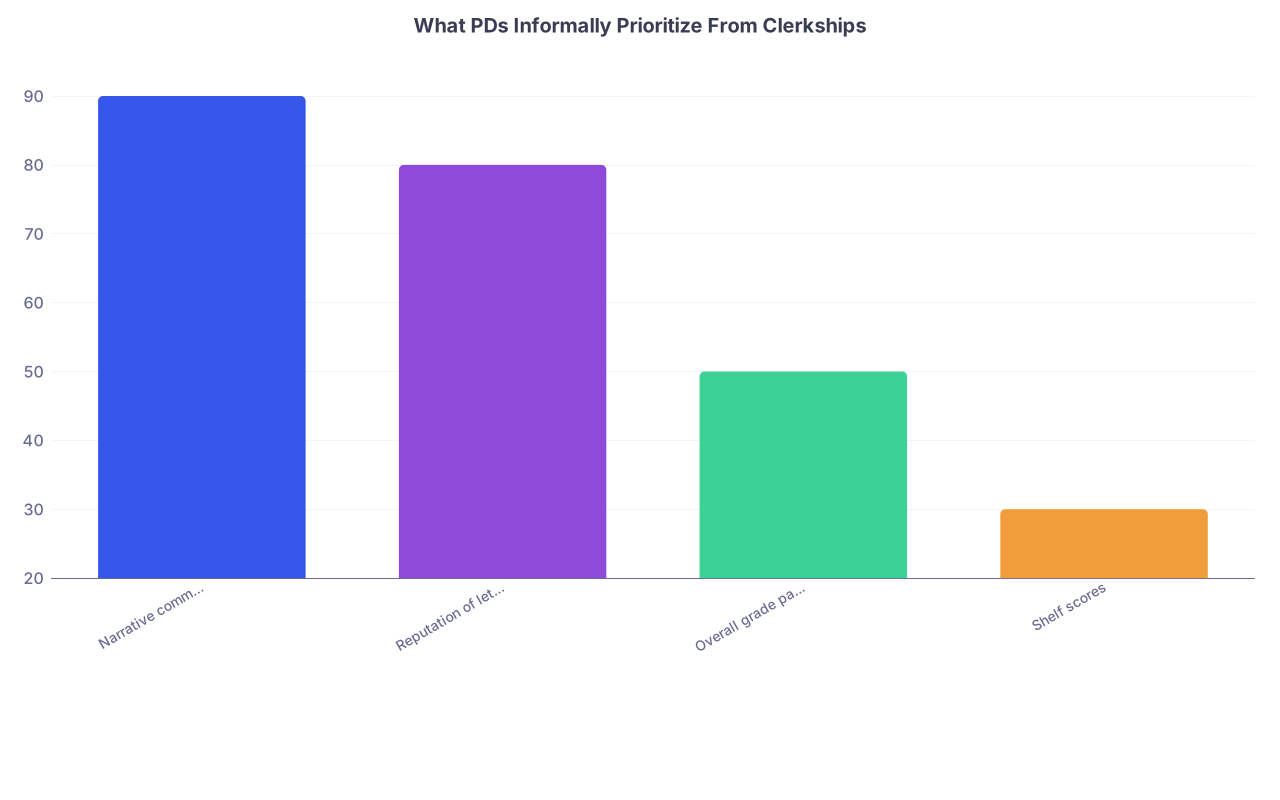
| Category | Value |
|---|---|
| Narrative comments | 90 |
| Reputation of letter writer | 80 |
| Overall grade pattern | 50 |
| Shelf scores | 30 |

| Step | Description |
|---|---|
| Step 1 | Clerkship Performance |
| Step 2 | Attending Impression |
| Step 3 | Narrative Comment Written |
| Step 4 | ERAS Application Read |
| Step 5 | Neutral/Positive Impression |
| Step 6 | Application Flagged as Risk |
| Step 7 | Stricter Interview Evaluation |
| Step 8 | Lower Rank or No Rank |
| Step 9 | Negative Phrase Present? |

FAQs
1. Which is worse for the Match: one Pass in a core clerkship or one negative clerkship comment?
The negative comment. Every time. Programs see a Pass and think “tough rotation / grading variability / off month.” They see “needed frequent reminders” or “professionalism concerns” and think “possible problem intern.” Grades get averaged in. Comments get repeated in rank meetings.
2. Can I ask my school to remove or edit a bad clerkship comment?
Sometimes, but success is rare and very school-dependent. If the comment is factually wrong or contains inappropriate language (HIPAA issues, personal attacks, discriminatory phrasing), you have a better shot. If it’s just unflattering but defensible, most schools will keep it. What you can do is make sure any formal response process is used wisely and then overwhelm that comment with glowing, specific later evaluations and letters.
3. Do away rotations (audition rotations) comments matter more than home clerkship comments?
Yes, often they do. Away rotation comments are read as “how you behave when you know you’re being watched by a program that might hire you.” A bad comment there suggests you either didn’t understand the stakes or couldn’t adjust. Conversely, strong away comments can rescue a mediocre home record, especially if they come from respected people in the specialty.
4. If I have a bad comment, should I address it in my personal statement?
Usually no. The personal statement is a terrible place to spotlight something programs might have glossed over. You do not want to frame your whole application around your worst moment. Save explanations for when you’re directly asked by a PD or in a secondary/”additional information” field if your school specifically recommends it. Then be brief, accountable, and focused on growth, not blame.
Two things to remember.
First, one bad clerkship comment can hurt you more than one bad grade because residency programs buy behavior, not transcripts. They care about what you’re like at 3 a.m., not just what you scored at 3 p.m.
Second, you’re not helpless. Force early feedback, cultivate strong relationships on later rotations, and get letter writers who can vouch — in writing — that the worst thing written about you is not who you are now.