
Most students have the wrong goal on clerkships. They’re trying to be impressive when they should be trying to be effortless. The students who match best are not always the flashiest. They’re the least draining to have around.
Let me tell you what faculty and residents actually say once you leave the floor:
“I’d work with them again.”
Or: “Please don’t send that one back to our service.”
That’s the real grading scale.
What “Low Maintenance” Actually Means (From Our Side of the Table)
Students throw this phrase around like a personality trait. “Oh, I’m low maintenance.” No. On the wards, being low maintenance is behavioral, not aesthetic. It’s how you function in a clinical ecosystem that’s already over-stressed.
Here’s the version you never see written in clerkship syllabi:
Low maintenance = I do not have to think about you more than I have to.
That sounds cold, but it is exactly how tired residents and attendings subconsciously evaluate you. When I sit in a faculty room discussing letters, we don’t say, “She had a strong fund of knowledge and solid clinical acumen.” We start with:
- “They didn’t need hand-holding.”
- “They just slotted into the team.”
- “They never created extra work or drama.”
Only later do we talk about knowledge and presentations. Emotional and logistical load comes first.
On the wards, “high maintenance” doesn’t mean you ask questions. It means you generate friction: constant clarification of logistics, vague commitments, poor follow-through, emotional volatility, boundary problems. You make everything 5–10% harder.
Low maintenance students, on the other hand, create negative friction. The team feels lighter, smoother, safer with them around. That is gold.
And it converts directly into better comments, better narratives, and better residency advocacy.
Why Silent Advocates Matter More Than You Think
There’s a naïve view of the match: “If I work hard and get honors, I’ll be fine.” That’s only half the story. Let me show you the other half—the part no one prints on the website.
Behind closed doors, there’s an informal network that makes or breaks borderline cases. That’s where your “low maintenance” reputation pays off.

| Step | Description |
|---|---|
| Step 1 | Rotation Behavior |
| Step 2 | Resident/Faculty Impression |
| Step 3 | Written Eval & Grade |
| Step 4 | Informal Reputation |
| Step 5 | Letters of Recommendation |
| Step 6 | Program Director Emails/Calls |
| Step 7 | Interview Offers |
| Step 8 | Rank List Discussions |
Here’s how it really works:
An associate program director at a mid-tier IM program is reviewing ERAS. They have 2,500 applications for 15 categorical spots. They filter by Step 2, school tier, maybe AOA. That gets them to 300–400. Still too many.
Then they start scanning for familiar names: letter writers, deans, program directors they trust. They see your LOR from Dr. S on a busy inpatient service. Dr. S is not a superstar researcher, but she’s clinically heavy and blunt.
The PD sends two emails in five minutes:
- To Dr. S: “Any thoughts on this student? Worth interviewing?”
- To the chief resident at your school: “How is this one to work with?”
If the response from either person is some version of:
“Very solid, easy to work with, no issues. I’d take them.”
You get an interview.
If it’s:
“Smart, but a little needy / high maintenance / took a lot of coaching.”
You may be done. Especially if your numbers are average-ish.
Most of you obsess over what’s written in the letter. You underestimate the power of what’s said in one unguarded sentence behind the scenes.
That sentence almost always reflects: How much work were you?
The Behavioral Anatomy of a “Low Maintenance” Student
Let’s break down what residents and attendings actually see when they say “low maintenance.” It’s surprisingly specific.
1. You Handle Logistics Without Drama
We shouldn’t need to chase you about basics: pre-round times, where to be, how to find notes, how to find the pager, who’s on nights.
Low maintenance means:
You hear once: “We pre-round at 6:15, table rounds at 9, sign-out at 5:30.” You show up, on time, in the right place. If you’re unsure, you ask once, clearly, then you own it.
What we see far too often:
- Student disappears at 3:30 “to study” when the team is drowning.
- Student texts the resident at 9 p.m. with a question that could easily wait until morning.
- Student “forgets” to follow a patient they picked up.
These are small sins individually. Put together, we label you as someone we cannot trust to operate independently. And independence is the currency of letters and grades.
2. You Need Guidance, Not Babysitting
Low maintenance does not mean silent. It means you extract the maximum value from minimal supervision.
The students who help themselves:
- Before asking where to find labs, they try Epic/Cerner for 30 seconds.
- Before saying, “I don’t know,” they show their thought process.
- When given feedback, they implement it the same day, not after the third reminder.
I remember a student on surgery who, on day one, presented a vague H&P. I gave specific feedback: “Lead with the problem, then 3 key facts that matter for the OR, drop the fluff.” Next day, he opened, “Mr. X is POD1 after lap chole, main issue is pain and PO intake; key overnight events were…” Clean, targeted, better.
That’s low maintenance. I didn’t need a three-day remediation project.
By contrast, high maintenance students absorb feedback like Teflon. Same issues all week. Same wandering presentation, same missing vitals, same unchecked plan. That’s exhausting.
3. You Respect Bandwidth
Here’s something you probably don’t realize: by noon, most residents are out of cognitive runway. They’re juggling pages, orders, discharges, social work, documentation, cross-cover issues, and five different inboxes. Teaching is extra. So is emotional support.
Low maintenance students read the temperature.
They don’t launch into convoluted pathophys questions when we’re triaging new admits. They don’t ask, “Can someone go over my note line by line?” at 4:45 p.m. They say, “Is there a better time I can catch you to go over my note?” And if the answer is “Tomorrow,” they accept that without sulking.
The worst students behave like the service is built around their learning schedule. When you do that, people stop seeing you as a trainee and start seeing you as a burden. Nobody will say it to your face. They’ll absolutely say it in the workroom.
How “Low Maintenance” Shows Up in Your Evaluations and Letters
Let’s connect this to what actually appears in your file.
You won’t usually see the phrase “low maintenance” written. But it shows up in code words we all recognize.
| Real Behavior | What Shows Up in Eval/Letter |
|---|---|
| Handles tasks with minimal follow-up | "Worked at the level of a sub-intern" |
| Manages own learning and schedule | "Required minimal supervision" |
| No drama, reliable presence | "A pleasure to have on the team" |
| Reads and improves after feedback | "Rapidly incorporated feedback" |
| Anticipates team needs | "Exceptionally reliable and proactive" |
Those phrases—“minimal supervision,” “sub-intern level,” “exceptionally reliable,” “pleasure to work with”—are trust markers. Program directors can smell them a mile away.
I’ve been in letter-review meetings where someone says:
“I don’t care what the grade was. If Dr. K says ‘required minimal supervision,’ that student is good.”
On the flip side, high maintenance students get poisoned with very specific adjectives:
- “Enthusiastic, but needed significant guidance.”
- “Eager learner, will benefit from close supervision.”
- “Motivated, but required frequent redirection.”
Residents think they’re being diplomatic. Program directors read those as red flags.
So yes, your “vibe” on rotation strands itself in your letters. And those silent code words travel with you for the rest of the match process.
Concrete Behaviors That Make You Low Maintenance (Without Becoming Invisible)
There’s a line here. Students sometimes overcorrect: “If low maintenance is good, I’ll just disappear.” That’s not what I’m telling you to do. Vanishing is its own problem.
You want to be low-friction but high-value. Meaning: present, engaged, but not needy.
1. Set Expectations Early, Then Over-Deliver Quietly
Day one, brief, clear questions:
“What time do you like students to pre-round? How do you prefer presentations—problem-based or system-based? Is there anything past students have done that’s been especially helpful for the team?”
Then you adapt. Fast. You don’t keep renegotiating the basics every morning.
You also don’t keep asking, “Is there anything else I can do?” every 15 minutes. That’s actually high maintenance—you’re creating work by making us inventory tasks for you.
Instead, you learn the rhythm and plug yourself in:
- Offer to call consults after hearing how the resident does it once or twice.
- Pre-chart on upcoming admissions and have a plan sketched out.
- Track down chart data or imaging we obviously need but no one’s had time to pull.
You act like a junior colleague, not a guest.
2. Handle Your Own Emotional Regulation
I will be very blunt here: constant emotional management is one of the biggest hidden drains on teams.
Everyone has bad days. Everyone gets criticized occasionally. But low maintenance students absorb small slights, miscommunications, and stress without escalating everything to an existential crisis.
What this looks like:
- You get sharp feedback during rounds. You say, “Got it, I’ll fix that for the next one,” and you actually fix it.
- You feel slighted because the intern forgot to ask if you wanted to scrub. You mention it once, calmly, or just make sure you speak up next time. You do not sulk all day or vent to five people about how “unfair” the team is.
- You’re tired. You’re behind on questions. You don’t turn every sign-out into a monologue about how overwhelmed you are.
Are we sympathetic when students are struggling? Yes. But remember: interns and residents are often barely keeping themselves afloat. They cannot be your therapist and your teacher and your administrative assistant at the same time.
Low maintenance students get help when they truly need it. They don’t externalize every bump into someone else’s job to fix.
3. Own Your Mistakes Without Hand-Holding
You’re going to screw things up. Forget a lab. Miss a dose. Botch a presentation. That’s not what sinks you.
What torpedoes students is needing to be walked emotionally hand-in-hand through every error.
Better version:
“I realized I didn’t follow up the CT on Ms. X before rounds. I checked it now—no acute process—but I know I need to have that ready earlier. I’ve set a reminder in my list so I don’t miss imaging again.”
Thirty seconds. Problem acknowledged, corrective mechanism in place, no further work for the team. That’s low maintenance.
The opposite:
Explaining for five minutes why it was confusing, how no one told you, and how the system is unclear. That forces us to expend more effort getting you to accept reality than it would have taken to just do it ourselves. That’s when people quietly decide, “I can’t trust this one on nights.”
4. Learn to Solve 80% of Micro-Problems Yourself
There’s a simple filter: If you can figure it out in under 2 minutes by checking the EMR, asking a nurse, or looking at the call schedule, do that first.
Examples:
- “When are labs drawn?” Ask the nurse or look at the MAR.
- “Where do we find old operative notes?” Look in the chart, ask another student, check the resident cheat sheet on the desktop.
- “Who’s the night float?” Check the schedule posted at the workroom or online.
When you consistently bypass those steps and go straight to the senior, you train them to see you as helpless. That impression sticks far longer than any one mistake.
How This Directly Helps Your Residency Match
Let’s pull this out to the 30,000-foot view and tie it explicitly to your match outcome.
Program directors are trying to answer three questions about every applicant they rank:
- Will this person be safe with patients?
- Will they require an unreasonable amount of supervision and emotional energy?
- Would my residents want to work with them at 3 a.m. on a bad call night?
Being low maintenance hits questions 2 and 3 with a bullseye. And it partially reassures them about 1, because low maintenance students tend to be organized and reliable.
Look at which rotations feed most directly into your match:
- Medicine and surgery core clerkships
- Sub-internships (IM, surgery, EM, OB, peds, psych)
- Away rotations
These are where reputations are formed. And those reputations drive the informal feedback channels that almost no student sees but every applicant is subject to.
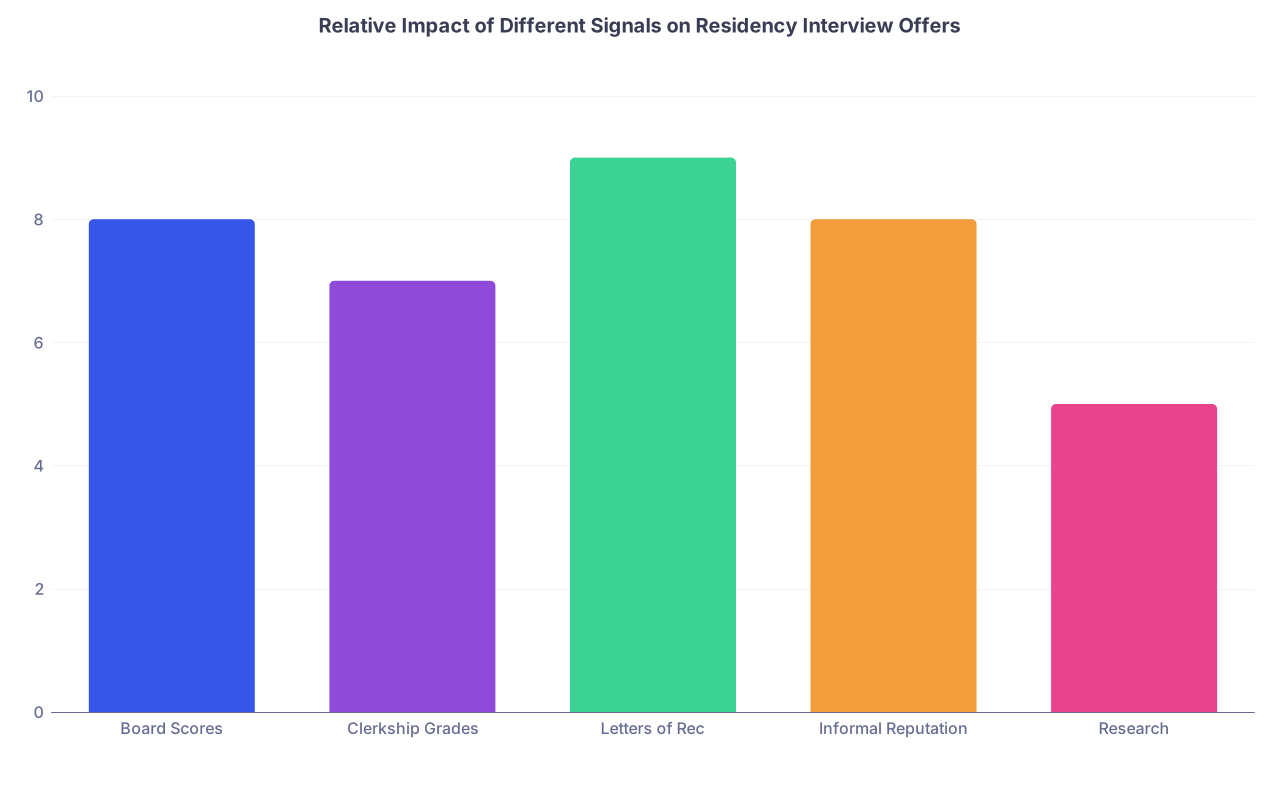
| Category | Value |
|---|---|
| Board Scores | 8 |
| Clerkship Grades | 7 |
| Letters of Rec | 9 |
| Informal Reputation | 8 |
| Research | 5 |
Those “informal reputation” and “LOR” bars are heavily shaped by whether you were easy to work with.
When I’m asked, flat-out, “Would you take this student as a resident?” I’m not thinking about their third-year OSCE score. I’m flashing back to how I felt when I saw their name on the patient list at 6 a.m.
Was I relieved? Or did my shoulders tense?
You want faculty saying: “Oh yeah, them? Absolutely. Low-drama, gets stuff done. Interview them.”
That’s your silent advocacy. No one will tell you it happened. You’ll just get an interview invite you otherwise would have missed.
How to Practice This Without Ending Up Invisible
The last piece: you have to avoid becoming wallpaper. Low maintenance doesn’t mean boring. Strong residents and PDs don’t want ghosts; they want colleagues-in-training.
So you balance three things:
- Visibility: You speak up enough that your reasoning and work are known.
- Reliability: You do what you say you will do, when you say you’ll do it.
- Friction: You don’t create avoidable extra work.
Concrete way to test yourself:
At the end of a week, if your senior got asked, “What does this student add to the team?” they should be able to answer in one sentence without thinking. Something like:
- “She quietly kept all the follow-up tasks tracked and never dropped anything.”
- “He took complete ownership of 3–4 patients and I didn’t have to re-do his work.”
- “They were flexible, stuck around when things got busy, and never complained.”
If your contribution is “seemed nice and attended rounds,” that’s not enough. You’re low-impact, not low maintenance.
Remember: the goal is to be pleasantly unforgettable. When your name comes up months later, the instinctive reaction should be, “Oh yeah, that one. Easy to have around. Good.”

Putting It All Together: Day-by-Day Application
To make this real, let’s walk through how a “low maintenance” mindset plays out over a single week of an inpatient rotation.
Monday
You show up 10–15 minutes early, find the team, and ask succinct setup questions. You write down answers. You pick up 2 patients. You ask a co-student or intern to show you where things live in the EMR, then you remember.
You present, get feedback on structure, and implement it on Tuesday.
Tuesday–Thursday
You add one more patient. You’re consistently ready for pre-rounds and table rounds. If you finish your tasks early, you quietly help the intern with simple things: looking up outside records, pre-charting a new admit, calling the pharmacy.
You keep a to-do list that includes your tasks plus any you volunteer for. You do not make the intern chase you.
If something confuses you repeatedly, you collect questions and ask for 5–10 minutes of teaching at a natural break, not in the middle of a code.
Friday
You already know how sign-out works. You already know who is on nights. You’ve shown up every day as a stable, non-dramatic presence who adds value.
By now, the team has internally decided who you are: reliable or not. Needy or not. They’re building your narrative before anyone opens the eval form.
And that’s what you carry forward into your letters, your MSPE, and your off-the-record advocacy.

Final Truth: Being Low Maintenance Is a Strategy, Not a Personality
You don’t have to be naturally chill. You don’t have to be an extrovert. You don’t have to be the funniest person on the team. None of that is what wins you silent advocates.
What wins them is this:
You respect people’s time, bandwidth, and trust, and you behave accordingly.
From my side of the table, the students who match best from “normal” schools with “normal” scores are almost always described the same way in faculty rooms:
“Rock solid.”
“Very easy to work with.”
“I’d hire them.”
That’s low maintenance. And it’s one of the very few things in this process you can control every single day on the wards.
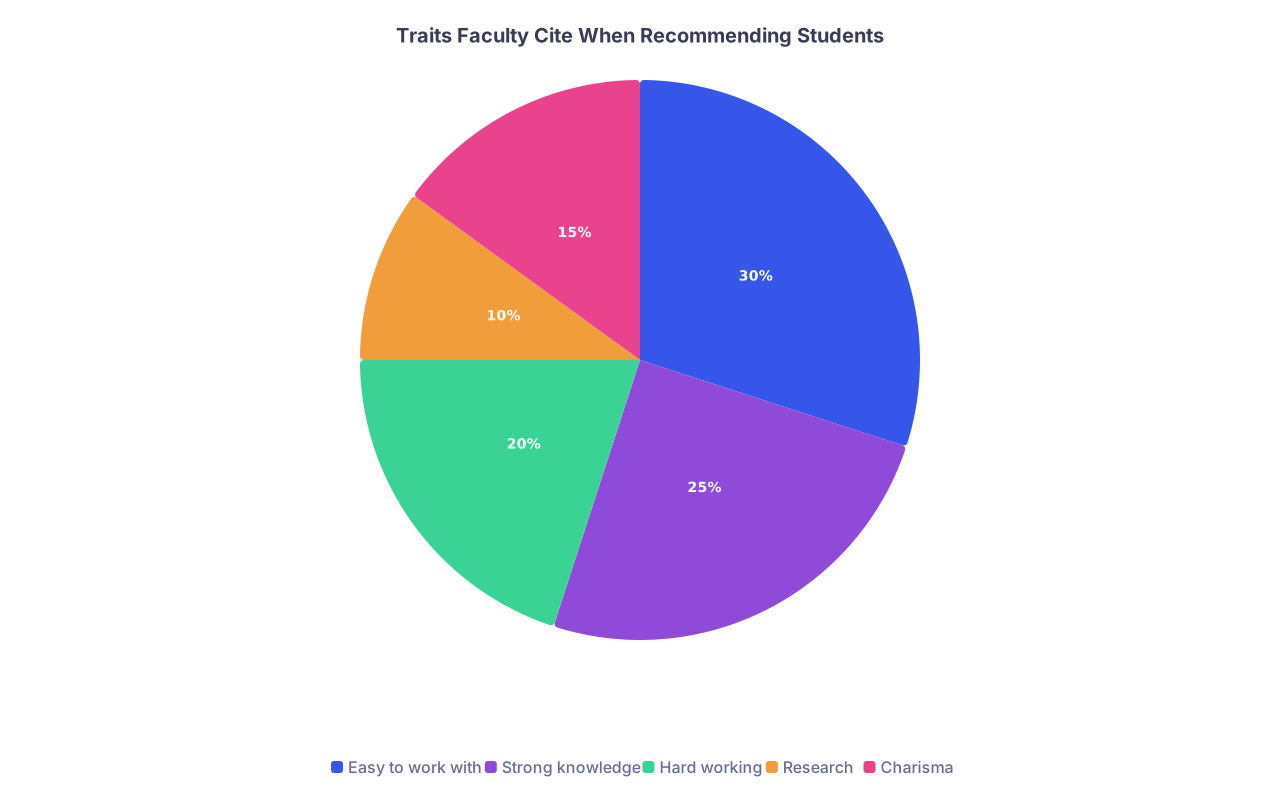
| Category | Value |
|---|---|
| Easy to work with | 30 |
| Strong knowledge | 25 |
| Hard working | 20 |
| Research | 10 |
| Charisma | 15 |