
The wrong third‑year calendar can quietly sabotage your residency match.
You are not just picking “whatever fits.” You are building a year‑long narrative that program directors will judge in about 30 seconds.
Below is the rotation‑by‑rotation, month‑by‑month way to decide when to do medicine, surgery, and ambulatory so that your clerkships actually help your residency application instead of tripping it.
Big Picture: What Your Third‑Year Calendar Must Do
By the time ERAS opens, your schedule needs to have accomplished four things:
- Given you strong core evaluations in at least one “big” clerkship (usually Medicine).
- Exposed you early enough to potential specialties that you can:
- Choose a field.
- Set up away rotations (if needed).
- Get at least 2–3 strong letters.
- Positioned your hardest rotations when you can actually perform well (not exhausted, not clueless).
- Created a clear story: “I became interested in X, then deepened it, then proved I was good at it.”
At different points in the year, your priorities shift.
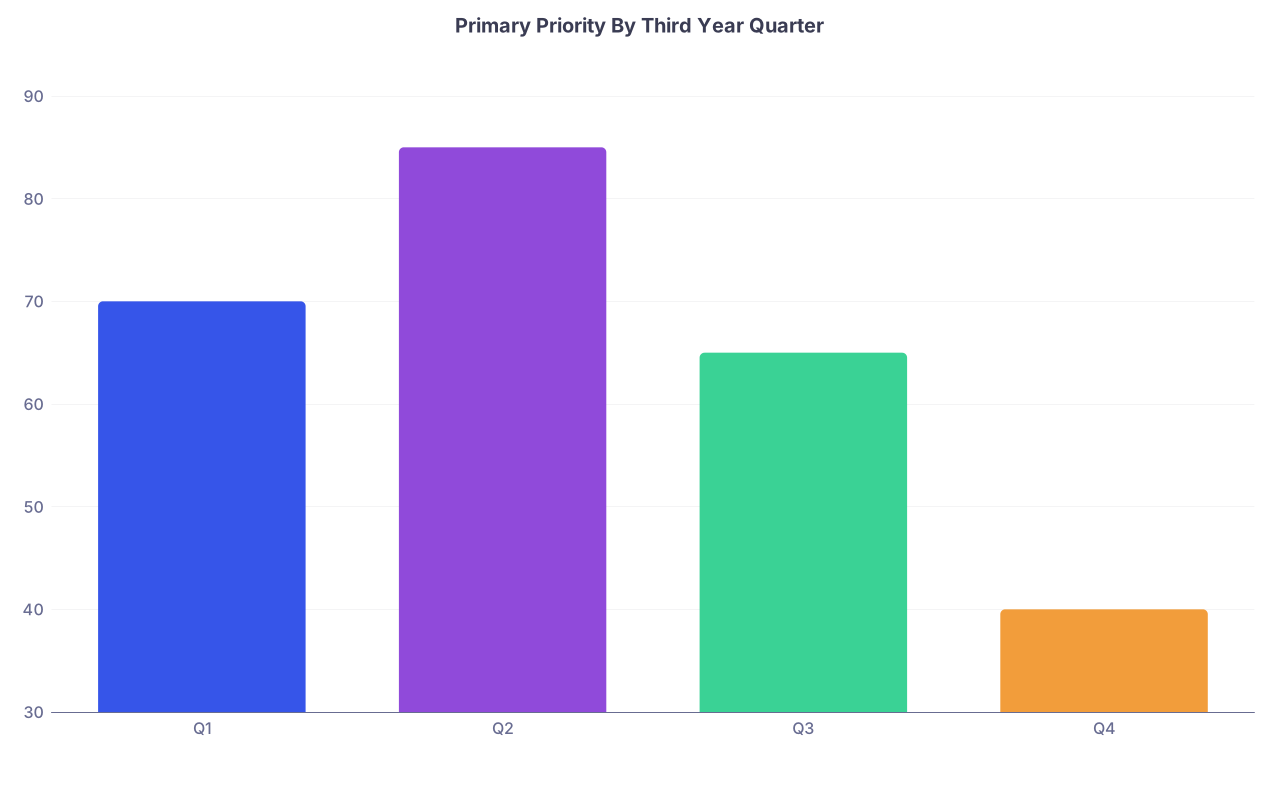
| Category | Value |
|---|---|
| Q1 | 70 |
| Q2 | 85 |
| Q3 | 65 |
| Q4 | 40 |
(Q1–Q4 here are basic emphasis scores: exposure and orientation early, performance and letters mid‑year.)
In practice, your school will give you a mix of:
- Internal Medicine
- Surgery
- Pediatrics
- OB/GYN
- Psychiatry
- Family Medicine / Ambulatory
- Neurology / EM / other requireds
- Electives
You do not control everything. But you usually have some choice: which block to put Medicine, which to put Surgery, when to do ambulatory, maybe where to put an elective.
That is where you win or lose.
Quarter 1 (July–September): Learning the Game Without Wrecking Your GPA
At this point you should not volunteer to be the sacrificial lamb on day one of Medicine or Surgery at many schools. You will waste potential honors while you are still figuring out what “one‑liner,” “assessment,” and “SOAP” actually mean.
Your goals in Q1
- Learn how the hospital works without high stakes.
- Sample enough breadth to start narrowing specialty choices.
- Avoid stacking the two hardest clerkships back‑to‑back while you are clueless.
Ideal Q1 combinations
If you can influence your schedule, push for something like:
- Psych + Neurology
- Family Medicine / Ambulatory + Pediatrics
- OB/GYN + Psych
Why?
- These still matter, but they are usually more forgiving for brand‑new third years.
- You learn workflow, notes, basic presentations.
- You start seeing adult vs peds, inpatient vs outpatient, procedural vs clinic.
If you already know you want a competitive specialty (Derm, Ortho, ENT, Plastics), you still do not need Medicine or Surgery first. You need to get good fast, then hit those heavy rotations once you can function.
Where Ambulatory fits in Q1
If your school offers ambulatory / primary care early:
- Doing ambulatory in Q1 is actually smart:
- You learn time management in clinic.
- You practice focused H&Ps repeatedly.
- You see bread‑and‑butter medicine that will help you later on IM or Surgery.
At this point you should focus on:
- Showing up early.
- Mastering basic notes.
- Getting comfortable calling staff and presenting to attendings without panicking.
Do not obsess over specialty yet. Your real exposure is still ahead.
Quarter 2 (October–December): Hit Medicine or Surgery (But Not Blind)
By Q2, you should know:
- How to write a daily progress note.
- How to present on rounds.
- How to not get lost walking from ED to radiology.
Now it is time to schedule your first “anchor” rotation.
Which should come first: Medicine or Surgery?
If you have a choice, here is the honest rule:
- If you are leaning toward any cognitive field (IM, Neuro, Psych, Cards, Heme/Onc, etc.)
→ Put Medicine in Q2 if possible. - If you are leaning toward any surgical field (Gen Surg, Ortho, ENT, Urology, etc.)
→ Put Surgery in Q2 if possible.
You want your likely “home base” field before the halfway point of third year, so you can:
- Decide how much you actually like it.
- Identify attendings for letters.
- Plan fourth‑year sub‑internships or aways.
Why not Medicine/Surgery both in Q2?
Back‑to‑back Medicine and Surgery in Q2 is a burnout trap. I have watched students crawl out of a 24‑hour call month into a 28‑hour call month and then wonder why their evals were “solid pass” instead of honors.
If you are forced into this sequence, fine. But if you can avoid it:
- Pair Medicine with:
- A lighter clerkship (Psych, Family, Ambulatory) OR
- A shorter elective (Radiology, Path, EM if your school configures it that way)
- Pair Surgery with:
- Something with more predictable hours (Ambulatory, Neuro, Psych)
Where Ambulatory fits in Q2
Doing ambulatory in Q2 is powerful:
- You have enough experience to function.
- You are not drowning in overnight calls.
- You can get strong, narrative letters from attendings who saw you repeatedly.
If you are considering Family, IM, Med‑Peds, or any outpatient‑heavy specialty, Q2 Ambulatory is prime real estate.
At this point you should aim to have:
- Either Medicine or Surgery finished.
- At least a preliminary feeling: “I like inpatient wards” or “I hate 5 am rounds.”
Quarter 3 (January–March): Lock in Specialty Direction and Letters
This is the most strategically important quarter for your residency match.
Why? Because letters, narratives, and your specialty choice crystallize here.
What must be done by end of Q3
By March, ideally you have:
- Completed Internal Medicine OR have it in progress.
- Completed Surgery.
- At least one rotation where you truly excelled and can ask for a letter.
If you are behind on these, Q3 is when you fix it.
Best timing for Medicine
Let us talk Medicine, because it quietly drives a ton of your application:
- Medicine in Q2 or Q3 is the sweet spot:
- You are competent enough to shine.
- Your evals and letters will be ready for ERAS.
- Medicine in Q4 only (April–June) is risky:
- Your Medicine letters may arrive late.
- Harder to show strong inpatient performance in your application.
If your school stuck Medicine in Q4 and you are going into an IM‑related field, you must compensate with:
- Strong performance and letters from ambulatory, subspecialty IM electives, or other inpatient rotations (Peds, OB, etc.).
Best timing for Surgery
For Surgery, the logic is similar but with one extra twist:
- If you are going into a surgical specialty:
- You want Surgery no later than Q3.
- You need time after this to:
- Schedule sub‑I’s or aways.
- Collect letters.
- Show sustained interest.
- If you are not going into a surgical field:
- Surgery in Q2 or Q3 is ideal.
- Too early = you flail.
- Too late = your bad or good performance is less usable for letters.
Where Ambulatory fits in Q3
Ambulatory/Family in Q3 is excellent for:
- Students leaning toward:
- IM
- Family
- Med‑Peds
- Outpatient‑heavy subspecialties (Rheum, Endo later on)
- Getting letter #2 or #3 from clinic attendings.
At this point you should:
- Have at least 2 potential letter writers in mind.
- Know your top 2–3 specialty choices, even if not final.
Quarter 4 (April–June): Clean‑Up, Confirm, and Set Up Fourth Year
Q4 is not the time to “discover” your specialty from scratch. That ship should mostly have sailed.
Q4 is for:
- Filling gaps (e.g., you still needed Medicine or Surgery).
- Confirming your specialty decision.
- Setting yourself up for early fourth‑year sub‑I’s and possibly away rotations.
If Medicine is in Q4
If your calendar forces Medicine into Q4:
- Push hard for:
- Outpatient IM or subspecialty elective earlier (Q2/Q3).
- Ambulatory earlier, where you acted like a junior intern and got strong comments.
- Ask attendings immediately for letters at the end of Medicine.
- Understand that some programs may not see those letters before interview invites go out, depending on your timeline. So your other letters must be solid.
If Surgery is in Q4
If Surgery lands in Q4 and you are not going into a surgical field:
- Great. You just need to survive and not trash your GPA.
- Use the earlier quarters for letters in your true specialty.
If Surgery is in Q4 and you are going into a surgical specialty:
- You are behind the ideal curve. You must:
- Use other rotations (Ortho, EM, ICU, etc.) for letters and exposure.
- Consider a very early fourth‑year sub‑I as your primary letter source.
- Talk with mentors ASAP about whether aways are still feasible.
Ambulatory in Q4
Ambulatory in Q4 is fine but less influential. By now:
- Your letters are mostly decided.
- Your specialty should be chosen.
- This block becomes more about rounding out your skills and not burning out.
At this point you should have:
- 3 solid letter writers identified.
- A clear plan for your early fourth‑year schedule (sub‑I’s, aways, specialty‑specific electives).
How Different Specialty Goals Change the Ideal Order
Your third‑year calendar is not one‑size‑fits‑all. Here is how I would prioritize Medicine, Surgery, and Ambulatory timing by broad specialty interest.
| Target Field | Medicine Timing | Surgery Timing | Ambulatory Timing |
|---|---|---|---|
| Internal Medicine | Q2–Q3 | Any Q2–Q4 | Q2–Q3 |
| Surgical Specialty | Q2–Q3 | Q2–Q3 | Q1–Q3 |
| Pediatrics | Q2–Q3 | Any Q1–Q4 | Q2–Q3 |
| Family / Med-Peds | Q2–Q3 | Any Q1–Q4 | Q2–Q3 (or Q1) |
| Psych / Neuro | Q2–Q3 | Any Q1–Q4 | Q2–Q3 |
The pattern is obvious:
- You want your anchor rotation (Medicine or Surgery) between Q2 and Q3.
- You want ambulatory anywhere from Q1 to Q3, earlier if you like outpatient work.
Example Year‑Long Layouts That Actually Work
Let me give you three sample third‑year calendars that align with different goals.
1. Student A: Leaning Internal Medicine / Cards
- Q1
- Psych
- Family / Ambulatory
- Q2
- Internal Medicine (Inpatient wards)
- Neurology
- Q3
- Pediatrics
- OB/GYN
- Q4
- Surgery
- Elective (ICU or Cardiology consult)
Why this works:
- Early clinic experience.
- Medicine in Q2 → time for IM letters.
- Peds and OB/GYN in Q3 build breadth.
- Surgery late, which is fine because they are IM‑bound.
- ICU/Cardiology elective bridges to fourth‑year sub‑I.
2. Student B: Leaning Surgery / Ortho
- Q1
- Psych
- Neurology
- Q2
- Surgery
- EM (if allowed) or Ambulatory
- Q3
- Internal Medicine
- OB/GYN
- Q4
- Pediatrics
- Elective (Ortho/Trauma)
Why this works:
- Surgery in Q2 when they are functional but not exhausted.
- EM/Ambulatory in Q2 gives procedural exposure and letters.
- Medicine in Q3 builds core knowledge for Step 2 and evaluations.
- Ortho elective in Q4 sets up early fourth‑year sub‑I’s and aways.
3. Student C: Undecided Start, Maybe Psych or Peds
- Q1
- Family / Ambulatory
- Psych
- Q2
- Pediatrics
- OB/GYN
- Q3
- Internal Medicine
- Neurology
- Q4
- Surgery
- Elective (Psych consult or Peds subspecialty)
Why this works:
- Early ambulatory and psych for initial leaning.
- Peds in Q2 while still open‑minded.
- Medicine in Q3 for a core letter and Step 2 prep.
- Surgery saved for last; not central to their specialty story.
Month‑by‑Month Checklist: What You Should Be Doing
Here is how I want you to think about each chunk of the year.
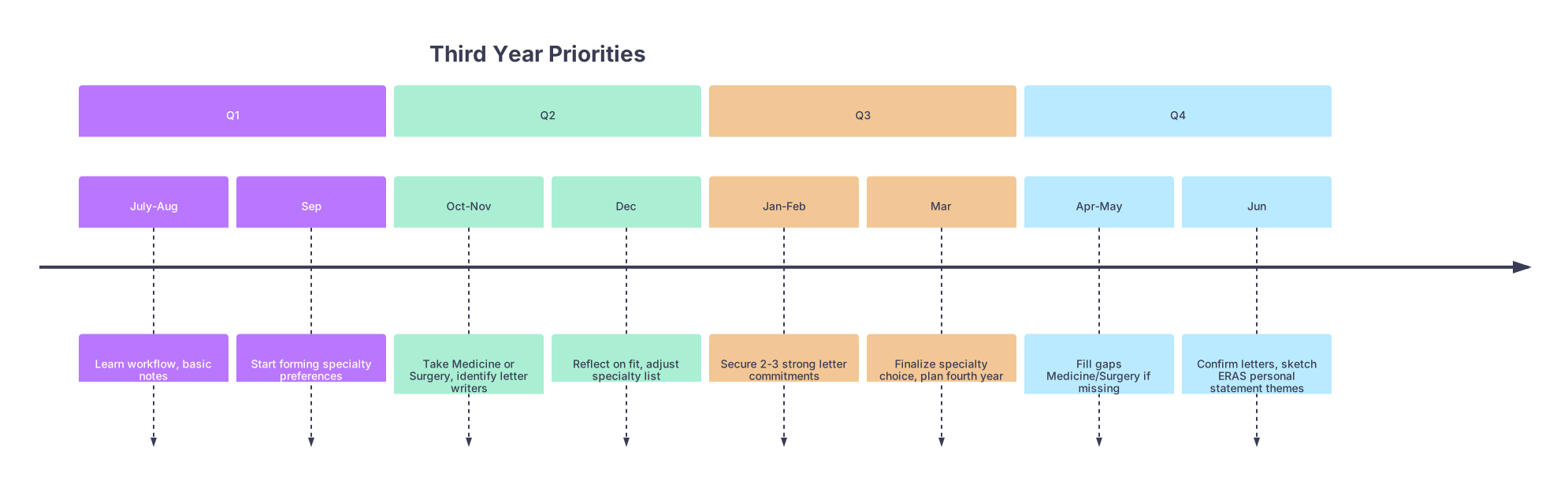
| Period | Event |
|---|---|
| Q1 - July-Aug | Learn workflow, basic notes |
| Q1 - Sep | Start forming specialty preferences |
| Q2 - Oct-Nov | Take Medicine or Surgery, identify letter writers |
| Q2 - Dec | Reflect on fit, adjust specialty list |
| Q3 - Jan-Feb | Secure 2-3 strong letter commitments |
| Q3 - Mar | Finalize specialty choice, plan fourth year |
| Q4 - Apr-May | Fill gaps Medicine/Surgery if missing |
| Q4 - Jun | Confirm letters, sketch ERAS personal statement themes |
July–September (Q1)
At this point you should:
- Learn:
- How to pre‑round efficiently.
- How to structure a 3–5 minute patient presentation.
- Decide:
- Which attendings seem like potential mentors.
- Start a:
- Running document of meaningful cases and patient stories for future personal statements.
October–December (Q2)
At this point you should:
- Take either Medicine or Surgery.
- Ask yourself, realistically:
- “Could I see myself doing this for 30 years?”
- Flag attendings who praise your work:
- Write their names down.
- Ask early: “I am considering X field; would you be able to write me a strong letter if I keep working hard?”
January–March (Q3)
At this point you should:
- Have at least one IM or core clerkship in which you performed at your peak.
- Directly ask 2–3 attendings for letters.
- Block time to:
- Talk with residents or advisors about realistic specialty fit.
- Sketch a rough CV and identify holes (research, leadership, etc.).
April–June (Q4)
At this point you should:
- Patch missing cores (Medicine/Surgery if unlucky with scheduling).
- Lock in:
- Fourth‑year sub‑I’s in your chosen specialty.
- Away rotations (if needed) with application deadlines usually in late winter/spring.
- Confirm:
- Every promised letter is actually requested officially in your school’s system.
Common Calendar Mistakes That Hurt Your Match
I will be blunt. I have watched these specific patterns backfire.
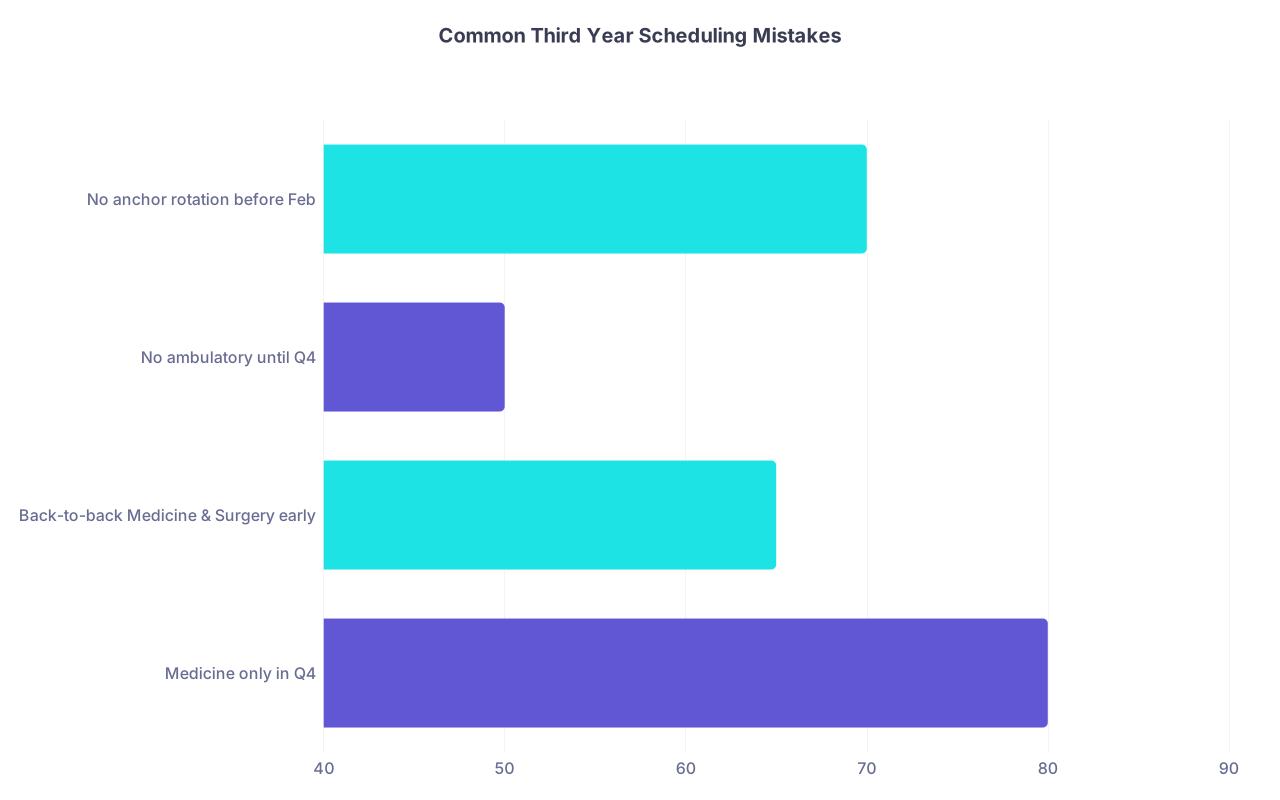
| Category | Value |
|---|---|
| Medicine only in Q4 | 80 |
| Back-to-back Medicine & Surgery early | 65 |
| No ambulatory until Q4 | 50 |
| No anchor rotation before Feb | 70 |
Medicine only in Q4 for IM‑leaning students
- Consequence: weak IM narrative, late letters, programs wonder why there is no robust inpatient evaluation.
Stacking Medicine and Surgery early (Q1) when you are clueless
- Consequence: average evaluations on the two most important rotations.
No ambulatory until Q4 when considering outpatient fields
- Consequence: flimsy outpatient story and fewer clinic‑based letters.
No anchor rotation (Medicine or Surgery) before February
- Consequence: late specialty clarity, rushed fourth‑year planning, weak narrative.
If your school forces one of these, you survive. But if you volunteered for it, you made the game harder for yourself.
Quick Decision Tree: Where To Put Medicine, Surgery, Ambulatory
Use this simple mental flow:

| Step | Description |
|---|---|
| Step 1 | Start Planning |
| Step 2 | Put Surgery in Q2 or Q3 |
| Step 3 | Put Medicine in Q2 or Q3 |
| Step 4 | Use Q1 for lighter cores |
| Step 5 | Schedule Medicine by end of Q3 |
| Step 6 | Place Surgery any time Q2-Q4 |
| Step 7 | Ambulatory or Psych in Q1 |
| Step 8 | Decide lean by Dec |
| Step 9 | Know likely specialty? |
Overlay ambulatory:
- If you like clinic → Q1–Q3.
- If you have no idea → Q1 or Q2, so you at least know if outpatient life appeals to you.