
It is late March of your M3 year. Your classmates are arguing in the hallway about whether to do away rotations in July or October. Someone says, “Do them late so they remember you.” Someone else: “No, do them early so they can write your letter.” You just want a straight answer: when should you actually schedule away rotations if you care about interview invitations?
Here is the answer. Chronologically. Month by month and, where it matters, week by week.
Big Picture: How Away Timing Interacts With Interviews
Before we go month-by-month, you need the core timeline in your head for a typical specialty (IM, peds, EM, gen surg, OB/GYN). Hyper-competitive fields (ortho, derm, plastics, ENT, neurosurg) behave similarly but are even less forgiving.
| Milestone | Typical Timing (AY 2025–26 style) |
|---|---|
| VSLO opens / away apps due | Feb–Apr M3 |
| Away rotation blocks | Jul–Oct M4 |
| ERAS opens to applicants | Early Jun M4 |
| ERAS submission start | Early–Mid Sep M4 |
| First interview invites released | Late Sep–Oct M4 |
| Peak interview season | Nov–Jan M4 |
At this point you should understand one rule:
Programs cannot invite you based on an away you have not done yet.
They can like your application and figure they will see you on rotation. But formal interview invites usually follow:
- What is on your ERAS at submission (Step scores, MSPE, letters already in).
- Your home rotation performance and letters.
- Any completed away rotations that have already produced a letter or strong advocate.
So your goal is simple:
- Do your highest-yield aways before or early in the main interview invitation wave.
- Leave space to both:
- get letters in time, and
- have your performance inform interview decisions, at least for later-round invites.
M3 Winter–Spring (Jan–Apr): Planning and Applications
It is February of M3. You are still on wards, but away timing is already being decided behind the scenes.
January–February M3: Decide Strategy and Specialty
At this point you should:
- Be 80–90% sure of your specialty.
- Know how many aways your specialty actually expects.
Rough reality check:
- EM, ortho, neurosurg, ENT, plastics, urology:
2 aways is standard. Sometimes 3. - Gen surg, OB/GYN, radiology, anesthesiology:
1–2 aways common. - IM, peds, psych:
Often 0–1 away, more optional unless you are geographic-shifting or aiming very high.
You should:
- Talk to:
- Your specialty advisor.
- A recent graduate who matched in that field.
- Decide:
- How many away blocks.
- Which months you want for each away (first choice and backup).
General rule I will stand by:
- Best away months for interview impact: July, August, September.
- June is decent if your school allows it (and if you are ready).
- October is borderline.
- November and later are usually poor for interview invitations but still useful if:
- You are late to decide on a specialty.
- You need another strong letter for SOAP or a re-application.
March–April M3: Submit VSLO / Away Apps
VSLO (or equivalent) is usually opening and closing during this stretch.
At this point you should:
Have your away calendar mapped:
- Block 1: July – Top choice away (ideal for letter + early invites).
- Block 2: August – Second away at a region or program cluster you care about.
- Optional Block 3: September – Third away or home sub-I if your school requires.
Apply with month flexibility:
- Example: “July or August” instead of “August only” for higher acceptance odds.
- But know your ERAS/interview goals: if they offer you October instead of August, that has consequences.
Practical ranking of months, if your priority is maximizing interview invitations:
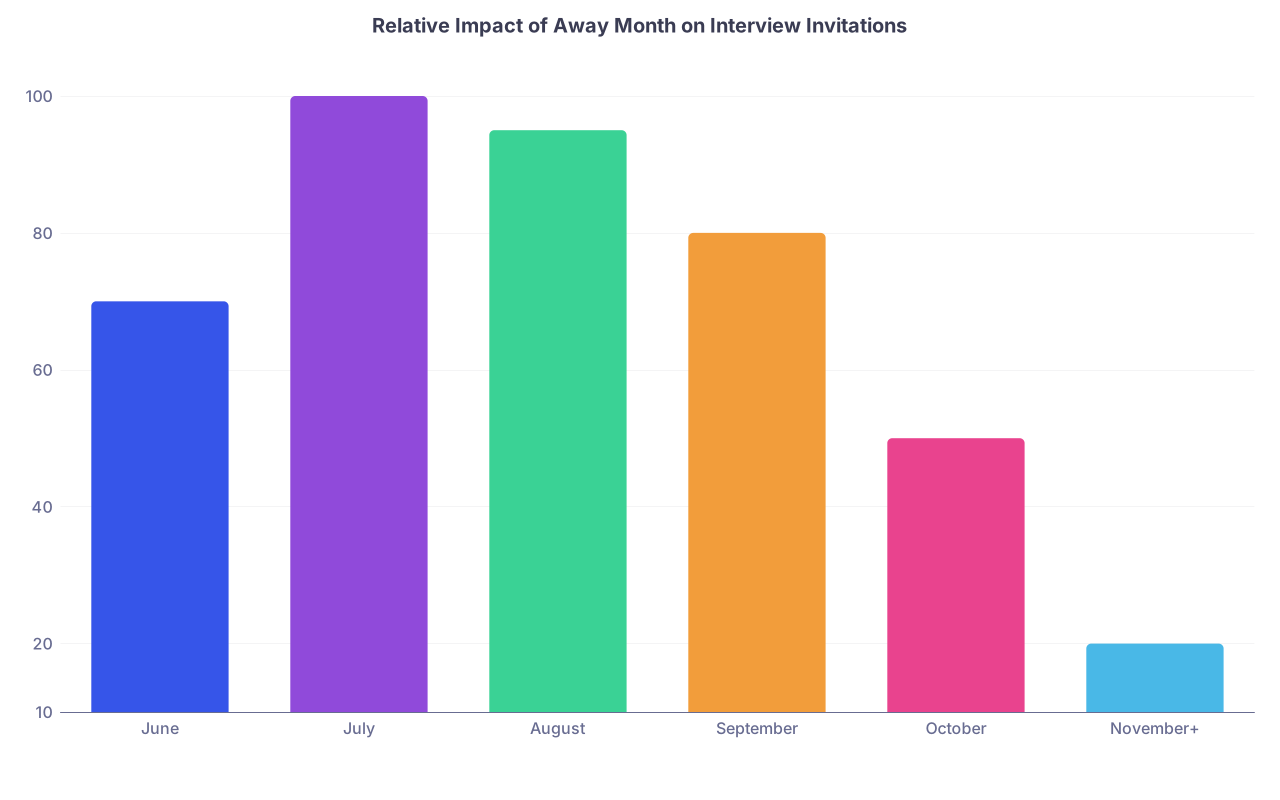
| Category | Value |
|---|---|
| June | 70 |
| July | 100 |
| August | 95 |
| September | 80 |
| October | 50 |
| November+ | 20 |
(Scale is relative impact, not percentages. July ~ “ideal,” others relative to that.)
Short rationale:
- June – Good if allowed. Early letters, but MS3 fatigue and limited experience can hurt performance.
- July – Sweet spot. You look like a senior but still early enough for letters and word-of-mouth.
- August – Also strong. Letters can barely make early interview season, but the impression still spreads.
- September – Mixed. Good for matching at that specific institution. Less useful for generating broad invites.
- October – Mostly too late for mainstream invites but may affect waitlist movement and mid-season adds.
- November+ – For letters, backup plans, or changing specialties. Not for influencing first-round interviews.
Late M3 – Early M4 (Apr–Jun): Locking in and Preparing
April–May M3: Confirm Rotations and Avoid Calendar Traps
At this point you should:
- Confirm actual start and end dates of:
- Your home sub-I(s).
- Each away rotation.
- Overlay this with:
- ERAS open date (early June).
- ERAS submission target (early–mid September).
- Step 2 CK date.
Do not do this wrong:
Scheduling Step 2 during a July away is almost always a mistake. You will underperform on one or both.
Better patterns:
- Take Step 2:
- Late May / early June → then start July away fresh.
- Or between aways (for example: July away, Step 2 in August gap week, September away).
By early May you should have:
- Away months fixed.
- Home rotations placed so that:
- You have at least one strong home letter ready by ERAS submission.
- You are not learning your specialty for the first time on an away.
June M4: ERAS Opens, Prep for Early Aways
You are now an M4. ERAS opens in early June.
At this point you should:
- Start building ERAS:
- Experiences list.
- Personal statement draft.
- Program list rough draft.
- Finish any pre–away rotation modules or credentialing (EMR training, vaccine proof, etc.).
Critically: if you have a June or July away, line up:
- Housing.
- Transportation.
- Uniform/coat access.
You want zero logistics drama. On a July away, you are auditioning for both a letter and a future interview spot. You cannot afford to show up frazzled or distracted.
The Core: July–October M4 — Month-by-Month Away Timing
Here is where the timing actually hits your interview chances.
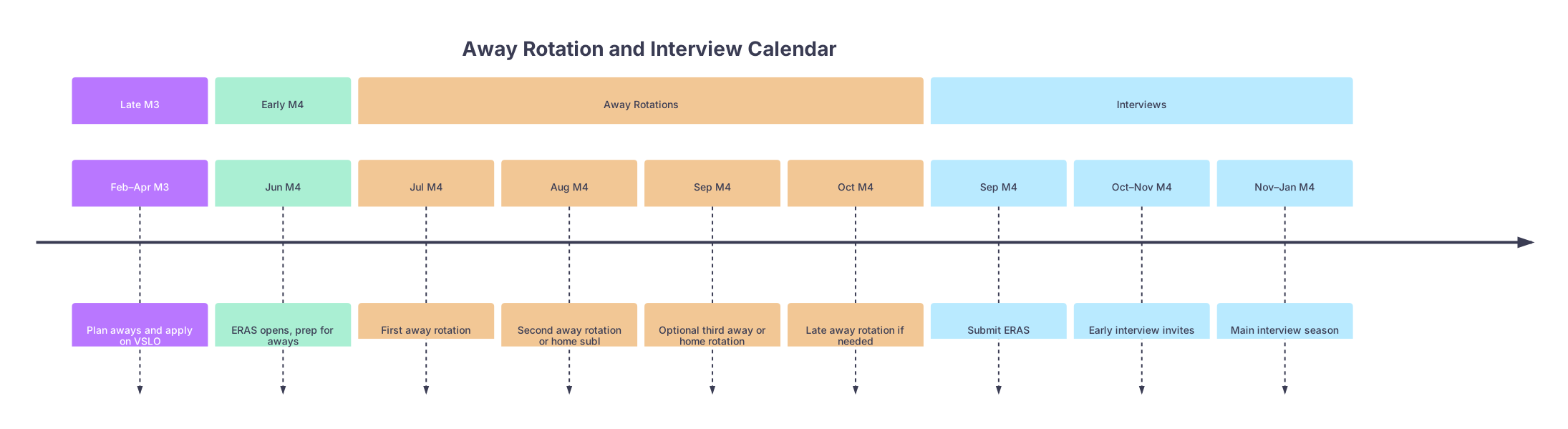
| Period | Event |
|---|---|
| Late M3 - Feb–Apr M3 | Plan aways and apply on VSLO |
| Early M4 - Jun M4 | ERAS opens, prep for aways |
| Away Rotations - Jul M4 | First away rotation |
| Away Rotations - Aug M4 | Second away rotation or home subI |
| Away Rotations - Sep M4 | Optional third away or home rotation |
| Away Rotations - Oct M4 | Late away rotation if needed |
| Interviews - Sep M4 | Submit ERAS |
| Interviews - Oct–Nov M4 | Early interview invites |
| Interviews - Nov–Jan M4 | Main interview season |
July Away: Maximum Impact
If you are serious about using aways to drive interview invitations, July is king.
At this point you should:
- Treat this like a 4-week interview.
- Early in the month:
- Identify rotation director and PD.
- Show up early. Volunteer for cases and consults. Be present but not clingy.
- End of the month:
- Explicitly ask for a letter if you performed well.
Impact on interviews:
- You can often get a July away letter uploaded by:
- Early–mid September if the attending is efficient.
- Programs will see:
- A strong specialty-specific letter already in ERAS.
- Possibly a limited comment in your MSPE addendum if your school updates it.
Better yet, the faculty who worked with you will:
- Email or mention you to their colleagues at other programs.
- Advocate during early file reviews: “This student is excellent; we should invite.”
This is the sweet spot for interview invitation influence.
August Away: Still Strong, Slightly Tighter
August is your second-best shot.
At this point you should:
- Do everything you did on the July away, but with even tighter follow-up.
- Ask for the letter during the final week:
- Provide ERAS info.
- Gently mention your timeline: ERAS submission in early September.
Impact on interviews:
- If the letter writer is prompt:
- Letter can land in ERAS late September / early October.
- It may not affect very first-wave invites but will influence:
- Second rounds.
- Waitlist movement.
- Programs that review later.
Even if the letter is delayed, the informal advocacy still matters. People talk.
Real scenario I have seen multiple times:
- Student crushes an August away at a mid-tier program.
- That PD emails their friends at two higher-tier programs.
- Student gets October invites from both, despite middle-of-the-road Step 2.
September Away: Good for That Program, Less for Broad Invites
September is trickier.
You are now:
- Submitting ERAS mid-September.
- Completing an away that will not have a letter ready until October at best.
At this point you should:
- Do a September away only if:
- You are targeting that specific institution or its region.
- You already have at least:
- One strong home specialty letter.
- One earlier away letter (or will soon).
Impact:
- For that single program:
- You are a known quantity during their file review.
- You may get a courtesy interview or strong ranking bump.
- For most other programs:
- The letter arrives after many early invitations are already out.
- They may still pull your application back up later (this happens), but you are not in the very first wave.
September away is great for:
- “I want to match here specifically.”
- “I need to show I can handle a higher-tier environment.”
It is not optimal if you are still trying to prove basic viability to the entire specialty.
October Away: Mostly for Late Game and Local Effect
October away rotations rarely influence first-round interview invitations. By then:
- ERAS has been out for 3–4 weeks.
- Many invites have been sent.
- Committees are shifting to “who do we waitlist or hold?” mode.
At this point you should only choose an October away if:
- The program is one of your absolute top choices, and:
- You were late to decide on specialty, or
- Your earlier aways fell through, or
- You are trying to salvage a weaker home performance.
- You are rerouting geographically and need face time somewhere new.
Impact:
- On that specific program:
- Still meaningful. They see you in person, may offer an interview even if they had not before.
- On other programs:
- Minimal. The letter will arrive in November or later.
- May help for:
- Additional late invites.
- Backfilling cancellations.
- Rank list nudges for programs where you already have interviews.
How Many Aways and How to Stack Them
You also care about how to stack these blocks relative to interview timing and fatigue.
Here is a practical configuration for a student in a competitive field (say ortho or EM) aiming to maximize interview invites:
| Month | Rotation Type | Rationale |
|---|---|---|
| Jun | Home subI (specialty) | Learn basics, secure home letter |
| Jul | Away #1 (top choice region) | Max influence, early letter |
| Aug | Away #2 (reach program) | Strong influence, advocacy |
| Sep | Home subI / research / light | ERAS submission, no burnout |
| Oct | Optional Away #3 (if needed) | Targeted program, late impression |
Why this works:
- You hit:
- One home rotation before aways → you do not look clueless.
- One or two aways before or around ERAS submission → letters and advocacy align with first-wave interviews.
- You leave:
- September less intense so you can submit ERAS properly, arrange documents, and not implode.
For less competitive fields (IM, peds, psych):
- You might do:
- July: Home sub-I.
- August: Single targeted away (region change).
- Rest of the fall: light electives, interviews.
Over-rotating (three aways back-to-back July–September) looks impressive on paper but often backfires:
- You are exhausted by September.
- Your ERAS personal statement and program list become sloppy.
- You have no flexibility when interview invites start dropping and you need days off for Zooms or travel.
Interview Invitations: How Away Timing Actually Shows Up
Put yourself in a program’s shoes. It is October 10th. They are skimming 1,000+ applications. What do they see that connects to your away timing?
For an applicant with a July away:
- Updated ERAS:
- Strong away letter already present.
- PD has heard a positive comment from that site.
- Result:
- You end up in the “invite now” pile more often.
- Updated ERAS:
For an applicant with an August away:
- Early October review:
- Maybe the letter has just come in.
- Your performance is fresh in that PD’s mind.
- Result:
- You get invited in the second wave or after they reassess applicants with new letters.
- Early October review:
For an applicant with a September away:
- During initial October review:
- No away letter yet.
- No formal data, just maybe a brief email if someone knows you.
- Result:
- You are often put in the “hold / maybe” pile until the letter appears, which can help or not depending on how full their interview days are.
- During initial October review:
For an applicant with only October+ aways:
- October review:
- No external specialty letters.
- Only home or generic letters.
- Result:
- You are evaluated mostly on scores, home letters, and CV.
- Away performance will matter more for rank list adjustments and last-minute invites than for first-wave interviews.
- October review:
When Late Aways Still Make Sense
I am not saying October–December aways are pointless. They are not. They just shift from “get interview invitations” to:
- Solidify rank list at that single program.
- Provide a rescue letter if:
- Your early interview season is thin.
- You are looking at SOAP or reapplication risk.
- Allow a specialty pivot:
- Switching from IM to anesthesia, for example, in late summer.
- Doing a November anesthesia away to have at least one decent letter.
But if your only concern is how many interview invitations you will receive, you should not rely on these late rotations.
Quick-Snap Summary: “At This Point You Should…” by Phase
To close, here is the condensed timeline in plain English.
M3 Feb–Apr
- Decide specialty and number of aways.
- Apply for July/August (plus maybe September) slots, not October as your default.
M3 May–Jun
- Schedule Step 2 separate from aways.
- Line up a home sub-I before or between aways.
M4 Jul–Aug
- Away #1 (July): Perform like it is a month-long interview. Secure letter.
- Away #2 (August): Same intensity. Clarify letter timing before leaving.
M4 Sep
- Submit ERAS on time with at least:
- One home specialty letter.
- Ideally one away letter (July or early August).
- Use September for a lighter rotation or home sub-I, not a third exhausting away.
M4 Oct–Dec
- Consider a targeted October away only if:
- You need that specific program or region.
- You already have baseline interviews.
- Use late aways to influence ranks, not to magically create a full interview season.
Final Key Points
- If your goal is to maximize interview invitations, front-load aways to July and August, with September as optional and October+ as targeted only.
- Plan Step 2, home sub-Is, and ERAS submission around, not inside, those key away months.
- Remember the rule: programs cannot invite you based on an away you have not done yet. Schedule your best effort before the invitation wave hits.