
The most common “strategic” ERAS move students make is the one that quietly ruins their letters: overloading electives right before applications open.
You think you are stacking the deck. You are actually watering everything down.
Let me walk you through how this goes wrong, because I have watched too many strong students turn themselves into “solid but unremarkable” on paper by making this exact scheduling mistake.
The Trap: Packing Your Pre‑ERAS Schedule With Electives
Here is the usual story.
You decide you want internal medicine, or surgery, or EM. Someone tells you, “You need multiple aways. Load them up just before ERAS so they remember you.”
So you build a schedule like:
- May: Sub‑I at home institution
- June: Away elective #1
- July: Away elective #2
- August: Home elective in desired specialty
- ERAS submission: early September
On paper, it looks ambitious. Competitive. Dedicated.
In reality, it is a recipe for:
- Tired, flat clinical performance
- Generic evaluations
- Lukewarm letters written in a rush
- Faculty who barely remember you because you were one of twenty rotating faces that month
And ERAS does not reward “busy”. It rewards “excellent and clearly described”.
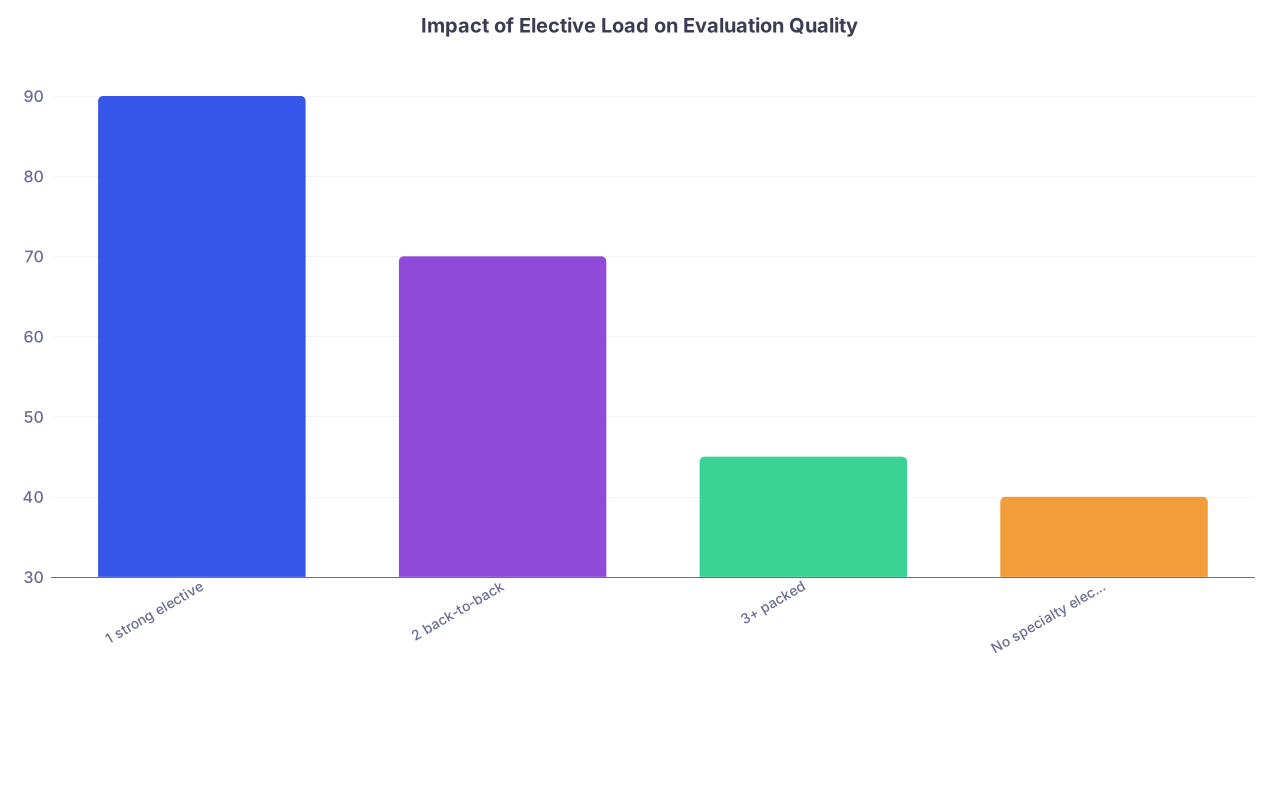
| Category | Value |
|---|---|
| 1 strong elective | 90 |
| 2 back-to-back | 70 |
| 3+ packed | 45 |
| No specialty elective | 40 |
Those numbers mirror what I have seen: once students hit back‑to‑back‑to‑back electives in the same short window, performance and evaluations drop, not rise.
The mistake is thinking more rotations automatically means more signal. It usually means more noise.
How Overloading Directly Produces Mediocre Evaluations
You are not just “tired.” You are handicapping exactly the behaviors attendings and residents evaluate.
1. Fatigue flattens your ceiling
By your second or third high‑stakes elective in a row, here is what tends to happen:
- You stop pre‑reading as much
- Your presentations become safe and mechanical
- You default to letting others take ownership because you are mentally spent
- You lose the energy to seek out feedback or stretch yourself
And those are precisely the dimensions that show up on evaluation forms:
- “Initiative”
- “Ownership of patients”
- “Preparedness”
- “Enthusiasm”
- “Clinical reasoning”
Nobody writes, “This student was probably excellent but appears sleep‑deprived.” They just check “Meets expectations” across the board. If they are kind, you get “Above average” without specifics.
Translation for program directors: fine, not memorable, not a clear reason to rank highly.
2. No time to improve between rotations
The biggest hidden cost of packing electives together: you do not leave any space to actually incorporate feedback.
Ideal pattern:
- Do a demanding elective
- Get honest feedback
- Have 2–4 weeks to deliberately fix your weaknesses
- Go into the next one sharper
Overloaded pattern:
- Finish a demanding elective Friday
- Start a new one Monday in a different system, different EMR, new attendings
- Carry the same flaws (sloppy notes, weak assessment/plan, poor time management) straight into the next evaluation
- Collect multiple variations of the same “good but not great” write‑up
You multiply your deficiencies instead of correcting them.
3. Personality wear‑and‑tear
Tired students are:
- Shorter with nurses
- Less patient with interns
- More likely to look disinterested or checked‑out, even when they care
You may think you are holding it together. The team sees something else:
- “Quiet, somewhat disengaged”
- “Seemed less enthusiastic by the end of the rotation”
- “Pleasant but reserved”
That reads like: not someone we will fight for on rank day.
Remember: nobody writes evaluations assuming you were burned out by your own scheduling choices. They judge the behavior in front of them.
Why “More Electives = Stronger Application” Is Bad Logic
You are not applying to show how many calendar boxes you can fill. You are applying to prove you can be outstanding somewhere and leave a clear, documentable trail of that excellence.
Overloading electives violates that principle in three ways.
1. Quantity dilutes attention
If you do:
- 1–2 key electives before ERAS
- 1–2 strategically timed after ERAS but before rank lists
You can:
- Focus on 1–3 letter writers who truly know you
- Make sure at least one evaluation is stellar and specific
- Allow your best work to stand out in your application
If you do:
- 3–4 electives all stacked in the 3 months before ERAS
You create:
- Multiple attendings who saw you at 70–80% capacity
- Several “fine” evaluations with overlapping generic praise
- No anchor rotation that everyone recognizes as “This is who I am at my best.”

Program directors are pattern recognizers. When every narrative sounds the same—competent, reliable, team player—they lose interest. They are not searching for “student who did the most electives”; they are searching for “student who was clearly exceptional when it counted.”
2. Aways are overrated when done in a blur
The myth:
“If I do three aways, at least one of them will love me.”
Reality when stacked tightly:
- You show up already drained from the prior elective
- You need a week just to learn the system and culture
- You hit your stride in the last 5–7 days, right as the rotation ends
- You leave before anyone has seen you at full power for more than a handful of shifts
Result: middle‑of‑the‑pack evaluations and lukewarm letters. And by the way, that faculty member who “loved you” also wrote 20 other letters this season.
An away only becomes high‑yield when:
- You are fresh enough to stand out from day 1
- You deliberately identify 1–2 potential letter writers
- You give them consistent, high‑level performance over several weeks
- You ask for the letter while you are still sharply in their memory
None of that is helped by scheduling three back‑to‑back aways.
3. ERAS timing does not require a pile‑up
You think August is your last chance to impress before ERAS. It is not.
A realistic, safe pattern:
- Strong core clerkships + 1 key elective or sub‑I before ERAS
- Submit ERAS with those letters
- Use later electives (Oct–Dec) to:
- Generate additional letters to upload mid‑season
- Create fresh advocates who might email program leadership
- Strengthen your performance for interviews and real‑time word‑of‑mouth
If you treat ERAS like a deadline for all possible strength, you over‑front‑load and burn yourself right as letters are being written.
What Mediocre Evaluations Actually Look Like (And Why They Hurt)
Let me be blunt: the enemy is not “bad” evaluations. It is boring ones.
Bad is at least clear. Boring is death by faint praise.
Common patterns from over‑scheduled students:
- “[Name] was a pleasure to work with. She completed tasks reliably and had good rapport with patients.”
- “He was a solid student who functioned at the expected level for his training.”
- “She got along well with the team and was dependable.”
Sounds okay, right? Now zoom out:
- You have 4–5 of these, all saying roughly the same thing
- None mention “top student,” “among the best,” “I would rank this student to match”
- No specific detail about clinical reasoning, ownership, or standout moments
Now imagine the comparison pile.
| Narrative phrase | How it is interpreted |
|---|---|
| "At the expected level" | Average, not a priority |
| "Solid, dependable" | Safe, but not exciting |
| "Among the best students I have worked with" | Strongly positive signal |
| "I would be happy to have them as a resident" | Clear advocate |
| "Top 10% of students at this level" | Concrete, high-value endorsement |
Overloading electives increases the odds you land in column two: safe, generic, non‑differentiated.
Remember: hundreds of applications look like yours on paper. It is the handful of glowing, specific comments that pull someone out of the noise. Over‑scheduling is how you prevent those comments from ever being written.
Smarter Scheduling: How To Protect Your Evaluations
You avoid this mistake by being strategic and slightly ruthless with your calendar, not by being a hero.
Step 1: Define your “must be excellent” rotations
For residency match purposes, these usually are:
- 1 medicine sub‑I or key acting internship (for IM, neuro, many subspecialties)
- 1 core specialty elective at home in your intended field
- 1–2 aways, max, in that field if the specialty expects them (ortho, derm, EM, neurosurg, etc.)
Everything else is secondary.
Your goal:
Each of those 2–3 rotations should be:
- Booked during a time you can be rested
- Protected from back‑to‑back overnight or brutal calls
- Spaced so that you can actually improve from one to the next
Step 2: Avoid the “three in a row” pattern
A simple rule that will save you:
Do not schedule more than two high‑stakes electives or aways back‑to‑back in the 3–4 months before ERAS.
High‑stakes = any rotation where you expect a letter or major evaluation used for applications.
Better pattern:
Option A:
- May: Medicine Sub‑I (home)
- June: Research / lighter elective / vacation
- July: Away 1
- August: Low‑intensity elective or step‑up prep, not letter‑critical
Option B:
- May: Lighter elective
- June: Specialty home elective (letter source)
- July: Away 1 (letter source)
- August: Research / buffer / interview prep

| Step | Description |
|---|---|
| Step 1 | Identify target specialty |
| Step 2 | Choose 2-3 key rotations |
| Step 3 | Schedule 1 home, 1 away pre-ERAS |
| Step 4 | Focus on home sub-I and elective |
| Step 5 | Insert buffer/light month between them |
| Step 6 | Add low-stakes electives after ERAS |
| Step 7 | Need aways? |
You are not weaker for using a buffer month. You are preserving your peak performance for the rotations that actually matter.
Step 3: Protect your energy on aways
Away rotations are evaluations plus interviews rolled into one. You cannot walk into those at 60% power.
Avoid:
- Doing an away immediately after a heavy ICU or night float month
- Signing up for extra research or leadership obligations during your away
- Double‑booking call days with major personal commitments
You want space for:
- Reading at night to sharpen your plans
- Asking thoughtful questions without your brain short‑circuiting
- Writing clean notes that impress the residents and attendings
- Being consistently pleasant—because you are not dying inside

What To Do If You Already Overloaded Yourself
Maybe you are reading this with three packed electives already scheduled right before ERAS. You are not doomed. But you need to adjust your strategy now.
Concrete salvage steps:
Identify your best potential letter source
Look at your upcoming rotations and pick the one where:- You are most likely to shine
- The faculty are known for teaching and mentorship
- The environment is less toxic and more structured
Down‑regulate the others
For the non‑priority electives:- Be reliable and professional, but stop trying to “max out” everything
- Accept that you might not request letters from those rotations
- Use them to practice skills and endurance, not to impress everyone
Ask for targeted, real‑time feedback early
On the rotation you care most about:- Ask an attending in week 1: “I am applying in X and hoping to be at my best. What is one thing that would move me from ‘good’ to ‘excellent’ this month?”
- Fix that first. Then ask again in week 2–3.
Aggressively protect sleep and bandwidth
Overloaded schedule + no sleep = guaranteed mediocrity.- Cut optional extracurriculars for that period
- Stop saying yes to every research task
- Prioritize being sharp during the day over cramming at 1 a.m.
Delay ERAS letters if needed
If your true standout rotation is August:- Submit ERAS with whatever you have, but
- Have that August attending upload a letter ASAP after completion
Programs will still see it in time for most interview decisions.
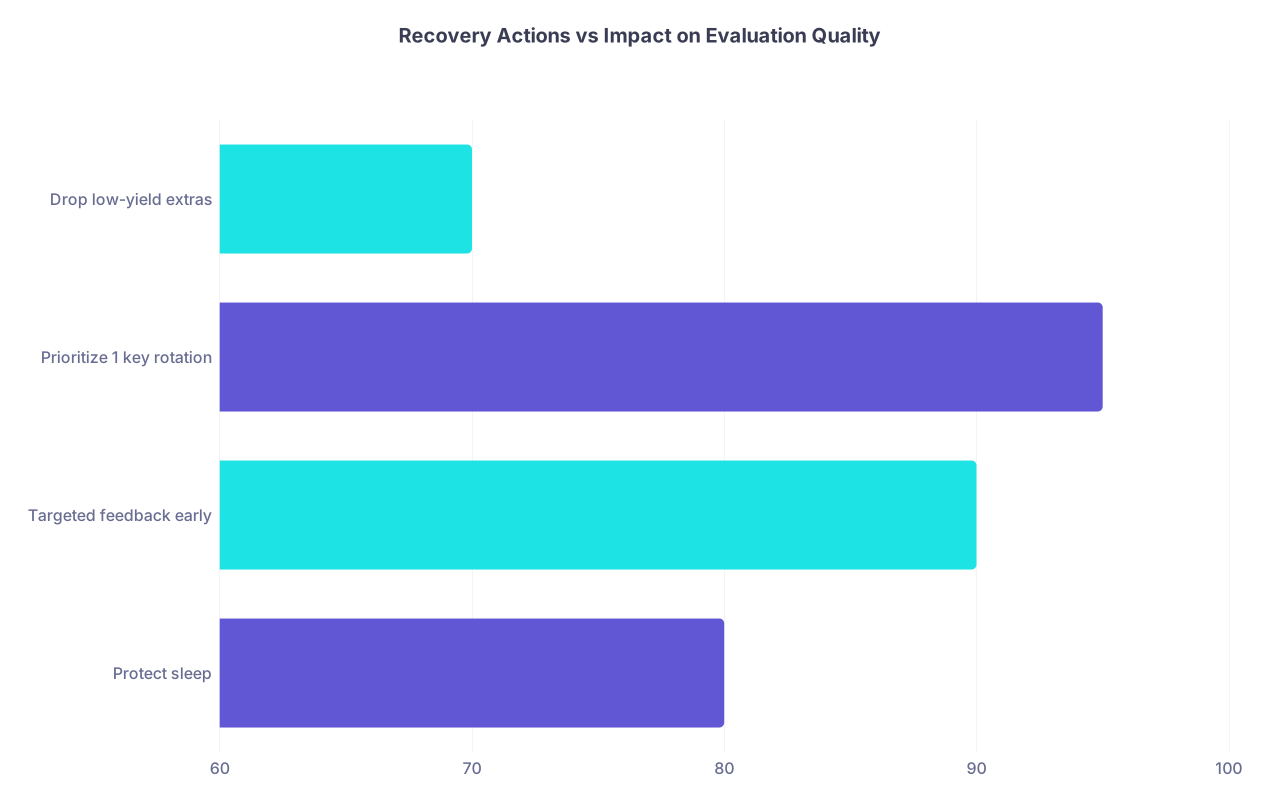
| Category | Value |
|---|---|
| Protect sleep | 80 |
| Targeted feedback early | 90 |
| Prioritize 1 key rotation | 95 |
| Drop low-yield extras | 70 |
You cannot undo a bad calendar, but you can stop compounding the damage.
The Real Goal: Fewer, Stronger Advocates
Stop thinking, “How many rotations can I cram in before ERAS?”
Start thinking, “Which two or three people will be willing to go to bat for me?”
You get advocates by:
- Giving them time to see you at your best
- Not arriving already burned from another intense month
- Demonstrating growth over the course of the rotation
- Asking for feedback and actually implementing it
- Being the student they remember when they open ERAS
You do not get advocates by:
- Showing up tired
- Being “fine” on three different services
- Collecting five generic evaluations that sound interchangeable

Your schedule should serve your future advocates. Not the other way around.
FAQs
1. Do I really need more than one elective in my chosen specialty before ERAS?
No. The common mistake is thinking you must showcase endless commitment. One excellent home elective or sub‑I, plus possibly one well‑executed away, is usually enough. Programs care more about strength and clarity of performance than raw number of rotations.
2. Is it better to have more letters, even if some are generic?
More letters do not help if they are mediocre. In fact, a stack of generic letters can dilute the impact of one truly strong one. Aim for 3–4 letters total, with at least 2 that are enthusiastic and specific. Do not chase volume at the expense of quality.
3. What if I feel I did “just okay” on an elective—should I still ask for a letter?
If you suspect the evaluation is lukewarm, prioritize other options. A safe rule: only request a letter if you have reason to believe the faculty sees you as above average or stronger. You can ask directly: “Do you feel you know my work well enough to write a strong letter of recommendation?” Then listen very carefully to how they answer.
4. How close to ERAS can I do a key elective and still benefit?
An August elective can still be very useful. The letter may not be in on day 1 of ERAS, but programs continue reviewing materials for weeks. Many will see that late‑arriving strong letter before offering interviews. Just make sure you or your dean’s office prompt the writer early and remind them of your timeline.
5. What is one change I can make right now if my schedule is already packed?
Open your upcoming 4–6 month calendar and circle the single most important rotation for your chosen specialty. Then, today, identify one rotation or commitment you can lighten or move to create bandwidth around that circled month. Protect that one rotation fiercely—that is where your standout evaluation and letter should come from.
Open your calendar right now and look at the 2–3 months before ERAS opens. If you see three high‑stakes electives packed back‑to‑back, choose one to downgrade or move. Do not let an overloaded schedule turn your hard‑earned potential into forgettable evaluations.