
It’s April of MS3. Your core clerkship grades just posted. You’re tired, your Step 2 CK date is looming, and VSLO/VSAS is open in another tab. You scroll through the MS4 elective catalog and your brain does the predictable thing:
- “Outpatient dermatology – chill, no call, great evals.”
- “Radiology reading elective – 8–4, lots of ‘Honors’ last year.”
- “Narrative medicine – purely pass/fail, no exams.”
You start mentally building a fourth year that looks like a vacation with a diploma at the end. One hard sub‑I to “show commitment,” and the rest? Easy A’s to “protect my GPA” and “focus on boards.”
This is the exact point where a lot of people quietly wreck their Match position.
Not by failing.
Not by bombing Step 2.
But by choosing electives that scream: “I avoided work when it mattered.”
Let me walk you through the landmines, because I’ve watched this blow up strong applicants who thought they were being “strategic.”
The Core Mistake: Treating MS4 as GPA Protection, Not Reputation Building
The biggest misunderstanding: thinking fourth year is about coasting and guarding your transcript.
Residency programs do not care that you crushed “Art in Medicine” and “Intro to Global Health” if:
- You have no rigorous clinical electives in your chosen specialty
- Your only strong evaluation is from your home sub‑I
- Your schedule looks like a vacation for nine months
They care about:
- What serious, relevant work you did after you were already “trained”
- How you performed when expectations were higher, not lower
- Whether attendings trusted you with real clinical responsibility and wrote like it
Programs understand one truth you might be trying to ignore:
By MS4, if you wanted to push yourself, you could have. Elective choices are data.
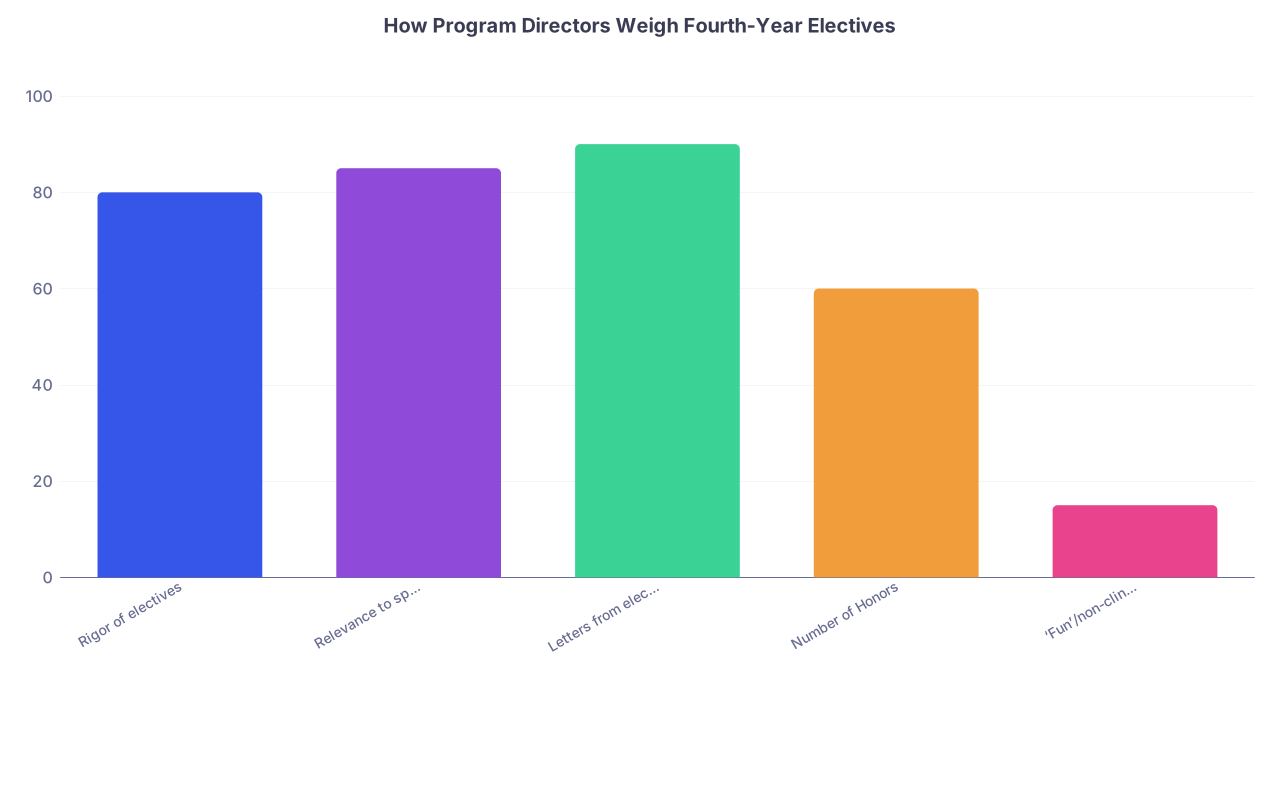
| Category | Value |
|---|---|
| Rigor of electives | 80 |
| Relevance to specialty | 85 |
| Letters from electives | 90 |
| Number of Honors | 60 |
| ‘Fun’/non-clinical electives | 15 |
An MS4 year filled with “easy A” electives sends a loud message:
- “I optimize for comfort.”
- “I avoided high-expectation rotations that might challenge me.”
- “I tried to game the system instead of proving myself.”
Even if that’s not who you are, that’s exactly how it reads on paper.
How “Easy A” Electives Quietly Undercut Your Match
1. You Starve Yourself of Strong, Credible Letters
The most expensive mistake I see: wasting your best letter-writing opportunities on fluff rotations.
Programs don’t just want letters that say:
- “Pleasure to work with.”
- “Will be a good resident.”
- “Shows compassion for patients.”
They want letters that hit:
- “Handled intern-level responsibility on a busy service.”
- “Managed complex patients with minimal supervision.”
- “Already functioning at or above our current interns.”
You don’t get that from:
- Shadow-only radiology electives
- Light clinic-only rotations where the intern still does everything
- Non-clinical electives with no on-call, no pager, no cross-cover
The letters that move the needle tend to come from:
- Sub-Is in your chosen specialty
- ICU rotations where you actually write notes, present, and manage
- High-volume inpatient electives (wards, consult-laden services)
I’ve seen this exact pattern:
- Student does 1 hard sub‑I in IM, then stacks derm clinic, radiology reading, lifestyle medicine, “medicine and film”
- Applies to competitive IM programs
- Only strong letter is from the IM sub‑I
- Other letters read like personality reviews, not clinical performance
Result? Mid-tier interviews, no love from the places they actually wanted.
You do not want your best letter to be from “Mindfulness and Medicine.”
2. Your Transcript Looks Like You Were Hiding
Program directors are not stupid. They read between the lines.
If your fourth year looks like:
- Jul: IM Sub‑I
- Aug: Away elective in your specialty
- Sep: “Medical Spanish for the Clinic”
- Oct: “Integrative Medicine”
- Nov: “Outpatient Dermatology”
- Dec: “Medical Humanities Seminar”
- Jan: “Radiology Reading Room”
- Feb: “Vacation”
- Mar: “Vacation”
What they see:
- 2 months of work
- 7–8 months of avoiding anything that might produce a high-stakes eval
What a strong schedule looks like is different:
- 2 rigorous sub‑Is (home + away, or home in 2 different settings)
- 1–2 relevant ICU/wards-heavy rotations
- 1–2 consult-heavy or procedure-heavy electives in your field
- Some breathing room, yes. But not half the year.
If 60–70% of your year is soft electives, reviewers start asking:
- “What happened after MS3? Did they burn out? Did they stop caring?”
- “Why no SICU or MICU if they’re applying surgery/IM?”
- “Why so much outpatient if they’re matching into a hospital-heavy field?”
And the unspoken one: “Will this person crumble when we put them on nights?”
3. You Miss the Only Time You Can “Audition” Safely
Early MS4 is your proving ground. This is where you practice being an intern with a safety net.
On tough electives, you:
- Carry 6–10 patients
- Admit from ED
- Call consults and present like a real team member
- Stay for sign-out, handle cross-cover plans
- Learn what actually sinks or saves you on busy services
If you punt those experiences in favor of:
- Two weeks of wellness
- “No note writing required” specialty clinics
- Read-at-home rotations with minimal expectations
You walk into residency on Day 1 with less real practice than you could have had. And programs can tell.
I’ve heard attendings say in rank meetings:
“Their CV is fine, but they barely did any heavy clinical rotations after third year. I’m worried they’re soft.”
You don’t want “soft” attached to your name when they’re picking from 600 applicants.
4. You Look Indecisive or Disengaged from Your Chosen Field
For competitive specialties especially, your electives are part of your “story.”
If you’re going into:
- Ortho – they expect multiple ortho rotations, maybe trauma, SICU, something procedure-heavy
- ENT – ENT electives, head & neck, SICU, maybe radiology with real ENT exposure
- IM – at least one MICU, another wards/sub‑I, maybe cards or heme/onc consults
If instead they see:
- One away elective
- One home acting internship
- Then months of stuff with zero relationship to your specialty
It looks like:
- You’re hedging so hard you never really committed
- You just grabbed “easy” regardless of fit
- You weren’t actually that interested once the work got real
A few “fun” electives? Fine.
A year dominated by them? Red flag.
The Specific “Easy A” Patterns That Hurt You Most
Let’s call out the usual suspects, because I’ve seen the same damaging patterns again and again.

Pattern 1: Stacking Low-Responsibility Outpatient Clinics
- Derm clinic
- Allergy clinic
- Lifestyle medicine
- Integrative medicine outpatient
- “Pre-op clinic” where you barely touch a stethoscope
Individually, some are fine.
Stacked back-to-back? You look like you ran away from inpatient work.
Why this hurts:
- Little to no intern-level responsibility
- Super subjective evals, often inflationary and meaningless to PDs
- Weak letters: too shallow, not enough real data
Use outpatient to supplement, not define, your year.
Pattern 2: Long Blocks of Non-Clinical or Minimal-Clinical Electives
- Health policy
- Narrative medicine
- Research-heavy “clinical” electives with almost no patient contact
- Global health planning (vs. actually working in a clinic or hospital)
Again, these can be valuable for intellectual growth. I’m not against them.
But when multiple months look like this with no hard counterbalance, your “readiness” becomes questionable.
Programs ask, “What were they doing while others were in the ICU or on night float?”
Pattern 3: “Read-at-Home” Electives With No Real Accountability
Watch out for:
- Radiology electives where you’re barely present
- Pathology where you show up for a conference and disappear
- “Independent study” with a token project
These often produce evals like:
- “Read several articles.”
- “Seemed engaged in discussion.”
- “Completed required assignments.“
None of that helps you get ranked higher.
If you do radiology or path, pick versions where:
- You’re expected to be there full days
- You present cases, answer questions, prepare topics
- Someone actually gets to know your work ethic
Pattern 4: “Fake-Rigorous” Electives
The ones that sound intense but function as vacations:
- “Advanced Topics in Critical Care” that’s mostly lectures
- “Surgical Skills Seminar” where no one evaluates your reliability
- “Leadership in Medicine” that’s all reflection papers and no patients
You know exactly which electives at your school fall into this category. Students talk. There are “honors factories” and “ghost rotations.”
One or two? Whatever.
Building your schedule around them? Bad look.
What a Strong, Match-Helping Elective Strategy Actually Looks Like
You don’t need to martyr yourself and construct a year of pure misery. That’s dumb in its own way.
You do need a spine of rigor.
| Aspect | Weak 'Easy A' Strategy | Strong Match-Focused Strategy |
|---|---|---|
| Core inpatient exposure | 1 sub-I only | 2 sub-Is and/or ICU + wards |
| Elective relevance | Mostly unrelated to specialty | Majority aligned with specialty |
| Letter opportunities | 1 strong, 2–3 soft | 3 strong, clinically rich letters |
| Outpatient/soft rotations | 5+ months | 1–3 carefully chosen |
| Narrative to PDs | Avoided work, protected self | Sought responsibility, prepared for intern year |
Here’s a safer approach.
1. Anchor With 2–3 High-Responsibility Rotations
Non-negotiable if you want to avoid looking soft:
- 1 sub‑I in your specialty (home or away)
- 1 sub‑I in medicine/surgery/peds depending on your field (yes, a second sub‑I)
- 1 ICU or heavy inpatient elective if your specialty is hospital-based
For example:
- IM applicant: IM sub‑I, MICU, maybe another IM wards rotation
- Surgery applicant: Surgery sub‑I, SICU/Trauma, maybe vascular or onc surg with real floor/OR duties
- Peds applicant: Peds sub‑I, PICU or NICU, another wards month
On these, you want:
- Daily note writing
- Real patient load
- Presentations on rounds
- Night call exposure
These rotations produce the letters that change your rank.
2. Add Specialty-Relevant Electives With Substance
After the backbone is set, add electives that:
- Deepen skills in your field
- Show clear interest and commitment
Examples:
- Cards consults, heme/onc, nephrology for IM
- Trauma surg, vascular, ENT oncology for surgery
- EM shifts, ultrasound, toxicology for EM
Ask yourself bluntly:
“Can I describe specific, meaningful responsibilities I had on this elective in an interview, without stretching the truth?”
If the answer is no, reconsider.
3. Use “Lighter” Electives Sparingly and Strategically
I’m not saying you should be in the MICU every month until graduation. Burnout is real, and a charred MS4 is useless in July.
You can absolutely:
- Take 1–2 lighter electives after rank list is in
- Use a low-stress month to study for Step 2 if you planned poorly
- Do a humanities or wellness elective if that genuinely feeds you
The mistake is volume and timing:
- 1–2 soft electives? Fine.
- 4–6 soft electives before ERAS submission? Terrible signal.
- Packing pre-interview season with fluff? Even worse. That’s when PDs are reading your MS4 schedule.
Keep these principles:
- Before ERAS is submitted: majority rigorous, clinically meaningful
- After rank list in: you can afford more “enrichment”

| Step | Description |
|---|---|
| Step 1 | End of MS3 |
| Step 2 | Plan specialty + target programs |
| Step 3 | Schedule 2 rigorous sub-Is |
| Step 4 | Add ICU or heavy inpatient |
| Step 5 | Layer in specialty-relevant electives |
| Step 6 | Add 1-2 lighter electives |
| Step 7 | Finalize ERAS and interviews |
The Hidden Risk: You Underestimate How Much Programs Talk
Here’s something nobody tells you early enough: attendings and PDs talk about the “easy culture” at certain schools and the obvious “fluff” rotations at others.
I’ve heard variations of:
- “Oh, they did the [School X] lifestyle medicine month… everyone Honors that. Doesn’t mean much.”
- “Their narrative medicine rotation is a joke. Ignore that Honors.”
- “The only grade that matters here is their SICU month.”
If your file is anchored by rotations everyone knows are soft, your “Honors” do not carry the weight you think they do.
You’re not gaming the system. You’re just giving them an easy reason to discount half your transcript.
How to Audit Your Planned Electives (Before You Lock Them In)
Do this before you click “submit” on anything.

Run your schedule through this filter:
Count hardcore months (sub‑I, ICU, heavy wards):
- Less than 2 before ERAS submission? You’re under-doing it.
Count specialty-relevant electives:
- Do at least 3 of your MS4 rotations clearly connect to your chosen field? If not, you look unfocused or uncommitted.
Look at your letters pipeline:
- Can you name 3 attendings, from solid rotations, who will have seen you do real work and can write specifically about your clinical ability? If you’re at 1–2, you’re in danger.
Look at pre-ERAS vs post-ERAS rigor:
- Are you front-loading fluff? That’s exactly backward.
- Aim for: harder and more relevant before ERAS; lighter and broader after.
Ask a brutally honest resident or chief:
- “If you saw this schedule in an applicant, what would you think?”
- Make them actually say it. Their wince tells you more than their words.
Common Rationalizations That Will Cost You
Let’s dismantle the lies you’ll tell yourself to justify the easy A route.
“I need to protect my GPA / class rank.”
Reality:
- By MS4, the GPA ship has mostly sailed.
- Class rank is heavily driven by core clerkships and earlier grades.
- One or two slightly lower grades on rigorous rotations will not sink you.
What does sink you? Being the applicant with:
- No ICU
- Minimal sub‑I exposure
- An entire year of “safe” choices
A B+ in MICU is far more impressive than an A in “Physician Wellness Seminar.”
“I need time to study for Step 2.”
Again, partially true. But:
- Repeatedly dodging real clinical rotations to “study” looks suspect.
- You can usually carve out 4–6 dedicated weeks without gutting your schedule.
- Many people do well on Step 2 while still doing at least some hard rotations.
If you fill half your year with fluff and stamp it all “Step 2 prep,” no one buys it.
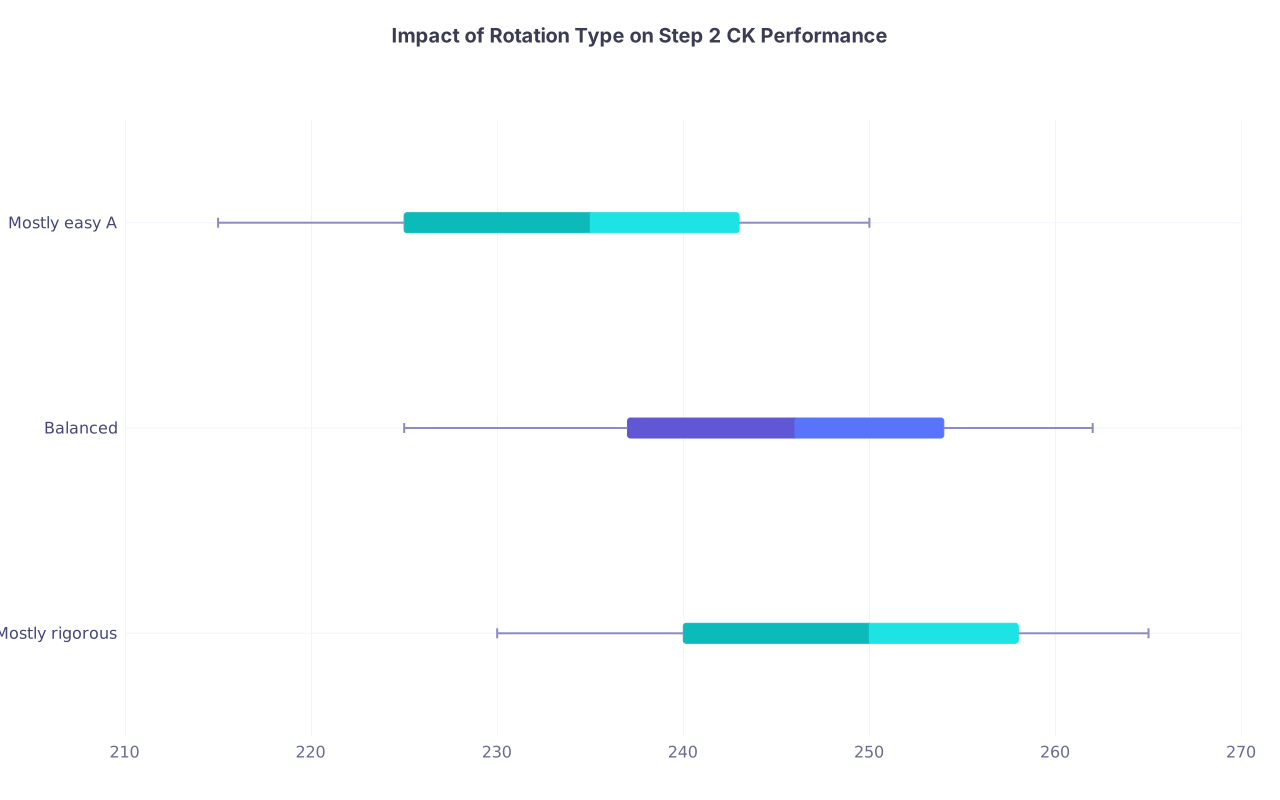
| Category | Min | Q1 | Median | Q3 | Max |
|---|---|---|---|---|---|
| Mostly rigorous | 230 | 240 | 250 | 258 | 265 |
| Balanced | 225 | 237 | 246 | 254 | 262 |
| Mostly easy A | 215 | 225 | 235 | 243 | 250 |
People who do mostly rigorous rotations tend to retain more clinical reasoning, and it shows on Step 2. Coasting doesn’t help as much as you think.
“Everyone does it at my school.”
No, they don’t.
You’re hearing the loudest, most cynical voices.
The top-matching students every year?
- They do at least 2–3 “tough” rotations as MS4
- They take electives that generate real letters
- Then they sprinkle some enjoyment on top, not the other way around
“Everyone does it” is usually code for “everyone in my immediate friend group talks about it,” which is not the same thing.
So What Do You Actually Do Now?
If you’re early MS3/MS4 planning:
- Build your year around: sub‑Is, ICU, and specialty-relevant clinical work
- Insert lighter electives after ERAS and especially after rank list
- Be intentional: each rotation should either:
- Strengthen your clinical readiness, or
- Strengthen your narrative/letters for your specialty
If you’ve already scheduled a fluff-heavy year:
- Swap a couple soft electives for ICU/wards where possible
- Add one more sub‑I if your school allows it
- Use “fun” electives late, not front-loaded
- Target your best rotations to be done before letters are written and ERAS is submitted
If you’re stuck with some fluff you can’t change:
- Crush your serious rotations
- Make sure your best attendings get asked for letters
- Use interviews to explicitly talk about how you prepared yourself clinically despite some lighter months

| Step | Description |
|---|---|
| Step 1 | Current fluff-heavy schedule |
| Step 2 | Identify 2-3 replaceable electives |
| Step 3 | Swap for ICU/wards/sub-I if possible |
| Step 4 | Confirm letter writers from rigorous rotations |
| Step 5 | Move lighter electives after ERAS if allowed |
FAQ (4 Questions)
1. Is it ever okay to choose an easy elective just for sanity or burnout recovery?
Yes. One or two well-placed, lighter electives can actually protect you from crashing. The mistake is volume and timing. If you’re stacking four or five easy months before ERAS, that’s not “recovery,” that’s avoidance. Use lighter rotations as a pressure valve, not the core structure of your year.
2. For internal medicine, do I really need both a sub‑I and an ICU rotation?
If you want to be taken seriously at solid IM programs, yes, you should try. A medicine sub‑I shows how you function on the wards as the primary manager. MICU shows how you think with sick patients and handle complexity. Together, they tell PDs you’ve seen enough real medicine to not completely drown as an intern.
3. What if my school doesn’t have many rigorous electives in my specialty?
Then you compensate with what you do have: more general sub‑Is (medicine, surgery, peds depending on your field), ICU, and high-responsibility consult services. You can also prioritize away rotations that are truly hands-on. The point isn’t to have a perfect specialty mirror; it’s to show you stepped into real responsibility wherever possible.
4. Are non-clinical electives (research, health policy, humanities) always a negative?
Not at all. They can be a real asset—if they complement a backbone of solid clinical work. A research elective that results in a poster in your specialty plus an ICU month? Great. Three months of non-clinical work instead of an ICU or second sub‑I? That’s where you start to look unprepared. They’re seasoning, not the main dish.
Key Takeaways:
- An MS4 year built around “easy A” electives looks soft and undercuts your Match, even if you think you’re being strategic.
- You need a backbone of rigorous, responsibility-heavy rotations (sub‑Is, ICU, relevant inpatient electives) to generate strong letters and prove readiness.
- Use lighter electives sparingly and intentionally—after you’ve already built the clinical record that shows programs you’re ready to work, not just ready to graduate.