
What do you actually do when you’ve just failed a clerkship and application season is coming—do you hide it, over-explain it, or rebuild from the ground up?
You’re not the first person to be here. I’ve seen it with medicine, surgery, OB, psych, even family med. I’ve seen people with a failed core clerkship still match into competitive programs—sometimes in that very specialty. And I’ve seen others tank their chances not because of the failure, but because of how they handled it afterward.
Let’s go step by step and get you from “I failed” to “I can still be a strong, credible candidate.”
Step 1: Get Crystal-Clear on Why You Failed
Do not skip this. “The attending didn’t like me” is usually not the full story.
You need specifics you can:
- learn from, and
- explain succinctly to program directors.
Here’s what you do in the first 1–2 weeks after the grade posts:
1. Schedule a debt-free, honest debrief
You want two meetings:
- One with the clerkship director.
- One with your dean’s office / academic affairs / student affairs.
Go into the clerkship director meeting with 3 questions written down:
- “Can you walk me through what specifically led to the failing grade?”
- “If you had to name the top 2–3 skills or behaviors I must improve before residency, what are they?”
- “If I improve those and pass the repeat, would you be comfortable supporting me with a neutral or positive assessment for residency?”
Then shut up and listen. Do not argue. Do not defend. Take notes.
Typical real root causes I see:
- Professionalism: chronic lateness, poor communication, not following instructions.
- Clinical reasoning: couldn’t synthesize, poor presentations, unsafe decisions.
- Work ethic / reliability: missing notes, half-done tasks, poor follow-up.
- Team friction: defensive, dismissive, or socially “off” with nurses/residents.
- One big incident: a documented professionalism or safety concern.
You need to know which one(s) you’re dealing with. Because your recovery plan has to match the actual problem, not what you wish the problem was.
2. Get the documented version
Ask: “What’s in my file that programs will see about this?”
You want to know:
- Is the failure mentioned in the MSPE (Dean’s Letter)?
- Is there a professionalism form / incident report?
- Will the repeat grade replace or sit next to the original?
Your strategy changes depending on whether this is:
- A quiet internal “F, remediated, now passes,” or
- A bolded line in your MSPE saying you failed medicine for professionalism.
If the written narrative is inaccurate or incomplete, calmly ask:
“Would you consider adding a brief clarification that includes the remediation I’ve completed and my improvement?”
Sometimes they’ll say yes. Sometimes no. You still ask.
Step 2: Contain the Damage—Right Now
Before we talk about applications, you need to stop this from turning into multiple problems.
1. Fix your behavior in your very next rotation
Everyone is watching the rotation after a failure. That eval carries extra weight.
On your next clerkship:
- Show up early. Not on time. Early.
- Tell your resident on day 1 (quietly):
“I had a rough experience on my last rotation and got feedback about X and Y. I’m working hard on them. If you see me slipping, I’d really appreciate you telling me early so I can correct it.”
This does two things:
- It signals maturity and insight.
- It invites mid-rotation feedback instead of a surprise bad eval.
Then absolutely crush the basics:
- Pre-round properly.
- Own your patients.
- Close the loop on tasks.
- Ask for specific feedback halfway through (“How are my notes? Presentations? Anything worrying you?”).
You’re building your “redemption narrative” right now. Not six months from now.
2. Decide: Is this still the specialty you want?
If you failed medicine and want internal medicine, or failed surgery and want surgery, you need a reality check, not a pep talk.
Ask:
- The clerkship director (off the record):
“Given my performance and what you see in applicants, do you think IM/surgery/whatever is still realistic for me if I significantly improve?” - A trusted resident in that field.
- Your dean / specialty advisor.
You’re not asking, “Is it guaranteed?” You’re asking, “Is it plausible if I outperform going forward?”
If 2–3 honest people tell you:
- “Yes, but you’ll need strong letters, a great repeat performance, and a thoughtful explanation.” → Game on.
- “I’d seriously consider a different specialty.” → You don’t have to pivot today, but you’d be foolish to ignore this. Keep options open (e.g., schedule electives in a less competitive but still interesting specialty).
Step 3: Rebuild: What Programs Actually Care About After a Fail
Residency programs don’t just see “failed clerkship.” They see the pattern around it.
Here’s the mental checklist most PDs use when they see a failure:
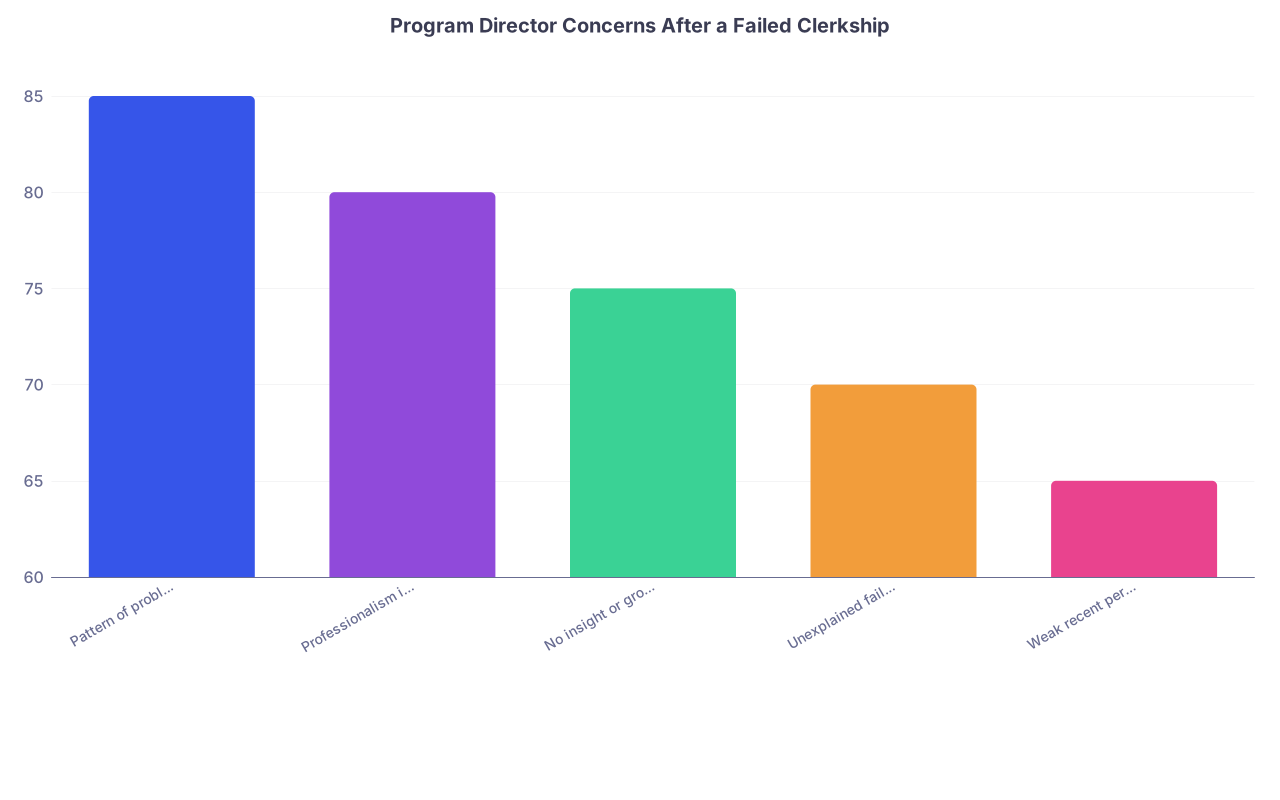
| Category | Value |
|---|---|
| Pattern of problems | 85 |
| Professionalism issues | 80 |
| No insight or growth | 75 |
| Unexplained failure | 70 |
| Weak recent performance | 65 |
They’re less worried about the letter “F” itself and more about:
- Is this a one-off or part of a pattern?
- Did you learn anything and change your behavior?
- Are you going to be a liability on their service?
So you need to consciously build evidence against those fears.
1. Academic / clinical performance after the failure
You want a visible upward slope:
- Pass → High Pass → Honors after the failed rotation
- Strong comments about reliability, initiative, professionalism.
If your school uses narratives heavily, aim for phrases like:
- “Significant improvement over the course”
- “Reliable, conscientious, responsive to feedback”
- “Would happily work with again as a resident”
If you’re still getting “quietly concerning” feedback after the failure, you have a bigger issue. You need intensive coaching: simulated patient encounters, videoed presentations, maybe counseling if there’s burnout, depression, or ADHD lurking under this.
2. Letters of recommendation that explicitly vouch for growth
You need at least one letter that does something like this:
“Student had a challenging early rotation resulting in a failure. When they came to my service afterward, they were candid about that experience, actively sought feedback, and demonstrated substantial growth. Their performance on my clerkship was solid, reliable, and far from the concerns of that earlier evaluation.”
To get that kind of letter:
- Perform well, obviously.
- Tell the attending near the end:
“I’ve had a setback earlier this year with a failed clerkship that I’ve worked hard to learn from. I’m applying to X. If you feel you’ve seen enough of my work and improvement to write a strong letter that reflects that, I’d be very grateful.”
If they hesitate: that’s a no. Move on.
Step 4: Strategy for the Application Itself
Now we turn this from “damage control” into a coherent application story.
1. Where does the failure show up?
Common places:
- MSPE / Dean’s Letter narrative.
- Transcript / grade table.
- Possibly in a professionalism section or separate comment.
You can’t hide this. But you can control how you address it.
There are three main vehicles:
- Personal statement (use sparingly for this)
- Secondary / supplemental questions about academic difficulties
- Interviews
You do not need to write about your failed clerkship in your main personal statement unless:
- It truly reshaped your approach to medicine, or
- It’s inextricably tied to why you’re now a better future resident.
Most people are better off addressing it in:
- A short “academic difficulties” essay, and
- A rehearsed, clean interview answer.
2. How to explain the failure (structure your story)
You want a tight, 3-part explanation: Context → Responsibility → Growth.
Bad version:
“I failed because the attending was harsh and did not like my personality. It was unfair.”
Good version (example):
“During my third-year surgery clerkship, I failed the rotation due to concerns about my reliability and follow-through. I struggled initially to manage the fast pace of the service and missed some critical communication about post-op tasks. That led to justified concerns about whether I was ready for that level of responsibility.
After that rotation, I met with the clerkship director and my dean, did a formal remediation plan focused on task management and communication, and started asking my residents for weekly feedback on subsequent rotations. Since then, I’ve consistently passed and honored my rotations, and my evaluations highlight reliability and responsiveness to feedback. The experience was humbling, but it forced me to build better systems and habits that I’ll carry into residency.”
Notice:
- Clear statement of what happened.
- Ownership without self-flagellation.
- Concrete steps taken.
- Evidence of improvement (later rotations, evals).
That’s what programs want to hear.
Step 5: Letters, Away Rotations, and Specialty Choices
This is where you lean into “show, don’t tell.”
1. Using away rotations (auditions) strategically
If your failed clerkship is in the specialty you want:
- You need at least one strong home rotation in that specialty done after the failure.
- An away rotation can be a make-or-break chance to show: “That failure does not represent who I am now.”
On an away:
- Arrive as the reliable workhorse.
- Be the person who never needs to be asked twice about a task.
- Ask for mid-rotation feedback explicitly and act on it quickly.
Do not:
- Bring up the failed clerkship on day 1.
- Trauma-dump your story onto every resident.
If/when you have a supportive attending who’s seen your work: “Earlier this year I had a failed clerkship that I’ve worked hard to grow from. I’m applying in X, and I’d really value your honest perspective on whether my performance here reflects someone you’d feel comfortable recommending.”
If they light up and say yes: that’s your letter writer.
2. Plan B specialties and match strategy
You’re not required to bail on your dream specialty, but ignoring risk is naive.
Short version:
- If you failed one core clerkship and everything else is solid: you can still aim for moderately competitive specialties.
- If you failed multiple clerkships or have professionalism flags: you’d better build a realistic list, including less competitive fields and prelim programs if relevant.
| Situation | Risk Tier | Strategy Snapshot |
|---|---|---|
| One failed clerkship, strong subsequent evals | Low-Med | Apply broadly, strong explanation, solid LORs |
| Failed core + marginal later evals | Medium | Consider backup specialty, max away rotations |
| Multiple failures or professionalism flags | High | Strong backup plan, heavy advising, broad list |
Use your specialty advisor and dean’s office to build a list. You want someone who’s seen multiple cycles to say, “With your record, I’d apply to about X programs, including Y% in your backup specialty.”
Step 6: Interview Season – Owning It Without Letting It Own You
You will be asked about this. Maybe in every interview. That’s fine—if you’re ready.
1. Build and rehearse a 60–90 second answer
Template you can adapt:
- “What happened” (1–2 sentences)
- “What you learned and changed” (2–3 sentences)
- “How you’ve done since” (2–3 sentences)
Example:
“On my OB/GYN clerkship, I failed the rotation because of concerns about my time management and communication with the team. I underestimated how quickly small lapses—like not closing the loop on lab follow-ups—can erode trust on a busy service.
After that, I sat down with the clerkship director and my dean to build a remediation plan. I started using structured task lists, checking out with residents more systematically, and asking for concrete mid-rotation feedback on every subsequent clerkship. Since then I’ve passed all my rotations and honored two, and my evals call out reliability and follow-through as strengths. The experience was difficult, but it forced me to build systems and habits that I’ll bring with me as an intern.”
Practice it until it’s calm and boring. No trembling voice. No long justification.
2. Don’t over-center the failure
Answer the question, then move on. Do not:
- Circle back to it every time they ask about challenges.
- Preemptively apologize for existing.
Your goal: By the end of the interview, the failure is a footnote, not the headline. Programs should be thinking about:
- Your clinical examples.
- Your curiosity and work ethic.
- Your fit with their culture.
Not replaying your one bad rotation.
Step 7: Common Pitfalls That Actually Sink Applications
I’ve watched people survive a failure and match just fine. I’ve also watched people sabotage themselves afterward.
Here’s what hurts you more than the failure itself:
Blaming everyone else
“The attending had it out for me.” “The residents were toxic.”
Even if there’s truth there, if you can’t find your own contribution, PDs assume the problem will follow you.Minimizing it
Saying “it wasn’t a big deal” when it’s written in your MSPE as a serious concern. Programs read that as poor insight.Letting it become your identity
Walking around like “the student who failed.” You start performing down to that identity. Stop.Not fixing the underlying issue
If your real problem is untreated ADHD, depression, or burnout and you just keep grinding, you’ll carry the same weaknesses into residency. Get actual support—medical, psychological, coaching.Silence in the application
If there’s a major red flag and you never address it anywhere, programs feel like you’re hiding. A short, direct explanation usually helps.
Visualizing Your Recovery Timeline
Here’s roughly how this plays out over the rest of your med school timeline if you’re early in third year:
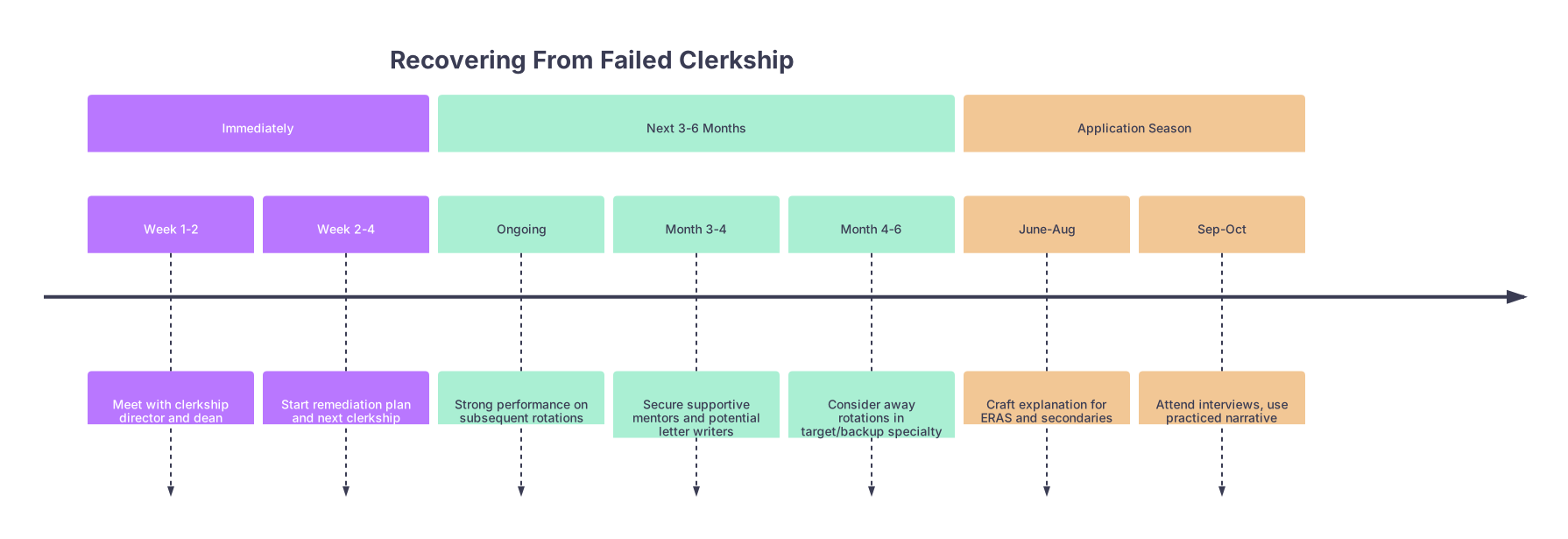
| Period | Event |
|---|---|
| Immediately - Week 1-2 | Meet with clerkship director and dean |
| Immediately - Week 2-4 | Start remediation plan and next clerkship |
| Next 3-6 Months - Ongoing | Strong performance on subsequent rotations |
| Next 3-6 Months - Month 3-4 | Secure supportive mentors and potential letter writers |
| Next 3-6 Months - Month 4-6 | Consider away rotations in target/backup specialty |
| Application Season - June-Aug | Craft explanation for ERAS and secondaries |
| Application Season - Sep-Oct | Attend interviews, use practiced narrative |
You will not fix this in a week. But you can absolutely fix how it defines your record over 6–12 months.
FAQs
1. Should I mention the failed clerkship in my personal statement?
Only if:
- It genuinely shaped your approach to medicine, and
- You can discuss it briefly and constructively without the essay becoming a justification piece.
For most applicants, it’s better handled in:
- The “academic difficulties” section of ERAS/supplementals.
- Interviews.
Your personal statement should primarily sell who you are as a future resident, not relitigate a past mistake.
2. Will one failed core clerkship automatically keep me from matching?
No. One failed clerkship is a concern, not a death sentence. Programs will look at:
- Everything you did afterward.
- Whether the narrative clearly shows growth and stability.
- How strong your letters and clinical performance are post-failure.
I’ve seen people with a failed medicine or surgery clerkship match into those fields. Not into the tippy-top hyper-competitive programs usually, but into solid residencies where they thrived. The pattern and response matter more than the single event.
3. My failure was for professionalism—am I done?
You’re not done, but you are in a more fragile position. Professionalism failures scare programs because they’re hard to fix and high-risk legally.
You need to:
- Complete any formal remediation thoroughly and document it.
- Have mentors who can honestly say, “I’ve seen clear, sustained change in their professionalism.”
- Be especially careful with how you talk about it—own it, show insight, and demonstrate sustained change over time.
If you have multiple professionalism issues, then yes, you’re approaching “may not match” territory unless there’s a very compelling story of change and strong advocacy from your school.
4. Should I delay graduation to repair my record before applying?
Sometimes that’s smart, sometimes it just delays the problem.
Delaying can help if:
- You need extra time to stack good rotations and letters after the failure.
- You’re adding a structured year (research, dedicated clinical year with close mentorship) that clearly strengthens your application.
It’s less useful if:
- You’re just “hiding” for a year without addressing the underlying issues.
- You’re adding non-clinical time that doesn’t show improved performance or professionalism.
Talk with your dean/specialty advisor. Ask directly:
“If I delay and do X, will that significantly change how programs view my application next year?”
If the answer is basically “not really,” think twice before adding debt and delay.
5. What’s one concrete way to show “growth” on paper?
The most convincing combination:
- A failed clerkship early.
- A remediation note.
- Then a string of strong later rotations with written comments like “reliable,” “professional,” “great team member,” plus at least one letter that explicitly says they saw you incorporate prior feedback and improve.
Programs trust other clinicians’ eyes more than your self-report. Your job is to create enough opportunities for good clinicians to see the “new you” and write about it.
Open your MSPE or clinical transcript right now and circle every evaluation that came after the failed clerkship. Ask yourself: “What story do these later comments tell about who I am now?” If that story isn’t clearly stronger and more stable, your next move is to fix your performance on your very next rotation.