
It’s mid-August. ERAS opens in a couple of weeks. You log in to double‑check your letters of recommendation, expecting to see that key attending’s name sitting there as “uploaded.”
Instead you see nothing. You refresh. Still nothing.
You email their assistant and get the auto‑reply: “Dr. X has left the institution and is no longer seeing patients.” HR directory has them listed as “inactive.” Now you’re in the situation nobody talks about: the attending who promised you a strong LOR is gone before they ever wrote it.
Here’s what to do. Step by step. No fluff.
Step 1: Confirm What’s Actually True (Not What You Assume)
First, you need facts. Not panic, and not guesses based on hallway gossip.
Do this today, not “this weekend.”
Check your ERAS LOR status
Look under the Letters of Recommendation section:- Is the LOR actually listed but just “Not Received”?
- Or did you never even create the LOR entry for them?
Confirm whether they really left and when
Use:- Institution email (send a short email; see below)
- Department website
- GME or medical education office
- Their coordinator if they had one
Sample email to their old institutional address:
Subject: Quick letter of recommendation question
Dear Dr. X,
I hope you are doing well. I rotated with you on [service] in [month/year], and you had kindly offered to write a letter of recommendation for my [specialty] residency application.
I wanted to confirm if you are still able to write this letter now that you have transitioned from [Institution]. If so, I can provide ERAS instructions and any materials you need.
Thank you again for your support,
[Name], [MS4, School]Ask your clerkship director or coordinator one direct question
“Has Dr. X officially left the institution, and if so, when was their last day?”
Why this matters: there are three very different scenarios, and your move depends completely on which one you’re in.
| Scenario | Core Problem | Priority |
|---|---|---|
| Left but reachable | Logistics, not impossible | Medium |
| Left and unreachable | Need backup plan fast | High |
| Never actually agreed | You need new writers | Very High |
Step 2: Identify Which Scenario You’re Actually In
Scenario A: They’ve Left, But They’re Reachable and Willing
Best case. They’re gone from the institution, but they:
- Reply to your email
- Are at a new job
- Still remember you
If they say “Yes, I can still write it,” you’re in business. Go to Step 3.
Scenario B: They’ve Left and They’re Basically Ghosted
They:
- Don’t reply to email after 5–7 days
- Have no new contact info on the web or on LinkedIn
- Clerkship director says “We don’t have updated contact info”
You might still track them down, but you cannot count this letter as “real” anymore. You need a Plan B while you keep trying. Go to Step 4.
Scenario C: They Never Clearly Agreed, You Just Assumed
Common pattern:
- They said: “I’d be happy to help your application” or “I’ll support you in applying to IM”
- You interpreted that as “I will write your letter”
- No follow‑up email. No ERAS request. Nothing concrete.
That is not a letter writer. That’s a vague supportive attending you liked. You now need to:
- Treat them as a long‑shot bonus if you can reach them
- Build a new, reliable letter strategy from people who are still actually there
Go to Step 4 and 5.
Step 3: If They’re Willing but No Longer at Your Institution
Here’s the good news: residency programs do not care where your evaluator is now. They care who they were when they supervised you.
Attending left your med school and is now at a private practice in another state? Fine. Happens all the time.
What you need to do:
3.1. Set Up the Mechanics
Explain ERAS and what they actually need to do. Many attendings genuinely have no idea.
Email:
Dear Dr. X,
Thank you so much for being willing to write on my behalf.
I will generate an ERAS letter request form listing your preferred email and title. ERAS will send you a link to upload a PDF of the letter directly. You do not need an institutional affiliation for this; you can use your current role and address.
Could you please confirm the best:
- Professional title and institution
- Mailing address to list in the letterhead (if applicable)
I’ve attached my CV, ERAS personal statement draft, and a short reminder of my work on your service.
Thank you again for your support,
[Name]
Key point: they do not need to be faculty at your current med school to write a valid ERAS letter.
3.2. Give Them a Memory Jogger
People forget. They’ve rotated with 200 students.
Attach:
- CV
- Personal statement (even if draft)
- A one‑page “reminder” of what you did on their service:
Bullet format is fine:
- “July 2024 – 4th‑year sub‑I, inpatient medicine at [Hospital]”
- “Took primary responsibility for 6–8 patients daily; consistently pre‑charted, wrote notes, and presented on rounds”
- “Presented teaching talk on [topic] you requested”
- “You gave me feedback on [date] that I ‘functioned at intern level in patient ownership’”
Do not write them a full letter. Write snapshots that help them recall specifics and your strengths.
3.3. Give a Real Deadline and Gentle Accountability
Most letters die by “whenever you get to it.”
You need a date. And you need to say it out loud.
“Programs begin downloading applications on September 25. It would help me a lot if the letter could be uploaded by September 15 so it’s in my file on time.”
Then:
- Send a polite reminder 7–10 days before the date
- One more reminder 2–3 days before if still not uploaded
- After that, assume it may not happen and prioritize your alternates
It’s not rude. This is your career.
Step 4: Build a Backup LOR Plan Right Now
Even if your departed attending might still come through, you cannot be held hostage by one unreliable variable. You need enough letters from people who are still breathing your hospital’s air and opening their institution emails.
For most specialties:
- 3 letters is expected
- 4 is common
- 1 “department” or “chair” letter is sometimes required
- 1 from your chosen specialty is non‑negotiable
4.1. Audit What You Already Have
Make a quick list of current and potential letters:
- IM Sub‑I attending – already uploaded
- Surgery clerkship director – agreed, not uploaded yet
- Departed Attending – uncertain
- Research mentor – strong, academic IM
Ask yourself:
- If the missing letter never comes, do you still have at least 2 solid specialty‑relevant letters?
- If not, you need to create those now.
4.2. Who Can Replace This Letter?
Here are the usual replacement categories:
- The clerkship director from the same rotation
- Another attending from that rotation who saw you often
- A subspecialist in your target field from another rotation
- A research PI in the same specialty (strong if academic programs matter to you)
- Your sub‑I attending (these are gold in most fields)
If that departed attending was your only letter from that specialty, your priority is to fix that hole.
Example: You’re applying EM. Your single EM attending left after promising a letter. That’s a crisis. You need:
- Another EM rotation (home/away/virtual) with a letter
- OR your EM clerkship director to step in and write something based on evaluations and faculty consensus
This may change your immediate schedule (Step 5).
Step 5: Use Your Remaining Time Strategically (Not Randomly)
You’re not just “hoping for letters.” You’re managing risk and probability.
Let’s be blunt: an “okay but available” letter that actually gets uploaded is more valuable than an “amazing if it ever existed” letter from a ghost.
Think in these buckets:
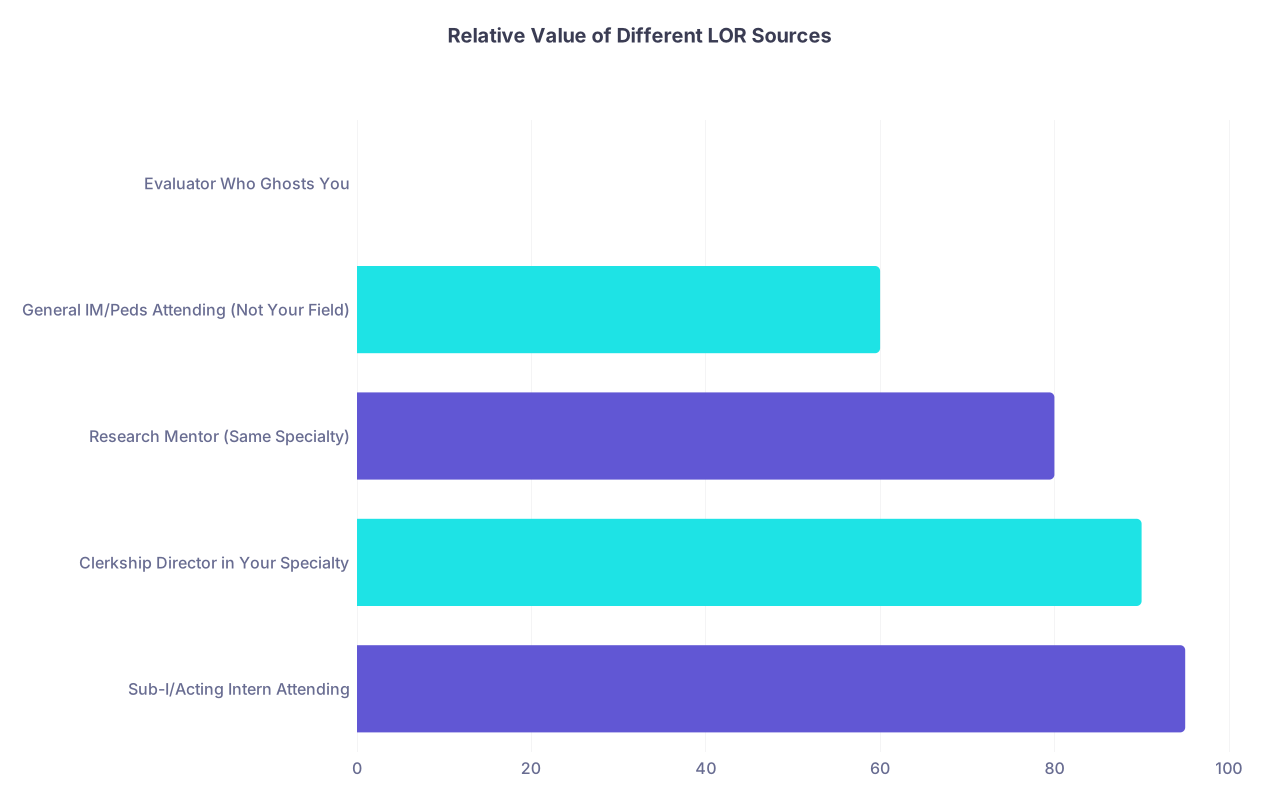
| Category | Value |
|---|---|
| Sub-I/Acting Intern Attending | 95 |
| Clerkship Director in Your Specialty | 90 |
| Research Mentor (Same Specialty) | 80 |
| General IM/Peds Attending (Not Your Field) | 60 |
| Evaluator Who Ghosts You | 0 |
5.1. If You Still Have Time for Another Rotation
If it’s early enough in the year (July–September), you might be able to:
- Add a sub‑I or acting internship in your target specialty
- Extend or repeat time with an attending who already knows you
- Do a short 2-week “selective” with someone letter‑friendly
During that time:
- Show up early, act like an intern
- Ask for feedback halfway through
- If the feedback is good, ask directly:
“Based on how things are going, would you feel comfortable writing a strong letter of recommendation for my [specialty] residency application?”
You’re not chasing perfection here. You’re building a reliable floor of solid letters.
5.2. If You Don’t Have Time for Another Rotation
If you’re trapped by schedule, interviews, or life, then:
- Lean hard on your best sub‑I letter
- Get the clerkship director letter in your field
- If required, secure the department/chair letter (often they’re formulaic but acceptable)
And then consider broadening your writer list:
- That attending on nights who saw you crush 12 admissions
- The fellow who technically can’t write the letter alone but can co‑sign with their attending
- The research mentor who knows you very well, even if not the same specialty, especially for less competitive fields
Ask yourself: “If my ghost attending vanished from Earth, would my application still have three decent letters that actually exist?” If yes, you’re safer than most of your class.
Step 6: Work the Institutional Angle (Quietly and Professionally)
Sometimes this problem is solvable with one email to the right person instead of six frantic texts to co‑students.
Targets:
- Clerkship director
- Program director in your intended specialty at your home institution
- Dean of students or “Associate Dean for Student Affairs”
- GME office if the departed attending was a core faculty member
Your ask is simple:
“Dr. Y,
I rotated with Dr. X on [service] and they agreed to write a letter for my [specialty] residency application. They have since left [Institution], and I have not been able to confirm if they can still submit a letter.
Given the importance of [specialty] letters, I wanted to ask how students in this situation typically proceed. Are there faculty who can write a letter based on my clerkship evaluations, or would you recommend I request a letter from [other attending/you] instead?
I’m happy to share my evaluations and CV if that helps.
Thank you,
[Name]”
I’ve seen clerkship directors do the following:
- Access all faculty evaluations and write a composite letter
- Ask another attending who rated you highly to write one
- Offer to write one themselves if they remember you reasonably well
Is that letter going to sound as intimate as the one from Dr. X? Probably not. But it will exist. Programs understand turnover.
Step 7: Decide How to Handle This in Your Application (And If You Even Mention It)
Programs see a lot of chaos behind the scenes. Faculty leave. Rotations change. Letters fall through. You are not the first.
Should you explain this anywhere? Usually, no.
You don’t write in your personal statement:
“I was supposed to get a letter from Dr. X but they left without writing it.”
You don’t put in the “additional info” section:
“One of my letters is missing because…”
It makes you sound like you’re making excuses or throwing someone under the bus. Program directors hate that.
You do:
- Make sure the letters you have tell a cohesive story: reliable, hardworking, good team member
- Focus your personal statement on your path, not your admin headaches
- Use interviews, if asked, to explain briefly and calmly:
If an interviewer directly asks:
“Did you get letters from both your EM rotations?”
You can say:
“From my first EM rotation, yes. For my second, the attending I worked most closely with left the institution shortly after my rotation, before the letter could be submitted. I reached out but never heard back, so I focused on securing strong letters from my sub‑internship and our clerkship director instead.”
No drama. No victim energy. Just problem → solution.
Step 8: Handling Timing Pressure (ERAS Opening vs. Letter Arrival)
This is the painful part. You have to decide when to certify and submit your application in the context of shaky letter timing.
Reality:
- Programs begin reviewing early applicants quickly
- Letters can be added later; you do not need all letters in to submit ERAS
- A late but strong letter is better than waiting forever and submitting late
General rule I stand by:
- Submit ERAS on time (within the first few days of opening for program download)
- Make sure at least 2 letters are assigned before you apply
- Continue to chase the remaining letter(s) aggressively over the next 2–3 weeks
- Add each letter to your programs as it arrives – they see updates
Where students screw this up:
- They wait to submit until “all 4 letters are in.” The fourth never comes. They submit late.
- They submit on time but never actually follow up with letter writers. Half their apps sit with 1 letter in October.
Set a hard internal timeline and stick to it:
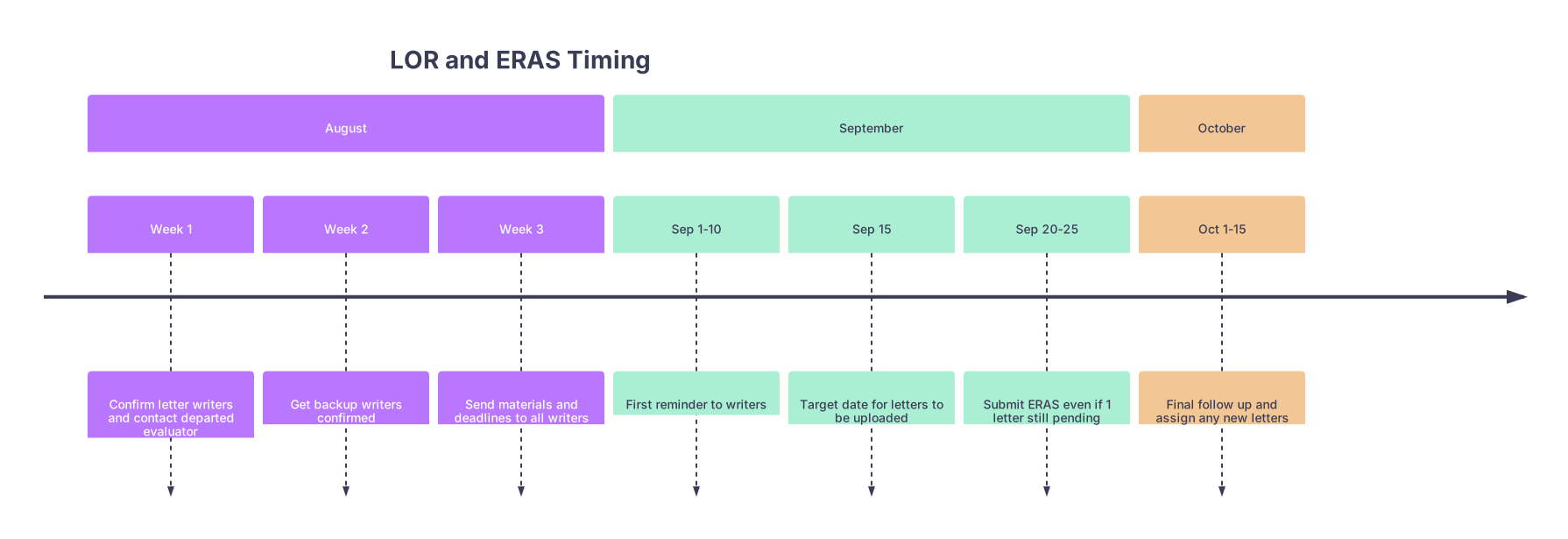
| Period | Event |
|---|---|
| August - Week 1 | Confirm letter writers and contact departed evaluator |
| August - Week 2 | Get backup writers confirmed |
| August - Week 3 | Send materials and deadlines to all writers |
| September - Sep 1-10 | First reminder to writers |
| September - Sep 15 | Target date for letters to be uploaded |
| September - Sep 20-25 | Submit ERAS even if 1 letter still pending |
| October - Oct 1-15 | Final follow up and assign any new letters |
If your ghost attending suddenly uploads a glowing letter in mid‑October, fantastic. You add it then. It can still influence later invites and ranking.
Step 9: Prevent This From Ever Happening to You Again
Yeah, too late for this cycle, but not too late for future rotations, future letters (fellowship, jobs, etc.).
Here’s how this usually goes wrong:
- No clear ask
- No written confirmation
- No deadline
- No backup plan
From now on:
Ask explicitly and early
“Would you feel comfortable writing me a strong letter of recommendation for [specialty] residency?”
If they hesitate or say “sure, just remind me sometime,” that’s a no. Move on.Get it in writing
A simple email recap:“Thank you again for agreeing to write my letter for [year] [specialty] applications. I’ll send my CV and statement by [date].”
Preload ERAS with their info and send the request within a week of the rotation ending, odds of success drop sharply after that.
Always have at least one more potential writer than you actually need
You want a margin of error. People move, get sick, lose interest, burn out.
Quick Reality Check
This whole situation feels personal, but it’s not. Faculty leave. Clinics shut down. Admin changes. Most PDs have seen multiple cycles where a great student lost their best letter because someone changed jobs.
They judge you more on:
- The pattern across all your letters
- The reliability and timing of your file
- How you carry yourself in your personal statement and interview
Not on whether your favorite attending followed through on time.
Key Takeaways
- Treat the departed evaluator as a bonus, not a cornerstone. Build a backup LOR plan from people who are still reliably reachable and in your specialty.
- Submit ERAS on time with the best letters you actually have, then keep adding as they arrive. Don’t hold your whole application hostage to one maybe‑letter.
- Going forward, get explicit commitments, written confirmation, and one extra potential writer beyond what you need. Turn “I hope they write it” into “I know at least three people actually will.”