
The idea that audition electives alone prove you are “ready” for residency is wrong. Programs judge advanced readiness long before your away rotations—through what you do on consult and subspecialty services in your own institution.
Let me break this down specifically.
If you use consult and subspecialty rotations the way most students do—shadow, write a few notes, nod along on rounds—you will get generic comments like “pleasant to work with” and “reads around cases.” That does nothing for your application.
If you treat them as rehearsals for being a junior consultant, you can generate exactly the kind of evidence program directors care about: independent reasoning, comfort with complexity, ability to communicate across teams, and ownership of follow-up. That is how you show advanced readiness.
This is not theory. I have watched letters from a 2‑week consult block move an applicant from “borderline” to “we need to interview this person.” And I have seen students waste a prime subspecialty month by acting like a quiet observer.
You are in the “RESIDENCY MATCH AND APPLICATIONS” phase. That means every clinical move needs to be engineered toward one outcome: concrete, documentable proof that you can function at an intern level on day one.
Consult and subspecialty rotations are your most underrated tools for that.
1. Why Consult and Subspecialty Rotations Matter More Than You Think
Programs do not read your transcript and think, “Completed cardiology elective – must be advanced.” They look for signals. These rotations can generate several of the strongest signals in your entire file:
- A powerful subspecialty letter that says, “This student already functions like a first-year resident.”
- Specific narrative examples in your MSPE from consult-heavy settings showing initiative, follow-through, and reasoning.
- A coherent story in your personal statement about your role in complex care and inter-team communication.
- Evidence that you understand the ecosystem of your chosen specialty—not just the wards, but the services that orbit around them.
Here is why consult and subspecialty services are uniquely positioned to demonstrate readiness:
– They are built on question-driven medicine: “Why is this patient decompensating?” “Can this person go to surgery?” “What is the right diagnostic pathway?”
– They demand synthesis across systems and services, exactly what interns struggle with.
– They give attendings a direct view of how you interact with other teams, not just your own.
On wards, you can hide a little. Follow the intern, copy the format, present the same 3 patients. On a consult team, if you do not know why you are being asked to see Mrs. X in room 431, it shows immediately.
The students who get called “advanced” do three consistent things on these services:
- Define the consult question precisely
- Generate and justify a plan tailored to that question
- Close the loop with both the primary team and the patient
That is the bar.
2. Different Services, Different Signals: What Each Rotation Can Prove
(See also: Maximizing Shelf Exams While Still Impressing on the Wards for detailed guidance.)
Not all consult and subspecialty rotations advertise the same strengths. If you are targeting the Match, you should be thinking transactionally: “What can this service say about me that will move the needle?”
Let me map out a few common ones.
| Rotation Type | Primary Signal of Readiness |
|---|---|
| General Medicine Consults | Systems thinking, triage, & peri-op skills |
| ICU Consult/Support | Comfort with acuity & escalation decisions |
| Cardiology Consults | Risk stratification & test selection |
| ID Consults | Diagnostic reasoning & stewardship |
| Nephrology Consults | Longitudinal ownership & precision prescribing |
General Medicine Consults (or Pre-op / Co-management services)
What it broadcasts:
- You can synthesize multiple comorbidities into a coherent risk assessment.
- You can prioritize: what matters today, before surgery, vs what can wait.
- You understand “consult question” vs “please admit this patient for us.”
How to behave:
- On pre-op consults, never recite risk calculators without interpretation. Say: “RCRI is 2; that puts her around 6–7% risk of MACE. I would recommend proceeding with surgery, but with telemetry and aggressive post-op pulmonary hygiene.”
- Document clearly what you are answering: “Consult reason: pre-operative risk assessment for elective hip arthroplasty.”
- When the primary team asks for “medical optimization,” spell out the trade-offs: “We can delay for 2–3 weeks to optimize volume status, but that needs to be weighed against fracture immobility and VTE risk.”
Readers of your application will see a strong gen med consult letter as proof that you can handle cross-cover pages and night float decisions. That is enormous.
ICU or Critical Care Consults
This does not have to be a full ICU rotation (though that helps). Many hospitals have rapid response teams, MICU consults, or stepdown co-management.
What it broadcasts:
- You do not freeze when vitals look ugly.
- You understand thresholds for escalation: pressors, transfer to ICU, urgent procedures.
- You have some early comfort with vents, drips, and “sick but stable” vs “sick and crashing.”
To look advanced:
- Speak the language of trends: “MAPs have been drifting from low 70s to low 60s despite 2L of fluid. Urine output is 0.2 mL/kg/hr. Lactate rising from 2.2 to 3.8.”
- Anticipate the next step: “If she does not respond to another 500 mL, I would start norepinephrine and call for ICU bed placement.”
- Do not present a shock patient like a ward SOAP note. Give the one-line, the hemodynamics, the likely etiology, and what you think the next 60–120 minutes should look like.
When a critical care attending writes “She was unusually composed in high-acuity situations and made appropriate first-pass plans,” program directors pay attention.
3. How to Operate on a Consult Service Like an Almost-Resident
There is a predictable gap between MS3 behavior and resident behavior on consults. You close that gap, you look advanced. Let us be specific.
Step 1: Own the Consult Question
Weak student: “We were consulted on Mr. Smith for help with COPD.”
Advanced student: “We were consulted for evaluation of whether Mr. Smith, with severe COPD and recent hospitalization, is optimized for elective colectomy next week, and to advise on perioperative pulmonary risk and management.”
Every note, every call, every presentation must answer:
What are they actually asking us?
Ask explicitly when you get the page: “Just to confirm, what is your main concern so I make sure we address it in our note?” Then you repeat that back on rounds and in your documentation.
That one move alone will make you look more senior.
Step 2: See the Patient Like the Buck Stops with You
This is where most students fall short. They skim the note, listen on rounds, maybe briefly examine.
On consults, you:
- Review the chart before entering the room. Not just the H&P—trend labs, vitals, imaging, prior echoes, prior scopes.
- Ask targeted questions linked to the consult. For syncope consult: prodrome, triggers, posture, exertion, incontinence, injuries.
- Document a focused but high-yield exam: “Orthostatics performed; HR from 72 to 92, BP from 132/78 to 102/64 with mild lightheadedness.”
You are not “checking the box.” You are interrogating the case to answer a specific clinical question.
Step 3: Build a Plan That Sounds Like It Came from a Junior Fellow
You are still a student. You will miss things. That is fine. What is not fine is having no structured thinking.
Structure your plan in a way attendings recognize instantly:
- Address the consult question explicitly.
- Lay out your reasoning in short, prioritized points.
- Propose a concrete plan with contingencies.
For example, on a cardiology consult for chest pain:
- “Low-intermediate risk for ACS given age, risk factors, and atypical symptoms; initial troponins negative x2, non-diagnostic ECG.”
- “I would recommend serial troponins to 3 or 4 total, repeat ECG with any symptom change, and risk stratification with an outpatient stress test if biomarkers remain negative.”
- “If pain recurs with dynamic ECG changes or troponin elevation, upgrade to ACS pathway with heparin and urgent cath discussion.”
Do that consistently, and your notes will read like resident notes. Which is the goal.
Step 4: Close the Loop Like a Professional
The best consult students understand that the consult is not over when the note is signed. They:
- Call or message the primary team with the bottom line: “Cardiology recommends…”
- Clarify follow-up responsibilities: “We will follow daily until troponins are downtrending” vs “We will sign off if no recurrent episodes.”
- Communicate with the patient: “We are the [service] team; your primary doctors asked us to see you because…”
This is where strong letters are born. An attending sees you:
- Proactively updating surgery about a new pulmonary rec.
- Catching that the anticoagulation you recommended was never started and fixing it.
- Coming back the next day to re-evaluate a borderline patient without being asked.
That is advanced readiness.
4. Choosing Rotations Strategically for the Match
At the “residency match and applications” phase, your schedule is not just about learning. It is a portfolio design problem: which rotations will generate the right kind of evidence for the specialty you are applying to?
Let us be blunt. There are smart and dumb ways to build this.
Core Principle: One Home-Base, One Adjacent, One High-Complexity
For most competitive and semi-competitive specialties, I recommend aiming for three types of consult/subspecialty rotations before ERAS submission:
Home-base rotation in your chosen field
– IM applicant: General medicine consults, hospitalist co-management, or advanced inpatient medicine.
– Surgery applicant: Surgical subspecialty consults (vascular, trauma consults, ACS).
– EM applicant: ICU consult/control service or hospitalist consults.Adjacent field that highlights breadth
– IM → Cardiology, ID, Nephrology.
– Surgery → Anesthesia pre-op clinic, SICU, interventional radiology consults.
– EM → Cardiology, ICU, toxicology.High-complexity or decision-heavy service
– Any ICU consult support.
– Transplant services.
– Oncology inpatient or heme/onc consults.
You do not need to do all three at once, but if your transcript and MSPE show you functioning in these environments with strong comments, it is very hard for programs to argue you are “unproven.”
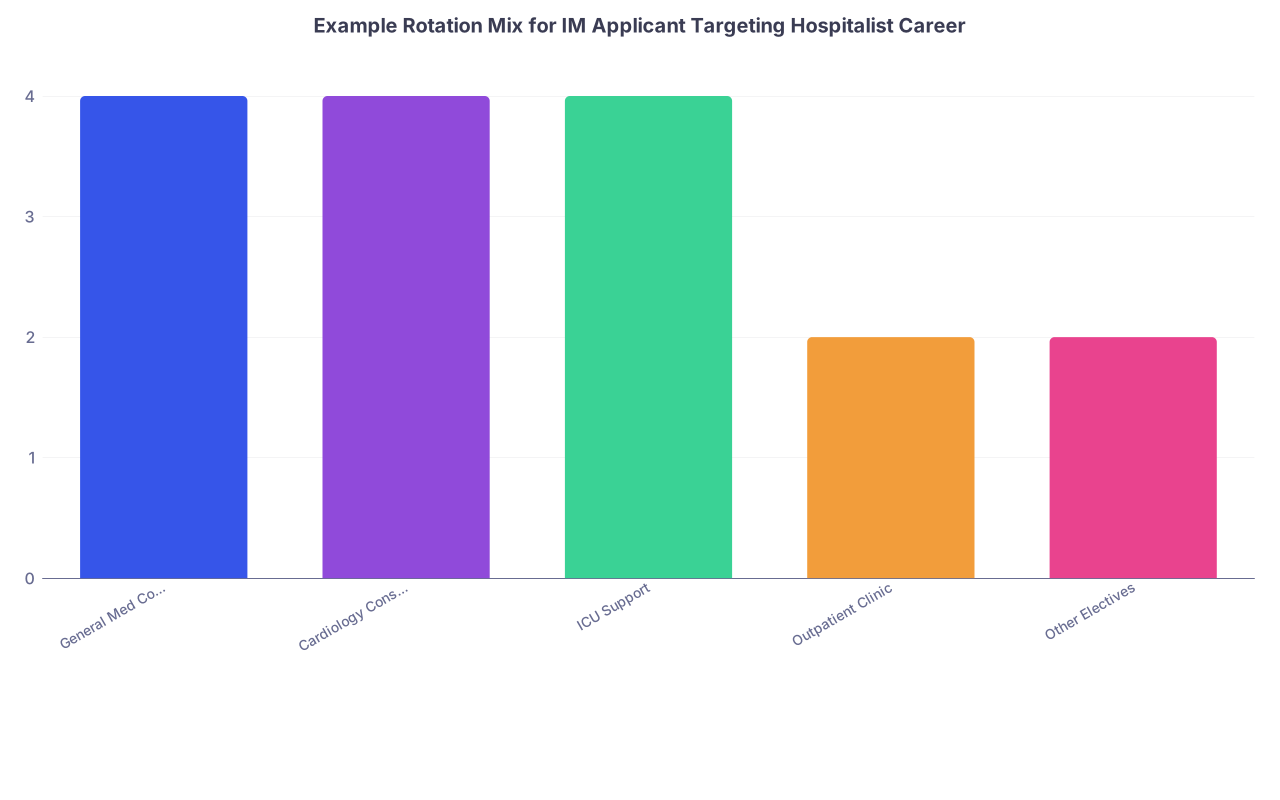
| Category | Value |
|---|---|
| General Med Consults | 4 |
| Cardiology Consults | 4 |
| ICU Support | 4 |
| Outpatient Clinic | 2 |
| Other Electives | 2 |
(Values above are weeks—an example 16-week senior schedule weighted toward consult-style experience.)
Timing Relative to ERAS
Best-case timing:
- One strong consult/subspecialty month in late MS3 or very early MS4 → letter-generating.
- Another in the first half of MS4 → reinforces pattern of performance.
- Have at least one key attending who can submit a letter by August.
Worst move: stacking all consults after September when your ERAS is already in and letters are locked.
5. Converting Rotation Performance into Application Gold
Performing well is half the battle. You also need to extract the performance into your application materials.
A. Letters of Recommendation: What to Ask For Explicitly
Do not just ask, “Can you write me a strong letter?” That yields bland content.
Say something like:
“I am applying to internal medicine and I am trying to show that I can already function close to an intern on consult services. If you feel it is accurate, I would be grateful if you could comment specifically on my:
- ability to define and answer consult questions,
- independence in formulating assessments and plans,
- communication with primary teams and patients,
- reliability with follow-through and re-assessment.”
You are not scripting them. You are focusing them on the exact domains that scream “advanced readiness.”
Good letters from consult services sound like:
- “She routinely called the primary team to clarify vague consults and reframed them into actionable questions.”
- “By the second week, his consult notes required minimal edits and his plans were appropriate, with only minor adjustments.”
- “I allowed her to see new consults first and propose a management plan, which was frequently implemented with little modification.”
That is gold.
B. MSPE and Clerkship Comments
You have less control here, but you can seed the narrative.
When your clerkship director or site director asks for reflection or feedback at the end, you can say:
“I found consult work especially rewarding because it stretched my independent reasoning and inter-team communication. I tried to consistently clarify the consult question, propose my own plan, and personally update the primary team and the patient.”
Occasionally, those exact phrases show up in the final comments. Which is exactly what you want.
C. Personal Statement and Experiences
You do not need to write a love letter to cardiology or ID. What you should do is:
- Use one or two very specific consult cases to illustrate how you think and act.
- Show that you understand the resident role in consult-heavy settings.
Bad example:
“I enjoyed my cardiology rotation and realized how fascinating the heart is.”
Better:
“On cardiology consults, I learned to start every new consult by clarifying the question. When the primary team asked, ‘Rule out NSTEMI,’ I re-framed the consult as, ‘Is this troponin elevation type 1 MI, type 2 ischemia, or a non-ischemic process, and what are the implications for antithrombotic therapy?’ That shift forced me to integrate the clinical picture, not just chase numbers.”
That is a candidate who understands what residents do.
6. Specialty-Specific Angles: How Different Fields Read These Rotations
Let us be specialty-specific for a moment. Because the same rotation looks very different to different programs.
Internal Medicine
They want to see:
- You are comfortable with scattered, multi-problem patients.
- You can call balls and strikes on who is “sick” and who just needs good medicine.
- Your consult work shows systems thinking, not just organ-by-organ recs.
Strong evidence:
- Gen med consults, nephrology, ID, cards, or transplant.
- Comments like “functioned at or above intern level” from medicine-based consults.
General Surgery
Surgery cares about:
- Safe perioperative judgment.
- Reliability and follow-through when patients leave the OR.
- Comfort with pre-op optimization and post-op complications.
High-yield rotations:
- Acute care surgery consults.
- Vascular surgery consult-heavy services.
- SICU or trauma ICU consults.
A letter saying, “This student routinely saw ED consults first, gathered key data, and presented a clear plan to the senior resident,” has more impact than another generic floor rotation.
Emergency Medicine
EM programs watch for:
- Early recognition of sick vs not sick.
- Willingness to call consults with a clear question and reasonable data.
- Ability to respond when specialty services push back.
Great prep rotations:
- ICU consults, toxicology, trauma, cardiology consults.
- Gen med consults (for the “can this be admitted to medicine tonight?” triage mindset).
If your EM letters mention, “He already understands how to formulate targeted consult requests and accept recommendations critically,” you are ahead of many applicants.
Pediatrics, OB/GYN, Psychiatry
Same principles, different flavor:
Pediatrics: NICU consults, PICU, pediatric subspecialty clinics (cardiology, heme/onc). Focus on growth over time, family communication, longitudinal follow-up.
OB/GYN: MFM consults, Gyn-onc, anesthesia pre-op for complex pregnant patients. Show that you can think beyond the pelvis—cardiac, pulmonary, heme issues in pregnancy.
Psychiatry: C/L psych consults, med-psych units. Emphasize inter-team communication, risk assessment, safety planning, and comfort with medically complex psych patients.
7. Concrete Behaviors That Separate “Advanced” from “Fine”
Let me list the patterns I see over and over.
Advanced students on consult/subspecialty services:
- Arrive with a running list of all active consults, who requested them, and what the questions are.
- Pre-round on new consults before attendings, even if not required, and write their own skeleton assessment and plan.
- Look up one key article or guideline per day relevant to an active patient and briefly summarize for the team.
- Track follow-up labs, imaging, and responses to therapy for “their” consults without prompting.
- Call the primary team with the attending in the room, succinctly present the recs, and gracefully handle questions.
Middling students:
- Show up on time, wait for assignments, follow the team passively.
- Present the data but rarely commit to a plan (“maybe we could consider…”).
- Depend on the intern or resident to contact the primary team.
- Check out mentally once the note is written.
One more thing: advanced students recover from being wrong well. They propose thoughtful plans, listen to corrections, adjust, and do not shut down. Attendings respect that.
8. Using Visuals and Tools to Track Your Growth
If you are serious about optimizing these rotations, you should be tracking something beyond “feeling more confident.”
Here is a simple mental tracker I have had students use:
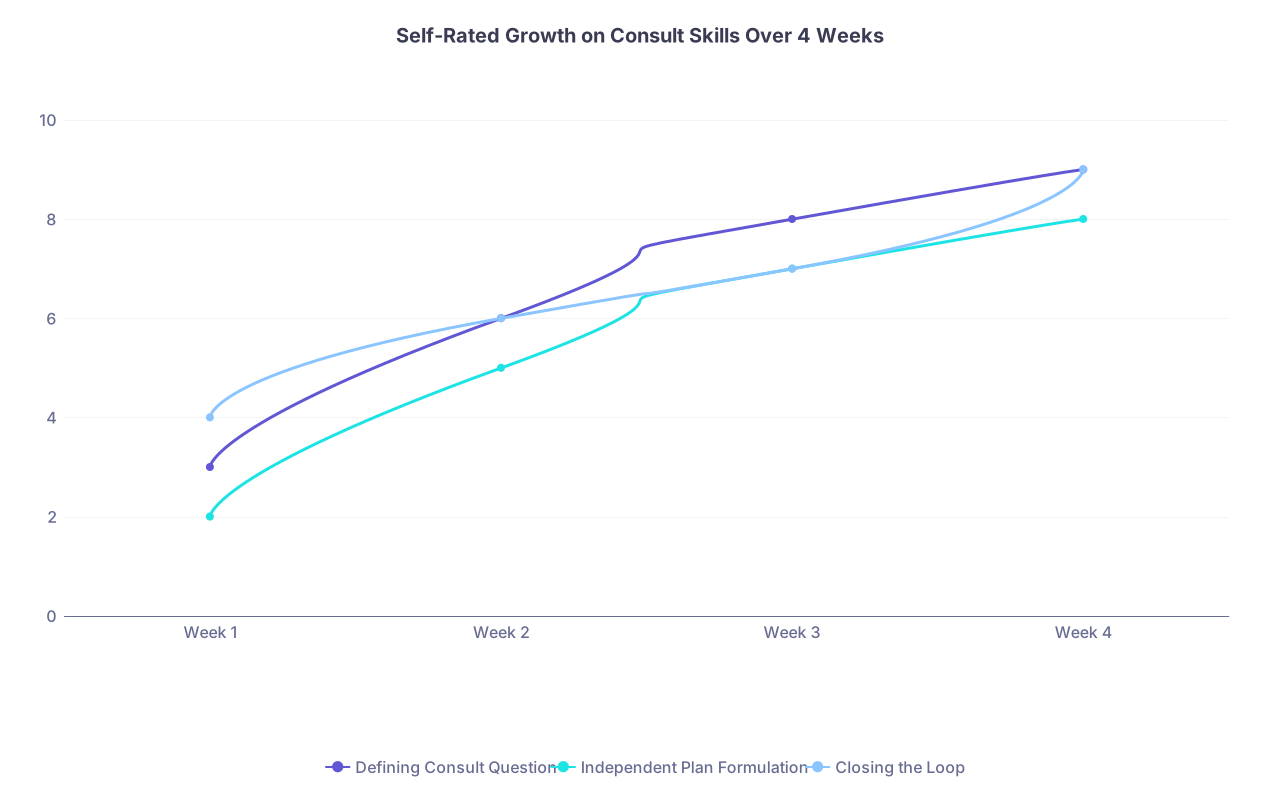
| Category | Defining Consult Question | Independent Plan Formulation | Closing the Loop |
|---|---|---|---|
| Week 1 | 3 | 2 | 4 |
| Week 2 | 6 | 5 | 6 |
| Week 3 | 8 | 7 | 7 |
| Week 4 | 9 | 8 | 9 |
You rate yourself daily or weekly on a 1–10 scale in three domains:
- How clearly did I define today’s consult questions?
- How independently did I generate plans (even if later corrected)?
- How reliably did I close the loop with teams and patients?
If you are honest, that curve will usually jump between Week 1 and Week 3. Mention that growth story explicitly in interviews if asked about a time you grew into more responsibility.
FAQ (Exactly 6 Questions)
1. Do I need a consult or subspecialty letter for every residency specialty?
No. For some fields (like family medicine), a strong inpatient medicine letter plus a primary care letter may be enough. But a subspecialty/consult letter that highlights advanced reasoning is nearly always a positive, especially for IM, EM, surgery, and competitive fields. If you can get one good consult-based letter, do it.
2. What if my consult rotation is only 2 weeks—can that still help my application?
Yes, but you must compress your impact. From day one, tell the attending you want frequent feedback and are eager to take “ownership” of specific consults. See a smaller number of patients but follow them intensively. A short, intense rotation with strong comments beats a passive 4‑week block every time.
3. How do I avoid stepping on resident toes while acting more “independent”?
You loop them in early. Say to the senior: “I would like to practice seeing new consults and forming my own plans. I will always run everything by you before talking to the attending or primary team.” Then actually do that. You are not going rogue; you are doing first-pass thinking under supervision.
4. What if my consult attending seems disengaged or not very teaching-oriented?
You adapt. Bring them organized, concise presentations and 1–2 explicit questions per day. “I am struggling with whether this troponin bump changes our plan—can I run my thinking by you?” Even crusty attendings respond to sharp, concise questions and clear effort. And you can still extract strong cases and narratives for your application, even if the letter itself ends up coming from someone else.
5. How do I showcase consult and subspecialty experiences in ERAS beyond letters?
Use them in your Experiences section and personal statement with specific language: “clarified vague consult requests,” “coordinated recommendations between cardiology and surgery,” “followed complex nephrology consult across multiple admissions.” Interviewers read those phrases differently than generic “participated in patient care.”
6. Is it a mistake to do subspecialty consult rotations outside my target field?
Not if you are intentional. An EM applicant doing nephrology consults can spin that into strengths in electrolyte management and dialysis decisions. A surgery applicant on ID consults can emphasize post-op infection management. The key is to explicitly connect the skills you used on that service to the demands of your chosen specialty, both in your interviews and written materials.
With these consult and subspecialty strategies wired in, you are not just “collecting” electives anymore—you are building a portfolio that proves you can already think and act like an intern. The next step is using your interviews to make those stories land in the room. But that is a conversation for another day.


