

It is late February of third year. Your classmates are talking in circles about away rotations, Sub‑Is, Step 2 timing, and “keeping doors open.” You are staring at the scheduling portal with twelve empty blocks and a sinking feeling that whatever you put there will either lock you out of a specialty or make you look scattered.
This is where fourth‑year either works for you or against you.
The best applicants do not just fill slots. They design a schedule that tells a coherent, on‑theme story: “This person is becoming an intern in X specialty and already behaves like one.” The mediocre schedules look like a random buffet of electives that could belong to anyone.
Let me walk through how to build that first kind of schedule—one that quietly but unmistakably sells your career narrative to residency PDs.
Step 1: Decide on the Story You Are Actually Telling
Before you drag a single rotation into a slot, decide what story the schedule needs to tell.
Not “I like people and procedures.” That is personal statement fluff. I mean what a PD can infer in 20 seconds scanning your MS4 year.
Three common story types:
Single‑specialty commitment
“This student is clearly all‑in on internal medicine / EM / OB / etc.”Specialty + subspecialty interest
“This student is applying IM with a serious interest in cards / heme‑onc / pulm‑crit.”Borderline or switching narrative
“This student started down one path (e.g., surgery), pivoted to another (e.g., anesthesia), and now the schedule explains and supports that shift.”
If you cannot say your story in one sentence, PDs will not either. And if they cannot say it, they will not remember you.
So write it down in a single sentence, literally. Example:
- “I am an aspiring academic internist with a strong interest in oncology and medical education.”
- “I am a future emergency physician with proven performance in high‑acuity settings and a track record of systems‑level thinking.”
- “I am pivoting from orthopedics to PM&R after sustained exposure to neuro‑rehab and thoughtful advising.”
Your fourth‑year calendar needs to back that up. Consistently.
Step 2: Understand What PDs Really Look For in Your Fourth‑Year
PDs are not impressed by “busy.” They are looking for a few specific signals when they scan your MS4 schedule:
| Schedule Feature | PD Interpretation |
|---|---|
| Early Sub-I in specialty | Committed, decisive, good planning |
| Multiple same-specialty aways | Strong interest, maybe regional targeting |
| Step 2 taken by Aug/Sept | Organized, risk-aware |
| Critical care / wards mix | Building intern-ready skills |
| Random unrelated electives | Unclear focus, weak advising |
They want to see:
Proof you can function like an intern.
That is why Sub‑Is/Acting Internships and ICU rotations matter. They simulate PGY‑1 reality.Consistency of interest.
If you say you love Pediatrics but did one Peds Sub‑I and then six months of Derm, Ophtho, and Radiology, they notice the contradiction.Strategic thinking.
Early specialty exposure, proper Step 2 timing, and logical sequencing (Sub‑I → away → interview month) read as “this person can plan and anticipate.”Risk management.
A back‑up plan, especially for competitive specialties, that is honest but not chaotic: e.g., two ortho aways plus strong transitional or prelim medicine positioning, not orthopedics + dermatology + neurosurgery fantasyland.
Once you internalize those filters, building the schedule becomes less “What sounds cool?” and more “What reinforces my narrative under each of those lenses?”
Step 3: Anchor Rotations – What MUST Be on the Schedule
Think of fourth year as a spine with required vertebrae. You fill in around them.
For almost everyone applying in the regular Match, there are five “anchor” categories:
- Home Sub‑I / Acting Internship in your intended specialty
- At least one rotation showing robust inpatient responsibility (often medicine Sub‑I or equivalent)
- One or more away rotations (for many—not all—specialties)
- Dedicated Step 2 CK timing
- One or two critical care rotations (ICU, ED in some fields)
Let me break these down by specialty family, because the pattern is repeatable.
Medicine‑Type Applicants (IM, Peds, Neuro, Psych with med flavor)
For internal medicine, pediatrics, and often neurology:
- Home IM (or Peds) Sub‑I by July–September
- Another inpatient month (medicine wards, oncology, hospitalist team)
- At least one ICU month (MICU / PICU / NICU depending on career angle)
- One away rotation if geography or competitiveness justifies it (e.g., academic IM or Peds targeting a region)
- Step 2 CK finished by mid‑August if you have any doubt about your Step 1
Surgical‑Type Applicants (GS, Ortho, ENT, Urology, Neurosurgery, etc.)
For surgical fields, the calendar pressure is harsher.
They want:
- Home specialty Sub‑I early (often June–July if your school allows)
- 1–3 away rotations in your specific surgical field by August–October
- One ICU month (SICU often preferable, but any ICU is better than none)
- A solid general medicine or surgery ward month to show you can manage floor patients, not just operate
- Step 2 CK timing that does not destroy your aways (more on that later)
Emergency Medicine
EM programs pay disproportionate attention to:
- EM rotations that generate SLOEs (Standardized Letters of Evaluation)
- Typically one home EM rotation and one away EM rotation, both early enough that SLOEs arrive before rank list decisions
- A medicine Sub‑I or strong ward experience
- ICU exposure (e.g., MICU or SICU)
- Step 2 CK on the earlier side if Step 1 is pass/fail or marginal
If you apply EM without at least two strong SLOEs, you are handicapping yourself. Your schedule must produce those letters.
Primary Care / Less Competitive Specialties
For FM, Psych, some Peds, and smaller fields where away rotations are less critical:
- One home Sub‑I in the specialty
- A strong inpatient month (wards or ICU)
- Strategic electives showing niche interest (addiction, geriatrics, women’s health, rural medicine, etc.)
- Step 2 CK scheduled such that your score can rescue a weaker Step 1 if necessary
Once these anchors are placed, you can see what is left to shape your “story” and your sanity.
Step 4: Map the Calendar – Quarter by Quarter Logic
The academic year is not symmetric. What you do in July is not interpreted the same way as what you do in February.
Here is the high‑yield pattern by quarter.
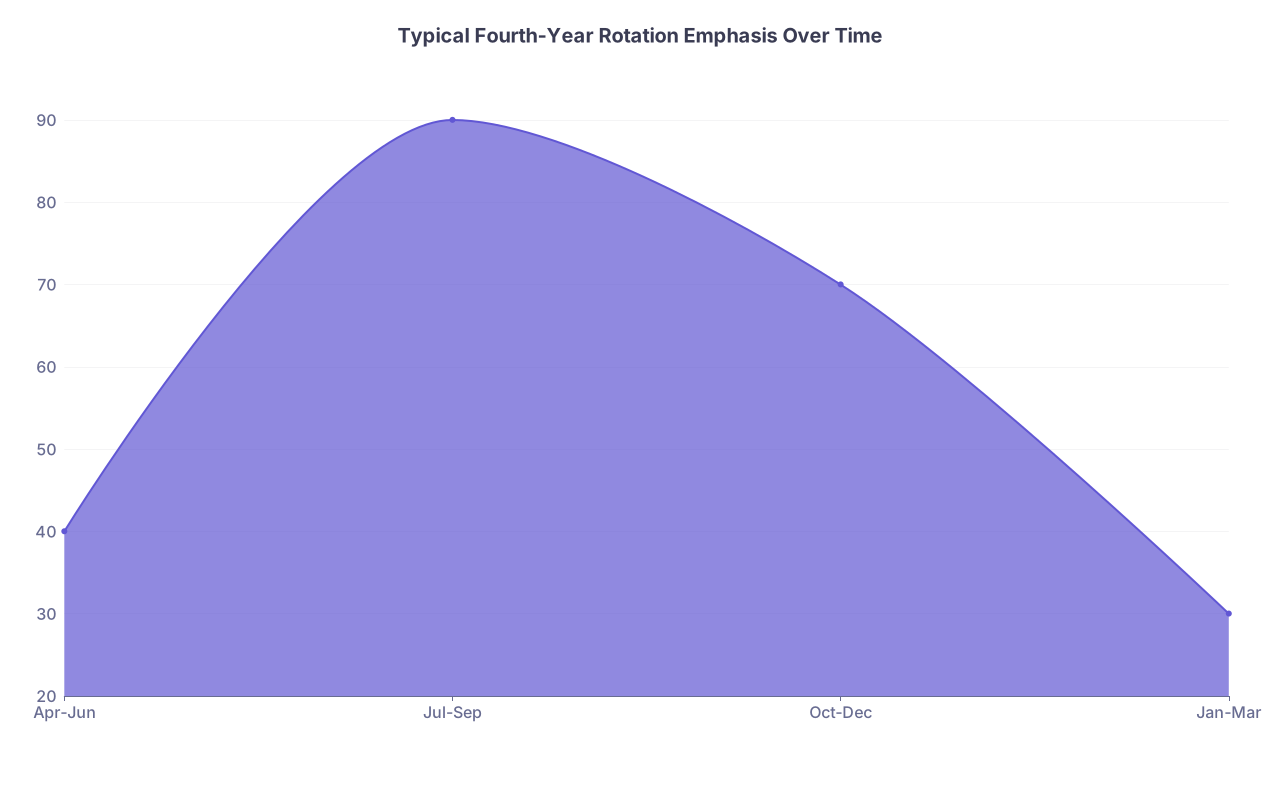
| Category | Value |
|---|---|
| Apr-Jun | 40 |
| Jul-Sep | 90 |
| Oct-Dec | 70 |
| Jan-Mar | 30 |
(Values are rough “career-impact intensity” on a 0–100 scale.)
Early Q1 (Spring of MS3 / Pre‑MS4 start)
Tasks, not rotations:
- Decide on a working specialty choice with your advisor
- Identify programs where away rotations actually help (some fields, they do not)
- Reserve Step 2 dates and major rotations at your institution—top slots go fast
If your school allows an “early” Sub‑I at the tail end of third year, that can be powerful. Strong narrative: “I knew I wanted IM early and performed at an intern level in May–June.”
Q2 (July–September): The High‑Stakes Quarter
This is where you must be intentional. PDs heavily weight these months because:
- Aways occur here
- Your earliest specialty‑specific letters originate here
- Your Step 2 CK often lands here
For competitive fields, I recommend:
- July: Home specialty Sub‑I
- August: Away #1
- September: Away #2 or ICU / second Sub‑I
For less competitive fields:
- July: Home Sub‑I
- August: ICU or medicine wards
- September: Away or specialty‑adjacent elective (e.g., cardiology for IM applicant)
Step 2 CK should ideally be:
- Between a demanding and a lighter month
- NOT during an away rotation
- Early enough (July–August) that a good score can be in your ERAS
If your Step 1 is strong and numeric, you can push Step 2 as late as September–October. But if your Step 1 is pass/fail or marginal, earlier Step 2 helps your file get past initial filters.
Q3 (October–December): Polishing and Interviews Begin
October is usually the last meaningful rotation that will significantly influence new letters or SLOEs. Then:
- November: Many start interviews → choose a lighter but still relevant elective
- December: Keep it light to attend interviews, but do not disappear into non‑clinical oblivion
Good Q3 options:
- Specialty‑adjacent electives that reinforce your niche interest
- Example: Heme‑Onc, Palliative Care for IM candidates
- Example: Ultrasound for EM
- Example: Sports Medicine for FM or Ortho interest
- A second ICU month if you want to scream “I will survive intern year” (particularly strong for IM/EM applicants)
Avoid cramming a critical Sub‑I or away here if the letter timing means it will not arrive until after programs rank you. That is wasted suffering.
Q4 (January–March): Backfill Skills and Protect Yourself
By January, your narrative is mostly locked. PDs have interviewed you, and your rank list is forming.
Your goals now:
- Patch obvious skill gaps before you start residency
- Weak in procedures? Do anesthesia, ultrasound, or EM
- Weak in outpatient? Do clinic‑heavy electives
- Take truly restorative lighter electives (radiology, pathology, selectives) so you do not start internship burned out
- Finish any graduation requirements (subspecialty clinics, humanities, research) without compromising your core skills
This is where you can take that one “for your soul” elective—global health, medical humanities, sports med—as long as your core story is already solid.
Step 5: Specialty‑Specific Example Schedules
Let me give you concrete sample schedules that tell a very clear story.
Example 1: Internal Medicine Applicant with Oncology Interest
Narrative sentence: “Academic internist in training with early commitment to oncology and strong inpatient readiness.”
Assume 4‑week blocks, starting in July:
- Jul: Internal Medicine Sub‑I (home)
- Aug: MICU
- Sep: Hematology‑Oncology inpatient consults (home)
- Oct: Away IM rotation at academic cancer center
- Nov: Outpatient Hematology‑Oncology clinic + built‑in interview days
- Dec: Hospitalist wards (lighter than Sub‑I, still in the game)
- Jan: Palliative Care
- Feb: Cardiology consults
- Mar: Radiology + vacation / prep for internship
Step 2 CK: late June or early July
- IM Sub‑I attending (core letter)
- MICU attending (work capacity, acuity)
- Heme‑Onc attending (subspecialty commitment)
- Away IM PD or faculty (external validation)
When PDs see that calendar, they know exactly who you are and what you care about.
Example 2: Orthopedic Surgery Applicant, High‑Risk Field
Narrative: “Strongly committed ortho applicant with extensive early specialty exposure and high‑acuity preparedness.”
- Jun (if allowed late MS3): Orthopedic Surgery Sub‑I (home)
- Jul: Orthopedic Surgery away #1
- Aug: Orthopedic Surgery away #2
- Sep: SICU
- Oct: General Surgery Sub‑I (floor management, consults)
- Nov: Orthopedic clinic / sports med (lighter for interviews)
- Dec: Anesthesia (airway, OR familiarity, shorter days)
- Jan: Radiology (MSK focus)
- Feb: PM&R (musculoskeletal rehab exposure)
- Mar: Vacation / “bootcamp” elective
Step 2 CK: early June or between Nov/Dec if Step 1 was strong.
This schedule screams commitment and gives you at least two strong away letters plus a home letter, with ICU and GS Sub‑I demonstrating intern‑level responsibility.
Example 3: EM Applicant Targeting Competitive Urban Programs
Narrative: “Future EM physician who performs at a high level in ED and ICU settings, with strong SLOEs and solid medicine base.”
- Jul: EM rotation (home) – SLOE #1
- Aug: EM away rotation – SLOE #2
- Sep: MICU
- Oct: Medicine wards Sub‑I
- Nov: Ultrasound
- Dec: Toxicology elective (or Peds EM if available)
- Jan: Anesthesia (airway skills)
- Feb: Radiology (imaging interpretation)
- Mar: Vacation / EM “bootcamp”
Step 2 CK: early July (between late MS3 rotation and July EM) or late August if you can study on MICU.
A PD glancing at that schedule will not wonder if you really want EM. It is obvious.
Step 6: Addressing Red Flags, Pivots, and Back‑Up Plans
Not everyone has a clean, linear story. Plenty of students decide late, switch fields, or carry an academic blemish.
You can design fourth year to explain instead of hide those issues.
Scenario: Late Switch from Surgery to Anesthesia (Mid MS3)
You did two surgery Sub‑Is, maybe an away, and then realized you actually like the OR but not as the primary operator.
Your schedule should:
- Preserve the value of those surgical months as “proof I like the OR environment.”
- Add anesthesia‑specific rotations early enough to get letters.
- Include a solid medicine or ICU rotation to show you can manage complex patients.
You might do:
- Jul: Anesthesia (home)
- Aug: Anesthesia away #1
- Sep: MICU
- Oct: Surgery wards (shows continuity, not flakiness)
- Nov: Pre‑op / PACU / pain clinic
- Dec: Cardiology (pre‑op risk evaluation skills)
In your application, the narrative becomes: “Initially drawn to surgery, I realized I was more engaged by perioperative physiology and critical care than the technical aspects of being the primary surgeon. My fourth‑year schedule reflects that realignment.”
Scenario: Step 1 Pass/Fail With Weak Internal Performance
If your pre‑clinical performance was marginal, you cannot afford a fluffy fourth year.
You counter that with:
- Early Step 2 CK with strong score
- Two robust Sub‑Is (e.g., medicine and specialty)
- ICU rotation
- Fewer “easy” electives early; save them for after your interview season
Your schedule becomes your argument: “I may have started slow, but now I can handle real responsibility.”
Scenario: Dual‑Apply (e.g., EM + IM, Ortho + Prelim Surgery)
Risky, but sometimes necessary.
The schedule then must clearly show:
- Enough specialty‑specific time and letters to be credible in each field
- Clinically heavy blocks that both specialties respect (ICU, medicine wards, surgical Sub‑I)
What you avoid is a schedule that looks like you could not commit to anything. If you dual‑apply EM + IM, for instance:
- At least one EM home rotation + one away with SLOEs
- A real IM Sub‑I and ICU month
- Electives framed as “critical care interest” that both fields value
Your story: “I see my future at the intersection of emergency stabilization and longitudinal care; I have prepared myself to succeed in either pathway.”
Step 7: Do Not Forget the “Match‑Helpful” Non‑Clinical Pieces
This article is about clerkships, but a clean career story often includes a few non‑rotation ingredients. Fold them into your schedule deliberately.
Research Electives
If you claim a strong interest in a subspecialty but have zero scholarly output or exposure, that looks thin.
A 4‑week research elective with:
- A poster or abstract submitted
- Mentorship relationship you can mention in your personal statement
- A short letter from your PI validating your interests
can plug that hole.
Education / Leadership Electives
For applicants who want academic careers or MedEd roles, a month as a teaching assistant in anatomy, clinical skills, or small group facilitation is legitimate signal.
But slot these in Q3 or Q4, after your critical specialty months.
Global / Away‑from‑Home Experiences
They are great life experiences. They rarely move the Match needle unless:
- They are directly related to your career narrative (rural FM, global EM, etc.)
- You already have the core specialty requirements locked in
Global health in January is fine. Global health in August when you still need a Sub‑I? That is indulgent.
Visualizing the Decision Flow
Here is a simplified decision map you can run through when you are dragging rotations around.

| Step | Description |
|---|---|
| Step 1 | Choose target specialty |
| Step 2 | Schedule aways Jul-Sep |
| Step 3 | Focus on home Sub I early |
| Step 4 | Place home Sub I before or between aways |
| Step 5 | Schedule ICU and wards blocks |
| Step 6 | Pick Step 2 date between heavy months |
| Step 7 | Add subspecialty electives that fit story |
| Step 8 | Reserve lighter months for interviews |
| Step 9 | Fill remaining with skills or interest electives |
| Step 10 | Need aways? |
If any rotation on your draft calendar does not clearly serve one of those nodes—reconsider it.
Common Mistakes That Blunt Your Career Story
I have watched this play out in rank meetings and advising sessions. A few patterns consistently hurt otherwise solid applicants:
Front‑loading fluff, back‑loading responsibility.
July radiology + August derm + September vacation, then a January medicine Sub‑I. The message: you chose comfort over preparation when it mattered most.Elective tourism.
Four one‑off rotations in totally unrelated fields “because they sounded cool.” You are not a pre‑med any more.Taking Step 2 during critical rotations.
You either half‑ass the rotation or the exam. PDs can sometimes see both.Ignoring ICU or wards because they are “too hard.”
Programs want residents who have already tested themselves under pressure. A fourth year full of clinics and consults does not reassure anyone that you can cross‑cover 40 patients at night.No geographic logic with aways.
If all your aways are in the Northeast but you swear you “must match in California” in your personal statement, the story does not track.
Putting It All Together: A Quick Self‑Audit
When you think you have a final schedule, run this checklist:
- Can I summarize my career story in one sentence, and does each rotation clearly support it?
- Do I have:
- A home Sub‑I in my specialty?
- At least one inpatient heavy month (wards or equivalent)?
- An ICU month?
- Enough specialty exposure and letters to be credible?
- Is Step 2 placed so that:
- I can actually study?
- The score arrives in time to help if needed?
- Are aways (if any) in months that maximize letter utility and geographic logic?
- Have I left some breathing room in interview season without turning the entire winter into vacation?
If you cannot justify a rotation’s place in that framework in 1–2 sentences, it probably does not belong where you put it.
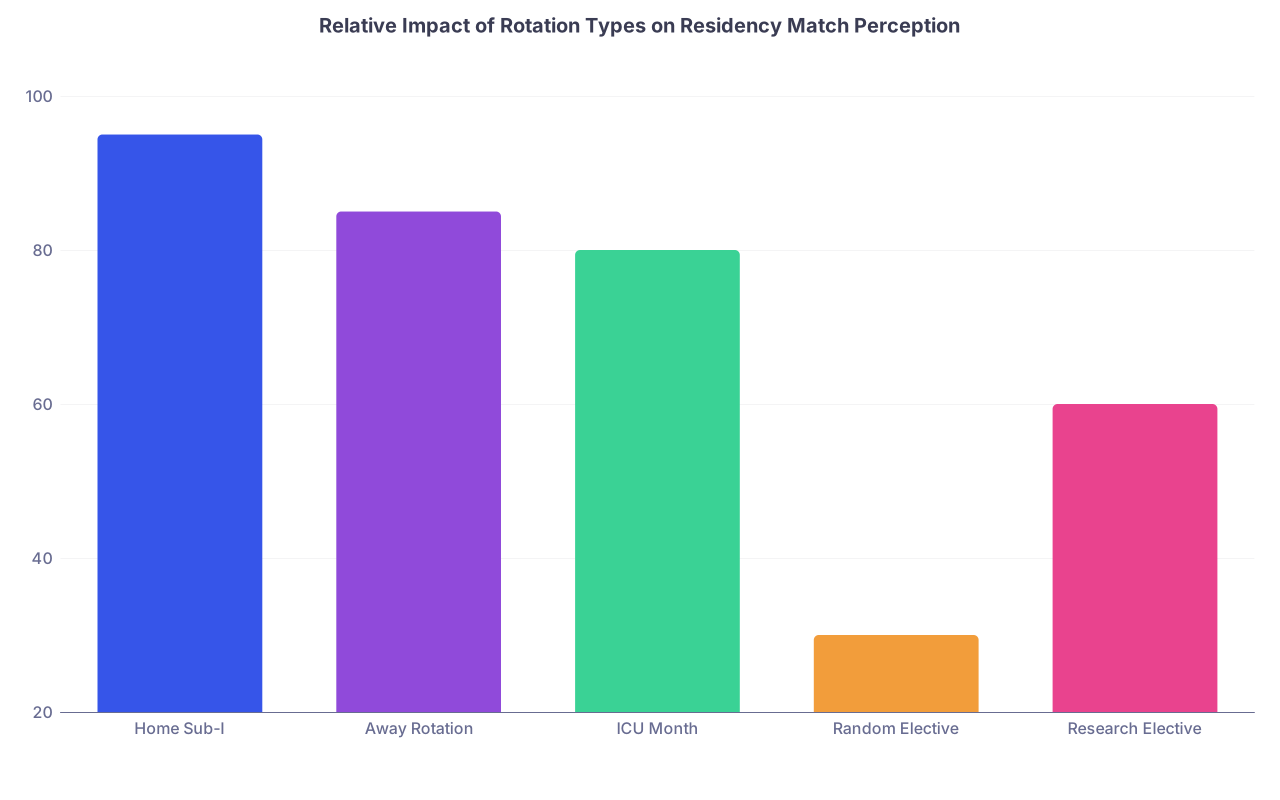
| Category | Value |
|---|---|
| Home Sub-I | 95 |
| Away Rotation | 85 |
| ICU Month | 80 |
| Random Elective | 30 |
| Research Elective | 60 |
The point: build around the high‑impact blocks first. Then decorate.
FAQs
1. How many away rotations should I actually do?
For most competitive surgical subspecialties and EM, 2 aways is a good default. Three is occasionally useful if you are geographically targeting or have weaker home letters, but beyond that you start to look like you are chasing validation. For IM, Peds, FM, and Psych, many applicants do 0–1 away and match very well.
2. If my school does not offer a Sub‑I in my target specialty, what should I substitute?
Then you lean on the closest proxy for intern‑level responsibility. For example, an IM applicant without a formal IM Sub‑I can do a high‑acuity ward month plus an ICU rotation and a strong consult month. Make sure your letters explicitly describe you functioning at intern level. PDs care more about function than labels.
3. When is it too late to take Step 2 CK for it to help my application?
If you sit for Step 2 after mid‑September, there is a good chance many programs will already have filtered you without that score. If your Step 1 is weak or pass/fail, you want Step 2 released before programs download ERAS (often mid‑September). If Step 1 is strong, you have more flexibility, but I still would not push into November unless there is a very specific reason.
4. Do lighter fourth‑year electives hurt my chances?
No, as long as they are in the right place. Taking radiology or derm in November or February while you are interviewing or recovering is totally reasonable. The problem is stacking those easy months in July–September when PDs expect to see you doing real work in your future field. Timing and proportion matter more than the mere presence of light electives.
5. How do I use fourth year to support a future fellowship interest without looking premature?
Signal, do not scream. One or two targeted electives (e.g., Cardiology and CCU for a future cards applicant, Rheumatology for a future rheum applicant) plus maybe a research month is enough. Your primary identity still needs to be “solid future intern in IM/EM/etc.,” not “already thinks they are a fellow.”
6. Who should I run my draft schedule by before locking it in?
At minimum:
- A faculty advisor in your chosen specialty who understands the Match landscape in that field.
- Your dean’s office or academic affairs person who knows institutional graduation requirements and common pitfalls.
Ideally add a chief resident or recent graduate in your target specialty; they remember what actually helped and what was a waste of time. If those three groups all think your schedule tells one clear, coherent story, you are in good shape.
Key points:
Design fourth year backwards from a one‑sentence career story, not forwards from a list of electives. Front‑load Sub‑Is, ICU/wards, and aways into July–October, with Step 2 in a strategically sane slot. Everything else—research, global health, lighter electives—gets added only after the core narrative and responsibility pieces are locked in.


