
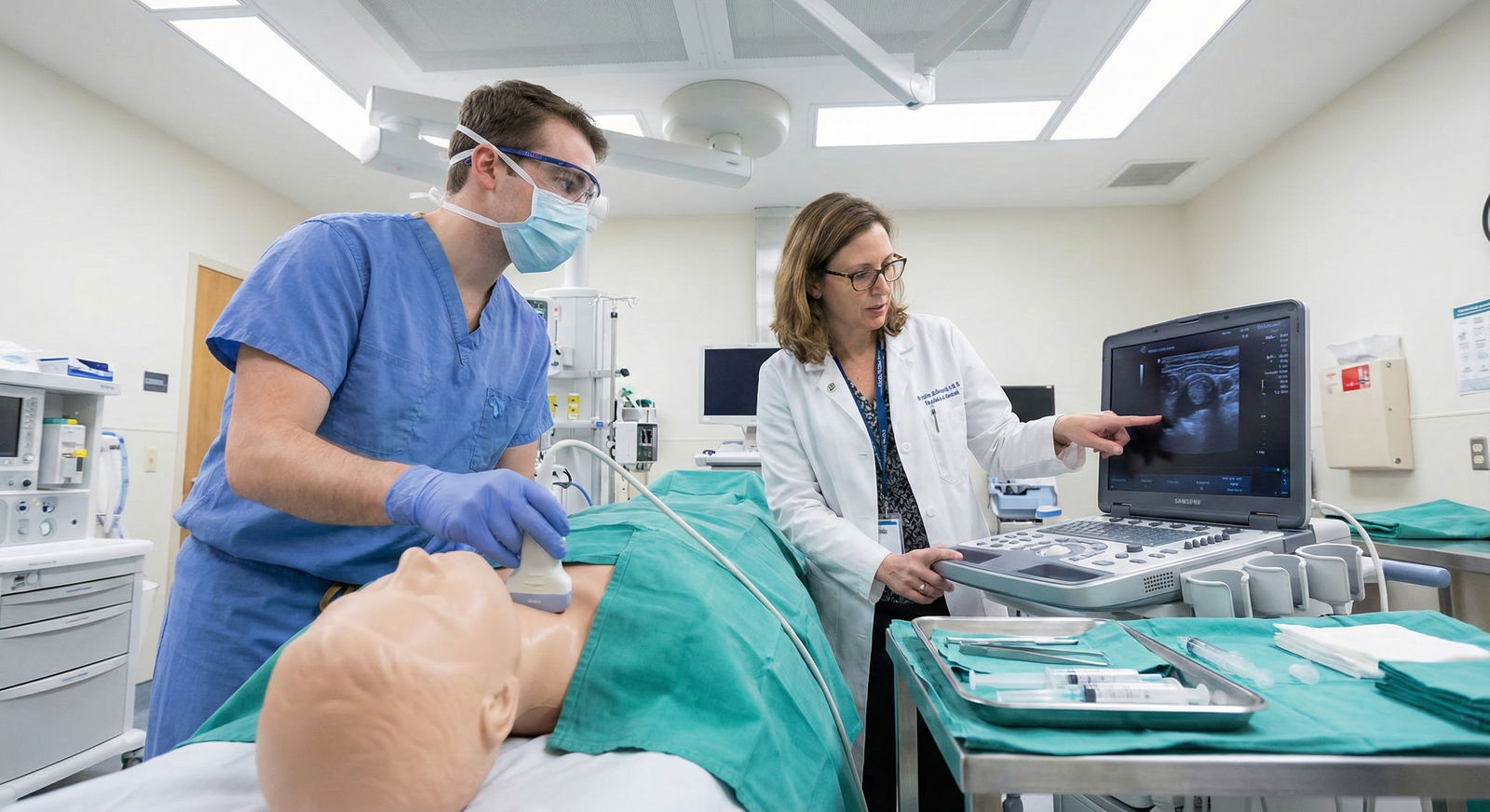
The students who match best into procedural fields are not always the “smartest.” They are the ones who walked into interview season already looking like junior operators. Ultrasound in one hand, needle in the other, with stories and numbers to prove it.
If you want surgery, EM, anesthesia, IR, critical care, or any procedure‑heavy field, your generic “I like working with my hands” line is useless. You need evidence. Ultrasound‑heavy and procedure‑dense rotations are where you manufacture that evidence.
Let me break this down specifically.
1. Who Actually Needs to Think This Way?
Not every specialty cares how many lines you have placed. But some absolutely do.
If you are even mildly serious about a procedural field, this is your list:
- Emergency Medicine
- General Surgery and most surgical subspecialties (Ortho, ENT, Plastics, Vascular, CT, Urology)
- Anesthesiology
- Interventional Radiology and DR/IR pathways
- Critical Care (IM‑CCM, Anesthesia‑CCM, EM‑CCM)
- Cardiology (interventional or EP down the road)
- OB/GYN (especially if you like MFM or minimally invasive surgery)
For these, “clerkships that help with residency match” are not abstract. You are building a procedural identity.
I am talking about:
- Structured ultrasound rotations
- EM clerkships with real POCUS integration
- ICU rotations with central lines, arterial lines, thoracenteses
- Anesthesia months where you own intubations and airways
- IR elective where you actually scrub and manipulate wires, not just “observe”
- Procedure clinics (paracentesis, LP clinics, joint injections) if your school has them
These rotations do three things for you:
- Generate verifiable procedural numbers and skills
- Feed concrete stories for your personal statement and interviews
- Hook you up with attendings who can write letters that actually say: “This student can already function like an intern in the procedure room.”
You need all three.
2. Ultrasound: Your Most Underrated Weapon
If you are heading toward any procedural field and you do not aggressively use ultrasound, you are leaving points on the table. Full stop.
2.1 Why Programs Love Ultrasound Experience
Because it is:
- Objective: You either can obtain and interpret a view or you cannot.
- Directly translatable: The way you hold a probe for a subxiphoid cardiac view is almost identical from one hospital to another.
- A multiplier: Once you think in images and planes, every needle‑in‑a‑body procedure gets safer.
Residency PDs will not say, “We need you to have placed 30 central lines.” But they do perk up when they see:
- Dedicated ultrasound rotation or significant POCUS integration
- Ultrasound‑based research or QI
- EM or ICU letters that specifically reference your skill with bedside ultrasound
You should be deliberately constructing that portfolio.
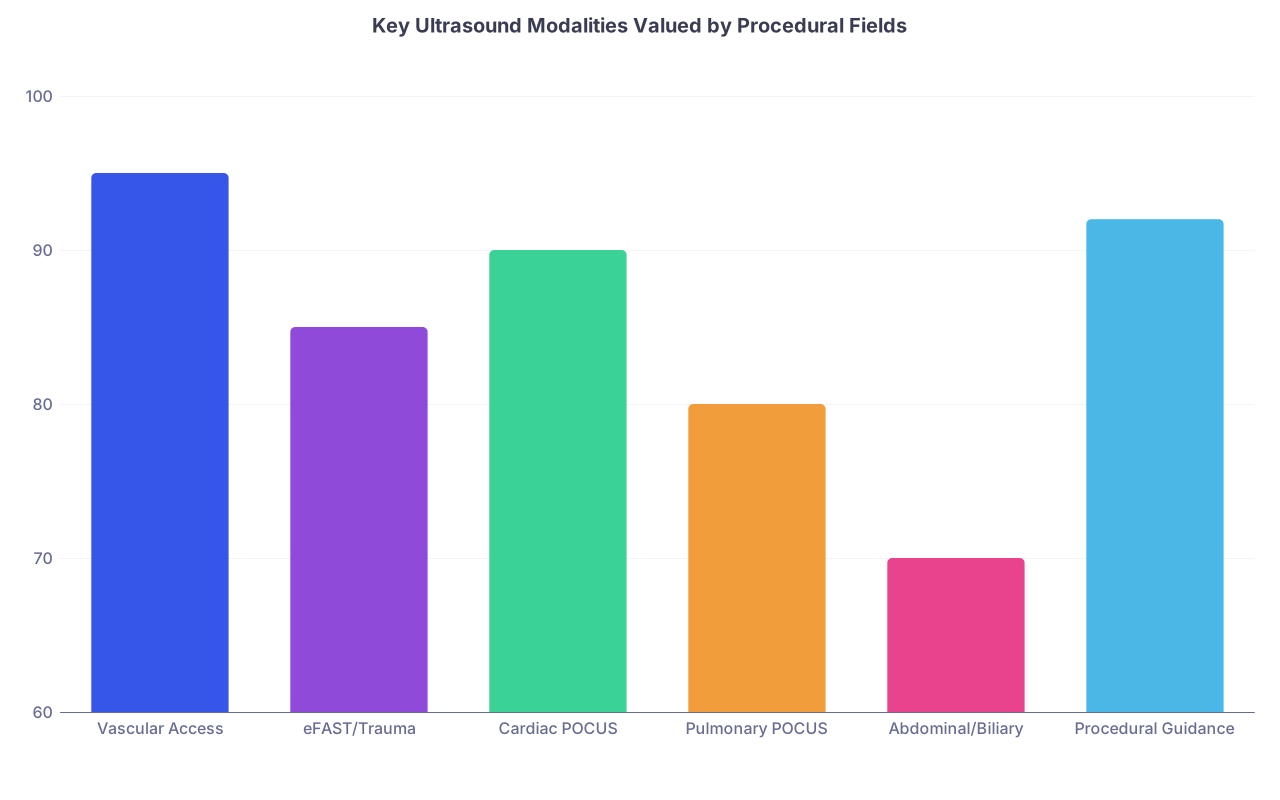
| Category | Value |
|---|---|
| Vascular Access | 95 |
| eFAST/Trauma | 85 |
| Cardiac POCUS | 90 |
| Pulmonary POCUS | 80 |
| Abdominal/Biliary | 70 |
| Procedural Guidance | 92 |
(Percentages here are a stand‑in for relative importance in the eyes of procedural PDs.)
2.2 What “Ultrasound Competent” Actually Means at Application Time
Most students wildly overestimate their ultrasound competency. Seeing one eFAST in the trauma bay and nodding does not count.
By the time you apply, aiming for procedural fields, you want to be able to honestly say:
- You can independently obtain and interpret:
- IVC view for volume status (with caveats)
- Basic limited echo: parasternal long, parasternal short, apical 4‑chamber, subxiphoid
- eFAST: RUQ, LUQ, pelvic, subxiphoid, anterior lungs
- Basic lung: B‑lines, pneumothorax signs, effusion
- You can reliably use ultrasound to:
- Guide peripheral IVs in difficult access
- Help with central lines (IJ at minimum)
- Mark out thoracentesis and paracentesis sites
This does not require a fellowship or a superhuman number of rotations. It requires one dedicated ultrasound month (ideal) or a well‑run EM rotation plus an ICU month where you are allowed to hold probes instead of just watching.
2.3 How to Extract Maximum Value From an Ultrasound Rotation
I have watched students waste ultrasound months by passively scanning random things and having nothing concrete to show for it.
Do this instead:
Define a log from day 1
- Use a simple spreadsheet or phone app. Log: date, patient ID (de‑identified), study type, whether you acquired images, whether you interpreted, whether an attending confirmed.
- Categories: cardiac, eFAST, lung, aorta, biliary, renal, vascular access, procedural guidance.
Create a quantifiable summary
By the end of the month you want to be able to write something like:
“Completed approximately 120 focused ultrasound exams including 30 eFAST, 35 cardiac, 25 lung, 10 aorta, and 20 vascular access/procedural guidance studies under attending supervision with image review and feedback.”Get something educational out of it
At least: one short case presentation or teaching file. Ideally: a short QI or education project.
You want that rotation director to be able to put in a letter:
“Over 4 weeks, this student independently acquired and interpreted over 100 structured ultrasound studies and consistently taught more junior learners at the bedside.”
That gets attention.

| Step | Description |
|---|---|
| Step 1 | Start Ultrasound Month |
| Step 2 | Set Case Log Template |
| Step 3 | Identify Core Views to Master |
| Step 4 | Scan Daily with Feedback |
| Step 5 | Create Case Archive |
| Step 6 | Present Case or Teaching Session |
| Step 7 | Request Letter Highlighting Ultrasound Skills |
| Step 8 | End of Week Review |
3. Procedure‑Heavy Rotations: What Actually Counts?
Not all procedure exposure is equal. Chart reviews and “I watched a lot” do not move the needle.
These rotations tend to give you real procedural reps if you work them correctly:
- EM (especially at high‑volume, procedure‑friendly sites)
- MICU/SICU/CCU
- Surgical oncology/acute care surgery/trauma surgery
- Anesthesia
- Interventional Radiology
- OB triage/L&D at busy centers
- Some IM wards with procedure services (paracentesis/thoracentesis/LP clinic)
3.1 Understand Your Role and Ceiling by Specialty
Let me be blunt. As a student, you are not “owed” procedures. Nobody is going to hand you the needle unless you ask, prove yourself safe, and show up early.
Typical realistic ceilings if you are aggressive and your site is cooperative:
| Rotation | High‑Achiever Target (4 weeks) |
|---|---|
| EM | 10–20 lacs, 5–10 US‑guided PIVs, 3–5 intubations, 5–10 simple I&Ds |
| MICU/SICU | 5–10 central lines, 5–10 arterial lines, 3–5 thoras/paras combined |
| Anesthesia | 20–40 intubations, bag‑mask on nearly every case, a few LMAs |
| IR | 10–20 cases scrubbed, hands on basic wire/needle steps in some |
| OB/L&D | 20–40 vaginal deliveries, some laceration repairs if proactive |
Are these guaranteed? Of course not. But they are achievable if:
- You show up for early cases and late cases
- You are already reading about the procedure the day before
- You explicitly say: “I want to get very comfortable with X. Can I do the next one?”
3.2 How to Turn Procedures Into Application Ammo
The difference between “I placed some lines” and “this helped my match” is in how you capture and present it.
You want three outputs from any procedure‑heavy rotation:
A rough procedure log
Not for your CV line‑by‑line, but for credibility. You cannot cite specific numbers in ERAS the way you would in residency, but you absolutely can say in your personal statement or interviews:
“Over my MICU and EM rotations I performed approximately 10 central lines and 15 arterial lines under direct supervision, almost all ultrasound‑guided.”Concrete stories
Not “I did a thoracentesis.”
Instead: “On my MICU rotation, I performed an ultrasound‑guided thoracentesis on a patient with rapidly worsening hypoxia. I had scanned and marked the site myself, and my attending trusted me to advance the needle. That was the moment I realized how directly my technical skills translated into a patient sleeping comfortably later that night.”Faculty who remember you as procedural
You want your name to trigger: “Oh yeah, the student who was always asking about lines, ultrasound, and airways.”
That means you need to be intentional about who sees you do what. If the letter‑writer never watched you touch a procedure, that experience will not show up in the letter.
4. Building a Coherent Procedural Story Across Rotations
Here is where most students fall apart. They collect random experiences but never stitch them into a coherent narrative.
Your job is to make your entire third and early fourth year look like an intentional runway into your chosen procedural field.
4.1 The “Common Thread” Concept
Imagine you are applying to EM. Your schedule might look like this:
- MS3 IM wards: Learned to manage decompensated cirrhosis, sepsis, DKA
- MS3 Surgery: First exposure to the OR, basic knot tying, suturing
- MS3 EM: Realized you enjoy resuscitation and procedures; first eFAST and intubations
- MS4 EM Sub‑I at home: Took primary responsibility, ran some lower‑acuity rooms
- MS4 EM Away: High trauma volume, a lot of procedures
- MS4 MICU: Managed vents, did lines and thoracenteses
- MS4 Ultrasound elective: Consolidated POCUS skills
The “common thread” you should sell:
- Early: Liked acute care and hands‑on involvement
- Middle: Gravitation toward settings where you could directly intervene (airway, lines, chest tubes)
- Late: Deliberately chose rotations that deepened skills in ultrasound and invasive procedures
Same logic for surgery or anesthesia.
Your goal: when a PD looks at your transcript and experiences, the pattern is obvious without you having to over‑explain.
4.2 Choosing Rotations Strategically (Not Just “What Fits My Schedule”)
For a procedure‑heavy target specialty, you want three tiers of rotations:
Core identity rotations (in your target field)
- EM sub‑Is for EM
- Surgical sub‑Is (trauma/ACS, vascular, subspecialty) for surgery fields
- Anesthesia sub‑I plus ICU for anesthesia/critical care
Procedural support rotations
- Ultrasound elective
- MICU/SICU
- IR elective
- OB month for those heading to OB or even EM (delivery experience is valuable)
Breadth rotations that still feed the story
- Cardiology consults for someone looking at interventional down the line
- Pulm/critical care clinic plus bronchoscopy exposure for certain paths
You do not need 15 electives. You need a handful that all point in the same direction.
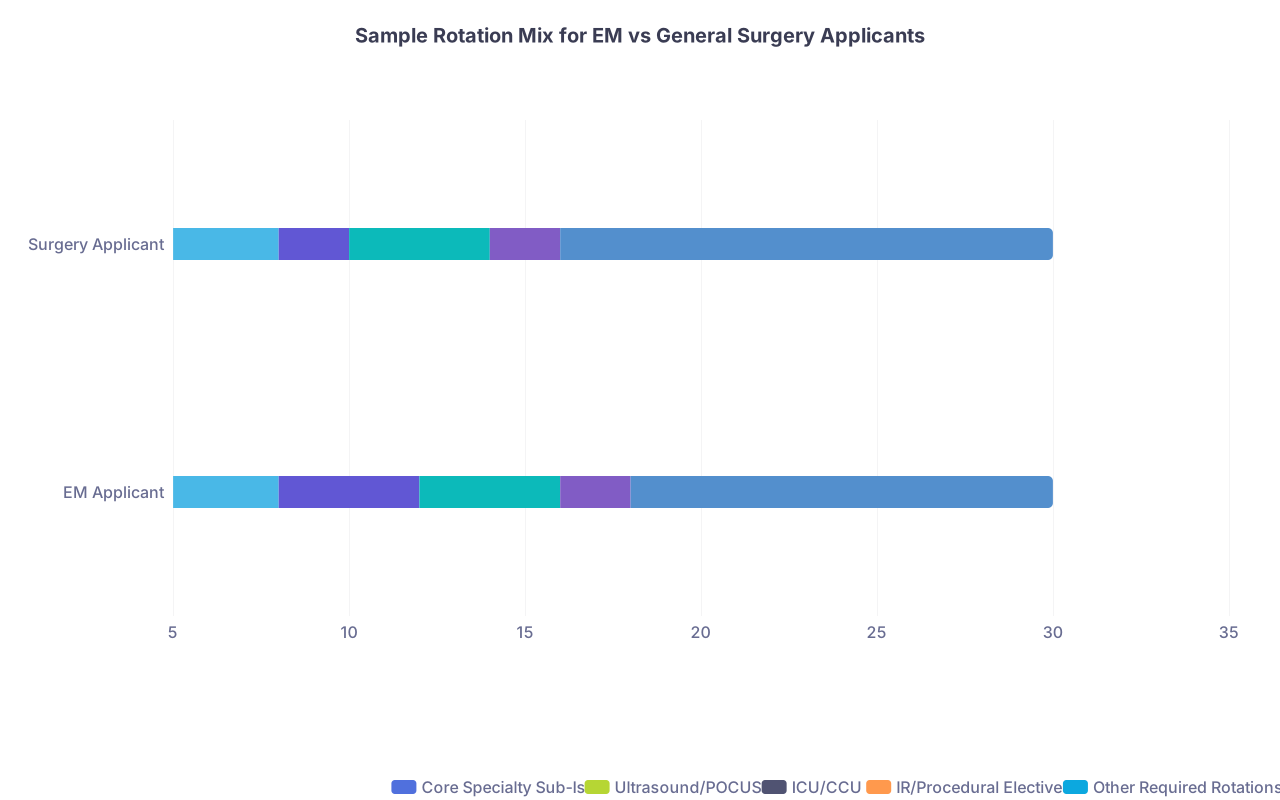
| Category | Core Specialty Sub-Is | Ultrasound/POCUS | ICU/CCU | IR/Procedural Elective | Other Required Rotations |
|---|---|---|---|---|---|
| EM Applicant | 8 | 4 | 4 | 2 | 12 |
| Surgery Applicant | 8 | 2 | 4 | 2 | 14 |
(Weeks shown; adjust to your school’s calendar.)
5. What to Actually Say About These Rotations in Your Application
Experience does not help if you cannot talk about it properly. This is where your ultrasound and procedure‑heavy rotations separate you from the generic applicant.
5.1 On Your CV / ERAS Experiences
Do not list “Performed multiple procedures” as a line. It is vague and unimpressive.
Better structures:
Role:
“Senior medical student on MICU team with emphasis on procedural competency.”Description (2–3 strong bullets):
- “Performed ultrasound‑guided central venous catheter placement and arterial line insertion under direct critical care attending supervision.”
- “Independently obtained and interpreted focused cardiac and lung ultrasound examinations to assist with volume assessment and shock evaluation, with attending image review.”
- “Led bedside teaching for junior students on sterile technique and basic ultrasound image acquisition.”
If you have a dedicated ultrasound rotation:
- “Completed 4‑week point‑of‑care ultrasound elective, performing approximately 120 focused studies including eFAST, cardiac, lung, and vascular access scans under faculty review.”
Notice the pattern: numbers, modalities, supervision, educational role.
5.2 In Your Personal Statement
You do not need to write, “I love procedures” ten times. You need one or two well‑chosen stories that show it.
Example framing for an anesthesia applicant:
- Brief setup: ICU rotation, patient in shock, hypotensive, escalating pressors.
- Technical pivot: You are asked to place an ultrasound‑guided central line. Describe your mental checklist: landmarks, vein compressibility, needle visualization.
- Emotional synthesis: The first time the CVP waveform appears, drips get moved, and the MAP stabilizes, you have this clean arc: your hands, your decision‑making, a measurable physiologic change.
- Tie‑back: “On my subsequent anesthesia rotation, that same combination of physiology and procedure—the ability to change a patient’s status in seconds—felt exactly right.”
This reads far better than “I really enjoy working with my hands and thinking quickly.”
5.3 During Interviews
Expect variants of these questions:
- “Tell me about a complication or near‑miss during a procedure you were involved in.”
- “What is your approach to learning a new procedure?”
- “How have you used ultrasound so far in your training?”
- “Do you see yourself as more clinically / cognitively oriented or more hands‑on?”
You should be able to answer with:
- Specifics (what the procedure was, your role).
- Reflection (what you learned, what you changed).
- Humility plus self‑awareness (you are not an expert, but you are clearly on the path).
For ultrasound questions, a solid 30‑second answer looks like:
“I have used ultrasound most extensively on EM and MICU. On EM, I performed eFAST exams on trauma patients and basic cardiac and lung ultrasounds for dyspnea cases, always reviewed with attendings. On MICU, I focused heavily on vascular access—most of the lines I assisted with were ultrasound‑guided—and I became comfortable obtaining IVC and lung views to contribute to our assessment of volume status. I am by no means an expert, but I have a solid foundational skill set and I am eager to formalize it in residency.”
That sounds like someone who will not fumble the first ultrasound probe handed to them.
6. Getting Letters That Highlight Your Procedural Strengths
Letters are where your ultrasound and procedure‑heavy rotations really cash out.
You want at least one, ideally two, letters that:
- Explicitly mention procedures you have done
- Comment on your technical learning curve and safety
- Link your procedural ability to your judgment and teamwork
6.1 Choosing the Right Letter Writers
For a procedural field, prioritize:
- An attending in your target specialty who actually watched you perform procedures
- An ICU or anesthesia faculty who saw you do lines/airways
- An ultrasound director or EM faculty who ran your POCUS experiences
- For surgical paths: a surgeon who saw you in the OR, not just on rounds
If you have an ultrasound elective where the director knows you well, that letter can be gold, especially for EM, anesthesia, and critical care.
6.2 How to Prime the Letter
You cannot script their letter, but you can make it easier for them to remember you accurately.
Send a brief email with:
- Your CV
- A 1‑paragraph summary of your career goals
- A very short recap of what you did on their service, including procedure‑related highlights and ultrasound numbers if relevant
For example:
“During my month in the MICU with you, I particularly appreciated the opportunity to participate in central line and arterial line placements. Over the rotation I assisted with or performed approximately 8 central lines and 10 arterial lines, almost all ultrasound‑guided, and became much more comfortable with both the technical and cognitive aspects (patient selection, consent, complication recognition). I am applying to anesthesiology with long‑term interest in critical care.”
You are not telling them what to write. You are jogging their memory and giving them accurate numbers and context.
7. A Few Specialty‑Specific Nuances
Let me zoom in briefly, because the expectations are not identical across fields.
7.1 Emergency Medicine
EM programs are obsessed with three things: ultrasound, resuscitation, and team function.
On your EM and ultrasound‑heavy rotations:
- Aim to be the student who volunteers for every eFAST, every “can someone scan this belly,” every “do we have access?”
- Prioritize: eFAST, cardiac views in undifferentiated hypotension, lung for dyspnea, and vascular access.
- If you can, get involved with a small ultrasound teaching session for MS2s or interns. Even a single anatomy‑plus‑scanning lab looks good.
Away rotations in EM are where you prove you are safe, teachable, and not dangerous with a probe and a needle.
7.2 General Surgery and Surgical Subspecialties
Programs care more about your OR work ethic and your ability to function as an intern than raw line counts, but procedures still help:
- On trauma/ACS: chest tube exposure, eFAST participation, bedside procedures.
- On vascular: exposure to lines, grafts, ultrasound mapping is a plus.
- On SICU: lines, drains, and procedural consults.
Surgery applicants often forget ultrasound. That is a mistake. Trauma surgeons, vascular surgeons, and a growing number of general surgeons rely on POCUS heavily.
7.3 Anesthesiology
Airway, lines, and ultrasound again.
On an anesthesia rotation where faculty trust you, you can easily get 20–40 intubations. But only if:
- You read on airway anatomy, RSI, and drugs before day 1.
- You show up early enough to help set up rooms, preoxygenate patients, and be in the right place when induction starts.
- You explicitly say to your attending on day 1: “I am very interested in anesthesia. If it is safe and appropriate, I would really like to get as much hands‑on airway and line experience as I can.”
Many anesthesia PDs remember the students who took airways seriously. Do not be the one standing in the corner when the laryngoscope comes out.
8. Practical Mistakes That Kill the Benefit of These Rotations
I have seen variants of these every year.
Passive observation
“I did an ICU rotation but did not really ask to do procedures because it felt awkward.”
Translation: you chose discomfort over growth. Nobody will hand you the needle without you asking.Sloppy or nonexistent logging
You “think” you did about 10 lines, maybe 5 intubations, a bunch of eFASTs. When pressed in an interview, you sound vague. That undermines your credibility.Overselling yourself
You say you are “comfortable” with ultrasound or intubations, then fumble basic anatomy in an interview or cannot describe an eFAST. Better: “solid foundation but excited to formalize training.”No reflection on complications or near‑misses
If you claim to have done a decent volume of procedures and cannot recall a single error, scare, or learning moment, you sound either oblivious or dishonest.Zero connection between rotations
Your schedule is a Frankenstein of random electives and has no obvious relationship to your stated interest in a procedural field. That leaves PDs thinking you decided late or are not truly committed.
9. Pulling It All Together
If you want a procedural specialty, you cannot treat ultrasound and procedure‑heavy rotations as nice extras. They are your leverage.
Three core points to walk away with:
- Use ultrasound and procedure‑dense rotations to build a provable, quantified skill set—logs, numbers, and concrete stories, not just vague “exposure.”
- Choose and sequence your clerkships so they form a coherent procedural narrative that clearly points into your target field, then reflect that narrative explicitly in your CV, personal statement, and interviews.
- Be relentlessly proactive on these rotations—ask for the needle, ask for the probe, ask for feedback—then channel those experiences into strong, specific letters that say what PDs want to hear: this student already behaves like a safe, teachable junior proceduralist.


