

You are in your M3 spring advising meeting. The dean is asking, “So, what are you thinking for your fourth‑year schedule?” You’ve got a Step 2 date on the calendar, a specialty you are 80% sure about, and absolutely no idea how to juggle sub‑Is, away rotations, interviews, and “easy” electives without blowing up your sanity or your application.
This is where a lot of people quietly screw themselves. Not with scores. Not with letters. With a fourth‑year calendar that sends mixed signals to programs or leaves zero buffer for when life goes sideways.
Let me walk through how to build a balanced MS4 schedule—sub‑Is, aways, and buffer rotations—so your transcript, your stamina, and your ERAS story all line up.
Step 1: Know what your MS4 schedule has to do for your Match
Forget what your school says fourth year is “for.” Functionally, for the Match, your MS4 schedule has to accomplish five things:
- Prove you can function as a near‑intern in your chosen specialty (sub‑I).
- Get you at least 2, ideally 3, strong letters in that specialty.
- Show commitment and realistic interest breadth on your transcript.
- Give you time to take and do well on Step 2 / Level 2.
- Build in slack—because interviews, illness, or personal issues will hit.
If a proposed schedule looks “cool” but does not clearly do those five, it is fluff.
Most people overestimate how much they can grind from July–November and underestimate how long interview season blows up their life. When in doubt, protect your energy around:
- Step 2 test date.
- Heavy sub‑Is.
- Interview season (roughly November–January for most).
We will anchor around those.
Step 2: Understand the pieces – what each rotation type actually does
Sub‑internships (Sub‑Is)
Sub‑Is are not just “hard medicine” or “hard surgery.” They are your audition for “Can this person be our intern in 3 months?”
What a sub‑I should accomplish for you:
- One letter from someone who saw you act like an intern.
- Concrete comments on your MSPE about ownership, reliability, and clinical reasoning.
- A clear signal to programs: “I understand the day‑to‑day of this specialty.”
For many specialties, programs and advisors expect:
- Internal medicine: 1–2 IM sub‑Is (wards, cards, heme/onc, hospitalist)
- Surgery: 1 sub‑I in your chosen field, sometimes 1 in general surgery
- OB/GYN: 1 OB/GYN sub‑I, sometimes 1 on L&D or Gyn‑Onc
- Pediatrics: 1 inpatient peds sub‑I
- EM: 2 home EM rotations that count as SLOE‑eligible (not classic “sub‑I,” but same function)
You do not need four sub‑Is. Doing four just proves you do not understand diminishing returns.
Away rotations (Aways / Visiting electives)
Away rotations are not mandatory for every specialty. They are high‑risk, high‑yield tools used for:
- Getting noticed at specific programs or geographic regions.
- Getting additional letters where home opportunities are limited.
- Showing commitment when you come from a lesser‑known school.
They carry downside:
- One bad month away is essentially a 4‑week interview you failed.
- They’re expensive and exhausting.
- They eat prime summer/fall real estate.
Home vs away: which matters more for letters?
For most core specialties, programs still give a bit more weight to home institution letters and well‑known “letter writers.” A strong home sub‑I letter usually beats a lukewarm away letter at a fancy name place.
Where aways matter more:
- Ortho, ENT, neurosurgery, plastics, derm: aways are often standard.
- EM: SLOEs from away sites are effectively required.
- Programs that do not know your school at all: an away there can de‑risk you.
If your specialty is not hyper‑competitive, lean heavier on strong home rotations plus 1–2 targeted aways at most.
Buffer rotations / “Easy electives”
Let’s be honest: some electives are built as buffer rotations.
“Radiology MS4,” “Derm outpatient clinic,” “Intro to palliative,” “Quality improvement elective,” “Independent study.” Light call, predictable hours, fewer pages, room to breathe.
These serve very specific purposes:
- Step 2 prep / recovery.
- Time for personal life (weddings, moves, family issues).
- Time to work on ERAS, personal statement, and letters.
- Flexibility during peak interview season.
If your advisor tells you a schedule of July ICU → August Sub‑I → September Away Surgery → October Away Surgery → November MICU is “ambitious but doable,” ignore them. That is how you end up interviewing off zero sleep, giving mediocre vibes, and getting mediocre ranks.
Step 3: The real constraint – time windows that matter
There are three windows you must plan around:
- Step 2 window.
- Letter‑gathering window.
- Interview season window.
1. Step 2 window
If you are applying in September, most people take Step 2 between:
- Late May and late July.
You want:
- 4–6 weeks of moderate intensity prep.
- A rotation that protects at least some studying (no night float, no Q4 in‑house call).
If your Step 1 was marginal or your specialty is competitive, Step 2 is not optional noise; it is a rescue opportunity. That means:
- Do not schedule your strongest sub‑I during Step 2 prep or immediately after your exam.
- Use a lighter elective or ambulatory block before Step 2.
- If you are weak in medicine, do an IM wards block before Step 2 that allows some study time.
2. Letter‑gathering window
ERAS typically opens to programs mid‑September. You want:
- Key letters uploaded by early to mid‑September.
Most letter writers need:
- 2–4 weeks after the rotation ends to write and upload.
So rotations that you want letters from should finish by:
- Early to mid‑August, latest. July/August sub‑Is are prime for this.
A September away can still generate a letter, but that letter likely lands after initial application review. It can help for later interview waves and rank list decisions, but it will not rescue a weak early application.

| Step | Description |
|---|---|
| Step 1 | Complete Key Sub I by Aug |
| Step 2 | Ask for Letters Immediately |
| Step 3 | Letters Uploaded by Early Sep |
| Step 4 | ERAS Submission Mid Sep |
| Step 5 | Interview Invites Oct to Dec |
3. Interview season window
For most specialties (excluding some super subspecialties and SOAP):
- Interview invitations: October–December.
- Actual interviews: November–January.
Those months need to be light. Not empty. Light.
You do not want:
- ICU.
- Sub‑Is with heavy call.
- Rotations where being gone 2–3 days a week is a problem.
Good fits for Nov–Jan:
- Research elective.
- Reading elective / independent study.
- Radiology.
- Pathology.
- Outpatient specialty clinics.
- Online or hybrid courses that your school allows.
Step 4: Build from anchors, not from wish lists
Forget the dream list of “cool rotations.” Start with anchors:
- Step 2 date.
- 2–3 best months to impress in your specialty (sub‑Is / aways).
- Light blocks for interview season.
Let me show you concrete patterns by specialty type.
Step 5: Example frameworks by specialty category
These are generic skeletons. You will tweak for your school’s calendar (4‑week vs 6‑week blocks), graduation requirements, and personal life. But the logic stands.
A. Internal Medicine applicant (average competitiveness, no disaster scores)
Goal: 1–2 strong IM sub‑Is, 1 away if needed, decent Step 2, sane interview season.
Assume July–June 4‑week blocks.
| Month | Rotation Type |
|---|---|
| May | Light elective + Step 2 prep |
| Jun | Step 2 + light outpatient |
| Jul | IM wards sub-I (home) |
| Aug | Cards or heme/onc sub-I |
| Sep | Away IM (optional) |
| Oct | Non-IM elective / consult |
| Nov | Research or radiology |
| Dec | Outpatient elective |
Why this works:
- May/June: Protect Step 2. One of those months is mostly study + test; do not put a monster rotation there.
- July/Aug: Two home IM sub‑Is. Prime letter months. You get faculty who know you, plus MSPE comments.
- September away: Optional. Use if you want to break into a new geographic region or your home department is weak.
- Oct–Dec: Light to moderate with clear room for interviews.
You could swap the away to July and a home sub‑I to August, but that risks you flailing away from your home support system while you are still learning how to operate at sub‑I level. I have watched that backfire more often than it helps.
B. General Surgery applicant (moderately competitive, thinking academic)
Goal: Home sub‑I(s), maybe 1–2 aways at serious targets, survive fall.
| Month | Rotation Type |
|---|---|
| May | Surgical subspecialty elective |
| Jun | Step 2 + light elective |
| Jul | General surgery sub-I (home) |
| Aug | Away 1 (target region) |
| Sep | Away 2 (stretch program) |
| Oct | Surgical consults / SICU |
| Nov | Research / imaging |
| Dec | Outpatient clinic |
Notes:
- General surgery applicants often feel pressured into 2–3 aways. Two is usually enough. Three is punishing.
- I prefer the home sub‑I first (July) so you hit the away in August when you already know how to function.
- If your Step 2 is shaky, move it to late May/early June with a truly soft elective.
And no, you do not need SICU in October if interviews will swallow half the month. Surgeons care that you can handle the OR, wards, and call; ICU is icing.
C. Emergency Medicine applicant (SLOE‑driven)
EM is its own beast. You need:
- 1–2 home EM rotations producing SLOEs.
- 1–2 away EM rotations (SLOEs).
- All of those done and SLOEs uploaded ideally by early September.
A typical strong plan:
| Month | Rotation Type |
|---|---|
| May | IM wards or light elective |
| Jun | Step 2 + light elective |
| Jul | Home EM rotation (SLOE 1) |
| Aug | Away EM rotation (SLOE 2) |
| Sep | Second away or home EM (SLOE 3 optional) |
| Oct | ICU or IM consults |
| Nov | Research / community EM |
| Dec | Outpatient electives |
I see a lot of EM students do their first EM rotation away. That is a mistake unless your home has no EM. You do not want to “learn EM” for the first time while everyone is silently evaluating you.
Step 6: Where buffer rotations belong (and what they look like)
Let’s be blunt. A “balanced” schedule is not noble suffering every month. It is strategic:
- Hard month.
- Medium month.
- Soft month.
- Repeat.
If you stack three “hard” blocks in a row in M4, you are just not thinking long‑term.
Common buffer rotations:
- Radiology.
- Pathology.
- Outpatient subspecialty clinic (cards clinic, rheum, endocrine).
- Palliative care.
- Research elective (if your PI is reasonable).
- Reading or independent study electives.
Bad choices for buffer rotations:
- ICU of any kind.
- Night float.
- Trauma or transplant services.
- Any rotation with Q4 call or frequent overnight pager.
Where they should go:
- Month before Step 2 (buffer for prep).
- Month after a long/demanding sub‑I or away.
- Interview-season months (Nov–Jan).
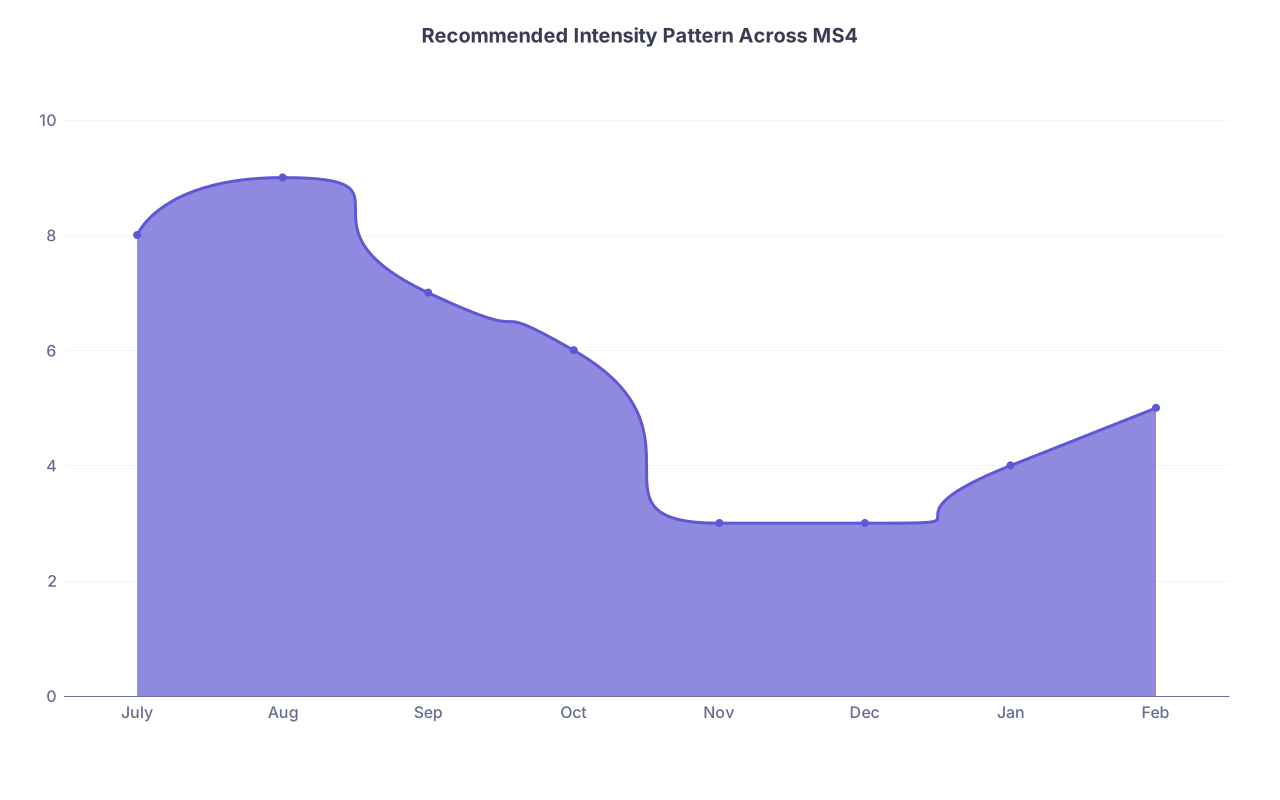
| Category | Value |
|---|---|
| July | 8 |
| Aug | 9 |
| Sep | 7 |
| Oct | 6 |
| Nov | 3 |
| Dec | 3 |
| Jan | 4 |
| Feb | 5 |
(Think of that “intensity” scale as 1–10. You want peaks around key sub‑Is/aways, valleys around interviews and exams.)
Step 7: Common scheduling mistakes that quietly hurt applications
I have seen versions of these every year.
Mistake 1: The “late hero” sub‑I
You schedule your main sub‑I in October or November.
Result:
- That letter may not arrive until December or January.
- Programs have already given away half their interview spots.
You end up with:
- Mediocre early‑cycle application.
- A “great letter” that came too late to matter much.
Solution: Key sub‑Is in July/August. If your school blocks you from that, at least one by September 1 and aggressively manage letter upload.
Mistake 2: All your eggs in away rotations
Some people schedule:
- July: Away 1.
- August: Away 2.
- September: Away 3.
And no robust home sub‑I early.
Problems:
- You are inexperienced in July; risk of flat or negative evaluations.
- You are exhausted by September; performance dips.
- You may not have a strong advocate at any single place.
One stellar home letter + one solid away letter beats three “he/she did fine” away write‑ups.
Mistake 3: Brutal rotations during interview season
This one is simple.
You cannot give a good interview after:
- Post‑call 24‑hour trauma night.
- Three consecutive 14‑hour days on a busy ward.
- Week of nights in the ICU.
Programs can smell exhaustion. They will not say “Oh, but she was on ICU, poor thing.” They will say “She seemed disengaged” and move on.
Do not fight this. Just do not schedule heavy stuff in November–January unless you have no choice.
Mistake 4: No contingency for failed Step 2 or personal crises
Life happens in fourth year:
- Illness.
- Family emergencies.
- Failed Step/Level exams.
If your entire schedule is wall‑to‑wall required sub‑Is and away rotations with no flex, there is nowhere to move anything. That is how you end up delaying graduation or scrambling rotations in ways that look chaotic on paper.
You always want at least:
- One “low stakes” block in late summer/fall.
- One flexible/elective block in winter/spring.
So if you have to retake Step 2 or reshuffle, it does not destroy your entire plan.
Step 8: How to decide which aways (and how many)
The right number of aways depends on:
- Specialty competitiveness.
- Strength of your home department.
- Your Step scores and class rank.
Use this as a blunt starting grid:
| Specialty Type | Typical Aways |
|---|---|
| Low-mod competitiveness (FM, Psych, Peds) | 0–1 |
| Mid (IM, OB, General Surgery, Neuro) | 0–2 |
| High (Ortho, ENT, Plastics, Derm, NSGY) | 2–3 |
| EM (SLOE-based) | 2 |
Pick aways based on:
- Geography where you realistically want to live.
- Tiers that mathematically match your profile. (If your Step is 225, an away at a program where the average matched is 255 is not high‑yield.)
- Programs that actually take students from your school or similar schools.
An away is not a lottery ticket. It is closer to “second look plus four weeks of live evaluation.” Aim for:
- One “reach but realistic.”
- One “target.”
- Optional third for hyper‑competitive fields or weird school situations.
Step 9: Balancing requirements vs Match priorities
Your school will throw required rotations at you:
- Geriatrics.
- Neurology.
- Subspecialty clinics.
- Capstone courses.
You have to fit those in without kneecapping your Match strategy.
Triage them:
Rotations that can generate useful letters or skills in your target specialty.
Those can occupy earlier MS4 months.Rotations that are box‑checking only.
Push these into:- Spring semester.
- After interview season.
- Periods where “what it looks like to programs” matters less.
Never let a random required geriatrics elective occupy your prime July/August letter‑gathering window if you have a choice. Trade, swap, petition. Use the fact that this is objectively bad for your residency application as leverage with your dean.
Step 10: Example “balanced” year templates
Let me lay out three templates that actually work in the real world. We will keep them general, and you can map them to your situation.
Template 1: Solid but not superstar applicant, mid‑competitive specialty
Profile: Step 1 pass, Step 2 goal > 240, wants IM/OB/Neuro level specialty.
- May: Light elective + Step 2 prep.
- June: Step 2 + ambulatory clinic.
- July: Home sub‑I #1 (core specialty).
- August: Home sub‑I #2 or allied specialty (e.g., cards for IM).
- September: Away rotation (if doing one) or consult month.
- October: Required but moderate rotation (e.g., neuro, geri).
- November: Radiology or research (interview heavy).
- December: Outpatient elective (interviews).
- January: School capstone / required course.
- Spring: Degree requirements, one “fun” elective, maybe an ICU if you really want it.
Balance check:
- Step 2 has buffer.
- Letters ready by early September.
- Interviews protected.
- Still time for personal life and not hating medicine by March.
Template 2: High‑risk, high‑reward applicant in very competitive field
Profile: wants ortho/ENT/derm, Step 1 pass, strong Step 2 or research.
- May: Required IM wards (get your general medicine baseline).
- June: Step 2 + lighter surgical specialty.
- July: Home specialty sub‑I (ortho/ENT/derm).
- August: Away #1 at realistic target.
- September: Away #2 at another realistic or stretch program.
- October: Research or consult month in your specialty.
- November: Outpatient clinic or very light elective (interview tsunami).
- December: Radiology/path (interviews + some rest).
- Spring: Satisfy graduation requirements, maybe ICU or another sub‑I now that the application cycle is set.
For these people, the year is front‑loaded by necessity. You are going to be tired by October; that is unavoidable. The buffer is in November–December.
Template 3: Student still slightly uncertain between two fields
Profile: Torn between IM and anesthesia, for example.
You need:
- Enough exposure to both early.
- A commitment by July/August for sub‑I choice.
- A narrative that is coherent, not “I randomly decided in August.”
One approach:
- April–May of MS3: do an elective or short rotation in the “secondary” option (e.g., anesthesia).
- June: Step 2 + light but related elective (e.g., pulm consult).
- July: Sub‑I in front‑runner field (e.g., IM).
- August: Elective in second field (e.g., anesthesia), ideally at home.
- September: Commit. Do an away or second sub‑I in your chosen field.
- October+: Align the rest of year with your final choice.
You must decide early enough that your letters and ERAS application are not confused. Having one strong letter in each of two unrelated specialties often reads as “ambivalent,” not “flexible.”
Step 11: How to actually finalize this with your advisors
Reality: many “official” advisors push generic templates that ignore specialty nuance and your individual risk factors.
When you walk into that meeting, you should have:
- A draft month‑by‑month schedule sketched out.
- Clear anchors labeled:
- Step 2 date.
- Planned sub‑Is.
- Planned aways.
- Interview‑season buffers.
Then check with them on:
- School‑specific pitfalls (e.g., “Our neurology must be done by December”).
- Rotation reputation. Every school has rotations that are secretly more or less intense than the catalog suggests.
- Political landmines. Some departments get angry if you do an away there before doing a home sub‑I.
If they recommend filling your July–September with three required non‑specialty rotations, push back. Calmly. Explain exactly how that undermines letters and ERAS timing. Most reasonable deans will find you an alternative.
If you remember nothing else
- Build around anchors: Step 2, early sub‑Is/aways for letters, and light interview‑season months. Everything else is negotiable.
- One or two strong home sub‑Is plus targeted aways beats three frantic aways with no rest and late letters.
- Buffer rotations are not laziness. They are how you show up to sub‑Is, exams, and interviews as the best version of yourself instead of the exhausted, half‑present one programs quietly rank to the bottom.


