

The idea that you must choose between crushing your shelf exams or impressing on the wards is a false dichotomy. The best applicants do both, and the way they do it is not magic. It is systems and discipline.
Let me break this down specifically: clerkships that help you match are the ones where your evaluations, narrative comments, and shelf scores align to tell the same story. “Hard-working, clinically sharp, reads independently, strong fund of knowledge.” If your shelves are great but your evals say “quiet, seemed disengaged” – programs notice. If your evals are glowing but shelves are weak – programs also notice.
You are trying to build a consistent brand: reliable, prepared, teachable, and high-yield smart.
We will walk through how to structure your time, how to use question banks while staying clinically present, and how to behave on the wards in a way that both impresses residents and reinforces your exam prep.
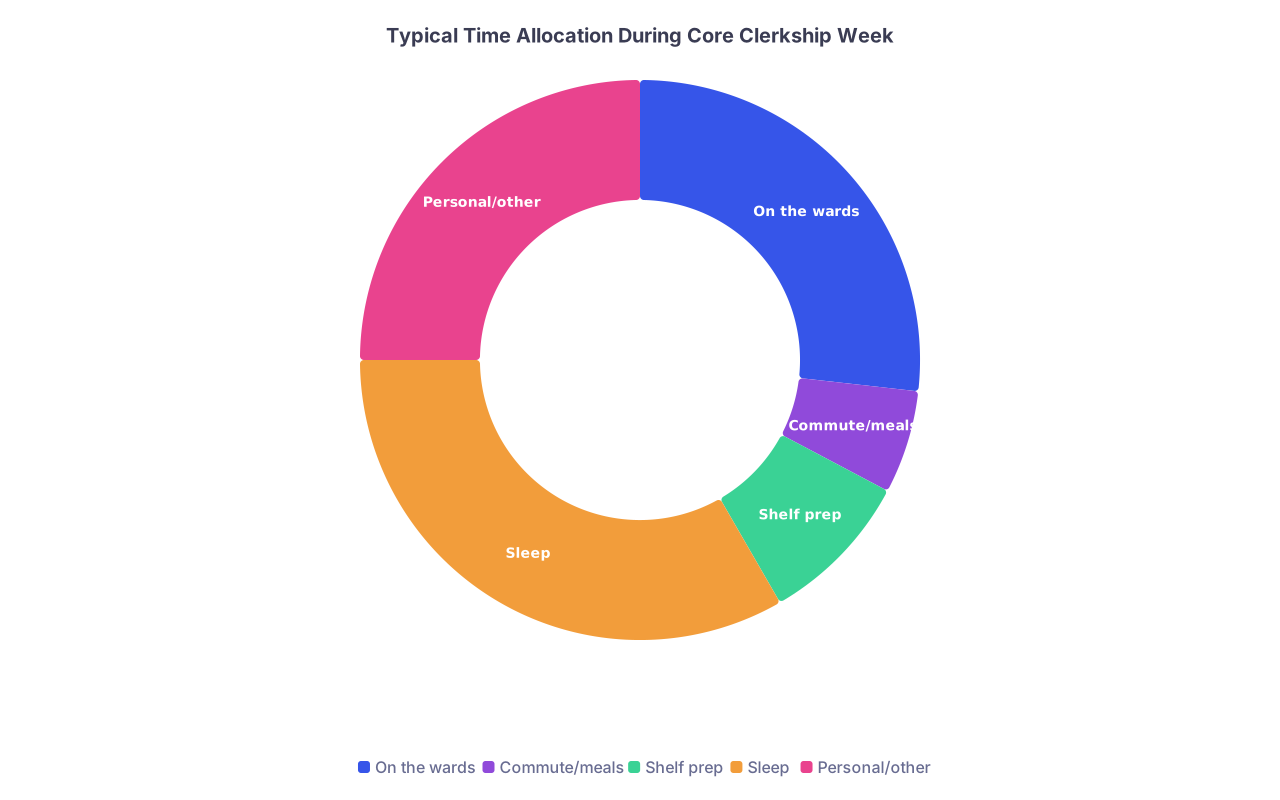
| Category | Value |
|---|---|
| On the wards | 45 |
| Commute/meals | 10 |
| Shelf prep | 15 |
| Sleep | 56 |
| Personal/other | 42 |
The Real Stakes: Why Shelf + Wards Matter for Match
Most schools weigh your clerkship grade using some mix of clinical evaluations and the NBME shelf. Programs then see that grade and often a breakdown of comments. You are not just trying to pass; you are competing in a national pool of applicants.
Here is the part many students understand too late: strong clerkship performance is one of the few standardized signals you still control when you are applying to residency, especially in the Step 1 pass/fail era. Your Step 2 CK matters. But so does the pattern that leads to it:
- High shelf scores across core rotations
- Strong comments like “read nightly and applied knowledge on rounds”
- Honors or high pass in heavy-hitter rotations (IM, Surgery, Pediatrics, OB/GYN)
Programs infer trajectory. A run of mediocre shelves is a red flag that Step 2 CK might also be soft. Conversely, a student with excellent shelves and strong clinical comments screams “safe bet, productive resident.”
So your goal is not just to “do fine.” Your goal is to build a portfolio of clerkship performance that supports the story you will sell in your personal statement and interviews.

Core Principle: Clinical Time Is Non‑Negotiable, Study Time Must Be Engineered
You do not sacrifice clinical performance for one more UWorld block at 10 AM. That is how you get comments like “often disappeared,” which hurt you more than a few extra shelf points help you.
So the working rules:
- When you are scheduled to be on the unit, clinic, or OR, you are on. No questions, no “quick” QBank blocks.
- Studying happens:
- Early morning before pre-rounds
- Between cases/clinics when your team truly does not need you
- Evenings after sign-out
- Weekends in protected, planned chunks
If you do not actively schedule shelf time, the ward will eat every spare minute. The hospital is a time sink that expands to fill the space you give it.
Designing a Weekly Structure That Actually Works
Let us take a standard medicine rotation schedule:
- 6 days/week
- 6:30–7:00 arrival, sign-out at 5–6 PM
- Post-call day sometimes lighter
A realistic study schedule might be:
- Weekdays:
- 45–60 minutes in the morning (single QBank block review OR quick topic reading)
- 60–90 minutes at night (questions + targeted reading from missed topics)
- Weekends:
- One “heavy” day: 3–4 focused hours (2–3 blocks plus review)
- One “maintenance” day: 1.5–2 hours
That yields roughly 12–18 hours/week of focused shelf prep. Done consistently, that is enough to perform very well if the questions are high quality and your review is serious.
| Rotation | Weekday Study (per day) | Weekend Total | Primary Resource Mix |
|---|---|---|---|
| Medicine | 1–1.5 hrs | 5–6 hrs | UWorld + OnlineMedEd |
| Surgery | 45–60 min | 4–5 hrs | UWorld Surg + Pestana |
| Pediatrics | 1–1.5 hrs | 5–6 hrs | UWorld + BRS Peds |
| OB/GYN | 1–1.5 hrs | 5–6 hrs | UWorld + Case Files |
| Psych | 1 hr | 4–5 hrs | UWorld + First Aid Psych |
This is not theoretical. I have seen students with this structure hit 80+ percentile shelves while getting “outstanding” on evals, because they guarded clinical engagement during the day and structured evenings.
Resource Strategy: Stop Hoarding, Start Executing
Most students do not fail shelves because they do not own enough resources. They fail because they spread themselves thin across five half-used things and never master any of them.
For each rotation, you need:
- A primary QBank (non-negotiable)
- A lean, high-yield content resource
- Optional: a quick reference for in-the-moment ward questions
That is it. If your list is longer than three, you are diluting your focus.
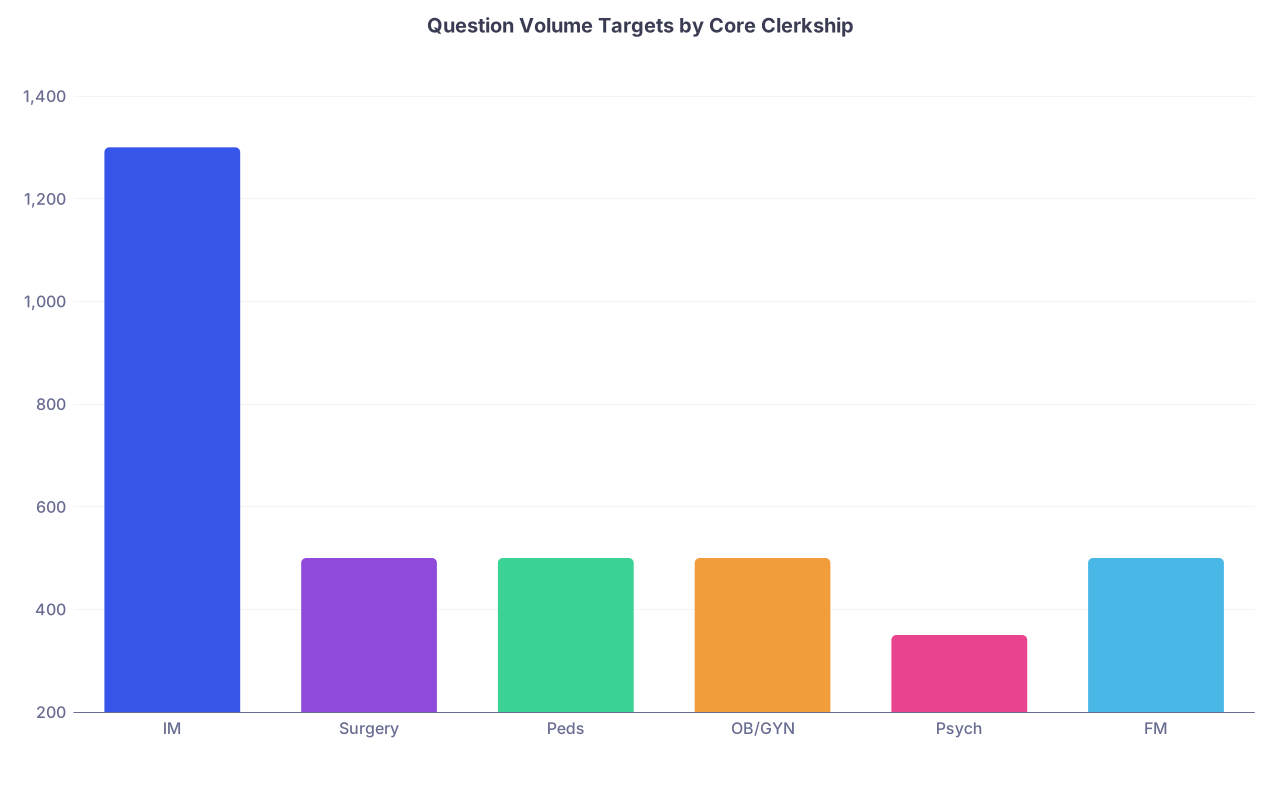
How Many Questions Per Rotation?
Aim to complete the full dedicated QBank section for that shelf. Rough ballpark:
- Internal Medicine: 1,000–1,500 questions (UWorld + maybe Amboss)
- Surgery: 400–600 questions
- Pediatrics: 400–600 questions
- OB/GYN: 400–600 questions
- Psychiatry: 300–400 questions
- Family Medicine: 400–600 questions
If your school uses NBME shelves, prioritize NBME-style question sources (UWorld/AMBOSS, NBME practice forms when available). Your metric is not “time spent,” it is “high-quality questions completed and reviewed.”
How to Use Questions Without Burning Out
The main mistakes I see:
- Doing massive blocks after 12–14 hour days and half-sleeping through the review
- Only doing questions in tutor mode, single-system, which gives you a false sense of security
- Racing through explanations to hit an arbitrary “question count” goal
A better pattern:
- Early in the rotation:
- Tutor mode, smaller blocks (10–15 questions)
- System- or topic-based aligned with what you are seeing (e.g., pulmonary while you are on the pulmonary service)
- Focus on understanding explanations deeply
- Mid rotation:
- Mixed blocks of 20–40 questions in timed mode
- Start simulating real shelf pacing
- Track weak topics and make a short list to read about in the evening
- Last 1–2 weeks:
- Full-length timed blocks (40–50 questions)
- At least 2–3 “mock shelf” sessions
- NBME practice exams if available
| Category | Value |
|---|---|
| IM | 1300 |
| Surgery | 500 |
| Peds | 500 |
| OB/GYN | 500 |
| Psych | 350 |
| FM | 500 |
Using the Wards to Study (Without Looking Like a Gunner Robot)
If you are doing shelf prep correctly, the rotation itself is part of your studying. You just have to be intentional.
Here is how you integrate:
1. Turn Patients Into Learning Anchors
Every patient is a mini-board question waiting to be written. Use them.
Example: You admit a 65-year-old with decompensated heart failure.
Your move that night:
- Do 5–10 questions on acute decompensated HF, diuretics, and cardiogenic shock
- Read one short, structured review (Uptodate summary, hospital pathway, or a trusted outline)
- On rounds the next day, volunteer to present that patient and smoothly incorporate what you learned:
“Given his worsening creatinine after higher-dose furosemide, I read about adding a thiazide-type diuretic like metolazone to overcome diuretic resistance…”
Attendings notice this. And your brain locks the information in because there is a real human attached.
Do this with 1–2 patients daily. Not all of them. You are not writing a textbook.
2. Ask Shelf-Oriented, Not Random, Questions
There is a huge difference between:
- “What is the pathophysiology of constrictive pericarditis?”
and
- “I have seen two patients with suspected constrictive pericarditis now. On questions, I get confused distinguishing constrictive pericarditis from restrictive cardiomyopathy. Clinically and on imaging, what should I lock in for test purposes?”
The second type of question shows you study, recognize patterns, and think about exams. Residents love that. It gives them something specific to teach.
3. Use Downtime Intelligently (Without Being Socially Blind)
There is a social calibration piece most people never talk about.
Wrong move:
Team is in the workroom chatting about the last consult. Chief asks, “Anyone know the CHADS-VASc cutoffs?” You sit in the corner doing your QBank and keep your headphones in.
Right move:
You close the laptop, engage, answer if you can, and then maybe say, “This came up in a question I missed last night, and I learned that stroke risk jumps a lot at a score of 2 or above…”
Later, when everyone is quietly doing notes, your resident says, “I am good, go ahead and do whatever you need to do.” That is when you run a short block (10–15 questions) if and only if your notes and tasks are done.

| Step | Description |
|---|---|
| Step 1 | Wake up |
| Step 2 | 30-45 min QBank or review |
| Step 3 | Pre-round and signout |
| Step 4 | Morning rounds |
| Step 5 | Patient care tasks |
| Step 6 | Help team, notes, follow up |
| Step 7 | 10-15 questions or topic read |
| Step 8 | Afternoon signout |
| Step 9 | Dinner break |
| Step 10 | 60-90 min focused study |
| Step 11 | Sleep |
| Step 12 | Downtime? |
Rotation-Specific Tactics: Where Students Commonly Screw Up
Each clerkship has a slightly different “failure mode” for balancing shelf and ward performance.
Internal Medicine
Common problem: You get swallowed by notes, endless rounding, and scut. Studying shrinks to 30 minutes of half-conscious reading in bed.
Targeted strategies:
- Be efficient with notes. Templates, macros, and structured assessments free time. Your goal is to finish most documentation by mid-afternoon.
- Pick 1–2 “study patients” daily. The heart failure case, the DKA case, the new AFib. Do questions that night directly tied to those.
- Use sign-outs. After you hand over, do not linger for an extra hour just passively observing unless the team clearly wants you there. Go home and study.
Medicine shelves are breadth and nuance. You do not out-memorize medicine; you out-consistency it.
Surgery
Common problem: Brutal hours, OR early, zero energy left at night. Shelf suffers badly.
Reality: Surgical attendings respect people who show up early, are reliable, and still study.
Here is the blueprint:
- Protect mornings: 20–30 minutes. That might mean 4:30 AM alarm. I am not sugar-coating it. Do a small block or read 1–2 topics (fluids, trauma, pre-op eval).
- Use case-based learning: For tomorrow’s cases, read succinctly:
- Indication for surgery
- Key anatomy
- Most common complications
- Use “micro-blocks”: 5–10 questions while waiting for a case to start, as long as your attending is not scrubbed in expecting you.
- Weekends = surgery shelf lifeline. One weekend day must be non-negotiable shelf prep.
Pestana or equivalent + UWorld Surgery, done thoroughly, is usually enough for a solid shelf if you are consistent.
Pediatrics
Common problem: People underestimate it. They think “it is just little medicine.” Then they get hammered by vaccine schedules, developmental milestones, and obscure congenital things.
Tactics:
- Make Anki or some spaced tool your ally for must-memorize items: vaccines, milestones, screening ages. Short, repetitive review pays off.
- During clinic, when you see well-child visits, silently predict vaccines and anticipatory guidance. Then check yourself against what actually happened.
- Do QBank blocks heavily weighted to outpatient pediatrics and common inpatient pediatrics (bronchiolitis, pneumonia, dehydration, neonatal jaundice).
OB/GYN
Common problem: Fragmented days – a bit of triage, some L&D, some GYN clinic. People cannot form a coherent mental model.
You fight that by forcing structure:
- Map your days to topics. If you are on L&D all day, your studying that night is exclusively OB triage, fetal heart tracings, induction/augmentation, and common complications.
- Learn algorithms cold: Shoulder dystocia maneuvers, postpartum hemorrhage steps, preeclampsia management, GBS prophylaxis timing. These are shelf gold.
- Ask residents to quiz you. Most OB residents will happily run through active management of third stage labor or eclampsia sequence if you show interest.
Psychiatry
Common problem: People coast. “It is chill, I will just absorb it.” Then the shelf exposes every gap in neurobiology, medications, and diagnostic criteria.
Fix:
- Be ruthless with DSM criteria and first-line vs second-line treatments. Memorization here is straightforward and rewarded.
- Use cases to fix medications in your brain. The bipolar patient stable on lithium, the psychotic patient on clozapine after two failed antipsychotics.
- Do questions every single day. Psych question stems are extremely pattern-based. Once you see enough, the shelf feels predictable.
How to Impress on the Wards without Sacrificing Shelf Prep
Let us be blunt: your goal is not to be the most knowledgeable person on the team. That is unrealistic as a third-year. Your goal is to be the most useful and prepared student they have.
What residents and attendings actually remember:
- You are on time. Consistently.
- You know your patients cold. Labs, meds, overnight events, active plans.
- You read about your patients and improve daily.
- You do not disappear. You ask, “Anything else I can help with?” before leaving.
- You are not a burden. Your notes help. Your follow-ups are reliable.
The shelf can reinforce all of that, rather than compete with it.
Specific Behaviors That Translate Into Strong Evals
Concrete moves that pay off:
- Pre-round like a machine. Be the one who knows the latest potassium and overnight vitals without looking. That comes from arriving prepared, not from being a genius.
- Prep one teaching point per day. Tiny.
- “I read last night about when to bridge anticoagulation; can I run it by you?”
- “Can we quickly review how to interpret this fetal heart tracing?”
- Volunteer for follow-ups that dovetail with your studying:
- “I can call radiology and then read a bit about pulmonary embolism workup tonight.”
- Close the loop. If you said you would look something up, the next day deliver a 30-second, focused summary.
This is how your shelf studying shows up in real life, and how glowing comments get written.
](https://cdn.residencyadvisor.com/images/articles_svg/chart-contribution-of-clerkship-components-to-residency--7881.svg "Contribution of Clerkship Components to Residency Applications")
| Category | Value |
|---|---|
| Clerkship Grades | 80 |
| Shelf Exam Scores | 70 |
| Narrative Comments | 85 |
| Step 2 CK | 95 |
| [Letters from Clerkships](https://residencyadvisor.com/resources/best-clerkships-match/how-to-engineer-your-best-letter-writer-through-targeted-clerkships) | 90 |
Timing Your Peak: Thinking Ahead to Step 2 CK and the Match
You are not working rotation-by-rotation in isolation. You are building the base for Step 2 CK and, ultimately, for your application year.
Patterns I see in strong applicants:
- Their early shelves (IM, Peds, OB) are solid, then they climb. They do not crash.
- They reuse missed questions and notes when studying for Step 2 CK; nothing is wasted.
- Their letters repeatedly mention “excellent knowledge base for level” and “clear upward trajectory.”
Your plan:
- Preserve your notes and missed-question logs. Do not delete them at the end of each rotation.
- After each shelf, do a 1–2 hour “post-mortem”:
- What topics repeatedly felt weak?
- Did timing hurt you?
- Were your resources adequate?
- Adjust. If you crashed on endocrine topics in medicine, you fix that before family med and Step 2 CK prep.
By the time you write your personal statement, you should be able to say something like:
“Across third year, I consistently sought feedback on my clinical performance and adapted my study approach; this is reflected in progressively stronger shelf scores and increasingly independent contributions on the wards.”
That is not fluff. That is anchored in real, trackable behavior.

Red Flags and How to Correct Mid-Rotation
Stuff goes sideways. You bomb the first quiz. An attending clearly is not impressed. Your first shelf percentile is embarrassing. The worst move is pretending it is fine.
Common warning signs:
- You are constantly staying late to finish notes because your workflow is chaotic.
- You have not completed even 25–30 percent of your planned QBank by mid-rotation.
- You feel “too tired to study” every night and rely utterly on last-minute cramming.
- Feedback suggests you seem disengaged or passive.
The fix is never “just work harder.” The fix is restructure.
Stepwise:
- Have a blunt conversation with a trusted resident or mentor on that rotation:
- “I want to do better on both the shelf and my evals. Here is what I am currently doing. Where is this falling apart?”
- Cut resources. Go down to one QBank + one outline resource. Drop the rest.
- Rebuild your daily schedule on paper. Get precise:
- Wake time, study block length, exact QBank target per day.
- Use your next weekend as a reset:
- Catch up on question volume.
- Triage your weak topics with focused reading.
A mid-clerkship pivot can absolutely salvage both your shelf and your eval narrative. Programs care more about trajectory than perfection.
Final Distillation: How to Do Both Well, Consistently
You are playing a long game. Each clerkship is a chapter, but the book is your residency application.
So the backbone:
- Guard clinical presence during the day. You are there to take care of patients and learn in real time. Act like it.
- Engineer non-negotiable shelf time in the margins – mornings, evenings, and one weekend day – with one primary QBank and one lean resource.
- Use your patients and daily cases as anchors for that studying, then bring that knowledge back to the team in small, useful ways.
- Constantly adjust. If a strategy is clearly not working by week 2–3, do not cling to it out of pride.
If you do these consistently, you end up in the small but very real group of students who both honor rotations and post strong shelves. Those are the students residents remember. And those are the applications that feel obviously strong when programs build their rank lists.


