
Program directors do not want a “star medical student.” They want a PGY‑1 they could drop into their call schedule tomorrow. Your acting internship is where you prove you can be that person.
Let me break this down specifically: most students chronically underuse their AI month. They think it is about “working hard” and “being keen.” PDs and senior residents are looking for something different and much more concrete: day‑to‑day behaviors that map cleanly onto intern responsibilities and reduce the friction of having you on their team.
If you treat this rotation like a slightly more intense third‑year clerkship, you are wasting it. The bar is higher, the grading rubric is different, and PDs absolutely talk about you based on how your AI went.
What PDs Actually Expect From an Acting Intern
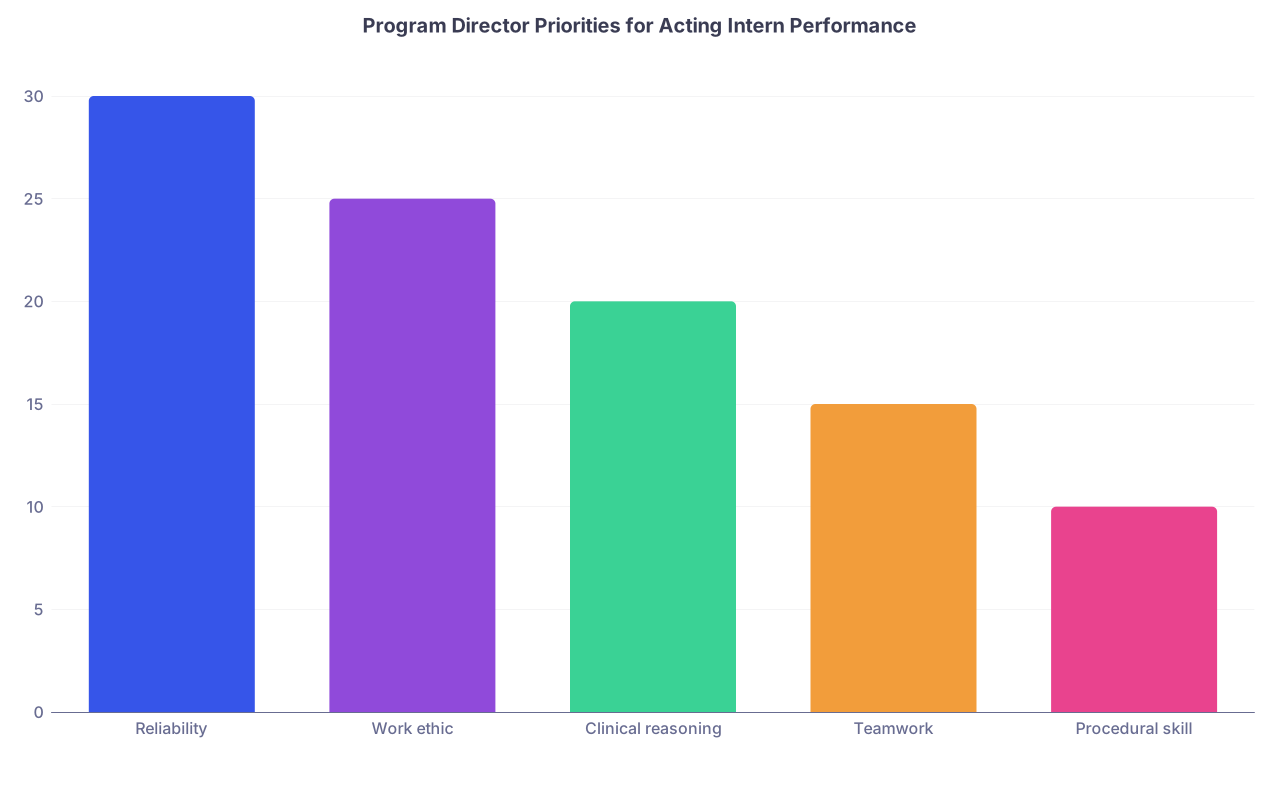
| Category | Value |
|---|---|
| Reliability | 30 |
| Work ethic | 25 |
| Clinical reasoning | 20 |
| Teamwork | 15 |
| Procedural skill | 10 |
The biggest misconception: that acting interns are evaluated primarily on knowledge and note‑writing. That is backward.
When I have sat in rank meetings, the conversation about a strong AI almost always includes some version of:
- “You could put them on nights day one.”
- “Never had to worry about follow‑through.”
- “Senior said they were basically already an intern.”
Notice what is missing: “They knew every guideline” or “Their presentations were the most detailed.” Those are nice, but not decisive.
Program directors, via their residents and faculty, are looking for:
Operational reliability
Do you show up on time, stay until the work is done, and close the loop on tasks without being chased?Intern‑level ownership without intern‑level autonomy
You act like each patient is yours, but you still route decisions through your senior/attending.Safe, organized clinical reasoning
Not brilliance. Safe, structured thinking that does not miss red flags and leads to executable plans.Team integration
Can you function inside the system: communication with nursing, case management, consults, ED, family, and your own team?Emotional stability under mild stress
Not crumbling when census is high, when you get criticized, or when your plan gets shredded on rounds.
If you calibrate your behavior to those five buckets, you will look like an easy “yes” on the rank list.
Step 1: Recalibrate Your Identity – From Student to Junior Intern
Most acting interns stay in “student mode” until someone explicitly tells them to act differently. That is a mistake. You should walk in on day one already operating with an intern mindset.
How your role actually changes
On a typical medicine or surgery AI, you should be functioning at roughly 0.6–0.8 of an intern, not 0.2–0.3 like third‑year:
| Dimension | MS3 Clerkship | Acting Intern | Intern |
|---|---|---|---|
| Patient load | 2–4 patients | 4–8 patients | 8–12+ patients |
| Order entry | Draft orders, limited | Enter most orders for your pts* | Enter all orders |
| Notes | Daily SOAP/progress | Full progress + admit notes | All daily notes, admits/discharges |
| Call responsibilities | Shadow only | Short calls, some cross‑cover | Full call schedule |
| Task ownership | “Help when asked” | Primary for your pt’s tasks | Primary for all assigned patients |
*With co‑sign, depending on institution.
On day 1, you say to your senior, explicitly and calmly:
“I want to function as close to an intern as is safe for the team. For my patients I’d like to: pre‑chart, see them first, write the notes, put in orders for your review, and handle pages about them when you are comfortable. Can we calibrate what you’re okay with?”
That sentence alone separates you from 80% of your peers. It tells your senior what role you want and shows you understand the boundaries.
Expand your workday like an intern, not like a gunner
The AI day should mirror the intern day, shifted slightly shorter for sanity. Rough template for an inpatient AI:
- Pre‑round: on the floor by 5:30–6:00 if rounds at 8:00. You should have:
- Vitals, I/O, labs, imaging, consult notes reviewed.
- A provisional plan in your head (or written) for each patient.
- Work rounds: present succinctly, propose a plan, write orders as they are decided.
- Post‑round work: execute tasks, update families, follow up consults, coordinate with nursing, write notes.
- Late afternoon: last check on labs, re‑examine anyone unstable or borderline, update sign‑out on your patients.
You leave when:
- Your notes are done.
- Tasks are completed or clearly handed off.
- Your senior says “You are good to go.”
Not when the clock hits some arbitrary time.
If you do this consistently, your team will say you “worked like an intern” rather than “stayed late to impress people.” The difference is whether your staying changes someone else’s workload.
Step 2: Own the Bread‑and‑Butter Intern Tasks
Residents and PDs infer your future performance from how you handle very specific, boring tasks. They are not judging you on rare zebras; they are judging you on sodium checks and discharge summaries.
Admission workflow: run it like you are holding the pager
Every program director I know hears about this: can you handle a standard admission without hand‑holding?
Your goal by mid‑rotation: For a common scenario (CHF exacerbation, COPD flare, DKA, post‑op fever), you should be able to:
- Take a focused history and exam in ≤20–25 minutes.
- Present an organized, problem‑based assessment in ≤5–6 minutes.
- Enter reasonable initial orders (labs, imaging, meds, diet, nursing orders) before rounds, ready to be edited, not created, by your senior.
When you get a new admit on call, say to the senior:
“I will see the patient, write a full H&P, and enter a draft order set. I will confirm key decisions with you before I finalize.”
You are signaling: I will not freeload on your cognitive labor, but I also will not free‑solo medical decision‑making.
Daily notes: write like the person who is on call at night
Your notes are not English essays. They are communication tools for cross‑cover and consultants. If your note leaves the on‑call intern confused about what to do at 3 AM, that is a failure.
Make your notes intern‑friendly:
- Start with a one‑line summary that is updated daily.
- Problem‑based A/P, with each problem structured:
- Diagnosis/status
- What changed in last 24h
- Today’s plan with concrete actions
Bad:
“AKI: monitor labs, likely prerenal.”
Good:
“AKI on CKD3 (Cr 1.2→2.0 over 48h, likely prerenal from poor intake and diuretics).
– Hold lisinopril, furosemide today
– 500 cc LR bolus now, then reassess BP/urine output
– Daily BMP; if Cr >2.5 or UOP <0.3 ml/kg/h, notify senior and consider renal consult.”
You think the second one takes longer. It does not, once you get the habit. And it screams “this person can write an intern note.”
Orders and task completion: the quiet metric that matters
Intern currency is tasks done. Acting interns who look like interns are the ones whose patients consistently have:
- Correct diet orders
- Appropriate DVT prophylaxis
- Daily labs only when needed (and discontinued when not)
- Timeout for a procedure ready, consents done
- Home meds reconciled and resumed or intentionally held
On rounds, aim for this rhythm:
- As your plan is being finalized, you are on the computer entering the orders live.
- At the end of each patient, you quickly confirm with the senior: “Orders are in. I will call the family and touch base with nursing.”
You are reducing cognitive and administrative load for your team. Program directors love that.
Step 3: Communicate Like Someone People Want on Nights
Technical skill is teachable. Poor communication under pressure is much harder to fix. PDs infer a lot about your eventual performance from how you interact on the floor.
Upward communication: how you talk to senior and attending
Do not sound like a passive student. Sound like a junior colleague with appropriate humility.
On rounds, your presentation should follow a standard structure, depending on specialty, but the key upgrade at AI level is this: you always propose a plan, even if tentative.
Instead of:
“Ms. X is a 65‑year‑old with CHF admitted for SOB. Overnight she had some mild desats but is currently stable. Physical exam…”
Do:
“Ms. X, 65, HFrEF 25%, here with volume overload and SOB. Net negative 1.5 L in 24 hours, still with JVP at 10 and 2+ edema. Mild nocturnal desat to 90% on 2L, asymptomatic. I think she remains volume overloaded and would benefit from another day of IV diuresis, with a goal of net negative 1–2 L. Plan for: furosemide 80 IV this morning, repeat BMP at 1500, and start weaning O2 if she remains >92% at rest.”
If your plan is wrong, fine. They will tweak it. What they are really grading is whether you are trying to think like the person who is going to hold the pager.
Horizontal and interprofessional communication
Nurses and consultants are not extra credit. They are your main collaborators, and PDs know exactly which students alienate them.
Concrete behaviors that scream “safe future intern”:
- Before changing anything big (new pressor, fluid bolus, major med addition), you call or visit the nurse and confirm understanding:
- “We will give 500cc bolus now; I will re‑check vitals in 30 minutes. Please page me if MAP remains <65.”
- When you page a consult, you have:
- Clear question: “We’re asking cardiology to evaluate for ischemia in new LV dysfunction; we need help deciding on ischemic workup before discharge.”
- Brief one‑liner, key labs/imaging at hand.
- You close the loop:
- “I spoke with endocrine, they recommend starting low‑dose basal insulin and outpatient follow‑up; I will put in the order set and add that to the discharge summary.”
Residents notice you doing that. It shows up in your written comments.
Downward communication: talking to patients and families
No, you are not the attending. But you can still carry a huge chunk of the education and updates.
On AIs, I pay attention to one question: If I am in clinic all afternoon, am I comfortable with this acting intern updating the family on the plan without me holding their hand?
That means:
- You explain the plan in plain language, consistent with what the attending said.
- You avoid overpromising (“We hope to discharge in 1–2 days if your labs and breathing improve,” not “You’re going home tomorrow”).
- You document key discussions briefly in the chart.
When letters are written, the faculty line often reads: “Families specifically commented on how clearly they explained the daily plan.” That carries weight.
Step 4: Hit the Behavioral Landmarks PDs Care About
PD expectations are surprisingly similar across specialties for AI performance. There are a handful of behaviors that show up in nearly every strong letter or end‑of‑rotation eval.

Reliability: the non‑negotiable
By week 2, everyone on your team should implicitly know:
- You will be physically present when you say you will.
- If you accept a task, it gets done or you escalate early if blocked.
- Your sign‑out on your patients is updated and accurate.
The classic failure mode: accepting too many tasks, not tracking them, and then at 5 PM saying “Oh, I forgot to call that family” or “I never ordered that CT.” Residents do not forget this.
Solve it like an intern:
- Keep a running task list per patient (paper card or digital, I do not care; just something you actually look at).
- Use simple symbols: open box = pending, half‑box = in process, filled box = done.
- Before you leave:
- Scan your list.
- Check off or sign out every open item.
Simple, boring, but this is exactly what PDs want.
Adaptability: how you respond to feedback and volume spikes
Every strong AI has at least one day where the wheels could have come off. Census jumps, two admits at once, your attending decides to teach for 45 minutes at the worst possible time.
You will be judged on how you respond when stressed:
- Do you get scattered and defensive?
- Or do you tighten up your prioritization and ask for help early?
On a heavy day, say to your senior at some point:
“We have 2 new admits and 6 follow‑ups; I can fully manage admits A and B and three existing patients today. For the other three, I will pre‑chart and you can split them with the intern. I’d rather do a smaller number well than be unsafe.”
That sentence shows judgment. Residents know you are not trying to collect “numbers”; you are trying to maintain quality. It is a very intern‑like way of thinking.
Professionalism: the quiet red flag detector
PDs worry less about whether you know the latest trial and more about whether you will create problems.
Behaviors that absolutely tank applications:
- Repeated lateness or early disappearance.
- Disrespectful comments about nurses, other services, or patients.
- Blaming others for your own missed tasks (“Nursing never told me,” “The intern did not remind me”).
On the flip side, small acts stand out:
- Owning your errors without drama:
- “I forgot to check the 2 pm labs; I have ordered them now and I will follow up personally. I am also adding a timed reminder to my task list going forward.”
- Protecting colleagues in your language:
- “There was a miscommunication between me and the nurse about the time of the CT; we have clarified it and rescheduled.”
Senior residents mention this in their eval comments. PDs read those carefully.
Step 5: Align Your AI Performance With Letters and Rank List
Let us connect the dots to the residency match, because this is where most students are fuzzy.
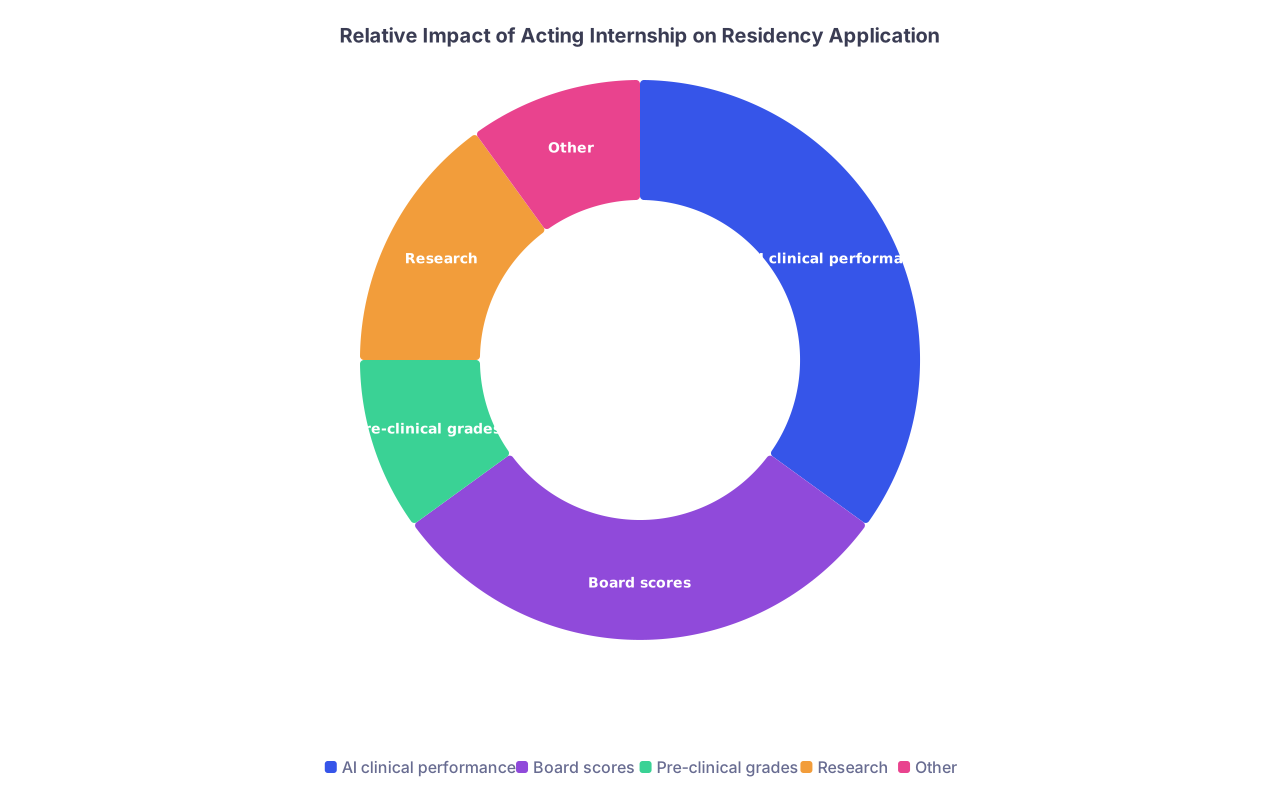
| Category | Value |
|---|---|
| AI clinical performance | 35 |
| Board scores | 30 |
| Pre-clinical grades | 10 |
| Research | 15 |
| Other | 10 |
For many core specialties (IM, peds, surgery, OB/GYN, EM), a home or away AI is one of the most heavily weighted data points for PDs, alongside your Step scores and MSPE. It influences:
- The narrative of your letters of recommendation.
- Comments in your MSPE “Noteworthy Characteristics” and clerkship summaries.
- Informal emails or hallway comments when PDs ask, “What did you think of them as an AI?”
Know what goes into a strong AI letter
The best letters from AIs follow a repeatable template. The faculty or PD is looking for evidence to justify phrases like:
- “Functioned at or near the level of an intern.”
- “Required minimal supervision appropriate for level.”
- “Exemplary ownership and follow‑through on patient care.”
- “One of the strongest acting interns we have had in recent years.”
Your job on the AI is to give them concrete material to support those claims.
Residents and attendings will write about things like:
- “Handled a busy call night with two admissions and one decompensation, communicated calmly and clearly.”
- “Consistently arrived before 6 AM to pre‑round and was fully prepared on every patient.”
- “Nursing staff repeatedly commented on their responsiveness and clear updates.”
None of that happens by accident. It comes from choices you make daily on the rotation.
Coordinate your ask: who should write and what should they see?
If the PD or a core faculty member oversees your AI, you want them to see you on:
- A heavy call day.
- A family discussion that you help lead.
- At least one new admission you run largely independently (with appropriate oversight).
Near the end of the rotation, you say clearly, not awkwardly:
“I am planning to apply in [specialty]. I would be honored if you felt comfortable writing a strong letter based on my performance as an acting intern.”
If they hesitate or say something vague (“I can write you a letter” without “strong”), you have your answer. Use someone else who actually saw your intern‑level behavior.
Step 6: Specialty‑Specific Tweaks in Acting Intern Expectations
The broad principles are the same, but there are nuances by specialty. Let me give you the high‑yield differences.
Internal Medicine / Pediatrics
- Bread and butter:
- Efficient pre‑rounding and systems‑based assessments.
- Discharge planning from day 1 of admission.
- What PDs look for:
- Solid differential diagnoses and evidence‑based plans.
- Comfort managing common cross‑cover issues (fever, pain, hypotension, agitation) with supervision.
On wards, signal intern‑readiness by:
- Proactively calling or messaging case management/social work early for likely discharges.
- Setting specific daily goals on rounds: “Today I would like to see if she can ambulate 100 feet with PT and tolerate PO diuretics.”
General Surgery / Surgical Subspecialties
- Bread and butter:
- Pre‑op and post‑op orders, wound care, early complication recognition.
- Efficient rounding with extremely concise presentations.
- What PDs look for:
- You do not slow the team down.
- You can spot badness early (tachycardia, fever, increasing pain) and escalate.
- You are ready to function as a floor intern on day one.
On surgery AIs, your metrics are different:
- You show up before the intern, not to flex, but to:
- Check labs, dressings, drains.
- Pre‑chart and have a plan: “If drain output continues downtrend, can we pull on day 3?”
- You focus in the OR on:
- Knowing the steps of the case and anticipating equipment.
- Handling basic tasks (closing, retracting) smoothly, without being asked twice.
Letters from surgery AIs often read: “Never needed to ask where they were; always one step ahead on floor work and pre‑op preparation.” Aim for that.
Emergency Medicine
Technically not always called an “AI” but same idea: sub‑I or EM rotation where you function closer to an intern.
- Bread and butter:
- Seeing patients independently, formulating dispo decisions, managing common ED complaints.
- What PDs look for:
- Throughput without sacrificing safety.
- Clear, concise case presentations: “2‑minute pitch, plus plan.”
On EM, signal readiness by:
- Explicitly stating priorities:
- “I can pick up 2–3 level 3 acuity patients at a time safely; if I am falling behind, I will let you know.”
- Owning follow‑through:
- “I ordered the DVT ultrasound, called radiology when it was delayed, and re‑evaluated the patient while waiting. I am ready to present the updated plan.”
OB/GYN, Neurology, Others
Same pattern. The details shift (more fetal monitoring interpretation, more neuro exams, specific procedures), but the intern‑level behaviors do not change:
- Timely, organized pre‑rounding.
- Clear, concise presentations.
- Prompt response to nursing concerns.
- Safe escalation when over your head.
Step 7: Avoid the Classic Acting Intern Mistakes

There are predictable ways students sabotage their AI. If you avoid these, you are already ahead of the pack.
Mistake 1: Over‑stepping clinical authority
Trying to “prove” you can be an intern by making unsupervised decisions that exceed your role is the fastest way to make people nervous.
Examples that get talked about in rank meetings:
- Starting high‑risk meds (heparin gtts, insulin drips, pressors) without senior co‑sign or clear prior plan.
- Changing code status or having major goals‑of‑care conversations solo.
- Cancelling or significantly changing specialist plans without discussion.
Your guardrails should be:
- You can propose almost anything.
- You do not implement significant new therapies or reversals of plan without explicit senior/attending agreement.
Mistake 2: Hiding uncertainty or mistakes
Interns who hide errors are radioactive. Acting interns who hide errors look like future interns who will do it under pressure.
If you order the wrong med, miss a lab, or forget a task:
- Fix what you can immediately.
- Tell the senior:
- “I realized I ordered 20 mg instead of 10 mg; I have already corrected it and re‑checked vitals. No harm done, but I wanted you to be aware.”
- Implement a micro‑system so it does not happen again (task list, double‑check ritual, etc.)
People are far more forgiving of errors than of concealment.
Mistake 3: Mistaking enthusiasm for value
Showing up early and staying late is meaningless if you do not reduce someone else’s workload or risk.
Real value as an AI looks like:
- You do a full discharge summary and med reconciliation before 10 AM, so the planned discharge actually happens.
- You notice a rising creatinine and call it out before anyone else, leading to early intervention.
- You anticipate discharge barriers (insurance, transportation, home oxygen) and involve the right people.
Pure “enthusiasm” is a commodity. Reliable, anticipatory work is not.
Step 8: Intentionally Shape How PDs Hear About You

| Step | Description |
|---|---|
| Step 1 | AI Performance |
| Step 2 | Resident Feedback |
| Step 3 | Faculty Evaluation |
| Step 4 | Letters of Recommendation |
| Step 5 | Informal PD Impressions |
| Step 6 | ERAS Application Strength |
| Step 7 | Rank Meeting Discussion |
| Step 8 | Final Rank List |
You are not just “doing a rotation.” You are feeding data into a system that ends with your name somewhere on a list.
Be visible to the decision‑makers
You do not need to be loud or performative. But you do need the people who write letters and make rank decisions to see you in action when you are performing well.
Concrete ways:
- Volunteer (within reason) to admit interesting but not impossible patients when the PD is on service.
- Ask directly once or twice:
- “Are there additional responsibilities I could take on to move closer to an intern role?”
- Request mid‑rotation feedback from someone who matters, not just the nicest resident.
Use feedback as a tool, not a grade
Mid‑rotation feedback is not an exam. It is a chance to adapt while there is still time.
When you get vague feedback like “work on efficiency,” push gently:
“Can you give me an example from this week where I was less efficient than an intern would be? Was it my pre‑rounds, notes, or post‑round task completion?”
Then pick one domain and improve it visibly. People notice responsive change, and that story often shows up in final evals:
- “Initially a bit slow with pre‑rounding, but rapidly adjusted and by second half of rotation was fully prepared on all patients.”
PDs read that as growth potential, not weakness.
Let me keep the summary tight:
- Treat your acting internship as a trial run of being an intern, not a more intense clerkship. Own patients, tasks, and communication at a level that makes your senior’s life easier, not harder.
- Optimize for PD‑relevant behaviors: reliability, safe clinical reasoning, team integration, and calm under moderate stress. Your goal is for residents to say, without hesitation, “We could put them on nights tomorrow.”
- Make sure your best days are visible to the people who write letters and sit in rank meetings. Your AI performance does not just earn you “honors”; it writes the narrative that either gets you circled in green on a rank list—or quietly dropped.


