

The biggest waste of a longitudinal clerkship is reducing it to one throwaway line in your ERAS experiences section.
You put in a year of continuity work; if it reads like a 4‑week block, you have thrown away one of the few built‑in narrative advantages you have over your competition.
Let me show you how to turn that year‑long clerkship into a coherent, long‑form narrative that threads through your ERAS application, your personal statement, and your letters—without sounding contrived or repetitive.
1. Why Longitudinal Clerkships Are Narrative Gold (If You Use Them Right)
Longitudinal clerkships are structurally different from traditional block rotations. That structural difference is exactly what makes them powerful for ERAS.
You did not just “do internal medicine for 12 months.” You:
- Saw the same patients over time
- Worked with the same attendings and residents repeatedly
- Watched disease trajectories, not just snapshots
- Accumulated responsibility in a visible, traceable way
Program directors are reading hundreds of apps where every student claims:
- “Strong work ethic”
- “Excellent team player”
- “Committed to continuity and follow‑up”
You can actually prove those phrases instead of reciting them.
Here is the core idea:
You must convert “a long experience” into “a long‑form story arc.”
Not a list of duties. Not a paragraph of adjectives. An arc.
That arc should do three things for your residency application:
- Anchor your professional identity
- Demonstrate growth over time with concrete evidence
- Create internal consistency across ERAS, personal statement, and letters
If your longitudinal clerkship is not doing at least two of those three, you are under‑leveraging it.
2. Dissecting the Longitudinal Clerkship: Raw Material for Your Narrative
Before you write a single ERAS character, you need to strip the clerkship down to its components. Not what the curriculum office calls it. What you actually lived.
Forget the official name for a minute. Break it down like this:
- Setting: Academic clinic, community site, VA, FQHC, rural practice
- Core specialty focus: IM, FM, peds, combined, or multi‑specialty
- Time frame and frequency: “Half day per week for 12 months” vs “4‑week blocks across a year”
- Continuity elements: Same preceptor, same panel of patients, same care team, recurring conferences
- Responsibilities: What did you do in Month 1 versus Month 9?
Now, pull out the narrative‑relevant pieces, not just the descriptive ones.
You are looking for:
The through‑line
What stayed constant despite everything else changing? (Same population, same clinic, same preceptor expectations.)The turning points
Specific moments where your role, confidence, or understanding jumped—a conversation when your preceptor said “I think you can run this visit,” or the first time a patient asked for you by name.The visible growth
Things an attending could honestly write in a letter as “I watched this student go from X to Y over the course of the year.”
If you cannot answer those yet, you are not ready to write. You are still at the “calendar and syllabus” level, not the “narrative raw material” level.
3. Choosing Your Core Narrative: Identity, Skill, or Population
You cannot tell twelve stories at once. You need one primary spine for the longitudinal narrative.
There are three main narrative angles that actually land with residency readers:
Professional identity arc
How this longitudinal clerkship crystallized your sense of “I am becoming X kind of physician.”Skill and responsibility arc
How your clinical reasoning, autonomy, and reliability evolved—visible, practical growth.Population or mission arc
How continuity with a particular population (rural, underserved, geriatric, pediatric, refugee) shaped what you care about and what you want from residency.
Pick one as the dominant theme. The others can support, but you need one clear center of gravity.
Here is what that looks like in practice:
- For internal medicine:
“This longitudinal clinic is where I stopped thinking of myself as a student ‘assigned to IM’ and started thinking like an internist.” - For pediatrics:
“Following the same kids through vaccinations, asthma flares, and school transitions made me fixate less on diagnoses and more on families’ daily realities.” - For family medicine:
“The year‑long relationship with multigenerational families in our community clinic turned ‘broad scope’ from a buzzword into something very literal—sometimes uncomfortably so.”
You are not writing yet. You are choosing the lens.
Everything you put into ERAS about this clerkship must serve that chosen lens.
4. Translating Longitudinal Experience into the ERAS “Experiences” Section
This is where most people mess it up. They either:
Use the generic template they used for every other rotation:
“Completed a year‑long continuity clinic on the internal medicine service. Responsibilities included history and physicals, presenting patients, and following up labs.” (Completely interchangeable with 50,000 other students.)Or they pack it with fluff:
“Developed deep relationships with patients over time and learned the value of continuity and holistic care.” (Meaningless without receipts.)
Your longitudinal experience entry must look materially different from your 4‑week rotations. It should emphasize:
- Time scale
- Continuity with patients
- Progressive responsibility
- Observable outcomes or changes
Structure it in three parts:
- Context (1–2 sentences)
- Longitudinal elements (2–3 sentences)
- Growth / impact (2–3 sentences, with one concrete example)
Example for an Internal Medicine longitudinal clerkship:
“Selected for a 12‑month continuity clinic in a safety‑net internal medicine practice, attending a half‑day clinic weekly while completing other core clerkships. Worked with the same attending and resident team, following a panel of patients with complex chronic disease.
Over the year, assumed progressive responsibility for pre‑charting, agenda setting, counseling on medication changes, and coordinating follow‑up testing. Several patients requested continuity with me as a student, and I managed repeated visits for uncontrolled diabetes and heart failure with close attending supervision.
By the end of the year, I was independently formulating assessments and initial plans for 6–8 patients per session, then reviewing with my preceptor. This longitudinal experience gave me direct feedback on how my decisions and counseling played out months later, sharpening my clinical reasoning and commitment to follow‑through.”
Notice several things:
- The year‑long structure is explicit.
- Continuity is not just claimed; it is demonstrated through “repeated visits,” “requested continuity,” “months later.”
- Growth is clear: starting responsibilities versus end‑of‑year autonomy.
- There is no vague “I learned” sentence; the learning is shown through changed behavior.
If you have more than one major longitudinal piece (for example, LIC model spanning IM/FM/Peds), you may:
- Use one “umbrella” experience describing the LIC structure and your overall role, then
- Use one or two specific sub‑experiences (e.g., “Longitudinal Pediatrics Clinic within LIC”) only if they add something distinct.
Do not clutter ERAS with five nearly identical entries that all say “longitudinal.” That looks scattered and unfocused.
5. Integrating Longitudinal Narrative into Your Personal Statement (Without Copy‑Pasting)
Your personal statement is not a longer version of the ERAS description. It is where you shift from “what I did” to “how this re‑wired my thinking and priorities.”
The longitudinal clerkship can function in one of three roles in your statement:
- The central narrative backbone
- The key middle chapter that explains your growth
- The quiet, stabilizing thread that ties several other experiences together
You choose based on how dominant that clerkship truly was in your formation and how strong your other narrative anchors are (research, non‑traditional background, etc.).
Option A: Using the longitudinal as your backbone
This works well if:
- You are in a longitudinal integrated curriculum (LIC)
- Or your year‑long clinic clearly drove your specialty choice
Basic shape:
- Opening anecdote from mid‑to‑late clerkship (not Day 1) that shows you operating at your best version during that year
- Brief flashback to early in the longitudinal experience when you were less sure / less skilled
- Explanation of how that year‑long context changed:
- How you see patients
- How you handle uncertainty
- How you think about continuity of care
- Tie to what you are seeking in residency: similar continuity, similar patient population, or structured longitudinal clinics / panels
Crucial move: do not use a single “miracle case” where one patient changed everything. That reads as naïve. Instead, show accumulation:
“By the time I saw Mr. R for his third appointment, I had already watched four other patients cycle through similar patterns of decompensation and readmission. The difference this time was not that I knew the guidelines better, but that I understood exactly which parts of the plan his life would not support.”
That is a longitudinal insight. Residency readers recognize it instantly.
Option B: Longitudinal as the middle chapter
If your primary story is something else (prior career, research, personal background), your longitudinal clerkship still has an important job: prove that your abstract motivations hold up in daily clinical work.
You can do this with one well‑chosen paragraph:
- 2–3 sentences establishing the clerkship structure
- 2–3 sentences on a repeated pattern (frequent no‑shows, language barriers, med non‑adherence, etc.) that you kept encountering
- 1–2 sentences tying what you learned there to the specialty you are applying to
Example for psychiatry:
“During my longitudinal primary care clinic, I stopped being surprised when depression, anxiety, or trauma surfaced in visits scheduled for diabetes or back pain. After the sixth or seventh patient broke down halfway through what was supposed to be a routine follow‑up, I started building time and space into my presentations for the emotional undercurrent of each visit. That year made it clear that I wanted a residency where extended conversations about mental health were the rule, not the exception.”
You have just converted a generic primary care longitudinal into a psychiatry‑relevant narrative bridge.
6. Aligning Your Longitudinal Story with Letters of Recommendation
Here is where longitudinal clerkships can really outperform 4‑week rotations: letters.
A preceptor who has seen you 30–40 times has credibility when they say:
- “I saw consistent growth”
- “I trusted this student with… over time”
- “Patients began asking specifically for this student”
But that only happens if you set it up consciously.
You want a longitudinal letter that complements—and does not duplicate—the rest of your application.
| Scenario | Best Use of Longitudinal Letter |
|---|---|
| Applying to same specialty as clinic (IM longitudinal → IM) | Anchor letter: continuity, growth, intern‑like functioning |
| Different but related specialty (IM longitudinal → Neuro) | Highlight complex medical management, chronic disease follow‑up |
| Different specialty (primary care longitudinal → EM) | Emphasize reliability, ownership, follow‑through between ED and clinic |
| Weak other clinical letters | Use longitudinal to demonstrate sustained performance, not a 4‑week spike |
How to prep your preceptor (without being annoying):
- Quietly remind them of concrete examples of your growth: early vs late in the year.
- Mention patients you followed longitudinally where your role clearly increased.
- Share your personal statement draft or a short written summary of “how this year shaped my sense of myself as a future ___ resident.”
You are not scripting their letter. You are aligning their vantage point with the narrative you are already building elsewhere.
If your longitudinal attending writes, “I watched this student become the de facto first point of contact for several high‑need patients over the course of the year,” and your ERAS description and personal statement both echo that progressive ownership theme, your application feels internally consistent. That is rare. And very persuasive.
7. Case‑Based Examples: Weak vs Strong Use of a Longitudinal Clerkship
Let me show you the difference with concrete examples.
Example 1: Family Medicine Applicant
Weak ERAS description:
“Participated in a family medicine longitudinal clerkship throughout third year, seeing adult and pediatric patients in an outpatient setting. Duties included taking histories, performing physical exams, and presenting to attendings. Learned the importance of continuity of care and working in a multidisciplinary team.”
This could be anyone, anywhere.
Strong ERAS description:
“Completed a third year longitudinal family medicine clerkship at a community health center, attending weekly clinics for 11 months while rotating on other services. Followed a growing panel of patients across preventive visits, chronic disease management, prenatal care, and acute concerns, often seeing the same families multiple times.
Early in the year I focused primarily on data gathering and basic plans; by spring my preceptor encouraged me to lead visits for patients I had seen before, frame the agenda, and independently propose management plans before debriefing together. Several patients and one entire family requested continuity with me as their student.
This sustained exposure gave me a concrete sense of how social context, transportation barriers, and family dynamics repeatedly shaped our medical plans, and it solidified my desire to train in a residency program with strong continuity clinics and community partnerships.”
Now the same applicant’s personal statement can anchor on three or four snippets from that longitudinal clinic without sounding repetitive:
- The prenatal patient you followed into postpartum depression
- The diabetic patient who kept missing lab draws until you understood the transportation issue
- The teenager whose asthma control only improved after you finally met the grandmother who actually managed the meds
These are serial encounters, not one‑off “hero moments.” Program directors trust that kind of story.
8. Making the Longitudinal Nature Visible in Your Activities List as a Whole
One more subtle point: your longitudinal story is more believable if your ERAS activities list, taken as a whole, reflects continuity behaviors.
Residency readers unconsciously scan for:
- Long‑term commitments (> 1 year) in anything: volunteer work, leadership, research
- Repeated involvement with the same population or clinic
- Roles that show “sticking with something even when it is less glamorous”
If your only longitudinal element is a required clerkship that everyone in your school did, it is still valuable—but less distinctive. You can strengthen the narrative by linking it to other long‑term patterns.
For example:
- Longitudinal IM clinic + 2‑year student‑run free clinic → continuity with underserved population is credible.
- Peds longitudinal clinic + 3 years of coaching youth sports → sustained interest in children is credible.
- Primary care longitudinal + 18 months of QI work on clinic no‑show rates → you are not just noticing problems; you are trying to fix them.
You can even make this link explicit in one experience description, without sounding heavy‑handed:
“My work in the student‑run clinic built on what I was seeing weekly in my longitudinal internal medicine clinic, especially around missed appointments and poor follow‑through. I joined a small team working on a quality improvement project to address no‑show rates by…”
That is a sophisticated move. You are telling the reader, “I do not see my experiences as disconnected; they talk to each other.”
9. Specialty‑Specific Angles for Longitudinal Narratives
Let me be very direct: different specialties care about different aspects of your longitudinal story. If you pitch the wrong angle, you lose some impact.
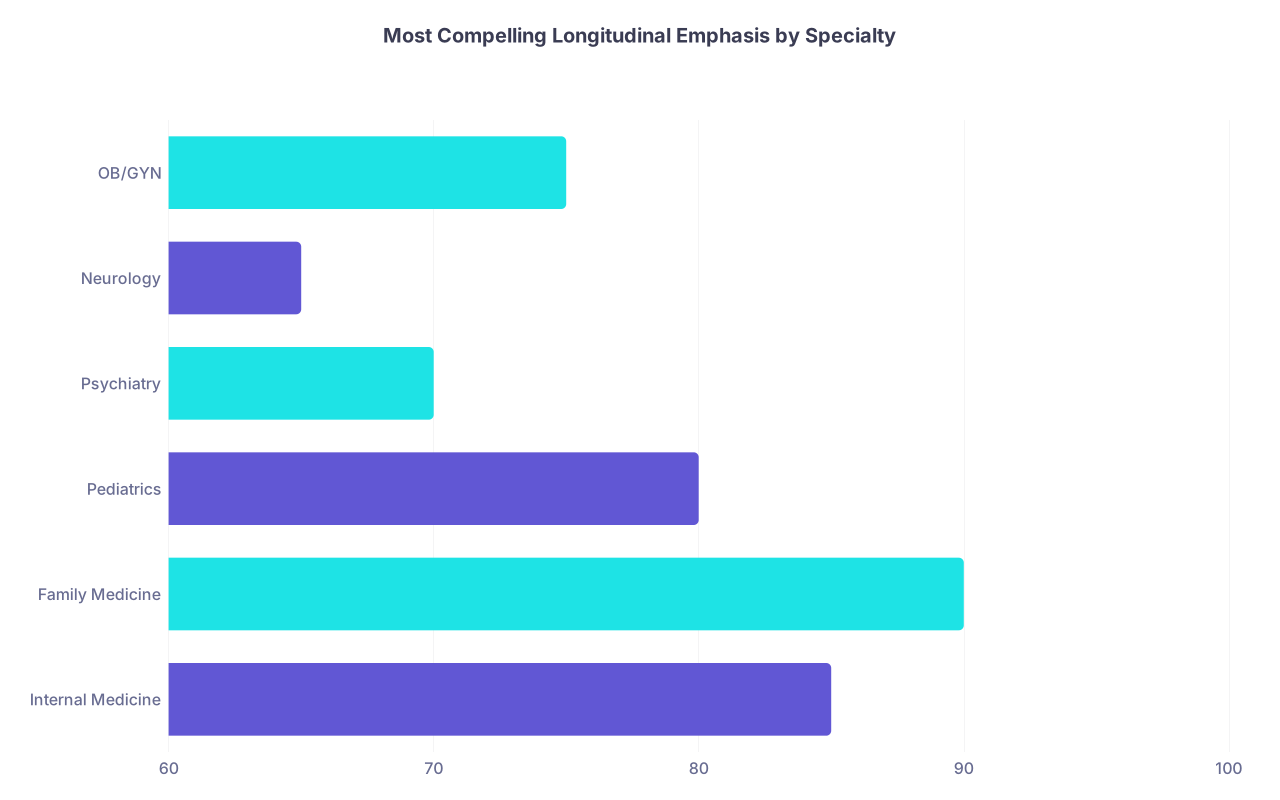
| Category | Value |
|---|---|
| Internal Medicine | 85 |
| Family Medicine | 90 |
| Pediatrics | 80 |
| Psychiatry | 70 |
| Neurology | 65 |
| OB/GYN | 75 |
Think of the numbers above as “how much they care about a well‑told continuity story” on a 0–100 scale. Primary care fields are obsessed with it. Others still value it, but in more specific ways.
Here is how to tweak the emphasis:
Internal Medicine
Emphasize longitudinal management of chronic disease, diagnostic uncertainty over time, adjusting treatment plans after seeing outcomes, and building a “mini‑panel” mindset.Family Medicine
Highlight scope (prenatal to geriatrics), family systems, community context, and evolving trust with patients over repeated visits.Pediatrics
Focus on developmental changes, longitudinal relationships with families, coordination with schools and subspecialists, and watching children grow into different life stages.Psychiatry
Use the longitudinal primary care context to show attentiveness to mental health over time, recognition of patterns across visits, and patient narratives rather than single episodes.Neurology
Emphasize longitudinal neurological symptom trajectories, functional changes, and how seeing patients multiple times sharpened your approach to history and exam.OB/GYN
Use prenatal care, postpartum follow‑up, or gynecologic issues tracked over months to highlight reproductive health continuity and trust‑building.
If you are going into a procedural or acute‑care heavy field (EM, anesthesia, surgery), do not discard your longitudinal clerkship. Just be smart about the angle:
For EM:
“Working in longitudinal primary care made me obsessed with what happened to patients after the ED visit, and I found myself reading follow‑up notes and discharge summaries differently.”For surgery:
“Following patients in clinic before and after operative interventions, even from the vantage point of primary care, made me pay attention to surgical decision‑making and long‑term functional outcomes.”
Those lines bridge an apparent mismatch between “longitudinal outpatient” and your chosen field.
10. Avoiding the Three Most Common Longitudinal Narrative Mistakes
Let me save you from the predictable errors I see every cycle.
Mistake 1: Chronological diary
Students describe the year month‑by‑month:
“Early in the year I did basic H&Ps, then later I saw more complex patients, and by the end I was more independent.”
That is not a narrative. That is a calendar. Instead, collapse time into a before/after contrast tied to a specific dimension of growth:
- Before: what did you not know, not see, or not do?
- After: what do you now consistently notice or handle differently?
Mistake 2: Vague “continuity” claims with zero proof
Everyone writes “I built strong relationships with patients over time.” Almost no one provides evidence.
Evidence looks like:
- “I saw Mrs. L during three hospitalizations and five clinic visits and eventually… ”
- “On his fourth visit, Mr. K told me he had waited to schedule until he knew I would be there.”
- “A patient I had initially met in the ED later became part of my longitudinal clinic panel.”
You do not need dozens of these. Two or three specific references across ERAS and your statement are enough.
Mistake 3: Letting the school’s language dictate your narrative
Your school calls it an LIC, or a “Doctoring 3 longitudinal clinic,” or whatever. Program directors do not care about the brand name.
They care about:
- Time course
- Setting
- Population
- Role
- Growth
If your official course name obscures that, translate it in ERAS:
“Third year longitudinal primary care clinic (half‑day per week, 11 months) in a federally qualified health center.”
Clear. No jargon.

| Step | Description |
|---|---|
| Step 1 | Longitudinal Clerkship Raw Material |
| Step 2 | Choose Core Narrative Angle |
| Step 3 | ERAS Experience Description |
| Step 4 | Personal Statement Integration |
| Step 5 | Letter Writer Preparation |
| Step 6 | Aligned Activities List |
| Step 7 | Coherent Application Story |
A year‑long clerkship gives you something most of your classmates do not have: credible evidence that you can show up for patients and teams over time and actually learn from repeated encounters.
If you reduce that to “Did a longitudinal clinic. Learned the value of continuity,” you are wasting it.
If instead you carve out a clear narrative angle, back it with specific longitudinal details, and align your ERAS entries, personal statement, and letters around that same arc, you turn a curriculum requirement into a differentiating feature.
With that narrative spine in place, your next job is to make sure your interview answers echo the same story—especially when someone asks, “Tell me about a patient you followed over time.” But how you handle that question in a 15‑minute Zoom call is its own skill set. That is a conversation for another day.


