
A single bad core clerkship evaluation will not destroy your residency chances—unless you handle it poorly.
The real risk is not the evaluation itself. It is the way students panic, avoid the problem, and then let it poison letters, MSPE language, and interview conversations. I have watched smart, capable students do permanent damage not because of the mistake, but because of the cover‑up, the denial, or the passivity that followed.
You are not going to do that.
Here is a step‑by‑step damage control plan that treats this like what it is: a fixable problem with high stakes that demands a disciplined response.
Step 1: Get the Full, Unfiltered Picture
Most students react to the grade and ignore the data. That is backward.
You cannot fix what you do not understand. Before anything else, you need the specifics.
1. Pull Every Piece of Documentation
Do this within 24–48 hours of seeing the bad evaluation or clerkship grade.
- Download or screenshot:
- The final clerkship grade page
- Narrative comments (honors vs non‑honors comments, mid‑rotation feedback if available)
- Any professionalism notes or incident reports
- If your school uses a system like MedHub, E*Value, or OASIS, export anything you can.
Then sort what you see into three buckets:
- Global performance issues
- “Below level in clinical reasoning”
- “Struggled with time management; often behind on notes”
- Interpersonal/professionalism issues
- “Came across as disinterested”
- “Dismissive comments to nurse”
- “Late to rounds multiple times”
- Outlier or personality‑driven comments
- “Did not read enough outside of assigned work” from the attending who never once mentioned expectations
- “Seems quiet” when every other rotation praised your communication
The third group is annoying but less lethal. The first two are what programs care about.
2. Separate Signal From Noise
Read the comments three times:
- First: Emotional read. Get the anger/embarrassment out of your system.
- Second: Highlighter read. Mark:
- Specific behaviors (“late to…” “did not…” “failed to…”)
- Repeated themes across multiple evaluators
- Third: Cold read. Ask yourself:
- “If I were a PD reading this, what story would I tell about this student?”
That last question is brutal but necessary. Residency program directors do not see “context.” They see patterns. Your job is to identify exactly what pattern they might see—and then start rewriting it.
Step 2: Clarify What Actually Happened (Objectively)
You need a clean, factual understanding of the incident or pattern that led to the evaluation. Not your feelings. The events.
1. If There Was a Specific Incident
Examples:
- You snapped at a nurse on a bad call night.
- You missed a page.
- You were late three times during the first week.
- You had a conflict with a resident that escalated.
Write a short factual timeline:
- Date(s)
- What happened
- Who was present
- How it was addressed at the time
- Any follow‑up you already did (apology, meeting, etc.)
Keep this to half a page. No justifying. No “I was tired” paragraphs. Facts only.
You are building the raw material for:
- Conversations with your clerkship director
- Future discussions with your dean
- An explanation during residency interviews if it surfaces
2. If It Was a Global Performance Issue
Examples:
- “Below expectations” on medical knowledge or clinical reasoning
- “Needs to work on presentation skills”
- “Not proactive”
You need to figure out whether:
- This was a one‑off mismatch with this rotation and team, or
- This reflects a real pattern that will keep biting you if you do not address it
Scan your other clerkship feedback, even from earlier rotations:
- Are there similar comments about:
- Being quiet/passive?
- Slow documentation?
- Struggling with prioritization?
- Or is this the only evaluation that looks like this?
If it is a clear outlier, your damage control plan focuses on documentation and framing.
If it is a pattern, your plan must also include genuine performance improvement before application season.
Step 3: Talk to the Right People, in the Right Order
Do not fire off an angry email to the attending. Do not start a long complaint thread. That is how you turn a bad eval into a professionalism problem.
The Order of Operations
- Clerkship Director
- Academic Dean / Dean of Students / Advisory Dean
- (Possibly) Specific attending or resident evaluator
1. Meet With the Clerkship Director
Your goal is clarity and future repair, not retroactive grade begging (even if you would love the grade change).
Schedule a short, focused meeting. In your email:
- Subject: “Request for feedback – [Clerkship Name] evaluation”
- Three sentences max:
- You reviewed your evaluation
- You want to understand areas for growth
- You want to make sure you improve for future rotations
In the meeting, do this:
- Start with:
“I have reviewed my evaluation and I can see there were concerns about [X and Y]. I want to understand exactly what I did or did not do, and what I can concretely change going forward.” - Then shut up and listen.
Ask very direct questions:
- “Were there specific incidents that stood out to you or the team?”
- “How did my performance compare to a typical student at this stage?”
- “If you were writing a dean’s letter about me right now, what would worry you?”
Take notes. Use paper. The director will see you are treating this seriously.
If you genuinely disagree about facts (e.g., you were not actually late three times), say:
- “My recollection is different on that point. Would it be possible for me to add a brief student comment to my record providing context, without disputing the team’s right to their impression?”
You are not trying to fight the evaluation. You are trying to make the written record as accurate and balanced as possible.
2. Loop In Your Dean/Educational Advisor
This person will help shape your MSPE (Dean’s Letter) and strategic application plan. They must not be surprised by a bad evaluation later.
Send a short summary email:
- One paragraph: what the evaluation said, what the main concerns were
- One paragraph: what you learned from talking with the clerkship director
- One line: “I would really appreciate your advice on how to address this in my overall application strategy.”
Then schedule a meeting.
Bring:
- Printed evaluation
- Notes from clerkship director meeting
- A list of questions:
- “How will this likely be reflected in my MSPE?”
- “Is this considered a red flag, yellow flag, or just a weaker rotation?”
- “What can I do in the next 3–6 months to build a counter‑narrative?”
Your dean has seen hundreds of students in worse situations. Use that experience.
3. Decide Whether to Approach the Attending/Resident
Sometimes this is valuable. Sometimes it just stirs the pot.
Good reasons to reach out:
- To apologize for a specific, valid professionalism concern
- To clarify expectations for future students (for your own learning)
- To potentially rebuild a relationship with an attending in your desired specialty
Bad reasons:
- To argue point‑by‑point
- To pressure them to change the evaluation
- To vent
If your clerkship director or dean says “let it go,” listen.
If you do reach out, aim for a short conversation:
“Dr. X, I read your evaluation from my rotation. You noted concerns about [specific behavior]. I wanted to thank you for the feedback, apologize for my part in that, and understand what I could have done differently. I am working hard to improve, and your perspective would help.”
Then actually improve. Or this becomes empty theater.
Step 4: Fix the Performance Problem (Not Just the Paper Trail)
If your bad evaluation was rooted in behavior or skill gaps, residency programs do not only want to see that you feel bad about it. They want evidence that you got better.
You have two tracks: clinical skills and professionalism/behavior.
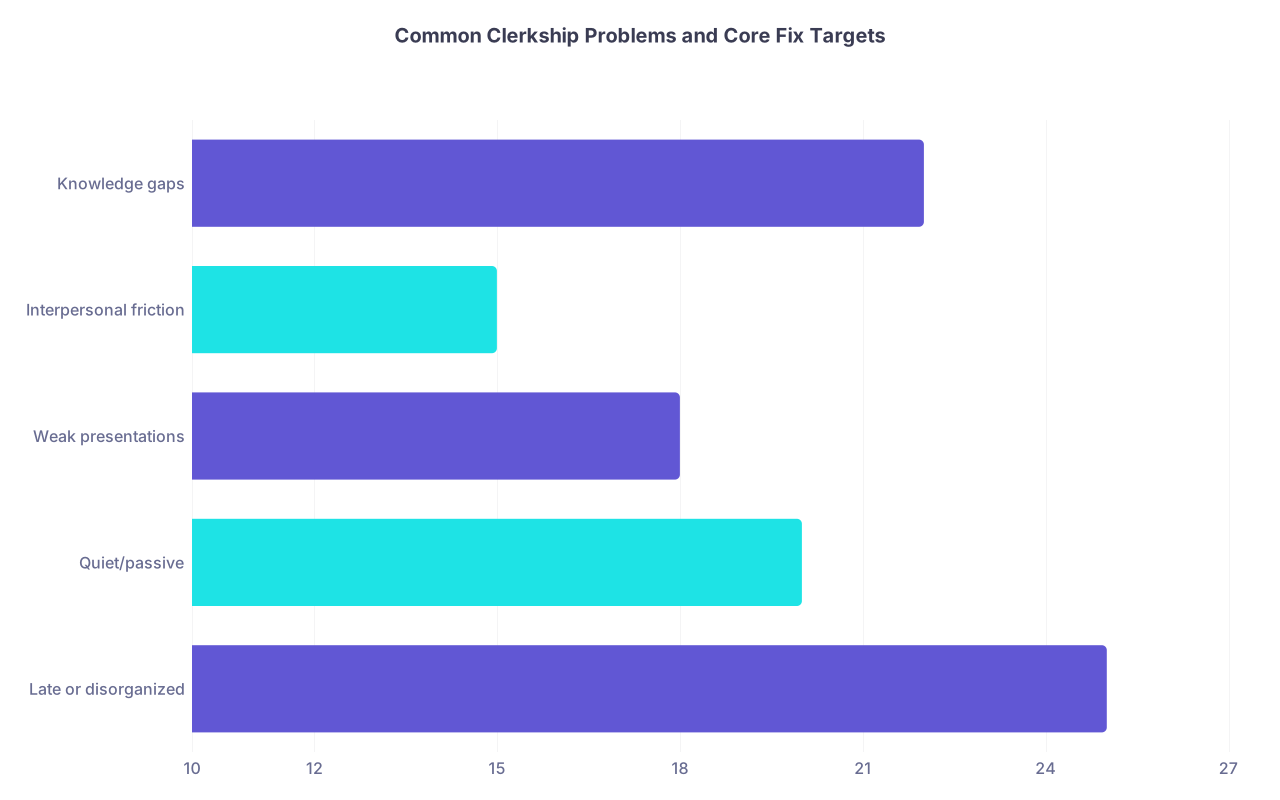
| Category | Value |
|---|---|
| Late or disorganized | 25 |
| Quiet/passive | 20 |
| Weak presentations | 18 |
| Interpersonal friction | 15 |
| Knowledge gaps | 22 |
1. Clinical Performance / Work Habits
Some high‑yield fixes that move the needle quickly:
Chronic lateness or disorganization
- Set arrival target: 15–20 minutes before expected time
- Pre‑round the night before when possible; write skeleton notes
- Use a simple task tracker (index card or small notebook) for each patient:
- Today’s tasks
- Pending labs/imaging
- Questions for resident/attending
Weak presentations
- Ask a senior resident you trust:
“Can I run one of my presentations by you after rounds and get critique for 5 minutes?” - Use a rigid structure for a month:
- One‑liner
- Focused overnight events
- New data
- Assessment with 2–3 prioritized problems
- Clear plan with bullets
- Record yourself (audio only, privately) once or twice and listen. Painful but effective.
- Ask a senior resident you trust:
Not proactive / too quiet
- Set minimum engagement goals per day:
- Ask at least 2–3 clinical questions (not “what are we doing,” but “why are we choosing X over Y?”)
- Volunteer for 1–2 extra tasks: calling family, following up a consult, looking up guidelines
- Tell your resident on day 1:
“One of my goals this rotation is to be more proactive and speak up more. If you notice me hanging back, I would appreciate a nudge.”
- Set minimum engagement goals per day:
2. Professionalism / Interpersonal Behavior
Professionalism hits are more toxic than knowledge gaps. Programs will tolerate a student who is a little slow but kind, honest, and reliable. They will not gamble on someone with attitude problems.
If your eval mentions:
- “Seemed disinterested”
- “Defensive when given feedback”
- “Tension with nurses or other team members”
The repair plan must include:
Explicit acknowledgment
To your clerkship director and/or dean:
“I understand that my behavior came across as [X]. That is not the colleague I want to be. I am working on [Y concrete behaviors] to change that.”Behavioral changes
- When getting feedback:
- Do: “Thank you, that is helpful. I will work on that today.”
- Do not: Argue, explain, blame the system
- With staff:
- Learn names. Use them.
- Ask: “Is there anything I can do to make your job easier with this patient?”
- With your own frustration:
- Never vent about team members in patient‑visible areas
- Keep your worst commentary off text threads with co‑students; those screenshots have a way of resurfacing
- When getting feedback:
Mentor check‑ins
- Ask a resident or faculty member you trust to give you “professionalism spot checks”:
- “If you ever see me coming off defensive or dismissive, can you tell me directly? I am working on being more aware of that.”
- Ask a resident or faculty member you trust to give you “professionalism spot checks”:
Step 5: Build a Counter‑Narrative With Future Rotations
One bad core clerkship is not fatal. A bad clerkship followed by silence is.
You need subsequent rotations that demonstrate change. Not just say it.
1. Target Two Upcoming Rotations as “Reputation Builders”
Ideally:
- A sub‑I in your intended specialty
- Another core or heavy‑weight elective where evaluations matter
Before those rotations start:
- Email the clerkship or elective director:
- State your specific learning goals
- Mention (briefly, without drama) that you received feedback in prior rotation about [X] and want to actively improve
- On day 1, tell your senior resident:
- “I have been told I can come off as quiet/disengaged. My goal this month is to be visibly engaged and proactive. Please call me out if you see me slipping.”
Then over‑perform on the basics:
- Be early
- Be prepared
- Be useful
- Be kind
The bar is not genius. The bar is consistency.
2. Capture Strong, Specific Letters of Recommendation
You want at least one, preferably two, letters that implicitly counter the concerns from your bad evaluation.
Ideal phrases in those letters:
- “Outstanding professionalism”
- “Integral member of the team”
- “Always prepared and reliable”
- “Responded to feedback and showed rapid growth”
To get those letters:
- Choose attendings who:
- Saw you often (not just once a week in clinic)
- Watched you on busy days, not only on the easy ones
- Late in the rotation, ask explicitly:
- “Would you feel comfortable writing me a strong letter of recommendation that comments on my growth, work ethic, and teamwork?”
When you provide your CV and personal statement draft, you can also include a short, honest note:
“Earlier this year I received feedback on [prior clerkship] that I needed to work on [X]. One of my goals on your service was to improve in this area. If you observed any change or strengths related to this, I would be grateful if you could comment on it.”
You are not hiding the past. You are orchestrating the evidence of improvement.
Step 6: Understand How This Hits Your MSPE and Application
Your bad evaluation does not live in isolation. It shows up in at least three places:
- The MSPE (Dean’s Letter)
- Your transcript / clerkship grade summary
- Sometimes in narratives attached to ERAS
| Area | What Programs See |
|---|---|
| Clerkship Grade | Pass / High Pass vs Honors anomaly |
| Narrative Comment | Critical or lukewarm language |
| MSPE Summary | Pattern of performance or one outlier |
| LORs | Either silence or explicit countering |
1. Work With Your Dean on the MSPE Language
You will not get to edit your MSPE, but most schools allow:
- A meeting to discuss themes and major comments
- Some negotiation on tone and selection of narrative quotes
In that meeting:
- Acknowledge the problematic rotation up front
- Emphasize:
- What you learned
- Concrete changes you made
- Subsequent strong clerkship performances
Ask directly:
- “How do you plan to summarize my clinical performance, given the weaker [X] clerkship and the stronger [Y and Z] later on?”
- “Can the MSPE highlight my growth over time, rather than just the low point?”
You are not asking to erase the problem. You are asking for a fair story arc.
2. Decide If You Should Address It in Your Personal Statement
This is tricky. Most of the time:
Minor bad rotation, unremarkable comments, no professionalism concerns:
Do not put it in your personal statement. Do your damage control in the rest of your file.Serious professionalism concern, explicit mention in MSPE, or anything that looks like a real “red flag”:
Consider a short, accountable paragraph in either:- A secondary essay (if a program asks about challenges or professionalism)
- The “additional information” section of ERAS (if your dean agrees)
- Occasionally in your personal statement, but not as the headline of your entire story
If you address it in writing, the structure should be:
- One sentence: what happened (no graphic detail, no excuses)
- Two–three sentences: what you learned
- Two–three sentences: concrete changes and evidence (later rotations, specific behaviors)
Example:
“During my third‑year internal medicine clerkship, I received feedback that my initial time management and communication with the team did not meet expectations. Hearing that was difficult but necessary. I began arriving earlier, pre‑rounding more efficiently, and asking residents for direct feedback about my communication. On my subsequent sub‑internships in medicine and cardiology, I was commended for my reliability, preparation, and teamwork. That experience has made me more deliberate about how I show up as a colleague, especially on busy teams.”
Short, owned, and future‑focused.
Step 7: Prepare to Talk About It in Interviews
If your bad evaluation rises to the level of a “thing” (an obvious grade drop, a professionalism line, or a dean’s note), program directors may ask about it.
You cannot wing this.
1. Build a 60–90 Second Script
Use this structure:
Acknowledgment
“On my [X] clerkship, my performance did not meet expectations, particularly around [specific area].”Ownership (no blame)
“At the time, I was [struggling with Y], but I take responsibility for how I showed up.”Insight
“The feedback made me realize [what specifically you were missing—organization, communication, situational awareness, etc.].”Action
“I met with my clerkship director, developed a plan to [concrete steps], and focused on that during my next rotations.”Evidence of change
“On my later [sub‑I / core clerkships], I received feedback that I was [positive traits] and was commended for [specific example].”
Practice it out loud until it sounds like you, not like a memorized confession.

| Step | Description |
|---|---|
| Step 1 | Identify issue |
| Step 2 | Write brief script |
| Step 3 | Practice out loud |
| Step 4 | Get mentor feedback |
| Step 5 | Refine and shorten |
| Step 6 | Use in interviews |
2. Avoid These Interview Landmines
Over‑explaining
If you spend five minutes on this answer, the interviewer will think you are still stuck in it.Blaming others
“The resident did not like me” or “the team was toxic” kills your credibility instantly.Minimizing
“It was just one comment” when the MSPE shows a clear issue makes you look dishonest.
Your tone should be: serious, accountable, and forward‑looking. Not ashamed. Not bitter.
Step 8: Adjust Your Residency Strategy (If Needed)
Not every bad evaluation requires a major strategy change. Some do.
1. Assess Your Risk Level With Your Dean
Rough scale:
Low risk
- One non‑honors grade with mildly negative comments
- No professionalism concerns
- Strong later rotations and letters
Moderate risk
- One or two low clerkship grades with clear performance concerns
- Pattern around time management or communication
- But demonstrable improvement afterward
High risk
- Explicit professionalism concern (rudeness, dishonesty, boundary issues)
- Multiple clerkships with similar negative themes
- Required remediation
Match strategy shifts with risk:
Low risk:
- Apply broadly but normally for your stats and specialty
- Focus on great letters and strong interview prep
Moderate risk:
- Apply more broadly than your peers
- Include a tier of “safer” programs and perhaps a secondary specialty if your primary is very competitive
- Maximize away rotations where you can show your best self and get fresh letters
High risk:
- Very deliberate specialty and program selection
- Possibly adjust away from hyper‑competitive fields
- Work closely with dean on whether to delay graduation or do additional work to repair your record
Step 9: Protect Your Mindset So You Do Not Spiral
I have seen one bad eval make students shrink. They start playing not to lose instead of playing to win. That is how you end up looking timid and disengaged on the very rotations that are supposed to redeem you.
You need a mental framework that keeps you moving forward:
Treat this like a data point, not a verdict.
View your third and fourth year as a trajectory, not a snapshot.
Decide on one sentence that will be your anchor:
- “I am someone who learns quickly from hard feedback.”
- “My job is to make the next rotation impossible to ignore—in a good way.”
Write it on a sticky note. Put it on your laptop. Silly? Maybe. But it beats letting one setback define your internal narrative.
What You Should Do Today
Do not just nod and move on. Pick one concrete action and do it now:
- Pull up the full written evaluation from the bad clerkship.
- Read it once, then go back with a highlighter and mark:
- Specific behaviors criticized
- Any phrases that would worry a PD
- Then send one email:
- Either to your clerkship director requesting a feedback meeting
- Or to your dean/advisory dean asking to discuss how this will affect your application
The worst thing you can do with a bad core clerkship evaluation is ignore it and hope it fades.
Open your evaluation, schedule that meeting, and start turning this from a liability into evidence of growth.