
No Honors on Any Rotations? Good. Now You Can Stop Chasing the Wrong Thing.
No honors on any clerkships looks catastrophic on paper. It is not. What is catastrophic is pretending it did not happen and submitting a residency application built for the student you wish you were instead of the one you actually are.
You do not fix “no honors” with hope. You fix it with a structured damage-control plan: targeted reframing, smart letters, strategic program list, and clinically grounded evidence that you are not a risk.
That is what this is about: how to reframe and recover for the Match when your transcript is wall-to-wall “Pass.”
Step 1: Get Specific About Why You Did Not Honor
You cannot reframe what you do not understand.
“Didn’t get honors on any rotations” is not a cause. It is an outcome. You need the cause.
A. Audit your evaluations like a consultant
Pull every clerkship eval and shelf score. Make a quick grid.
| Clerkship | Clinical Comments | Shelf Score | Grade | Theme |
|---|---|---|---|---|
| IM | Strong teamwork, needs efficiency | 65th %ile | Pass | Speed |
| Surgery | Hard worker, quiet in OR | 55th %ile | Pass | Initiative |
| Peds | Great with families, disorganized | 60th %ile | Pass | Organization |
| Psych | Good rapport, vague notes | 50th %ile | Pass | Documentation |
| OB/GYN | Reliable, low shelf | 40th %ile | Pass | Test-taking |
You are looking for patterns, not shame. Common ones I see:
- Shelf exams consistently mediocre or low
- Comments like “great team player, but quiet,” “needs to be more proactive”
- Late to notes, slow on prerounds, poor prioritization
- Early clinical awkwardness that improved but did not have time to convert into honors
- Attending variability, bad luck with grading rubrics (it happens, but do not blame this for everything)
Mark the themes that repeat. That becomes your narrative raw material.
B. Decide: content problem or perception problem?
There are two broad buckets:
- Content / skills problem – knowledge gaps, documentation, efficiency, exam performance
- Perception / brand problem – you actually did solid work, but came across as timid, disorganized, or invisible
You will fix both, but they require different tactics.
If shelves are uniformly low → you need a concrete plan to prove your cognitive ceiling is higher (Step 5).
If comments praise you yet grades are all Pass → you need letters and a strong MSPE language to counter the transcript.
Write down in one or two sentences:
- “I had no honors because my shelves lagged behind my clinical performance.”
- “I had no honors because I was too passive and slow at the beginning of third year.”
- “I had no honors because my organization and efficiency were weak and only improved late.”
That sentence will drive how you talk about this in your application.
Step 2: Decide If You Need an Explicit Explanation
Here is the hard truth: program directors will notice if you have zero honors in a grading system where honors is common.
But you do not open your personal statement with, “I did not honor any rotations.” That is self-sabotage.
You need a calibrated approach.
A. Where this “no honors” issue actually matters
It matters most when:
- You are applying to competitive specialties (Derm, Ortho, ENT, Urology, Plastics, Rad Onc)
- Your school’s MSPE explicitly highlights grade distributions or class quartiles
- Your Step 2 CK is modest or you took Step 1 after it turned Pass/Fail and lost that signal
- Your letters are fine but not clearly “glowing”
It matters less if:
- You are applying to less competitive specialties or programs
- Your clinical comments are consistently strong
- You have a solid Step 2 CK and clear upward trajectory
B. Who should do the explaining
In order of preference:
- Your MSPE / Dean’s letter
- Ideal: “Our grading system is stringent; only top 10–15% receive honors. Student consistently performed at or above expectations clinically, with particular strengths in [X, Y].”
- Your letter writers
- Ideal: “Although our department rarely awards honors, I would rank this student in the top third of rotating students for reliability and bedside care.”
- You, selectively, in:
- Personal statement – only one tight sentence, framed as growth
- Interview responses – when asked about grades / honors directly
You should not write a half-page essay about grading unfairness. You are not a victim. You are a candidate with a specific, fixable profile.
Step 3: Engineer Letters that Overrule the Transcript
Programs care more about what trusted faculty say than your GPA. I have watched PDs shrug off a weak transcript because a respected letter basically said, “Ignore the grades. This person performs.”
You need that.
A. Choose letter writers who saw you at your best
Even if all your rotations were Pass, the quality of your performance varied.
Prioritize:
- Attendings who saw you over several weeks, not random one-offs
- People who watched you improve over the rotation
- Faculty in your target specialty
- People who have a reputation for writing honest, detailed letters (ask residents who is good)
If you have to choose between:
- “Big name, barely remembers me” vs
- “Mid-level, knows my work really well”
For you, with no honors, the second is usually better.
B. Give them ammunition, not fluff
When you ask for a letter, do not send a generic CV and say, “Let me know if you need anything.”
Hand them a focused one-page “letter support” document:
Include:
- 3–5 specific patient care examples
- Clear strengths you want highlighted
- A one-liner about the honors issue, framed for them to comment on
Example:
“Our school awards honors to only the top ~15% of students per rotation. I did not receive honors on this rotation, but I would be grateful if you could comment honestly on my clinical performance relative to my peers, particularly in reliability, communication, and improvement over the block.”
You are not telling them what to write; you are reminding them of concrete behaviors.
Step 4: Reframe the Narrative Without Sounding Defensive
Now you know why you did not honor. You have letters lined up. Time to build a coherent story.
This is narrative triage: remove unnecessary bleeding, stabilize the rest, move forward.
A. Personal statement: one sentence, max two
Your personal statement is not your grade appeal. Use it mainly to:
- Show who you are clinically and personally
- Demonstrate fit with the specialty
- Highlight growth and resilience
If you mention grades at all, keep it short and integrated:
- “Early in third year, my clinical performance lagged behind my enthusiasm; I was slower than my peers and struggled with shelf exams. Over the year, I built a structured study system and became far more efficient on the wards, which is reflected in my later evaluations and Step 2 score.”
No blaming. No saga. Just problem → action → improvement.
B. CV and ERAS experiences: show “honors-level” behavior
You lack honors. So you must show you operate at that level through:
- Longitudinal responsibilities (clinic coordinator, QI project leader, curriculum design)
- Concrete outcomes (protocol you wrote adopted, clinic workflow improved, teaching sessions built)
- Leadership where someone trusted you with real work, not just titles
Describe experiences in results-oriented language:
- “Developed a pre-rounding checklist that reduced missed lab follow-ups on our team by ~50% over two months.”
- “Created a patient education handout for new diabetes diagnoses, now used in our resident continuity clinic.”
This is what makes a PD think: “Okay, the transcript is meh, but this person gets things done.”
Step 5: Use Step 2 CK and Sub-Is to Prove You Are Safe and Trainable
Program directors care about two main questions:
- Will this resident be safe for patients?
- Will this resident pass their boards and not cause headaches?
Your lack of honors triggers anxiety about both. You will calm that anxiety with evidence, not explanations.
A. Step 2 CK: your strongest rescue tool
If your shelves were weak, Step 2 CK is how you prove that was a timing/learning curve issue, not a ceiling.
You want:
- A clearly above-average score for your specialty and programs of interest
- If you already took it and it is average or low, you must lean harder on letters and clinical performance
Rough mental model (varies by year and specialty, but directionally correct):
- Competitive IM, EM, Anesthesia, OB/GYN, Gen Surg: aim for high 230s–240s+
- Ultra-competitive (Derm, Ortho, ENT, etc.): often 245–250+ territory or you need serious offsets (research, home support, connections)
- Less competitive fields (Psych, FM, Peds) can work with lower scores, but a strong Step 2 helps cover for zero honors.
If Step 2 is still ahead: treat it like your board rescue mission. Structured QBank schedule, early NBME practice, no shortcuts.
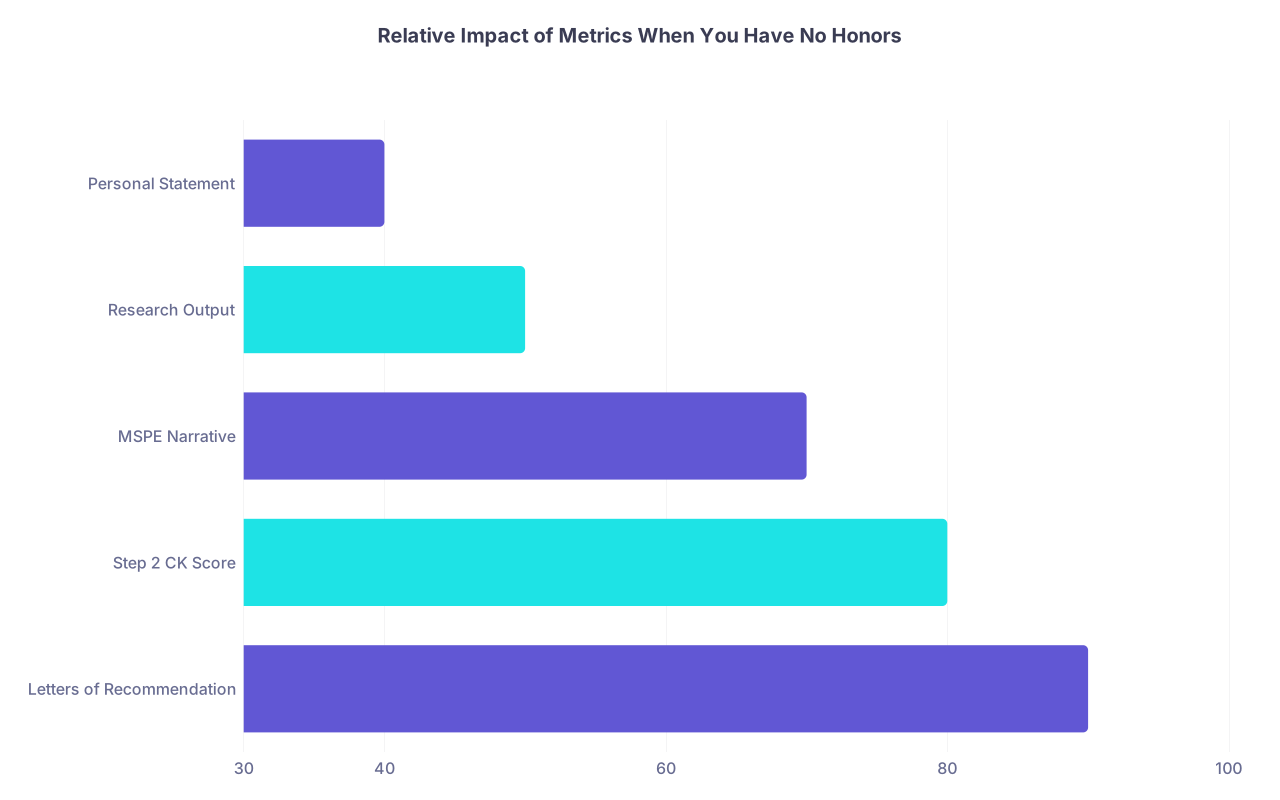
| Category | Value |
|---|---|
| Letters of Recommendation | 90 |
| Step 2 CK Score | 80 |
| MSPE Narrative | 70 |
| Research Output | 50 |
| Personal Statement | 40 |
B. Sub-internships (Sub-Is) and acting internships
This is your chance to show: “Put me in the intern role and I can handle it.”
On a Sub-I, your job is to:
- Be present like a resident (early, prepared, reliable)
- Own your patients, including follow-up calls, notes, cross-cover thinking
- Communicate clearly with nurses and residents
- Anticipate tasks instead of waiting to be told
Then you have an attending and senior resident who can write:
“On this Sub-I, [Name] functioned at the level of a strong incoming intern.”
That single sentence counters a lot of Pass grades.
If your Sub-I grade ends up as High Pass or similar but the comments are great, make sure those comments get into your MSPE and letters even if the label is not honors.
Step 6: Target the Right Programs and Build a Ruthless List
You cannot afford to treat the application list like a wish board. The “spray and pray” strategy fails especially hard for students without honors.
A. Understand where your profile fits
Be realistic. Not negative. Realistic.
You need to know:
- How competitive your chosen specialty is
- How your Step 2, school name, research, and letters stack up among typical matched applicants
- Whether your school has strong connections in that specialty (home program, alumni, known faculty)
If:
- No honors
- Average Step 2
- Average school prestige
- Minimal research
- Applying to a historically competitive specialty
You are in the danger zone. You need:
- A very broad list
- Significant number of “safety” programs or you need to pivot specialties early
B. Program list construction: stop thinking “dream / reach / safety”
Think in tiers based on actual likelihood.
| Tier | Program Type | % of List |
|---|---|---|
| 1 | Very Competitive / Top-Name | 10–15% |
| 2 | Solid Mid-Tier Academics | 35–40% |
| 3 | Community / New / Less Competitive | 45–55% |
That is for someone with a decent Step 2 and good letters but no honors, in a moderately competitive specialty (IM, EM, Anesth, OB, Gen Surg).
If your application is weaker than that, tilt even more heavily to Tier 3.
C. Lean on places that actually know you
Do not underestimate the power of:
- Your home program
- Institutions where you did aways / Sub-Is
- Programs where your faculty have existing relationships
Ask your mentors directly:
“Given my transcript and Step 2, which programs should I prioritize where I realistically have a shot?”
Then actually listen.
Step 7: Interview Season – Own It Without Apologizing for the Entire Hour
You reached the interview stage. Good. That means:
- Someone looked at your application
- Saw no honors
- And still thought you were worth a conversation
Do not walk in like you are on trial.
A. Prepare your “grades / honors” answer in advance
You will likely get:
- “Can you walk me through your academic performance in clinical years?”
- “I see you did not receive any honors. Tell me more about that.”
Your answer needs to:
- Be short
- Acknowledge reality
- Show improvement and insight
- Pivot back to your strengths
Example structure:
- Start with context: “Early in third year, I struggled to translate my book knowledge into efficient clinical work. My shelves were fine but not honors level, and my efficiency was behind my peers.”
- Describe what you changed: “I built a more structured approach to pre-rounding, used spaced repetition seriously for shelf prep, and asked for direct feedback midway through rotations.”
- Point to concrete evidence: “You can see that in my later evaluations and on my Sub-I, where I was functioning much more like an intern, as well as in my Step 2 CK score.”
- Finish with reassurance: “Those experiences forced me to build systems I still use, and I feel much more prepared now for the demands of intern year than I did at the start of third year.”
Then stop talking. Let them ask follow-ups if they want.
B. Lean heavily on clinical stories, not grades
In interviews, the strongest antidote to “no honors” is sounding like a clinician they would trust.
Have ready:
- 2–3 patient stories where you made a real difference (follow-up calls, catching an error, coordinating care)
- 1 story where you struggled, got feedback, and improved (shows coachability)
- 1 concrete example of functioning at intern level on a Sub-I or busy service
You want them walking away thinking, “This student sounds like someone my nurses would like and my seniors would not have to babysit.”
Step 8: If You Are Early Enough – Fix the Actual Weakness, Not Just the Story
If you are reading this before you apply, you have more options than just spin.
A. On current and upcoming rotations
You are not chasing the honors label anymore. You are chasing the behavior that earns trust.
Focus on:
- Reliability: be early, prepared, consistent for weeks, not days
- Visibility: speak up on rounds, present clearly, ask for specific tasks
- Efficiency: write notes faster, preround smarter (labs first, then focused exam)
- Feedback cycles: ask mid-rotation, “What is one thing I can do differently to function more like an intern?”
You might still not get honors (grading politics is real). But your comments will improve, your letters will be stronger, and your MSPE will have more to work with.
B. Concrete plan for shelves and Step 2 if still upcoming
Build a non-negotiable schedule:
- UWorld / AMBOSS blocks daily
- Weekly NBMEs or practice tests (when close to exam)
- Tight review loop: missed question log, flashcards or Anki
- Study with emphasis on clinical reasoning, not just facts
You are not trying to be the smartest person in the class. You are trying to show programs, “I can pass boards and handle clinical decision-making.”
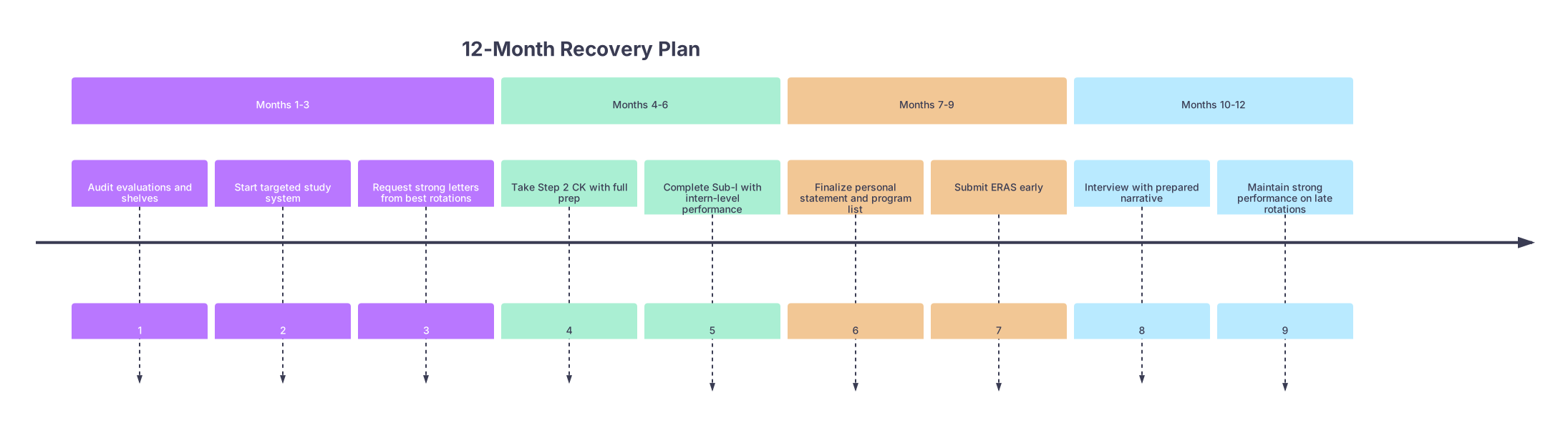
| Period | Event |
|---|---|
| Months 1-3 - Audit evaluations and shelves | 1 |
| Months 1-3 - Start targeted study system | 2 |
| Months 1-3 - Request strong letters from best rotations | 3 |
| Months 4-6 - Take Step 2 CK with full prep | 4 |
| Months 4-6 - Complete Sub-I with intern-level performance | 5 |
| Months 7-9 - Finalize personal statement and program list | 6 |
| Months 7-9 - Submit ERAS early | 7 |
| Months 10-12 - Interview with prepared narrative | 8 |
| Months 10-12 - Maintain strong performance on late rotations | 9 |
Step 9: If You Do Not Match – Regroup Intelligently
I hope you match. Many no-honors applicants do. But if you do not, panicking and randomly grabbing a research year without a plan is how people waste time.
A. Post-Match reality check
If you go unmatched:
- Get candid feedback from your Dean’s office and mentors
- Ask PDs (where you interviewed) for honest impressions when possible
- Identify if the main barrier was:
- Specialty competitiveness
- Step 2 score
- Lack of strong letters
- Geographic constraints
- Or yes, transcript + narrative
B. Strategic next steps
Depending on the gap:
- Prelim year (Medicine or Surgery) – for some fields, proves you can do the work and gives you new letters
- Research year – only useful if it builds real connections in your specialty and yields actual output
- Reapplication to a less competitive specialty – often the right move for many “no honors + average Step” applicants
Whatever you choose, do not repeat the core mistake: pretending the underlying performance issues do not exist.
Key Takeaways
- “No honors” is a signal, not a sentence. Understand and fix the underlying pattern, then build your application around concrete evidence of growth.
- Strong, specific letters plus a solid Step 2 CK and a high-functioning Sub-I can outweigh a transcript with all Passes.
- Your strategy must be brutally realistic: right narrative, right mentors, right program list, and actual changes in how you perform on the wards, not just how you explain it.