
The way most students “let clerkships happen” and then scramble to explain them in ERAS is backwards.
You do not wait for a narrative to emerge. You build it on purpose. On the wards. Week by week. And if you are not doing that, you are handing control of your application story to chance, to random attendings, and to whoever writes your dean’s letter.
Let me show you how to fix that.
1. Understand What “Narrative” Actually Means on ERAS
Before you shape anything, you need to know what you are shaping.
Your “clerkship narrative” is not some poetic paragraph. It is the pattern that shows up across:
- MSPE (Dean’s Letter) clerkship comments
- LORs (especially from core clinical rotations)
- ERAS Experiences descriptions
- Personal statement
- Interview answers about “Tell me about your clinical strengths”
Programs are not reading one thing. They are reading for consistency across many things.
They are scanning you for a small set of questions:
- Who is this person on a team?
- What kind of resident will this be on day 1?
- Do they show growth over clinical year or just random “honors”?
- Does their story fit our specialty and our program culture?
Your goal: make every piece of your application nudge them toward the same conclusion.
Something like:
- “Reliable, calm, team-oriented intern who takes ownership and learns fast”
- “Curious, detail-oriented future academic hospitalist with strong communication”
- “Technically inclined, procedure-comfortable, resilient future surgeon”
Notice what these have in common:
They are simple. Behavioral. Easy to remember.
So the job now is:
- Decide your narrative theme.
- Engineer clerkship behaviors and artifacts that support it.
2. Choose Your Narrative Intentionally (Before ERAS, Not After)
Most students reverse-engineer this in August of fourth year. They look back at their rotations and try to stitch together whatever happened.
Better play: choose your narrative direction early in third year (or early in fourth if you are late to this, which is common).
Step 1: Pick 1–2 core identity themes
You need one primary, maybe one secondary axis. Do not list five.
Examples that actually work:
- Dependable workhorse + strong follow-through
- Teacher-mentor type + great with patients and juniors
- Systems-improvement / quality-improvement mindset
- Loves complex, undifferentiated patients + diagnostic thinking
- Procedures-focused + steady under pressure
Tie this to your specialty:
- Internal Medicine: continuity, complex decision-making, communication
- Surgery: work ethic, technical progression, composure, ownership
- EM: rapid assessment, team communication, resilience
- Pediatrics: patience, family communication, teaching, advocacy
- Psychiatry: listening, alliance-building, longitudinal thinking
Pick something that is:
- True enough you can live it on the wards
- Visible enough that attendings and residents can see it and comment on it
Write it on a Post-it. Put it in your pocket. I am not joking. That Post-it is your script for how you show up.
Step 2: Translate your theme into concrete clerkship behaviors
Abstract: “Reliable and thorough”
Concrete on wards:
- Always know your patients’ labs, imaging, vitals trend
- Always have a plan A and plan B ready on rounds
- Close the loop on every task you say you will do
- Arrive earlier than your resident. Leave with them or later when needed.
Abstract: “Great educator and team glue”
Concrete:
- Offer to prep 5-minute chalk talks
- Check in on struggling classmates, help with notes or prerounds
- Teach MS2s basic exam maneuvers, review cases with them
This is what will show up in comments like “a joy to work with,” “held the team together during a busy month,” “went above expected level for a student.”
That does not happen by accident.
3. Engineer Each Clerkship to Feed Your Narrative
Stop thinking “I just need to honor this rotation.” Honors help. But narrative wins.
On each rotation, do three things:
- Decide what this clerkship should contribute to your ERAS story.
- Behave accordingly from Day 1.
- Capture hard evidence you can later use.
A. Set a Rotation-Level Narrative Goal on Day 1
Ask yourself:
- “What piece of my identity can realistically shine here?”
- “What specific feedback do I want in my eval?”
Examples:
- Surgery: “Ownership and work ethic—always one step ahead.”
- Family Medicine: “Communication and continuity with patients.”
- Psych: “Listening, building rapport, handling emotionally heavy cases.”
- IM Sub-I: “Functions at intern level, safe and reliable.”
You are not faking anything. You are choosing which true part of yourself you highlight, depending on the stage.
B. Script Your First 48 Hours
The first impression massively colors your entire evaluation. Use it.
Specific opening moves that work:
Day 1, tell your resident:
“My personal goal this month is to get better at X (e.g., presenting succinctly, writing efficient notes, managing cross-cover calls). I really value direct feedback, even if it is blunt. Is there anything that makes your life easier that I can just do from the start?”Volunteer for an unglamorous but visible responsibility:
- Tracking daily labs
- Pre-rounding on extra patients
- Updating the patient list religiously
- Calling families for daily updates (on services where this is appreciated)
Showing willingness early frames you as “helpful,” not “needy.” That sticks.
C. Use Mid-Rotation Feedback as a Steering Wheel, Not a Report Card
Midpoint feedback is not about your ego. It is a course correction.
Ask:
- “If the evaluation were written today, what would it say about me?”
- “What is one thing I should change this week to function more like an intern?”
- “Can you think of a moment when I could have done something differently?”
Then actually change. And make the change visible.
You want your evaluator thinking when they fill out your eval:
“She really took feedback and improved fast.”
That line is gold in the MSPE.
4. Build an Evidence Trail While You Are Still on the Wards
Future-you writing ERAS should not be guessing what happened on IM 9 months ago. Yet that is how most people do it.
You are going to build a small, private “clerkship narrative file.”
What to Track (After Every Week or Every 2–3 Shifts)
Open a simple doc or note with 3–4 bullet headings per rotation:
- “Specific patients / cases I managed”
- “Concrete things I did that helped the team”
- “Skills I learned or improved”
- “Feedback quotes (exact words if possible)”
Example entry from a medicine month:
- Patients:
- New onset HF with flash pulmonary edema – I proposed diuresis plan, escalated to ICU when he worsened, presented at morning report.
- Decompensated cirrhosis – handled family meeting about goals of care with resident.
- Team contributions:
- Kept signout list updated and accurate for 3 weeks.
- Always pre-charted imaging and pending tests before rounds.
- Skills:
- Learned to write discharge summaries on my two patients and handled med rec.
- Managed cross-cover pages with supervision on one long call night.
- Feedback:
- “You function at the level of a very junior intern” – Dr. Smith.
- “You make my job easier” – senior resident on night float.
You do not need essays. Just enough detail to later reconstruct strong ERAS entries and talking points for interviews.
Why This Matters
Those tiny notes become:
- The 3–4 bullet ERAS descriptions that sound specific rather than generic fluff
- Authentic material for your personal statement (“I remember the cirrhotic patient whose family…”)
- Interview stories that prove your narrative instead of just claiming it
Most people show up to ERAS with “worked well with the team” level vagueness. You are going to show up with receipts.
5. Align Letters of Recommendation with Your Narrative
Letters do not just sit in a vacuum. They are the loudest voice in your narrative.
You want:
- At least 1–2 letters from core clerkships or sub-Is that directly reinforce your themes.
- Letter-writers who saw you repeatedly, not just on one call night.
Step 1: Identify Potential Letter-Writers Early
On each major rotation, mentally classify attendings:
- A: Saw you a lot, gave feedback, clearly liked working with you
- B: Neutral/limited exposure
- C: Barely knows your name or clearly not a fan
Your letters should come from A-list only, unless your school forces a department chair letter.
During the rotation, make yourself letter-eligible:
- Be the student who volunteers for slightly harder tasks
- Ask for feedback and actually improve
- Ask attendings about their careers and cases (genuine curiosity reads as maturity)
At the end, if the vibe is good, say something like:
“I am strongly considering [specialty] and really enjoyed this rotation. If I continue on this path and apply, would you feel comfortable writing me a strong letter of recommendation?”
If they hesitate even slightly, you move on. You need “strong,” not “lukewarm.”
Step 2: Give Them the Narrative Script (Subtly)
When you later request the letter (email), you include:
- Your CV
- Draft of your personal statement (even if it is rough)
- A 1-page “clerkship snapshot” from that rotation — basically a cleaned-up version of your notes from earlier
Include 3–4 bullet points of traits you hope they can comment on, like:
- “My reliability and follow-through on patient tasks”
- “How I incorporated feedback over the month”
- “My communication with patients/families”
You are not putting words in their mouth. You are focusing their memory. Most of them will be relieved you did.
6. Turn Raw Clerkship Work into ERAS-Ready Material
Now we fast forward. You are in ERAS season, staring at the “Experiences” section, your personal statement doc, and the MSPE draft.
Here is how you convert everything you did into a coherent story.
A. ERAS Experiences: No Filler, No “Just Did My Job” Entries
Use clinical entries to demonstrate your narrative traits, not to re-describe what a med student is supposed to do.
You might have 2–4 clerkship-related experiences:
- “Sub-internship in Internal Medicine”
- “Clinical duties – Surgery clerkship”
- “Longitudinal clinic (Family Medicine)”
- “Student-run clinic (if significant responsibility)”
For each, your 3 bullet descriptions should:
- Start with a strong action verb
- Highlight behaviors that match your narrative
- Include some measurable or concrete element
Example: IM Sub-I entry for someone selling “intern-ready, reliable”:
- Managed a census of 4–6 patients daily, independently pre-rounding, writing notes, and presenting assessment and plans on rounds with resident oversight.
- Led communication with families of assigned patients, providing daily updates and clarifying treatment plans, documented in the chart.
- Handled cross-cover pages on two long-call shifts with supervision, escalating concerns appropriately and drafting orders for review.
This reads like an intern. Which is exactly what residency is buying.
B. Personal Statement: Anchor It in Real Clerkship Moments
Your personal statement should not be a generic “I love helping patients” essay. You already know this.
Instead:
Open with a brief, specific clinical scene that matches your narrative.
- If your theme is “handles complexity and uncertainty,” pick that case.
- If your theme is “communication and team glue,” pick that family meeting or interdisciplinary case.
In the middle paragraphs, explicitly connect:
- What you learned about yourself on clerkships
- The kind of resident you aim to be
- What evidence you already have that you can function that way
Close with a future-oriented statement that ties your clerkship experiences to your specialty choice and training goals.
The key: the same 1–2 traits you engineered on the wards should be obvious here.
7. Use Your MSPE and Grade Pattern Instead of Being Used by Them
You do not fully control your clerkship evaluations. But you can shape how you talk about them.
Programs know:
- Your school’s grading quirks
- The difference between a slightly weaker early rotation and a stronger later one
- That narrative often trumps one random “Pass” in a sea of “High Pass/Honors”
Accept the Grade Reality. Control the Arc.
If your clerkship record is mixed, your narrative becomes:
- “I learned to adapt to clinical work and improved steadily,” not
- “I have always been perfect.”
Examples of controlled framing (for interviews, PS, or advisor letters):
- “On my first clerkship I was still learning how to prioritize efficiency over exhaustive data collection. Feedback from that month pushed me to change how I pre-rounded and presented. On subsequent rotations, I was consistently told I functioned more like an intern.”
You are showing growth and insight. That reads as mature.
Notice Patterns and Correct Them in Real Time
If you see a theme in feedback:
- Too quiet on rounds
- Notes too long
- Struggle with time management
Pick one rotation to make that your laser focus. Tell your team:
“I have gotten feedback that my presentations are too detailed. For this month, I would like to practice being more concise. Please call me out if I am drifting.”
Then fix it. And later in ERAS, that is a story:
- I listen. I improve. I do not repeat the same error twelve months in a row.
8. Plan Clerkships Strategically Around Your Target Specialty
You are in the “Clerkships that help with residency match” territory. So let’s be blunt.
The strongest narratives are supported by:
- At least one sub-I or acting internship in your target field
- One or two adjacent rotations that reinforce overlapping skills
- Demonstrated longitudinal interest (clinic, research, QI, teaching) that connects to what you did clinically
| Target Specialty | Core High-Yield Clerkship | Ideal Sub-I | Helpful Adjacent Rotation |
|---|---|---|---|
| Internal Medicine | Medicine core | IM ward Sub-I | ICU or Cardiology |
| General Surgery | Surgery core | Surgery Sub-I | SICU or Vascular Surgery |
| Pediatrics | Peds core | Peds ward Sub-I | NICU or Peds EM |
| Psychiatry | Psych core | Psych Sub-I | Neurology or Addiction |
| EM | EM core | EM Sub-I | ICU or Trauma Surgery |
If you are late deciding specialty, your narrative can still be “I discovered X through Y.” But you must show credible exposure.
If You Change Your Mind Late
You are not doomed. But you must:
- Extract everything relevant from prior clerkships (e.g., your med rotation where you loved acute care now supports EM).
- Use an away rotation or late sub-I in the new specialty as a high-intensity narrative anchor.
- Get at least one strong letter from that field.
Then your story:
- “I entered third year open-minded, found I most enjoyed [shared skill] on [prior rotation], and confirmed that fit during [late sub-I / away]. My evaluations highlight [trait] which I am eager to bring to [new specialty].”
9. Practice Talking Your Narrative Out Loud (So It Sounds Human)
Your ERAS reads as a narrative only if your mouth can say the same story under pressure.
You need three ready-to-go, clerkship-backed answers:
- “Tell me about yourself.”
- “Why this specialty?”
- “What kind of resident do you think you will be?”
Structure them:
- Start with 1–2 line identity statement.
- Add 1–2 specific clerkship examples that prove it.
- Tie to future goals.
Example for IM:
“I am someone who thrives on complex, longitudinal patient care and being the reliable anchor on a team. On my medicine sub-I, I consistently managed a 5-patient census, led family updates, and was trusted with cross-cover pages by the end of the month. Those experiences confirmed that I enjoy the day-to-day work of internal medicine and that I function best when I am the person others can count on, which is exactly what I hope to bring to residency.”
That is clerkship narrative, spoken.
10. Quick Timeline: What To Do When
Here is a simple timeline so you are not just “hoping it works out.”
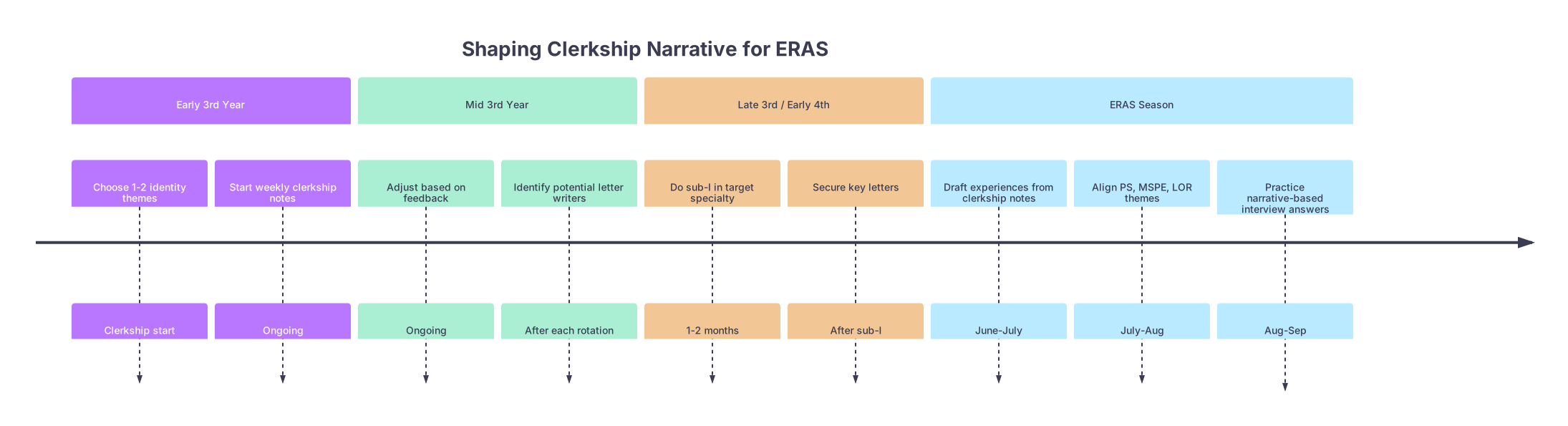
| Period | Event |
|---|---|
| Early 3rd Year - Choose 1-2 identity themes | Clerkship start |
| Early 3rd Year - Start weekly clerkship notes | Ongoing |
| Mid 3rd Year - Adjust based on feedback | Ongoing |
| Mid 3rd Year - Identify potential letter writers | After each rotation |
| Late 3rd / Early 4th - Do sub-I in target specialty | 1-2 months |
| Late 3rd / Early 4th - Secure key letters | After sub-I |
| ERAS Season - Draft experiences from clerkship notes | June-July |
| ERAS Season - Align PS, MSPE, LOR themes | July-Aug |
| ERAS Season - Practice narrative-based interview answers | Aug-Sep |
11. Common Mistakes That Destroy Your Clerkship Narrative
You can avoid most landmines just by seeing them first.
Being a chameleon
Acting like a completely different person on each service to match the culture. You want adaptation, not reinvention. Keep your core traits consistent.Hiding weaknesses instead of addressing them
Everybody has something. Time management, knowledge gaps, anxiety. The students who actively work on it and tell their teams “I am trying to fix this” end up with narrative gold: “rapid improver.”Trying to be The Smartest instead of The Most Useful
Nobody is impressed by a student who quotes UTD but never helps with discharge planning. Your narrative should scream “useful intern,” not “walking question bank.”Letting bitterness leak into your evals
Rough rotation, toxic team, unfair grade. It happens. Do not let it define the next rotation. Programs can smell an attitude problem through one bitter comment or passive-aggressive behavior.
12. If You Feel Behind Right Now, Do This
Maybe you are late third year. Or already in early fourth with a messy rotation record. Fine. You still have options.
Triage Plan for “I Screwed Up Clerkships” Mode
Pick 1–2 upcoming high-impact rotations
- Ideally a sub-I in your target field
- Or an away rotation where you want to match
Go in with a written game plan
- Narrative theme: [reliable / hard-working / rapid learner, etc.]
- Top 3 concrete behaviors you will show every day
Ask for aggressive feedback Week 1 and Week 3
- “I am hoping this rotation can be a key part of my growth before residency. Please be direct about anything that is holding me back.”
Secure at least one excellent letter from that rotation
- That letter can help overshadow earlier noise, especially if it explicitly notes your growth.
When writing and interviewing
- Own the early inconsistencies briefly.
- Hammer the turnaround and what you learned.
Residency programs like redemption arcs more than perfect robots. They want residents who can take a punch and come back sharper.