
It is July 1. Your MS3 grades just finalized.
You open your transcript and it hits you: a wall of “Pass,” one or two really ugly “Low Pass” or “Conditional” marks, and maybe a narrative comment that makes you wince.
You want a competitive residency. Or at least a solid, respectable one.
But your third-year performance is not screaming “top of our rank list.”
So you are thinking what every anxious MS3 thinks right now:
Can MS4 save this?
Answer: Not completely. But it can absolutely move the needle if you play it right.
This is the article I would hand any student with a mediocre or messy third year and 9–12 months left to course-correct. I am going to be blunt about what helps, what is cosmetic, and what is a waste of precious time.
Step 1: Diagnose What Actually Went Wrong in MS3
Before you pick a single MS4 clerkship, you need a clear problem list. “I had a weak third year” is vague. Programs will look at why and where.
Break it down like this:
By specialty
- Did you underperform in the specialty you want? (e.g., Surgery Pass with bad comments and you want Ortho)
- Or were your weaker performances in fields you are not pursuing?
By type of problem
- Purely grade-based but decent comments?
- Narrative red flags: “disorganized,” “slow to take feedback,” “issues with professionalism”?
- Shelf exam bombs versus clinical skills issues?
By trend
- Early rotations worse, then gradual improvement?
- Random scatter?
- One catastrophic rotation?
Programs read nuance. A rocky first rotation and then consistent Honors is a story of growth. Chronic Pass with no upward trend is a different story. Your MS4 schedule must be built to demonstrate a clear, visible upward trajectory, not just “more rotations.”
Here is the simple rule:
MS4 rotations must be chosen to directly rebut the weaknesses on your transcript.
That means:
- If you had weak Medicine → you need a strong Medicine Sub-I.
- If your comments say “passive, not proactive” → you need at least one rotation where you are explicitly described as the opposite.
- If your target specialty is the one you struggled in → you need targeted repair work in that field, not random electives.
Step 2: Know What MS4 Rotations Actually Matter for Match
Not all MS4 experiences are equal. There are four categories that move the needle the most.
| Rotation Type | Impact on Match | Best Use Case |
|---|---|---|
| Home Sub-Internship | Very High | Prove growth in core specialty |
| Away / Audition Elective | Very High | Show fit & earn strong SLOEs/letters |
| Core-like Acting Intern (e.g., IM, Surgery) | High | Fix poor third-year performance |
| Niche Electives (Clinic, Research) | Moderate | Fill gaps, build narrative |
You do not have room for fluff. The “fun” electives can wait until after interview season. Your pre-ERAS schedule needs to be ruthless.
Priority order if your third year was weak:
Home Sub-I in your target specialty (or closest core)
- This is your single biggest chance to prove: “I am not the same student I was 6–9 months ago.”
One or two strategic away rotations (if your specialty uses them)
- EM, Ortho, Derm, ENT, Urology, Neurosurgery, some IM subspecialties.
- Used correctly, they can overwrite a lot of doubt.
An additional core-like rotation that mirrors a weak MS3 clerkship
- Internal Medicine Sub-I if you were weak in MS3 Medicine.
- Surgical Sub-I (Trauma, Acute Care) if Surgery was bad.
- Inpatient Pediatrics or NICU if Peds was weak.
Letter-generating electives in friendly environments
- Places where attendings actually see you work closely and will write quickly.
Step 3: Core Strategy by Specialty Type
Let us go specialty by specialty group and talk tactics.
A. If You Are Applying INTERNAL MEDICINE (and IM subs)
Your third year was weak. Medicine programs still care deeply about:
- IM clerkship grade and comments
- Medicine Sub-I performance
- Step 2 score
- Letters from IM faculty
Your MS4 rotation priorities:
Medicine Sub-I at your home institution (early)
- Aim: July–September.
- Goal: crystal-clear comments like “functions at intern level,” “dramatic improvement,” “hard-working and reliable.”
Second IM-like inpatient experience
- Examples: Cardiology inpatient, Hem/Onc ward month, ICU (if well supervised).
- Purpose: show consistency, not a one-time spike.
Targeted Sub-I or elective at a program you really want
- Particularly if:
- Your home IM rotation grade was Pass.
- You lack a home IM letter from a big-name department.
- Away or visiting rotation: 4 weeks, must be high-yield for face time with faculty.
- Particularly if:
Electives for letters and narrative
- Examples: Geriatrics, Hospitalist service, Infectious Disease consult.
- Shorter rotations where you can shine and get quick letters.
What not to waste prime early MS4 months on:
- Outpatient-only electives with no chance for a strong letter.
- Ultra-niche subspecialty clinics that do not speak to your ability to manage inpatients.
B. If You Are Applying SURGERY or a SURGICAL SUBSPECIALTY
Surgery is unforgiving during MS3. Poor performance there hurts. But surgery people also respect visible grind and late bloomers.
They will judge you hard on:
- Surgery clerkship grade and comments
- Surgical Sub-I / acting internship
- Technical skills trajectory
- Letters from surgeons who actually worked with you
Your MS4 rotation priorities:
Home Surgery Sub-I (General Surgery or Trauma, early)
- Non-negotiable. Aim for July–September.
- You must live like an intern: pre-rounds, early in, late out, owning your patients.
- Goal: narrative that basically says “whatever is on paper from MS3 is outdated.”
Subspecialty away(s) if you are targeting competitive fields
- Ortho, ENT, Neurosurgery, Urology, Plastics.
- One strong away beats three mediocre ones.
- Go where:
- You’re realistically competitive.
- You can spend real time in the OR and on the floor, not just shadowing.
A second “heavy” inpatient month
- Could be another surgical service or ICU where:
- You write notes.
- You carry a patient load.
- You present on rounds daily.
- Could be another surgical service or ICU where:
Electives that highlight work ethic and team value
- Trauma ICU, SICU, transplant, vascular.
- Rotations known for tough work but visible, graded performance.
Avoid:
- Cush surgical “clinics only” rotations early in MS4.
- Rotations where residents do everything and students observe.
Your narrative needs to read: “Went from tentative, slow MS3 to reliable, hard-working near-intern by MS4.”
C. If You Are Applying EMERGENCY MEDICINE
EM has a very structured way of evaluating you: SLOEs (Standardized Letters of Evaluation).
If your third year was underwhelming, EM can still be salvaged with:
- Strong EM rotations (home + away)
- Great SLOEs
- Solid Step 2
Your MS4 rotation priorities:
Home EM rotation (if available) for a SLOE, ASAP
- Ideally June–August.
- You must treat this like an audition: aggressive learning, lots of patients, clear communication.
One away EM rotation at a realistic target program
- Get a second SLOE.
- Choose places:
- With a track record of taking outside rotators seriously.
- That match students with similar board scores and profiles.
Medicine or ICU Sub-I
- EM programs love critical care exposure, especially if your Medicine clerkship was weak.
- Shows you can handle sick patients longitudinally.
Optional: Ultrasound, Toxicology, or EMS electives
- Lower priority than SLOEs and ICU/IM, but can round out your application.
Avoid:
- Multiple away rotations at places where you are clearly below their usual metrics; they will not rescue a weak MS3 if you are outclassed there.
- “Shadowing” EM electives with minimal evaluation.
D. If You Are Applying PRIMARY CARE (FM, Peds, Psych)
Here the biggest damage from a weak MS3 year is usually narrative and consistency, not raw competitiveness. You have more room to recover, but you still need to be smart.
They care about:
- Commitment to the specialty
- Longitudinal patient care ability
- Team functioning, empathy, follow-through
- Letters from core faculty
Your MS4 rotation priorities:
Sub-I or acting internship in your chosen field
- Inpatient Peds.
- Adult inpatient Psych with significant responsibility.
- FM inpatient or combined outpatient/inpatient rotation with continuity.
Second core-like month in a related area
- FM → Inpatient Medicine or OB (if FM with OB focus).
- Peds → NICU or PICU (if well supervised).
- Psych → CL (Consult-Liaison) or Neurology.
Continuity clinic or longitudinal ambulatory experience
- Programs like to see that you can follow patients over time.
- Make sure it is evaluative and letter-generating, not just shadowing.
Away rotation at a region or program you strongly want
- Especially if:
- You want to relocate to a new geographic area.
- Your home department is weak or small.
- Especially if:
Avoid:
- Stacking only “light” outpatient electives and assuming your personal statement will carry you. You still need hard evidence of performance.
Step 4: Timing: Front-Load Your Repair Work Before ERAS Locks
The uncomfortable truth: once ERAS is submitted and MSPE (Dean’s letter) is released, the narrative is mostly fixed. MS4 rotations that count the most are:
- Completed before MSPE is finalized (usually October 1)
- With evaluations submitted on time
Here is a clean structure for a weak-MS3 student:
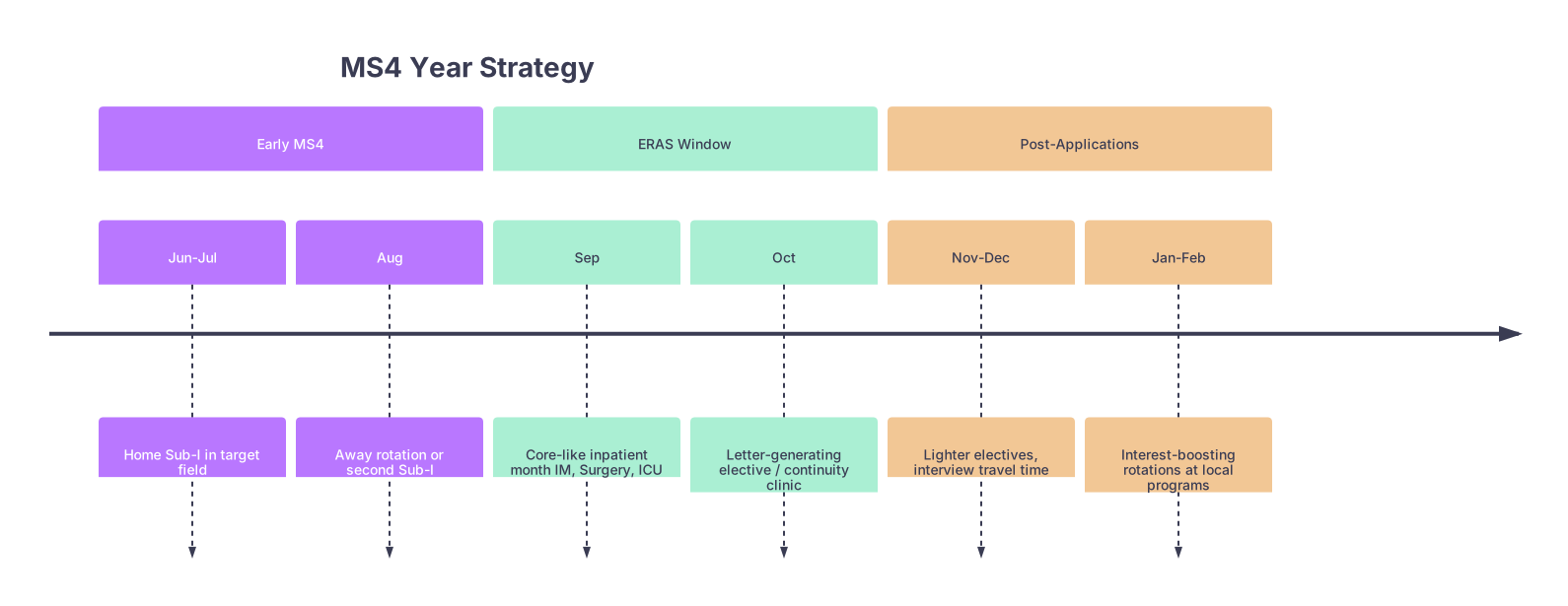
| Period | Event |
|---|---|
| Early MS4 - Jun-Jul | Home Sub-I in target field |
| Early MS4 - Aug | Away rotation or second Sub-I |
| ERAS Window - Sep | Core-like inpatient month IM, Surgery, ICU |
| ERAS Window - Oct | Letter-generating elective / continuity clinic |
| Post-Applications - Nov-Dec | Lighter electives, interview travel time |
| Post-Applications - Jan-Feb | Interest-boosting rotations at local programs |
Key points:
- Your best, hardest rotations should be June–September.
- Hound admin for prompt evaluations. Late evals that miss the MSPE update do not help your narrative.
- Schedule lighter, more flexible electives November–January when interviews happen.
Step 5: Use Specific Clerkships to Rewrite Specific Weaknesses
Now let us get surgical about it. Match your known weaknesses to targeted MS4 choices.
Problem: “Disorganized, slow with notes, not ready to function as an intern”
Fix with:
- High-intensity Sub-I where students write full notes and carry a real census.
- Internal Medicine Wards.
- General Surgery/Trauma.
- MICU with intern-level expectations.
How to execute:
- Before rotation: build templates for H&Ps, progress notes. Practice timers for presentations.
- During week 1: tell your senior, “One of my goals is to be more efficient and organized. I had feedback about this before, and I want to fix it. Please call me out if you see me slipping.”
- Ask for a midpoint evaluation. Adjust. Make it clear you changed within the month.
Problem: “Passive, not proactive, weak ownership”
Fix with:
- Rotations that reward initiative and patient ownership
- Sub-I where you:
- Call consults (with oversight).
- Follow up on imaging and labs.
- Lead family updates (with your team).
- Sub-I where you:
- EM or ICU where you must step up during high volume.
Your behavior on day 1–3 matters. Do not repeat the MS3 pattern of “quiet observer for two weeks, finally engaged in week 3.” You do not have that runway anymore.
Problem: “Knowledge gaps, poor test performance”
Fix with:
- Shelf-like rotations plus an aggressive parallel study plan
- Medicine Sub-I + daily UWorld blocks.
- EM + EM question banks / Rosh / SAEM.
- Step 2 CK scheduled before or early in MS4 with enough prep.
A strong Step 2 can partially offset weak third-year shelves.
Then ensure attendings see that knowledge gain:
- Volunteer to do a short chalk talk on a patient’s key disease.
- Be the person who has guideline-based answers ready.
Problem: One catastrophic rotation (e.g., failed or conditional pass in core)
You need one or two direct counter-rotations.
Examples:
- Failed Medicine →
- Medicine Sub-I with glowing comments.
- Another inpatient Medicine-like month.
- Low Pass in Surgery with professionalism concerns →
- Surgery Sub-I with language like “exemplary professionalism, always prepared.”
You want your MSPE and letters to contain sentences that begin with:
“During the Sub-Internship, we saw significant improvement compared to his/her/hir early clerkships…”
That wording is gold. It acknowledges the issue but frames it as past tense and solved.
Step 6: Away Rotations: When They Help and When They Hurt
Students with weak MS3 often default to: “I’ll just crush an away and they’ll see the real me.” Sometimes true. Sometimes fantasy.
Away rotations help most when:
- Your home department is small or not well known.
- Your target region is different from your med school region.
- You need a strong letter from someone in your specialty because your MS3 evaluations were lukewarm.
- The program you are visiting actually matches a lot of their rotators.
Away rotations hurt when:
- You’re significantly below their usual candidate metrics (board scores, AOA, etc.).
- You are still disorganized and not ready to perform at a high level.
- You schedule them too early (first month of MS4) without fixing basic issues.
Practical strategy if MS3 was weak:
- Do a home Sub-I first when possible. Fix your habits in a semi-safe environment.
- Then schedule one or two aways once you have:
- A system for notes.
- A reliable pre-rounding routine.
- A tested approach to integrating feedback quickly.
Do not use your very first MS4 month as an away at your dream program if MS3 was rough. You are likely to re-enact the same problems under more pressure.
Step 7: What to Ask For in Evaluations and Letters
You cannot write your own evals, but you can guide the narrative by how you talk to attendings and residents.
Near the end of a key MS4 rotation, say something like:
“Earlier in third year, I struggled with [organization / efficiency / initiative], and that showed in my Medicine rotation. I have been working hard on those areas. If you have seen improvement, it would be very helpful if that came through in your evaluation or any letter, since programs will see that earlier weakness.”
You are not gaming the system. You are connecting the dots for them.
For letters:
- Choose attendings who:
- Saw you from day 1 to 4 weeks.
- Watched you respond to feedback.
- Are likely to submit letters on time.
Give them:
- A short bullet list of your growth areas and what you improved.
- A copy of your CV and personal statement draft.
- A one-liner about your specialty goals.
You want phrases in letters like:
- “Marked improvement compared to earlier rotations.”
- “Fully ready to step into an intern role.”
- “Outperformed many students with stronger early transcripts.”
Step 8: Electives that Quietly Help More Than Students Realize
There are some underrated MS4 rotations that can subtly rescue your narrative if chosen well.
1. ICU (MICU, SICU, PICU)
Shows:
- Work ethic
- Comfort with sick patients
- Ability to think critically under pressure
Make sure:
- Students have active roles (not just shadowing).
- The attending writes meaningful evaluations.
2. Consult Services with Good Teaching Culture
Examples:
- Cardiology consults.
- Infectious Disease.
- Palliative Care.
These can highlight:
- Communication skills.
- Multidisciplinary teamwork.
- Thoughtful approach to complex cases.
3. Longitudinal Clinics with Continuity
If your comments painted you as detached or disinterested:
- A continuity clinic experience where you know your patients deeply can counter that.
- Ask preceptors to mention your follow-through and patient relationships.
Step 9: What NOT To Do With Your MS4 Year
Let me be explicit about some common mistakes when trying to “fix” a weak third year:
- Stacking too many fun or low-intensity electives before ERAS.
- Global health month, narrative medicine, radiology film reading, etc. All fine after you have fixed your core profile.
- Overdoing aways in hyper-competitive programs that will not rank you anyway.
- Three aways in top-10 academic centers with your record is a good way to generate 3 lukewarm letters.
- Ignoring Step 2 prep to cram more rotations.
- For a weak MS3, Step 2 CK is often your single biggest stat to repair your credibility.
- Letting evaluations be late.
- If your best Sub-I eval hits after MSPE is out and many programs have pre-screened, you lose major leverage.
Step 10: Combine Rotations with a Clear Story in Your Application
Rotations alone do not salvage you. The story they support does.
Your application should effectively say:
- “I had a slower or rougher start in clinical medicine during third year.”
- “I took the feedback seriously and deliberately scheduled hard, relevant MS4 rotations.”
- “Here is objective evidence of improvement: Sub-I grades, narrative comments, Step 2 score, and letters.”
You can reinforce this:
- In your personal statement: briefly acknowledge growth, not a confessional.
- In your MSPE “student comments” section: ask your Dean’s office how they handle contextualization. Some will include a line about your upward trajectory.
- In interviews: be ready with a 30–45 second, matter-of-fact explanation, then pivot to what you changed.
Two Sample MS4 Schedules (Realistic and Repair-Focused)
Example 1: Weak MS3, Applying Internal Medicine
- June: Medicine Sub-I (home)
- July: Cardiology Wards (home)
- August: IM away rotation at mid-tier academic program in desired region
- September: MICU (home)
- October: Outpatient IM clinic with letter-focused attending
- Nov–Jan: Lighter electives + interview travel (Endocrine clinic, Palliative, Radiology)
- Feb–Apr: Interest-based electives / research time
Example 2: Weak MS3, Applying General Surgery
- June: Trauma Surgery Sub-I (home)
- July: General Surgery Sub-I (home or away #1)
- August: Surgical ICU
- September: Away rotation at realistic academic/community hybrid General Surgery program
- October: Vascular or Colorectal Surgery elective (letter-focused)
- Nov–Jan: Lighter electives + interview travel
- Feb–Apr: Surgical specialties of interest (Transplant, HPB, etc.)
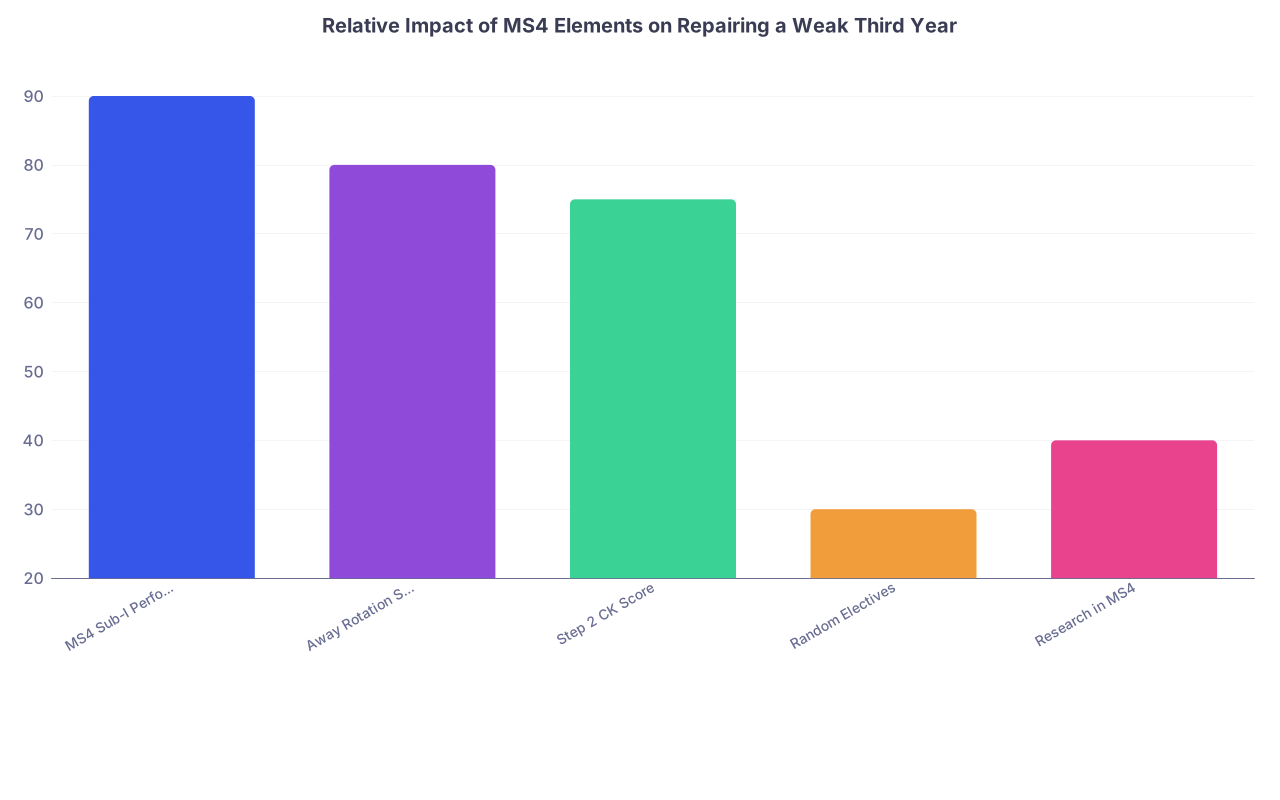
| Category | Value |
|---|---|
| MS4 Sub-I Performance | 90 |
| Away Rotation SLOEs | 80 |
| Step 2 CK Score | 75 |
| Random Electives | 30 |
| Research in MS4 | 40 |
Key Takeaways
- Your MS4 schedule must be a targeted repair plan, not a victory lap. Front-load hard, evaluative rotations (Sub-Is, ICU, core-like months) before ERAS and MSPE lock.
- Use specific clerkships to directly counter specific weaknesses from MS3—organization, initiative, knowledge gaps, or a disastrous core rotation.
- Back your rotations with timely evaluations, strong letters, and a clear growth narrative so programs see not just where you were as a shaky MS3, but who you became by early MS4.